Stay tuned to our new posts and updates! Click to join us on WhatsApp  & Telegram
  Channel
& Telegram Channel & Telegram Channel 




Remembered as Hindi cinema’s quintessential suffering mother, Nirupa Roy was far more than the woman who wept on screen. Vineesh Vedsen revisits her remarkable journey from romantic heroine to goddess, warrior and one of Indian cinema’s most compelling maternal figures, exploring the films and songs that reveal a versatile performer whose legacy deserves to be rediscovered. A Silhouette tribute on the actress’ death anniversary.
A familiar image, and a larger story
Who comes to mind when one thinks of Nirupa Roy? For many viewers, it is the woman in a tattered sari, seen in films from the late 1970s onwards: forever distressed, forever crying, a poor mother who suffers until the hero finally fights and saves her. Even then, her circumstances rarely change. She remains poor, and her suffering seems endless.
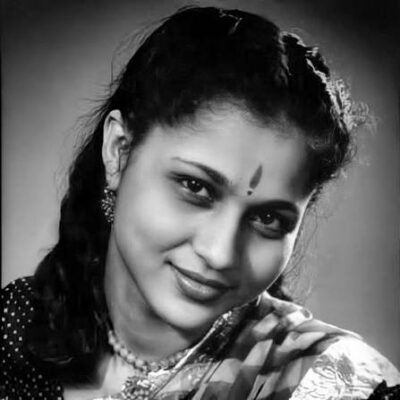
A young Nirupa Roy
But the actress is the same; the roles, the films and the worlds she inhabited are very different. The songs, heroes, singers, lyricists and composers are different too. Listen closely to the songs in the medleys and look at the artists involved. There is a whole world here waiting to be discovered.
Films such as Amar Akbar Anthony and Muqaddar Ka Sikandar, both from the late 1970s, helped fix this image of Nirupa Roy in the public mind as the suffering mother. Deewaar (1975), however, offered something more complex. Directed by Yash Chopra, it remains one of the greatest films of its time. Its mother is strong, not merely helpless, and Nirupa Roy gives her a moral authority that stays with the viewer. For many viewers, first encounters with these films came in childhood, when opinions were shaped by the images on screen. It is easy to see how the familiar image of the suffering mother came to overshadow the rest of Nirupa Roy’s work.
The mother in Deewaar
The familiar comparison with Ganga Jamuna (1961), produced by and starring Dilip Kumar alongside Vyjayanthimala, is worth remembering. In that film, a poor farm labourer is driven towards a life of crime by injustice and the cruelty of those in power. His mother, played by Leela Chitnis, is falsely accused of theft. Although her innocence is established, the damage has been done. The son turns to banditry, while his brother becomes a police officer. In the end, the policeman shoots his own brother.
Deewar follows a related emotional path, while making its own dramatic choices. Its most famous exchange is, of course, “Mere paas Maa hai.” The younger brother’s answer silences the elder, who has been flaunting his wealth and questioning his choices. The line has travelled far beyond the film and entered popular culture.
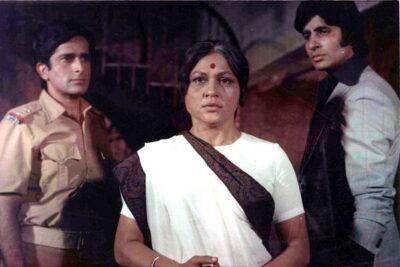
Shashi Kapoor, Nirupa Roy and Amitabh Bachchan in Deewar
Another moment involving Nirupa Roy is just as powerful. After the mother is discharged from hospital, the elder son, who has never believed in God, goes to the temple and confronts the deity. How could a devout mother be made to suffer so much? The brothers agree to meet again at the temple. Before the younger son leaves for what may be his final encounter with his brother, the mother gives him his gun and cap. She tells him that his hand must not tremble when he shoots his own brother.
Then she turns to her daughter-in-law and says, “Ek aurat apna kaam kar chuki. Ek maa apne bete se milne jaa rahi hai.” A woman has done what she had to do; a mother is going to meet her son. It is an extraordinary moment. Few screen mothers have handed a gun to one son so that he can shoot the other, and then walked towards the consequences with such resolve.
From Kokila to Nirupa Roy
Available material on Nirupa Roy’s life and career is uneven. Scattered articles and filmographies, along with several YouTube posts, offer useful lists of her films. These can be cross-checked against Harmandir Singh ‘Hamraaz’s collections, particularly for the 1950s. Records for the 1960s are more readily available, and that decade also marks a significant change in Nirupa Roy’s screen career.
The story begins in the wonderland of Indian cinema, with a little girl nicknamed Chibi, born in Kulwada village, in Gujarat’s Valsad district, on 4 January 1931. Her given name was Kokila Krishnachandra Bulsara. In those days, acting in films was not necessarily considered a respectable occupation by conservative families.
At the age of fifteen, she married Kamal Roy and moved with him to Bombay. When he saw an advertisement in a Gujarati newspaper seeking actors, he applied. He was good-looking and had always wanted to become a hero, but he was rejected. He then encouraged his wife to try. She was selected and appeared in the Gujarati film Ranakdevi in 1946. For her screen career, she was given the name Nirupa Roy. Her family back home did not accept this turn of events, and her father severed ties with her. Kamal Roy continued to try for acting roles, but without success.
That same year, Nirupa Roy appeared in Amar Raj, a Hindi historical drama made by Homi Wadia for Wadia Movietone. Her career had begun. It was Gunsundari (1948), a Hindi-Gujarati bilingual, that helped establish her as an actress. She played a wife trying to save her husband from another woman, and her expressive voice and eyes served her particularly well. It was the third version of the story, following Chandulal Shah’s films of 1927 and 1934. Along with Ranakdevi, Gunsundari was an important early success for Gujarati cinema. Nirupa Roy’s contribution to the industry’s foundations deserves to be remembered.
Goddesses, warriors and the ‘Mother of Mothers’
Nirupa Roy went on to play goddesses such as Lakshmi, Parvati and Sita, as well as legendary figures such as Meerabai and Savitri. Her screen career included a remarkable range of divine and mythological women.
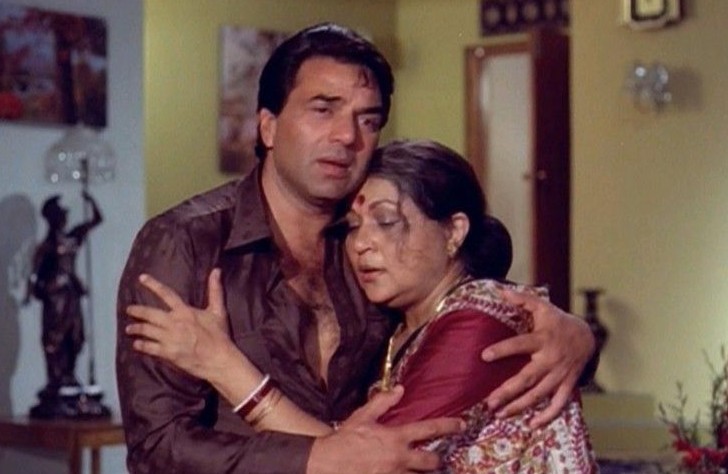
The suffering mother: Dharmendra and Nirupa Roy in Main Intaquam Loonga (1982)
She also came to be known as the ‘Mother of Mothers’, one of the most recognisable screen mothers in Indian cinema. Her characters often embodied sacrifice in a world driven by violence, greed and injustice. She brought emotional complexity and intensity to the maternal image, and few actresses, perhaps with the exception of Leela Chitnis, came to embody the suffering Indian screen mother as powerfully as she did.
That is why she is often called the ‘Queen of Misery’. This label, however, is limiting. The films most often remembered today show her suffering, but they do not tell the whole story. She was also a goddess, a brave warrior, a romantic heroine and a performer capable of considerable strength. ‘Mother of Mothers’ is a title is more fitting; ‘Queen of Misery’ seems too limiting. Her work in the 1950s makes the case particularly well.
Why the 1950s deserve a closer look
To say that the 1950s were Nirupa Roy’s decade may invite objections from film enthusiasts. The period gave audiences the films of Madhubala, Nargis, Vyjayanthimala, Meena Kumari, Geeta Bali and other fascinating heroines. Think of Baazi, Baiju Bawra, Barsaat, Taraana, Sangdil and Sujata: such classy films, such brilliant music. So where does Nirupa Roy fit in?

Nirupa Roy and Balraj Sahni in Do Bigha Zamin
In Bimal Roy’s Do Bigha Zamin (1953), Nirupa Roy played the wife of Balraj Sahni — a struggling farmer trying desperately to repay his debt. Her performance is gentle and moving. When her husband leaves for the city, she follows him to Calcutta, and her presence gives the film some of its most affecting moments. The film won several awards and is considered a pathbreaker in Indian cinema.
Nirupa Roy and Balraj Sahni went on to appear together in other films, including Heera Moti, Garam Coat, Do Roti and Ghar Ghar Ki Kahani (1970).
Mythological and historical dramas
Alongside the celebrated classics of the decade ran a parallel world of mythological, fictional, historical, family and stunt films. There were also narrative films, or aakhyan. Filmmakers such as Homi Wadia had helped build this tradition from the 1930s onwards, and it continued through the 1940s, 1950s and 1960s. Nirupa Roy became an important presence in many of these films.
Trilok Kapoor was a familiar face in mythological cinema, often playing Hindu gods. Nirupa Roy became a worthy partner in around eighteen films with him, including Har Har Mahadev, Shivkanya, Chakradhari and Wamanavtaar. Her portrayal of Goddess Parvati became so popular that people reportedly visited her home to seek her blessings. She also appeared in films such as Naag Panchami (1953), Janam Janam Ke Phere (1957), Ram Hanuman Yuddha (1957) and Maya Machhindra (1960), as well as numerous Gujarati films.
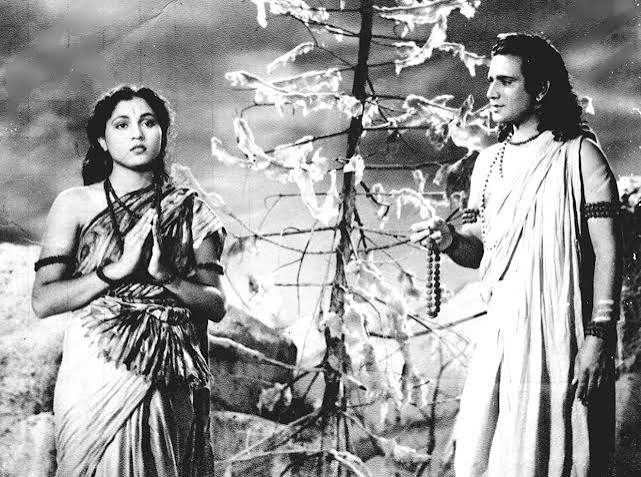
Nirupa Roy in a mythological film
Her films with Bharat Bhushan in the 1950s included Samrat Chandragupta, Rani Rupmati and Kavi Kalidas; she later appeared with him in Pyar Ka Mausam in the late 1960s. Samrat Chandragupta offers a particularly striking change of image. In the story of Chanakya and Chandragupta of the Magadh kingdom, Nirupa Roy plays a Greek princess who marries Chandragupta, played by Bharat Bhushan. Her costume and make-up are markedly different from her other roles, and the romance between the Greek princess and the Indian prince is beautifully presented. Rani Rupmati, too, is an extraordinary film and well worth revisiting.
Family dramas, warriors and unusual adventures
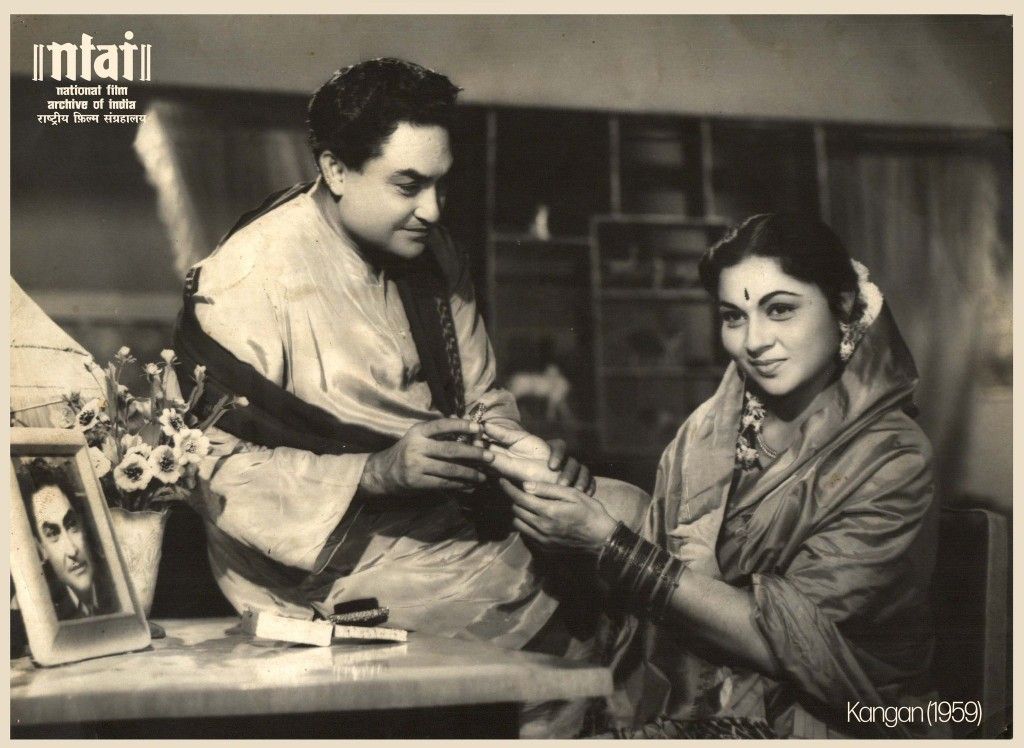
Ashok Kumar and Nirupa Roy in Kangan
Nirupa Roy also appeared with Ashok Kumar in a number of family dramas, including Bhai Bhai, Grihasti, Laadla, Bezubaan and Bedard Zamana Kya Jane. Grihasti is particularly striking for the scale of the family at its centre. Nirupa Roy begins the film as the mother of eight children and gives birth to a ninth. By the end, she has also adopted four children from Ashok Kumar’s second wife, who is played by Devika. The complicated family history involves two sisters who love the same man, a marriage, presumed deaths during the Second World War and an eventual return. The result is a household of thirteen children. How often has an Indian actress been asked to play a mother on that scale?
In Teen Batti Char Rasta (1953), she played one of the Gujarati daughters-in-law in a film concerned with the intermingling of India’s languages and cultures. The film’s inclusive theme remains an important part of its identity.
Jairaj appeared with her in historical films such as Amar Singh Rathod, Jai Chitod and Razia Sultana. In Amar Singh Rathod, Nirupa Roy is a fearless warrior, another reminder of how far her roles extended beyond the suffering mother. In Dulhan (1958), co-staring Raj Kumar, she is convincing as a loving and self-sacrificing wife and mother, and it is difficult not to feel for her character.
In Superman (1960), she even uses a specially designed flying device to fight her enemies. For an Indian film of that period, it is an unusual and wonderfully inventive touch.
A songbook waiting to be rediscovered
Nirupa Roy’s musical world is a delight in itself. Consider O pavan veg se udne wale ghode and Dhalti jaaye raat, then move to popular favourites such as Zara saamne to aao chhaliye and Aa laut ke aaja mere meet. Rani Rupmati offers something quite different from the familiar image of Nirupa Roy, moving from romance to a role of steadfast courage.
Aa laut ke aaja mere meet (Rani Roopmati, 1959 ) S N Tripathi / Bharat Vyas / Lata Mangeshkar
Her work in the 1950s, in the variety of genres of films and songs is fascinating, but many of these remain difficult to access because original video footage has not survived or is not readily available.
Nirupa Roy appeared in around 125 films during the 1940s and 1950s. Her output fell to about 45 films in the 1960s, as her screen image and the kinds of roles offered to her began to change.
The supporting actress who stood her ground
Nirupa Roy’s work was recognised with awards, but the roles themselves tell an important story. In Munimji (1955), she played the mother of Dev Anand, who was seven years older than her in real life. The film revolves around her character, even though she does not have songs of her own. She also shoots Pran in the film. So, if we think Nargis was the first screen mother to shoot her own son in Mother India (1957), Nirupa Roy’s role in Munimji had already explored a version of that dramatic situation two years earlier.
Clip of the mother (Nirupa Roy) shooting her son (Pran) in Munimji.
In Subhash Ghai’s Gautam Govinda (1979), she is the one who finally shoots the villain, played by Prem Nath. These are not passive characters waiting to be rescued; they take action when the story demands it.
She played Sunil Dutt‘s mother in Chhaya (1961), for which she received another Best Supporting Actress award. She won an award for Shehnai (1964) and was nominated for her performance in Deewar (1975), though she did not win. The industry’s recognition was deserved. Sustaining a career through substantial roles in major films requires skill, and Nirupa Roy could stand shoulder to shoulder with the leading actors of her time.
She played Shashi Kapoor‘s mother in Dharamputra (1961), in a sensitive story involving a Muslim child in a tense social environment, and again in Pyar Ka Mausam (1969). The Indian mother in these films may be burdened by struggle, but she is not without agency or strength.
The image that endured
After 1975, the image of Nirupa Roy as the suffering mother became increasingly dominant. In Deewar, she was mother to Amitabh Bachchan and Shashi Kapoor; in Amar Akbar Anthony, she was associated with Amitabh Bachchan, Rishi Kapoor and Vinod Khanna. She played Amitabh Bachchan’s mother in so many films that some viewers began to imagine a real-life connection between them. If the label ‘Queen of Misery’ fits any phase of her career, it is perhaps this later period, rather than the whole of her working life.
She received a Lifetime Achievement Award in 2004, the year she died. Nirupa Roy passed away in Bombay on 13 October 2004, following a cardiac arrest.
Her final film appearance was in Lal Baadshah (1999), in which she played Amitabh Bachchan’s mother. Across a career that ran from 1946 to 1999, she appeared in around 280 films: an extraordinary body of work.
Her long and active career invites comparison with that of Majrooh Sultanpuri, whose career span stretched from 1945 to 2000. Nirupa Roy’s career was not far behind. But duration is only part of the story. To remember her only as the mother who wept is to miss the heroine, the goddess, the warrior and the versatile performer who helped shape several strands of Indian cinema. These films and songs offer an invitation to rediscover that larger story.
(Pictures are courtesy the Internet)
More Must Read in Silhouette
Zindagi Bhar Nahin Bhoolegi: Bharat Bhushan’s Unforgettable Singer-Poet Musicals

Whether you are new or veteran, you are important. Please contribute with your articles on cinema, we are looking forward for an association. Send your writings to amitava@silhouette-magazine.com

Silhouette Magazine publishes articles, reviews, critiques and interviews and other cinema-related works, artworks, photographs and other publishable material contributed by writers and critics as a friendly gesture. The opinions shared by the writers and critics are their personal opinion and does not reflect the opinion of Silhouette Magazine. Images on Silhouette Magazine are posted for the sole purpose of academic interest and to illuminate the text. The images and screen shots are the copyright of their original owners. Silhouette Magazine strives to provide attribution wherever possible. Images used in the posts have been procured from the contributors themselves, public forums, social networking sites, publicity releases, YouTube, Pixabay and Creative Commons. Please inform us if any of the images used here are copyrighted, we will pull those images down.