Stay tuned to our new posts and updates! Click to join us on WhatsApp  & Telegram
  Channel
& Telegram Channel & Telegram Channel 




Ratnottama Sengupta revisits Bimal Roy’s enduring legacy, tracing how his humanism, realism and cinematic vision transformed Indian cinema and continue to inspire generations of filmmakers.

Bimal Roy with his camera (Pic: Roy family collections)
A filmmaker with a fine-honed visual sense, an excellent grasp of film grammar, an unerring skill in the use of montage, a marvellous narrational ability, a strong social conscience, and a fine aesthetic sensibility: This is how Phalke award winner Shyam Benegal had described Bimal Roy, born on July 12, 1909.
The recent screening of the restored print of Do Bigha Zamin in Venice, Kolkata and Mumbai underscore the significance of the iconic filmmaker who had ushered a new chapter in Indian cinema in terms of both, a deeply human content and a realistic style of making, with Udayer Pathey (1943), Anjan Garh, Do Bigha Zamin (1953), Sujata (1958), Bandini (1964)… I got to know both, the filmmaker and the man I had the privilege of calling ‘Jethu,’ in the process of directing the hour-long documentary, And They Made Classics (2017), on the unique bond between the director and his screen writer Nabendu Ghosh.
Thoughtful, soft-spoken, and circumspect, Bimal Roy had come to Kolkata in the 1930s from Dhaka, where he was born into a zamindar family. The handsome youth had hoped to become an actor, but he started life as a still photographer in New Theatres and matured into an ace cinematographer with P C Barua’s Devdas – among other hits – and eventually turned director with Udayer Pathey. That low-budget production, crafted from the leftover raw stock at New Theatres, not only became an unprecedented hit at the box office, but it also turned a new leaf in Indian cinema with the social theme of class conflict. More so, since it was expressed in a realistic idiom unknown to those bred in the theatrical tradition of the 1930s.
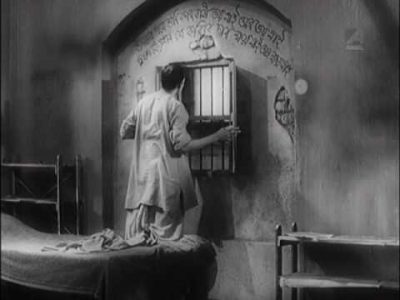
Radhamohan in Udayer Pathey
Based on a story by a then-unknown writer, Jyotirmoy Roy, Udayer Pathey had two newcomers – Radhamohan Bhattacharya and Binata Basu – in the lead, and had used Tagore songs including Jana Gana Mana in a very prescient manner. The landmark film, crafted when Bengal was reeling under the manmade famine that left more than 3 million dead on the streets of Kolkata, floored viewers with its fresh approach to everything. From crisp dialogues to the style of dressing and social conduct, it revolutionised the way films would be made and viewed in Bengal and outside, when it was released as Hamrahi.
Satyajit Ray was to say later, “Bimal Roy broke the tradition of theatrical acting and dialogues and introduced subtlety and realism wholly suited to cinema. He was thus undoubtedly a pioneer.”
Subsequently, Bimal Roy made Pehla Aadmi, set against the background of INA and its struggle in the North Eastern frontier under Netaji Subhash Chandra Bose. Again, the realistic war scenes were a first-of-its-kind experience for viewers. Mantra Mugdha and Anjangarh, based on Subodh Ghosh’s Fossil, were the other Bengali films he made before he left for Bombay in 1951, at the invitation of Ashok Kumar, to direct Maa for Bombay Talkies. He was accompanied by his unit comprising of editor Hrishikesh Mukherjee, assistant director turned comedian Asit Sen, actor Paul Mahendra – all of whom had worked with him at New Theatres – and screenplay writer Nabendu Ghosh.

Ashok Kumar and Bimal Roy
In Bombay, besides Maa, he directed Baap Beti for S H Munshi and Parineeta for Ashok Kumar before launching Bimal Roy Productions with Do Bigha Zamin. The film featuring Balraj Sahni and Nirupa Roy had won recognition at Cannes in 1954 – the second film after Chetan Anand’s Neecha Nagar to bring home an international award. Later, Gotama the Buddha, directed by Rajbans Khanna, also picked up the top award at Cannes while Nutan was adjudged the Best Actress at Karlovy Vary for Bandini. Prior to this, Sujata and Biraj Bahu were also screened at Cannes. Simultaneously, the producer-director would claim a trophy or two every year at the Filmfare awards, scoring a total of 11 when he died of cancer on January 8, 1966.

Bimal Roy (1903 – 1966)
Long after the rickshaw ceased to be the mascot of Kolkata, the rickshaw puller immortalised by Balraj Sahni continues to represent the struggling Indian from rural Bihar who still seeks jobs in Kolkata, Guwahati, Mumbai, Delhi, Punjab. The loss of land is an old story for agrarian India, and Tagore had captured its agony in the poignant poem that gave Salil Choudhury the film’s seedling. But the industrial boom post-Independence added piquancy to the tale of landless migrants, and rooted Do Bigha Zamin in the Indian soil in a way none has.
The realism in the film is traced to Italian neo-realism. The chase in rickshaw was inspired by De Sica’s Bicycle Thieves but much of the realism came from Bimal Roy’s involvement with characters and passion for reality. Lead actress Nirupa Roy had said the film had changed her image of being a star of mythological films. Coming from a small place like Balsar in Gujarat, she had the experience of peasant life. Still, Do Bigha Zamin was a learning experience for her; she’d said, narrating an incident from the days of shooting in Calcutta.
“One day when I had trimmed my eyebrows, Bimalda made them thick. Another day, when I overlooked the nail polish on my toes, he asked me if a village wife would wear polish!” More telling was the fact that their clothes were bought in Chor Bazaar since new clothes, even when washed, would not look worn. “One morning we were idling as we had no shooting, but Balraj Sahni was missing,” Roy recalled. “He was in a tea stall adda of rickshawallahs, studying their manners, getting an insight into their lives!”
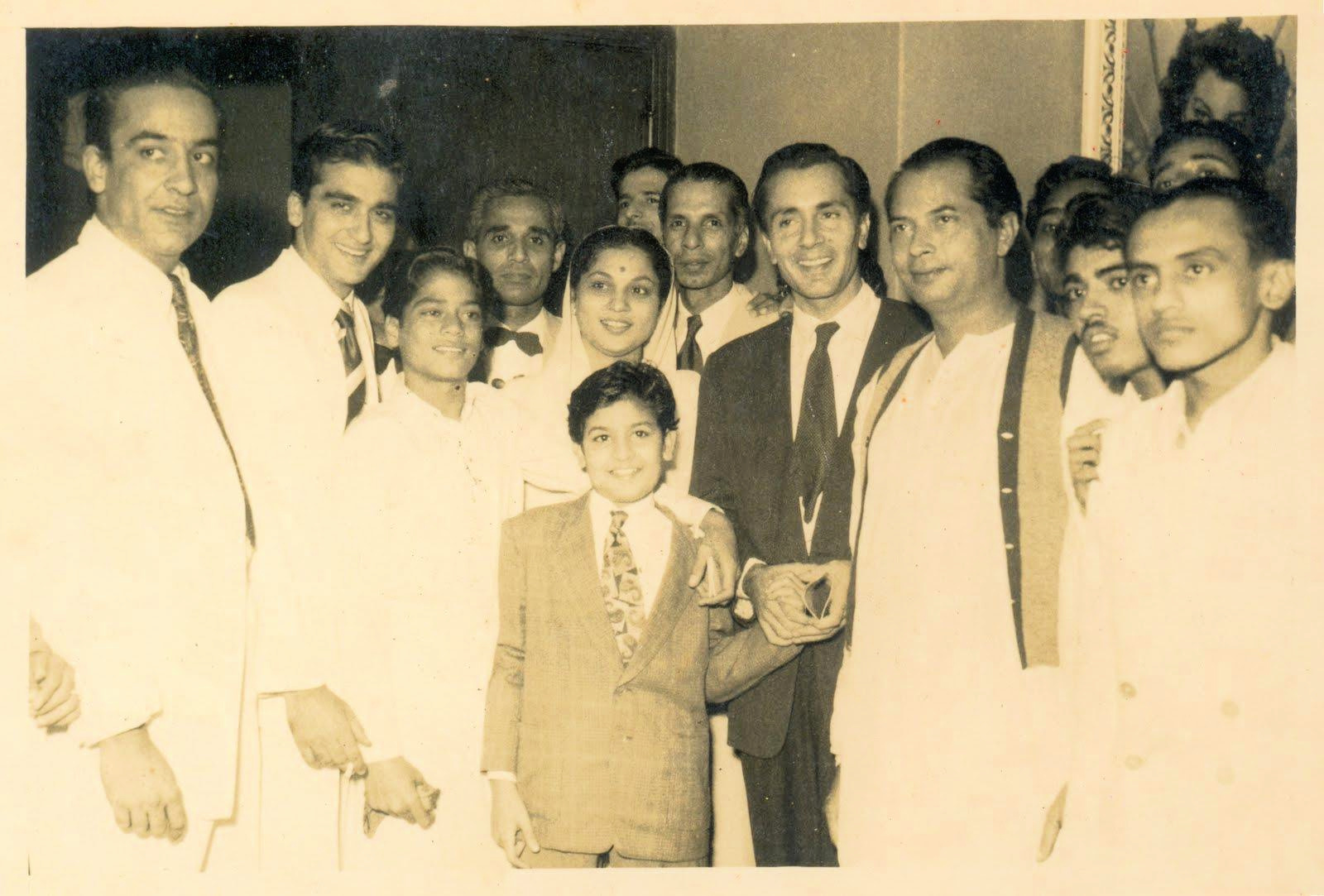
Bimal Roy, Jagdeep, Nirupa Roy, Balraj Sahni, Rattan Kumar and Sunil Dutt
*****
Moving on, Bimal Roy made Naukri, Biraj Bahu, Devdas, Madhumati, Yahudi, Sujata, Parakh, Prem Patra and Bandini. Haunting, evocative, yet simple and easy to understand, the timeless films continue to inspire generations of filmmakers from Hrishikesh Mukherjee (Anupama) and Pramod Chakravarty (Naya Zamana) to Ashutosh Gowarikar (Lagaan) and Farah Khan (Om Shanti Om). The most significant aspect of these films was their social relevance: they focused on class conflicts, caste differences, religious intolerance, sacrifices during the struggle for freedom, prison reforms, unemployment, sanctity of family bonds… all of which still make headlines.
Another notable fact was the deep empathy in the portrayal of women in particular and human relationships in general. Sujata, Kalyani, Biraj Bahu, Madhumati – the finely etched protagonists were the high points in the life of the actresses like Nutan, Vyjayanthimala, Kamini Kaushal, Meena Kumari, Nirupa Roy and Suchitra Sen. Realism was the touchstone. Likewise, the youngsters in Do Bigha Zamin, Baap Beti, Sujata, and Devdas too were not merely props in the narrative. They were all inhabitants of a real world, chased by hunger, or need for identity, and acceptance, in a planet ruled by adult patriarchs. They were integral to the storyline, realism was the touchstone of their performance, and their raison d’etre was realised by a technical team that included the cream of the respective streams.

Nirupa Roy and Balraj Sahni in Do Bigha Zamin
Do Bigha Zamin, with a timeless depiction of the peasantry faced with rural migration, launched the filmmaking unit of Bimal Roy Productions and won the Grand Prix at Cannes, 1954. Pather Panchali being more than a year away, Do Bigha Zamin can be identified as the first to spell Neo-realism on the Indian screen. However, long before that, and even before he became aware of the Neo-realists of Europe, Bimal Roy had introduced socialist realism in Indian cinema with New Theatre’s Udayer Pathey.
He saw De Sica’s Bicycle Thieves only in 1951, when the first international film festival was held in Bombay. Six years before that, in 1945, Udayer Pathey had introduced viewers to a new experience of enlightened entertainment. Artistic pleasure blended with social conscience became the signature of Bimal Roy. He projected Indian reality, sometimes contemporary, sometimes set in history, building on the foundation of a literary work, and glowing with the warmth of human emotion. This is underscored by Gopalkrishna Gandhi, aesthete and, former Governor of West Bengal who said “Bimal Roy neither mimicked nor mocked life. He took films along life’s grain, not over or across them. And that is why his films strike chords in viewers, and always will.”
A singular instance of Bimal Roy’s acute observation of life in India is found in Parakh (1951). As the villagers hurry to cast their votes, a hail-fellow-well-met senior sits in his veranda puffing on his hookah. “Why bother? Whether your vote falls in the frying pan or the fire, it will hardly make a difference!” This was barely 10 years after the country had initiated the battle of ballots. However, years before that, in Naukri (1954), again the unemployed youth played by Kishore Kumar is sarcastically advised by his landlord, “Keep applying! Sooner or later one of these paper planes might land on a job!” Was this cynicism – or prescient realism?
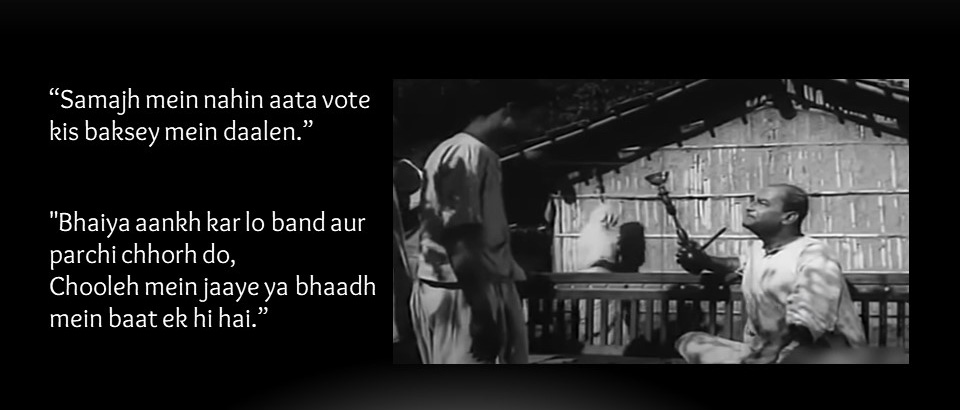
A scene from Parakh
An amazing aspect of Bimal Roy’s oeuvre is his internationalism. Go back to Yahudi, the story of a Jew in the Roman Empire. “How many times has the world gone round since then?” – a child in Jerusalem or Beirut, Haifa or Gaza could ask in all innocence. And the eternal question Sohrab Modi frames through Yahudi? “Tumhara khoon khoon hai, hamara khoon paani?!” Kabuliwala, produced by Bimal Roy answers positively: Love and affection, they know no barrier – of land or language, bloodline or borders.
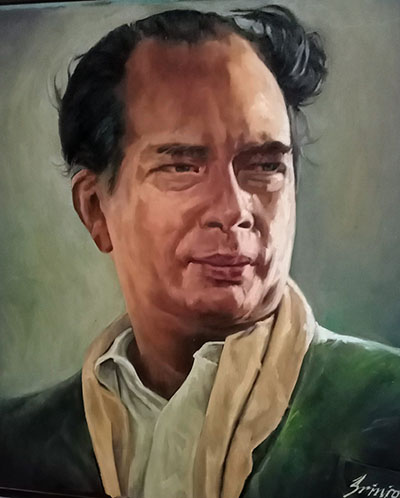
Portrait of Bimal Roy by Srinjoy Gangopadhyay 2009 (Pic courtesy: Ratnottama Sengupta’s personal collections)
Another signature feature of a Bimal Roy film was his treatment of love scenes. Think Sujata, think the ghat scene with Nutan dipping her feet in the river water. Think Yahudi, and you’ll think of Dilip Kumar and Meena Kumari expressing their love via a cockatoo. Think Bandini and you’ll recall Nutan with her back to Dharmendra as he expresses his love for her. Physical intimacy was discarded in favour of a poetic, super-romantic expression of that intangible feeling called love.
One index of Bimal Roy’s impact is that in countries like China and Russia, for years, Indian cinema was synonymous with Do Bigha Zamin and Awara. Another area in which Bimal Roy’s contribution is hard to match is his ability to identify and hone excellent artistic talents. Most of those who came under the BNR banner have left their signature on their respective disciplines like screenplay writing, editing, camera, art direction, and lyrics. They have also made films that bear the stamp of a gharana. Dadasaheb Phalke Award winner Hrishikesh Mukherjee, Nabendu Ghosh, Gulzar, Sudhendu Roy, Ritwik Ghatak, Salil Chowdhury, Asit Sen, Arabind Sen, Basu Bhattacharya, Kamal Bose, Bimal Dutt, Hemen Gupta – the long list is a mark of an institution. And just think: All of this creativity was immortalised on celluloid within merely twenty years – from 1944 to 1964!
(Pictures used in this article are courtesy Ratnottama Sengupta)
More Must Read in Silhouette
The Making of Maa: Bimal Roy’s Debut in Bombay
Bimal Roy: The Eastern Mystic Who Made Films

Whether you are new or veteran, you are important. Please contribute with your articles on cinema, we are looking forward for an association. Send your writings to amitava@silhouette-magazine.com

Silhouette Magazine publishes articles, reviews, critiques and interviews and other cinema-related works, artworks, photographs and other publishable material contributed by writers and critics as a friendly gesture. The opinions shared by the writers and critics are their personal opinion and does not reflect the opinion of Silhouette Magazine. Images on Silhouette Magazine are posted for the sole purpose of academic interest and to illuminate the text. The images and screen shots are the copyright of their original owners. Silhouette Magazine strives to provide attribution wherever possible. Images used in the posts have been procured from the contributors themselves, public forums, social networking sites, publicity releases, YouTube, Pixabay and Creative Commons. Please inform us if any of the images used here are copyrighted, we will pull those images down.