Stay tuned to our new posts and updates! Click to join us on WhatsApp  & Telegram
  Channel
& Telegram Channel & Telegram Channel 




Twenty-four school students aged 13 to 15 watched Satyajit Ray’s Nayak (1966) and completed the same questionnaire twice: once on the strength of their own viewing, and once after a guided close reading of the film and of Uttam Kumar’s performance by Silhouette editor Amitava Nag. The essay, delving into statistical analysis of students’ response, looks deep into how the teenagers reacted to the film and Uttam’s performance in it.
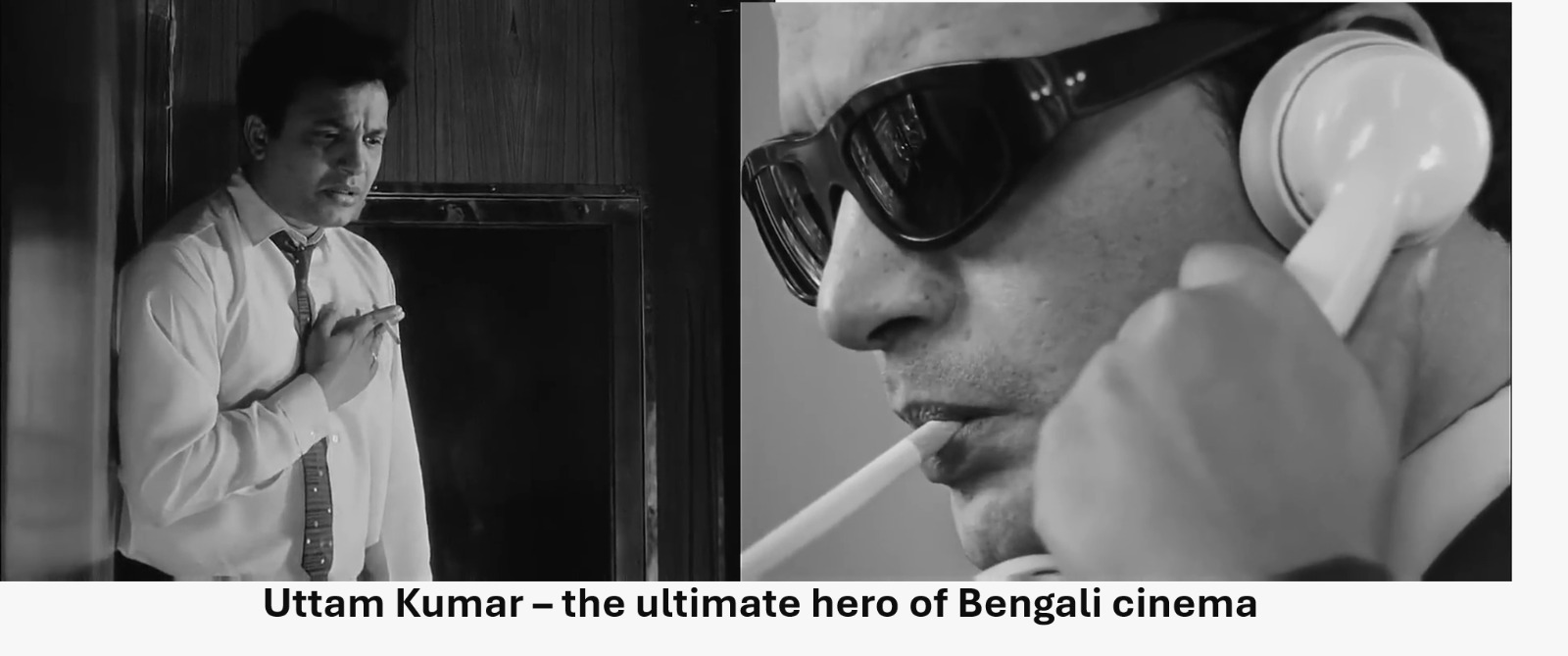
Twenty-four school students aged 13 to 15 watched Satyajit Ray’s Nayak (1966) and completed the same questionnaire twice: once on the strength of their own viewing, and once after a guided close reading of the film and of Uttam Kumar’s performance. All of them come from affluent, upper-middle class Bengali background staying in the city of Kolkata and studying in an ICSE School with Bengali, their mother tongue, as a Second Language subject. Most of them have heard the name Uttam Kumar, watched his face now that the city is draped with his posters as part of his centenary. Only 8 of them, at 33%, have watched any film of Uttam Kumar before.
The exercise tests a single proposition, whether a structured close reading of Nayak, covering its camera grammar, its dream sequences and above all Uttam Kumar’s modulated performance, will measurably sharpen young viewers’ perception of how the actor builds the star persona and then lets it crack.
The questionnaire has five sections, and it is laid out so that each student marks a “Before Analysis” column and an “After Analysis” column side by side. Sections A and B use a five-point agreement scale (Strongly Agree, Agree, Not Sure, Disagree, Strongly Disagree). Sections C and D use a four-point intensity scale (Very Strongly, Quite Strongly, A Little, Not at all). The final question in D offers five named attitudes towards Arindam.
| Section | Items put to the students |
|---|---|
|
A. The star we first meet
(How does Uttam Kumar create the public image of Arindam?)
|
A1. When Arindam first appears, Uttam Kumar makes him look like someone who is used to being admired by everyone.
A2. Arindam’s walk, posture, smile and way of speaking make him look powerful and confident.
A3. Arindam knew exactly how to behave differently with fans, journalists and ordinary passengers.
A4. Even when friendly or smiling, he sometimes seemed to keep people at a distance.
|
|
B. The man behind the star
(Does the person behind the public image gradually become visible?)
|
B1. As the film progresses, Arindam is not as confident inside
as he appears outside. B2. Uttam Kumar’s face and eyes often tell us what Arindam is thinking or feeling but does not say.
B3. I felt sympathy for Arindam when he spoke to Aditi about his past.
|
|
C. Acting without words
(How far does the non-verbal performance carry meaning?)
|
C1. Facial expressions.
C2. Silence and pauses.
C3. Body language: walking, sitting, turning, looking away.
|
|
D. What did you actually feel?
|
D1. How strongly were you disturbed or frightened by the dreams and nightmares? (followed by: how did the acting contribute to this?)
D2. At the end of the film, how did you feel about Arindam?
Liked him, Understood him, Unsure, Felt sorry for him, Disliked him; followed by: why? |
The questionnaire moves deliberately from the observable star (A) to the concealed man (B), to the technical means that reveal him (C), and finally to the viewer’s own emotional response (D).
The survey workbook tabulates Sections A to D. There is also a Section E that places the performance within Uttam Kumar’s wider work and invites the student to imagine an alternative Arindam. Only 8 of the 24 students had seen Uttam Kumar in another film. Between them they named 10 titles: Dhanyi Meye, Mouchak, Chiriyakhana, Deya Neya, Chadmabeshi, Jhinder Bondi, Sesh Anka, Saptapadi, Antony Firingee and Bhranti Bilas. Several of these are comedies or popular entertainments, which makes the students’ verdict more striking: six of the eight preferred his performance in Nayak, with one vote each for Deya Neya and Sesh Anka. Asked whether another actor could play Arindam better, ten students said that Uttam Kumar was best suited to the role, and six left the question blank. Soumitra Chatterjee, Ray’s other leading man, was the only alternative named more than once, with three mentions. The remaining choices were Tota Roy Choudhury, Ritwik Chakraborty, Emraan Hashmi, Brad Pitt and Charlie Chaplin. These suggest that students cast the role from the stars they know today more than from the demands of the character.
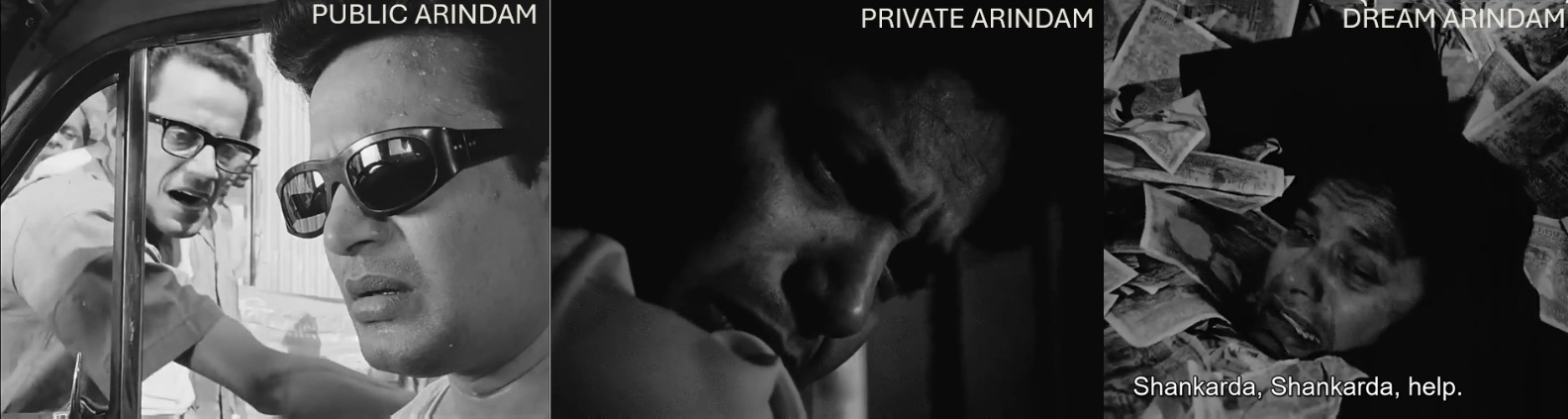
The three Arindams in Nayak
The film reading aimed to show how Ray progressively dismantled the public image of the superstar to reveal the vulnerable man beneath, through the actor’s body, the camera and the structure of the film.
This is the idea most directly tested by Sections B and C of the questionnaire.
After the analysis, the class moved towards the strongest response on ten of the eleven intensity and agreement items. The one exception was the item on the dreams. Across the seven agreement statements in Sections A and B, “Strongly Agree” answers rose from 72 to 100 of 168 responses (43% to 60%), and “Not Sure” fell from 28 to 14. Across the three items in Section C, “Very Strongly” rose from 33 to 47 of 72 responses, and the single “Not at all” disappeared
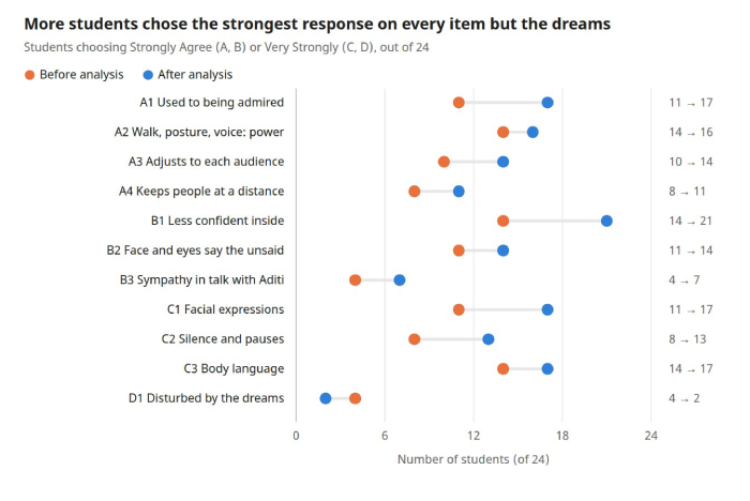
The students’ response to the public Arindam was already strong before any analysis. Twenty-three of 24 agreed that he is presented as a man used to admiration (A1), and 22 that his walk, posture and speech project power (A2). What the analysis changed was conviction, not recognition: “Strongly Agree” on A1 rose from 11 to 17. The item with most room to move was A3, on Arindam’s calibrated behaviour towards fans, journalists and fellow passengers. Before the analysis, five students were unsure. Afterwards, none were, and agreement rose from 19 to 22. A4, the more subtle observation that Arindam keeps people at a distance even when smiling, was the weakest statement in the section before the analysis (16 agreeing, 6 unsure). It rose to 19 agreeing with only 2 unsure.
One counter-movement needs noting. Before the analysis, Section A drew only two negative responses, both on A4. Afterwards it drew seven, including a “Strongly Disagree” on A2 and two on A3, where there had been none. The aggregate figures cannot show which students moved, but the pattern is consistent with a few students taking the analysis’s thesis, that the star’s confidence is a performance, and then rejecting statements that seemed to describe Arindam as actually powerful and assured. This point is taken up again in the observations.
The largest single shift in the survey is on B1: “As the film progresses, I could see that Arindam is not as confident inside as he appears outside.” Strong agreement rose from 14 to 21, and all 24 students agreed after the analysis. This is the statement closest to the analysis’s central thesis and to the “Three Arindams” slide. Its movement is the clearest evidence that the students absorbed the idea of the performance as controlled modulation.
B2, on the face and eyes saying what Arindam leaves unsaid, rose from 16 to 19 agreeing, with strong agreement up from 11 to 14. Responses stayed more scattered than elsewhere, with three still unsure and two disagreeing.
B3, sympathy for Arindam when he speaks to Aditi about his past, is the outlier of the whole questionnaire. It began lowest (10 agreeing, 8 unsure, 6 disagreeing) and remained lowest (13 agreeing, 6 unsure, 5 disagreeing). The analysis made students more confident that they could see Arindam’s vulnerability. It did far less to make them feel for him.
This section most directly measures what the students came to value in Uttam Kumar’s craft, and all three items rose:
The dream sequences are the one item where the analysis did not intensify the response. “Very Strongly” disturbed fell from 4 to 2, “Quite Strongly” rose from 11 to 14, and the two students who felt nothing did not change. The overall distribution barely moved: 15 of 24 were strongly or quite strongly disturbed before the analysis, and 16 after. The explanation of dream grammar, with money as landscape and images joined by emotional association, seems to have made the dreams more intelligible without making them more frightening. For a few students it may even have defused their immediate shock.
The final judgement of Arindam moved more:
| Feeling about Arindam at the end | Before analysis | After analysis |
|---|---|---|
| Understood him | 15 | 11 |
| Liked him | 4 | 7 |
| Felt sorry for him | 1 | 4 |
| Unsure | 1 | 2 |
| Disliked him | 3 | 0 |
The class moved away from a neutral, cognitive verdict towards warmer and more personal ones. This is the Section D, and it appears here even though the more specific sympathy item (B3) moved only slightly.
The proposition is broadly supported, most strongly for perception and least strongly for feeling. On every item about seeing how the performance works (Sections A, B1–B2 and C), the class moved towards stronger endorsement and away from uncertainty. On the items about feeling (B3 and D1), movement was small or reversed. Only the final judgement of Arindam (D2) shows a clear affective shift. A fair summary is that the analysis taught the students to read Uttam Kumar far more effectively than it changed how they felt about Arindam.
The results give a useful map of adolescent spectatorship. Thirteen- to fifteen-year-olds read the star’s outward expression easily, the swagger, the command of space, the charm. The inward one, the pause before a reply, the eyes that contradict the smile, the modulation from public to private Arindam, is what they need to be taught to see. That is a strong case for this kind of close reading in the classroom, and it is also a precise description of what makes Uttam Kumar’s work in Nayak distinctive.
Students of this age may recognize Arindam’s crisis without identifying with a successful, self-absorbed adult’s regret. Yet the end-of-film shift (no one disliking Arindam, and “Liked him” and “Felt sorry for him” rising together) shows that the analysis did soften judgement, even if it did not produce the specific sympathy B3 describes.
The richest evidence is in the untabulated answers. The open questions in Section D (how did the acting contribute? why did you choose this response?) and all of Section E (other Uttam Kumar films, preferred performance, an alternative actor for Arindam) are where students explain their thinking in their own words. Coding these answers were difficult and hence left out from quantification.
Yet, within its modest scope and ambition, the exercise shows that a single, well-structured close reading can move a class of young teenagers from recognizing a film star to understanding a performance. They were exposed to seeing the silences, the eyes and the controlled collapse of the public self that make Uttam Kumar’s Arindam more than a portrait of celebrity. What the analysis did not do and perhaps cannot be expected to do in one session, is make them feel Arindam’s loneliness as their own. The film’s closing irony, that the mask returns once the crowd reappears, may be a lesson that will take them even longer to learn.
Courtesy: The graphical representation of shift in student response before and after the film reading was done by AI based on the tabulated data from the questionnaire.

Whether you are new or veteran, you are important. Please contribute with your articles on cinema, we are looking forward for an association. Send your writings to amitava@silhouette-magazine.com

Silhouette Magazine publishes articles, reviews, critiques and interviews and other cinema-related works, artworks, photographs and other publishable material contributed by writers and critics as a friendly gesture. The opinions shared by the writers and critics are their personal opinion and does not reflect the opinion of Silhouette Magazine. Images on Silhouette Magazine are posted for the sole purpose of academic interest and to illuminate the text. The images and screen shots are the copyright of their original owners. Silhouette Magazine strives to provide attribution wherever possible. Images used in the posts have been procured from the contributors themselves, public forums, social networking sites, publicity releases, YouTube, Pixabay and Creative Commons. Please inform us if any of the images used here are copyrighted, we will pull those images down.











































































Really liked this exercise and its conclusion. Very creative way of analysing Uttam Kumar’s performance in Nayak, as well as underlining the case for cinema appreciation for young people!