Stay tuned to our new posts and updates! Click to join us on WhatsApp  & Telegram
  Channel
& Telegram Channel & Telegram Channel 




A tribute to Asha Bhosle’s versatility, the singer who could move across genres, moods, eras and languages with ease, revealing a different shade of her artistry each time.

Asha Bhosle (Pic courtesy: Internet)
Asha Bhosle – the name conjures up such a mesmerising medley of songs, spanning genres and styles that you are left wondering what to pick from her awe-inspiring repertoire.
From classical songs to ghazals, from devotional to pop, from melancholic to comic, from club songs to pathos-laden songs – Asha Bhosle traversed the gamut of Hindi film music with élan. Each song she rendered carried her indelible stamp – the texture, the tone, the verve and the pathos, so uniquely hers. One could immediately recognise that it was an Asha song and yet, it was never out of place with the situation or the actress on whom it was filmed.
Today, the legendary singer has left for her eternal abode, leaving behind her enduring aura and an unmatched legacy. We remember her with a hand-picked selection of songs, that display, to some extent, her massive range.
Written by Amrita Pritam, this is poetry woven into a beautiful melody by the renowned sitarist Ustad Vilayat Khan. The film Kadambari, was one of those middle-of-the-road films that created an offbeat genre of films in the 70s, bringing middle class realities to the screen. Starring Shabana Azmi and Vijay Arora, the film came and went but left behind this soft, melodious song that one can hum in solitude. The song is replete with striking imagery. Asha begins the song with a heavenly alaap.
kaise iskaa karz chukaayen
maang ke apni maut ke haathon
umar ki choli see hai hamne,
baat kufr ki ki hai hamne
ambar ki ik paak suraahi,
baadal kaa ik jaam uthaa kar
Ambar ki paak surahi (Kadambari, 1975) Ustad Vilayat Khan / Amrita Pritam / Asha Bhosle
Love Triangle or Love Square, call it what you will, Lal Patthar with its four-cornered love story stands out not only for its powerful performances and unusual storyline but also for its unforgettable semi-classical music by Shankar-Jaikishan.
Based on a story ‘Lal Paathor’ by eminent Bengali writer Prashanto Choudhury, this FC Mehra film starring Raaj Kumar, Hema Malini, Rakhee and Vinod Mehra is a remake of the 1964 Uttam Kumar-Supriya Choudhury starrer Lal Patthar, which was directed by Sushil Majumdar and was equally known for its music.
A story of intense passion, jealousy, love and rage that consumes everything and everyone around – Lal Patthar is unlike the usual run-of-the-mill masala films.
Re man sur mein gaa is a song that transcends time. Gopaldas Neeraj writes a song celebrating music – music is the rhythm of life, the highs and lows of it are like madhyam and pancham.
Jeevan hai sukh-dukh ka sangam
Madhyam ke sang jaise pancham
Donon ko ek bana
The heart beats in tune with the rhythm of time, so just let yourself flow.
Dil jo dhadake taal baje re
Taal taal mein samay chale re
Samay ke sang ho ja
Music is the universe, where tune is the king and melody the queen. Be the instrument which plays along.
Jag hai geeton ki rajdhaani
Sur hai raaja, lay hai raani
saaz-roop ban ja
Profound and so deep, isn’t it? One wonders, if only, one can look at life as music – melodious and rhythmic in every note.
Amazing aalaps and murkis by Manna Dey and Asha Bhosle, and a fascinating use of instruments by Shankar-Jaikishan. Well, you don’t have too many songs like this one. A class apart!
Re man sur mein ga (Lal Patthar, 1975) Shankar-Jaikishan / Neeraj / Asha Bhosle and Manna Dey
Aise mein kahin koi mil jaaye – that’s how the song begins with humming and an alaap (not with the first line Kaali ghata chhaye). It is Sujata’s secret wish, singing all to herself. The looming clouds are her audience. And we are too.
Nutan looks exquisitely beautiful with Bimal Roy capturing her most photogenic profiles. It’s a song synonymous with the onset of rains – not pouring rains. It’s the first song that comes to mind as soon as the sky darkens.
Sujata quietly closes the door before singing – so it’s just us who hear her song. Majrooh Sahab does what he loves doing – writing from a woman’s point of view. Burman Dada uses his favourite flutes. There are two flutes – one low-scale wind flute in the prelude and the other a high-scale flute. The sitar and tabla are soft, rippling like flowing rainwater. “The taal is an 8 matra Keharva, which is so very well designed as if raindrops are falling.”
Asha sings from her soul – just notice the delicate velvet-like expressions (so different from the masti-laden Asha).
hoon main kitni akeli wo yeh jaante
mere berang jeewan ko pehchaante
mere haathon ko thaame hanse aur hansaaye
mera dukh bhulaaye kisi ka kya jaaye
Bimal Roy makes this song and scene the world of the lonely Sujata. She has the clouds and the flowers and the plants as her friends. And wishes someone would just come and hold her hand, make her laugh and forget her sorrow.
Simple girl, simple wishes.
Simple lyrics, simple music.
When they come together – they create a masterpiece. And it is Asha, bringing it to us.
Kaali ghata chhaye (Sujata, 1975) SD Burman / Majrooh Sultanpuri / Asha Bhosle
We can have a full article on just Asha’s humming and alaaps. SD Burman wrote in his autobiography Sargamer Nikhad, “Lata’s sister Asha is also a very high calibre artist. She has that youthful vigour in her. With the two sisters, it was worth experimenting as they went merry with all types of songs. Asha, also has the rare quality of singing all kinds of songs, from the husky type to the soft ones. This is a great quality in a singer.”1 Dada’s innovative spirit flashed brightly in O nigahein mastana, where he made Kishore sing the song and interspersed his lines with Asha’s delectable humming and an aalap in the last interlude.
While on humming, we can think of the ultimate tonga song – the prankster Kishore Kumar and the pigtailed Chand Usmani. What more do you need to start bobbing wherever you are. The song is packed with exuberance and energy. It’s a romance with love and with life, with an irrepressible urge to celebrate the joy of living. And yes, Asha’s alaap – that famous interrupted one with Kishore Kumar on screen putting up his hand to stop Chand Usmani’s “aaaa”.
Enjoy the tug-bug-tug-bug song… 😊
Piya, piya, piya mera jiya pukaare (Baap re Baap, 1955) O P Nayyar / Jaan Nisar Akhtar / Kishore Kumar and Asha Bhosle
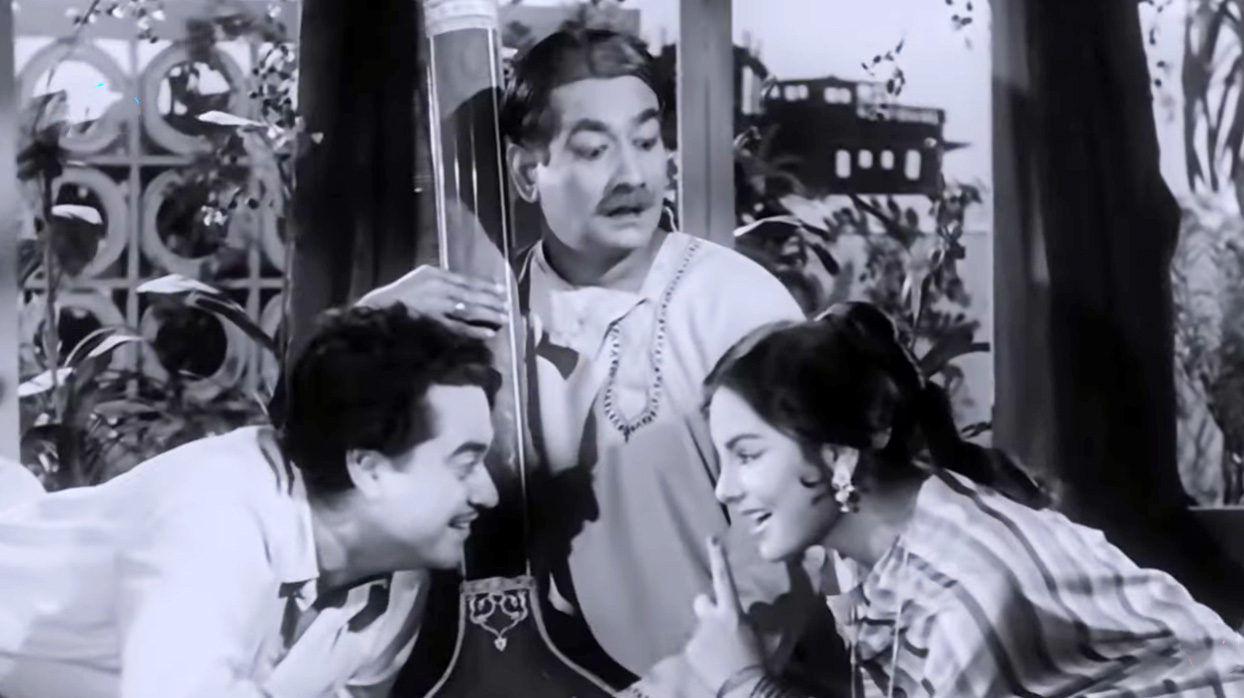
When Kishore and Asha are at the microphone for a fun song, they turn on the humour valve fully. There are umpteen examples of their comic songs together. But since we are talking about aalap, here’s one that’s a pure tongue-in-cheek take on classical music.
So we have Kishore Kumar singing “classical” music, vigorously shaking with every note he sings. The more he shakes, the more classical it gets!! And the tabalchi and Mama ji strumming the tanpura start shaking too. Mama ji is initially a bit suspicious at Kishore’s antics but gets totally lost in the music with his eyes closed. So much so that Kishore winds his arm around the tanpura and starts strumming it ulta! So you have two people strumming one tanpura!
Hindi films have stretched dramatic irony beyond every possible limit and this is no exception. So we all know what’s going on between the two lovebirds who sing about ‘marega Mama’ but Mama is in a trance.
Shailendra cooks up a rapid “classical” exchange between Kishore and Asha in verse right under the nose of Mamaji. SD Burman brings out his naughtiest side to create a hilarious piece that has generous doses of Kishore Kumar’s madcapism, with Asha following the cue brilliantly. The pièce de resistance is Kishore breaking into a rapid-fire sargam – ‘vasco da ga ma’ with teen taal on the tabalchi’s head. Can’t stop giggling when this one is on – a solid mood uplifter.
Sa sa sa sa re (Naughty Boy, 1962) SD Burman / Shailendra / Asha Bhosle and Kishore Kumar and
Asha Bhosle, RD Burman and Gulzar made a team that found a delicious joy in breaking the set norms of music. From the blank verse of Mera kuchh saaman to the semi-classical Piya bawri and a whole album of exceptional songs in Dil Padosi Hai, the trio came up with immortal songs. One such unforgettable album was Namkeen, where Asha’s voice was used in a range of songs – from the melancholic Phir se aayo badra bidesi, and the mujra Badi der se megha barsa to the sing-song folk-styled Aanki chali baanke chali.
Trust Gulzar to come up with these lines which only one who knows about Bengal’s food culture can relate to. Why he put them in is anybody’s guess but they sure are a teaser! For those who don’t know the meaning of the lines – Paanta bhaate taatka baigun poRRa – this is actually a simple meal of boiled rice with its water retained, topped with a freshly roasted eggplant – it is a sufficiently filling and nutritious meal for people who cannot afford the regular dal-chawal-subzi-bhaaji-chutney meal.
Asha Bhosle supported by Alka Yagnik excels in this beauty of a creation. RD Burman uses the beat of the huge mortar to lend a lively note to the giggling sisters singing as they work.
Aanki chali baanki chali (Namkeen, 1982) RD Burman / Gulzar / Asha Bhosle and Alka Yagnik
Bombai Ka Babu was a story way ahead of its times and a stellar star cast of Dev Anand and Bengal’s queen of hearts Suchitra Sen. The film gave Majrooh Sultanpuri and Burman Dada the scope to create a necklace of sparkling songs of myriad hues.
Asha and Rafi ruled in this musical. Think of the vivacious Suchitra Sen with her magnetic screen presence making a million hearts turn with Dekhne mein bhola hai dil ka salona and Aise mein kachu kaha nahin jaye (both sung by Asha). Or her effervescent, verve-laden celebration of spring with Dev Anand in Deewana mastana hua dil. Asha’s heavenly alaap and sargam flags off a fun Rafi-Asha duet where Majrooh’s lyrics celebrate nature, beauty, love and longing, buoyed by Burman Dada’s youthful music. Another Rafi-Asha duet Pawan chale to utthe was equally frolic-laden.2
In a BBC interview, Asha Bhosle spoke about how Dada Burman taught her the art of playback singing. The interviewer asked: “Yeh bataiye, kisi ek music director ne aapko jazbaati taur par khencha hai zyaada?”
Asha replied, “Jee haan. Jinhone mujhe playback singing kya hai woh sikhaya. Aur bahut zyada, apni ladki jaisa pyar karte thhe. Aur yeh batate thhe ki artist bolta kaise hai, dikhta kaise hai, uski figure kaisi hai — yeh sab cheez ko dekhke gaana gao. Aur yeh unhone sikhaya jinka naam hai SD Burman. Dada kehte thhe hum.”
I loved the way Monica Kar explained this inexplicable X-factor when Asha sang under Dada Burman’s music direction. She wrote, “SD Burman’s songs expressed a different facet of her personality. Something deeper, more resilient, a voice with a soul. Dada Burman explored her voice, not just for its range, but for its depth.”
As spring gives way to summer now, let’s listen to Deewana mastana hua dil once more to bid adieu to the season and the singer.
Deewana mastana hua dil (Bombai Ka Babu, 1960) SD Burman / Majrooh Sultanpuri / Asha Bhosle and Mohd Rafi
Talking of emoting, one cannot help but think of how these singers made every embellishment sound so natural in the song. Asha’s happy giggle at the end of the deeply introspective song Naina hain pyaase mere adds a dimension to the song, taking it to another level. Composed by the under rated Kanu Roy, this is a gem in the pearl-studded album of Aavishkar.
Naina hai pyaase mere (Aavishkar, 1973) Kanu Roy / Kapil Kumar / Asha Bhosle
Asha Bhosle’s versatility extended across genres, styles and also languages. She sang songs in various languages, including English. Apart from an enviable body of work in Hindi and her native Marathi, she had a rich repertoire in Bengali too. She could speak Bangla with ease, if not with expertise; not surprisingly, music directors from Bengal chose her for their film songs, Rabindra Sangeet and non-film (adhunik) songs. When singer-composer Shyamal Mitra forayed into Hindi music, he picked Asha to sing the pensive Kal ke apne na jaane kyun, ho gaye aaj paraye in Amanush.
Asha’s forte of getting into the heart of the character she would sing for is evident in this gem, picturised on Sharmila Tagore and Uttam Kumar. The pain bursts forth in every word, with the singer emoting the song as much as the actress on screen.
Kal ke apne na jaane kyun ( Amanush, 1975) Shyamal Mitra / Indeevar / Asha Bhosle
The one song that takes me away, far away in an instant, is this ethereal beauty from Pratham Kadam Phool. Music director Sudhin Dasgupta exploits the pitch of Asha’s voice so beautifully, making it rise and fall to create a dreamy song about taking flight into the unknown. The song is picturised on a gorgeous Tanuja singing by the riverside, almost to herself, although Soumitra Chatterjee (playing her husband) and Shubhendu Chatterjee look on in admiration. Even if you don’t understand the lyrics, simply immerse yourself in the melody. You will find yourself spreading your wings into the azure sky as Asha scales up with Chhaya neel shimaanaye…
Kon shey aalor swapno niye (Pratham Kadam Phool, 1969) Sudhin Dasgupta / Pulak Bandyopadhyay / Asha Bhosle
References:
More Must Read in Silhouette
Kanan Devi: ‘The First Singing Star’
Manna Dey: A Story of Amazing Versatility – Part 1

Whether you are new or veteran, you are important. Please contribute with your articles on cinema, we are looking forward for an association. Send your writings to amitava@silhouette-magazine.com

 Asha Bhosle: From Shadow to Spectrum
  The Evergreen Songs of Jeetendra
 Zindagi Ek Safar Hai Suhana: Shankar Jaikishan’s Melodies of 1971 – 18 Films, 104 Songs
 Which Was the True Voice of Pancham?
 ‘Deewana Mastana Hua Dil’ – Mesmerizing Music of SD Burman-Majrooh (Oct 1 Anniversary Special)
 Myriad Strands of Love: A Hindi Film Perspective
Silhouette Magazine publishes articles, reviews, critiques and interviews and other cinema-related works, artworks, photographs and other publishable material contributed by writers and critics as a friendly gesture. The opinions shared by the writers and critics are their personal opinion and does not reflect the opinion of Silhouette Magazine. Images on Silhouette Magazine are posted for the sole purpose of academic interest and to illuminate the text. The images and screen shots are the copyright of their original owners. Silhouette Magazine strives to provide attribution wherever possible. Images used in the posts have been procured from the contributors themselves, public forums, social networking sites, publicity releases, YouTube, Pixabay and Creative Commons. Please inform us if any of the images used here are copyrighted, we will pull those images down.










































































A top 10 of any singer with even 1000 recorded songs is a daunting task, so it must be 11 times more daunting to choose from Asha’s repertoire! But well done, Antara, and well commented. Even just Deewana mastana hua dil is enough for me. With Suchitra Sen of course!
Thank you so very much, Manek Sir, for your feedback.😊🙏 Truly, it is an impossible task to pick a few diamonds from a treasure chest filled with sparkling, precious gems.
I must also thank RTS. The eclectic and unique themes we have there throughout the year often nudge me to pick up the pen. When one is scratching one’s head, trying to choose from such a vast and amazing repertoire, it becomes easier to dive into those posts.
Suchitra Sen and those heavenly Asha songs in Bombai Ka Babu! Ufff… I fully agree with you. Deewana mastana hua dil truly makes the heart go deewana mastana, even in the middle of a busy workday. Such is its magic!🤩
It is certainly not an easy job for even a veteran and a connoisseur of Hindi Film Music to pay a tribute to someone like Asha Bhonsle, its scope restrained by the length of the write up. But even in this short and sweet tribute, the songs curated and the notes on them are a delight to read. A fitting tribute to one who, over 80 years, gave her all to lovers of such Music. Thank you, Antara.
Thank you so much, Rajan Sir. How can one even think of presenting a curated list from a repertoire so vast, so popular and so diverse?
That is why I chose to pick songs across a spectrum of music directors, including those who may have had only a few outings in Hindi film music. Each composer had their own requirements in terms of style and rendition, and for the artist to rise to each one, every time, so flawlessly. One can only say, naman. 🙏🙏🙏
Feels like an era has ended… Ashaji’s absence can never be filled❤️🙏
All time favorite singer Asha Bhosleji, perfect in every type of music…
Her songs are not just songs, they are a feeling, truly timeless and magical🙏
Antara, you have also carried her legacy so beautifully 👏
Thank you so very much Anup! I am so happy you liked this writeup. Grateful 😊🙏
Wonderfully woven and well articulated deciphering the varied shades of the versatile most songstress of our nation. She was the most versatile artist when it came to classical singing under Ustad Ali Akbar Khan Sab or be it delivering the game changers for Panchamda in Bollywood playbacks. I personally feel the inclusion of a Marathi classical song would have made the article more complete,followed by one of her dance numbers like Jawani Janeman just to demonstrate the range and depth of Ashaji. Though I understand that plucking off 10 songs from her vast repertoire is such a difficult task. Overall a great tribute to her colossal contribution in the field of Indian music
Soumyadeep, thank you so much for your generous and insightful comment.
You are absolutely right! A Marathi classical song would have added another beautiful dimension. This, however, was a rather hurried write-up, done quite late at night, and I must admit I am not very familiar with Marathi repertoire. At that hour, I also had no one to turn to for guidance.
As for a cabaret number, I did consider it. But somehow, the article seemed to be flowing within a certain mood, and a cabaret piece felt like it would shift that tone quite sharply, even though we are indeed talking about ‘The Many Moods of a Matchless Voice’. In that respect, an ommph-laden ‘Jawane jaaneman’ or ‘Mera naam hai Shabnam’ should have found a spot. Ufffffffffff… Asha ji makes it so difficult for us to choose! 😊😊
Thank you once again for your valuable perspectives. 🙏
Antara, the way you have brought out Asha’s vast repertoire—the sheer versatility and her effortless ability to mould her voice to every situation is remarkable. Considering the ocean of work she has given us, selecting just a few songs and weaving them into such a beautifully crafted essay is no small feat. It reflects not just your understanding, but also a deep sensitivity and connection with Asha’s songs. Truly exceptional.
Gaurav, thank you so much for your kind and generous words. It truly means a lot. Trying to pick just a few songs from such an ocean was daunting, but also deeply enjoyable. I simply went intuitively, quickly stringing together a few of the countless “top favourites”. 😀
On hindsight, I feel, the tight deadline of a few hours helped me finish this piece and publish it. Had I pondered over what to choose, it would be still in drafting stage. It is so, so, so difficult to choose from this treasure chest. So glad it resonated with you. 🙏
It’s most difficult to select my favourites from Asha’s repertoire. More so analysing them. Being a ghaati I will be more prejudicial towards Babuji and Hridaynath ji. Her voice carried maternal care to sisterly advice to devotion, motivation, romance to, organic sensuality to, devotion and you name it. Select your favourite …
🙏
Dada, thank you so much for sharing this. You’ve captured her range so beautifully. And yes, choosing favourites from Asha’s repertoire is truly the hardest part! So glad the piece resonated with you. 🙏 I have requested Sharvari to pen a writeup on Asha ji’s Marathi repertoire. It would be a learning for all of us who are not aware of that part of her exemplary repertoire, especially the music of Sudhir Phadke ji and Hridaynath ji.
I have been immersing myself in her songs since I heard the news. It feels like a part of my childhood died along with her. As it did earlier with Lata’s demise.
Your list just made me hungry for more Asha, in many more moods, across genres as well.
Pingback: Carnival of Blogs on Golden Era of Hindi Film Music – Volume XIV – April 2026 Edition – The world is too small? or Is it?