Stay tuned to our new posts and updates! Click to join us on WhatsApp  & Telegram
  Channel
& Telegram Channel & Telegram Channel 




Subha Das Mollick looks back at three hit films in which the two titans of Bengali cinema – Uttam Kumar and Soumitra Chatterjee co-acted.

Soumitra Chatterjee and co-actor in Jhinder Bondi (Source – Abesh Das, Pic Courtesy – Sukumar Roy)
In 1961, Tapan Sinha made Jhinder Bondi, a swashbuckling adventure film, replete with horse riding and fencing, set against the rugged, rocky backdrop of southern Rajasthan. This was Sinha’s ninth film, coming after he had already won audiences over with films like Kabuliwala, Kshudhita Pashan and Kshaniker Atithi. With Jhinder Bondi, he was breaking new ground – for himself and for the Bengali film industry. High action-adventure films are a rarity in the Bengali film industry. Built around a political conspiracy and mistaken identity, Jhinder Bondi remains unsurpassed to this day. The film is an adaptation of Saradindu Bandyopadhyay’s novel, which in turn, drew upon Anthony Hope’s 1894 novel The Prisoner of Zenda. In adapting the story, Bandyopadhyay transformed Hope’s novel into a distinctive Indian narrative by relocating the setting to an Indian princely state. Tapan Sinha preserved that Indian setting and sensibility in his filmic adaptation.

Uttam Kumar and Arundhati Devi in Jhinder Bondi
When Sinha decided to cast Uttam in the lead, the 35-year-old star of Bengali cinema accepted the challenge and agreed to train in horse riding and fencing. Sinha insisted that Uttam learn to ride like a royal cavalry officer rather than sit stiffly on horseback like an actor playing a part. Uttam reportedly began waking at 5 a.m. every morning to practise horse riding before shooting, training until riding became second nature rather than a conscious performance. Uttam carried that same discipline over to his fencing lessons with a professional instructor, who was impressed with Uttam’s extraordinary powers of observation. Instead of trying to become a competitive fencer in a short span of time, Uttam watched every movement with intense concentration and reproduced it with uncanny accuracy, not mastering the sport, but the illusion of expertise for the camera.
With his lead actor getting ready, Sinha needed an adversary to match him. His natural choice was Soumitra Chatterjee, who had played the young tax collector in Sinha’s earlier film Kshudhito Pashan. Tall, slim and athletic, with a sprightly energy, Soumitra was well-suited to play Mayur Vahan, the charming but diabolic henchman of the villainous Prince Udit Singh.
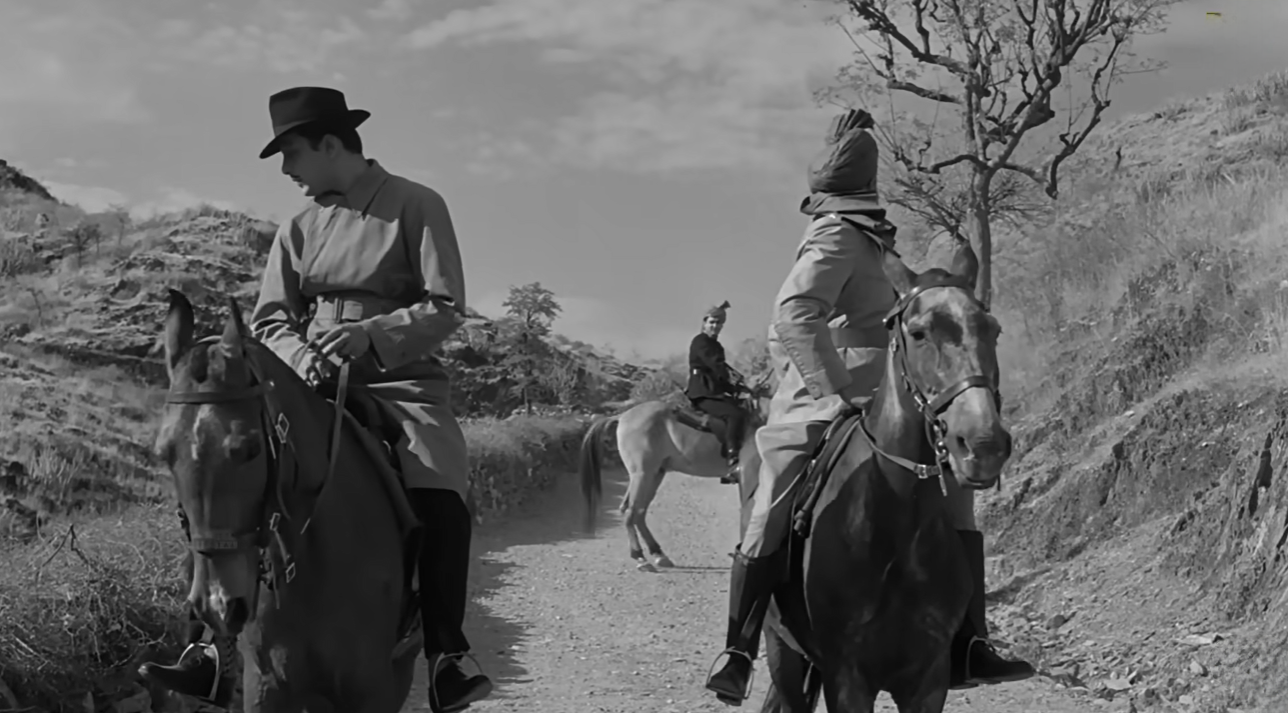
Both are on horseback and Gauri Shankar’s face is hidden beneath his hat
Gauri Shankar, impersonating Prince Shankar Singh, first encounters Mayur Vahan about twenty minutes into the film. Both are on horseback and Gauri Shankar’s face is hidden beneath his hat. Mistaking him for a woman, Mayur Vahan chides the elderly rider for turning womanizer in his old age. Gauri Shankar, charmed in turn, replies that, true to his name, he has the charm of Lord Karthikeya. The old Sardar accompanying him throws in a word of warning. The plot thickens.
By now the audience has met Uttam Kumar in his double role – Gauri Shankar, the suave, witty, self-possessed city-bred young man, and Prince Shankar Singh, impulsive and pleasure-loving lost in music and alcohol. Shankar Singh loves his younger brother Udit Singh deeply and has no idea about the conspiracy being hatched against him. Uttam switches from one persona to the other with such ease that the audience might struggle to believe that the same actor was playing both roles. His speech, body language, mannerisms, even his signature smile shift from one role to the other.
With the real Shankar Singh helpless in captivity, unable to defend himself against Mayur Vahan’s brashness, Gauri Shankar plays the imposter prince with ease and elan. The court doctor is surprised by his sudden good health, his lady attendant is charmed by his good manners, and his betrothed falls hopelessly in love with him. But Mayur Vahan knows the truth and plays a mind game with the imposter – one that turns into a fierce fist fight that ends in Mayur Vahan’s defeat.
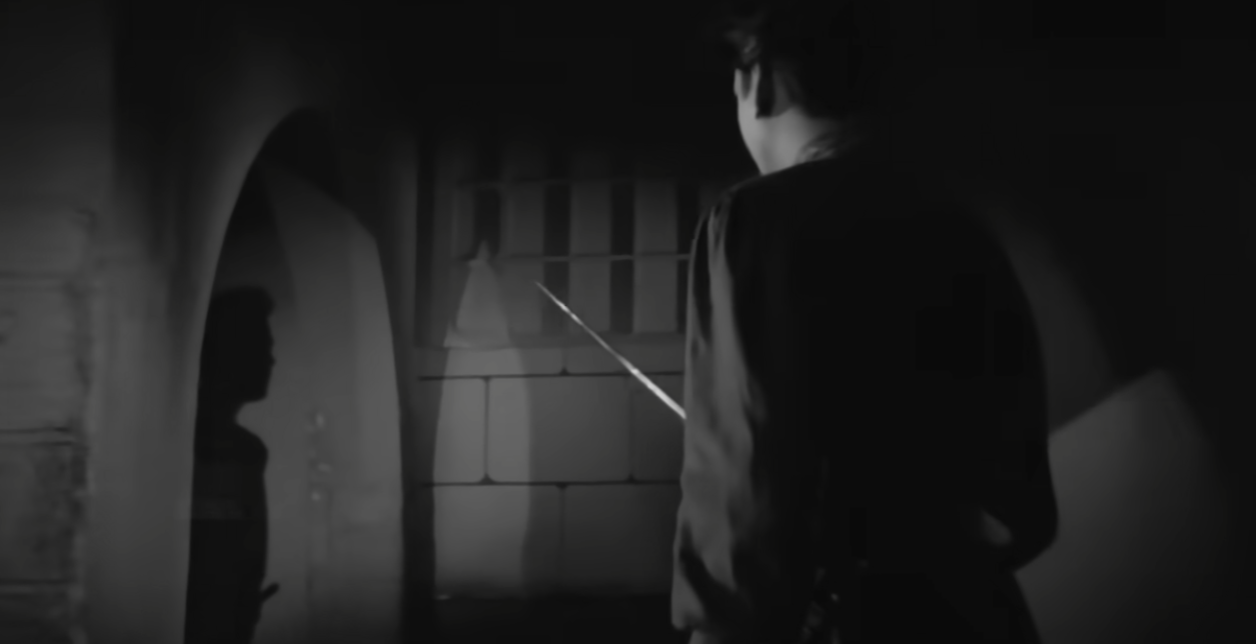
The fake Shankar Singh’s shadow falls across the wall
There is an interesting twist at the outset of the fight. The sequence begins with the fake Shankar Singh’s shadow falling across the wall of the underground chamber. Mayur Vahan notices it and draws his sword.
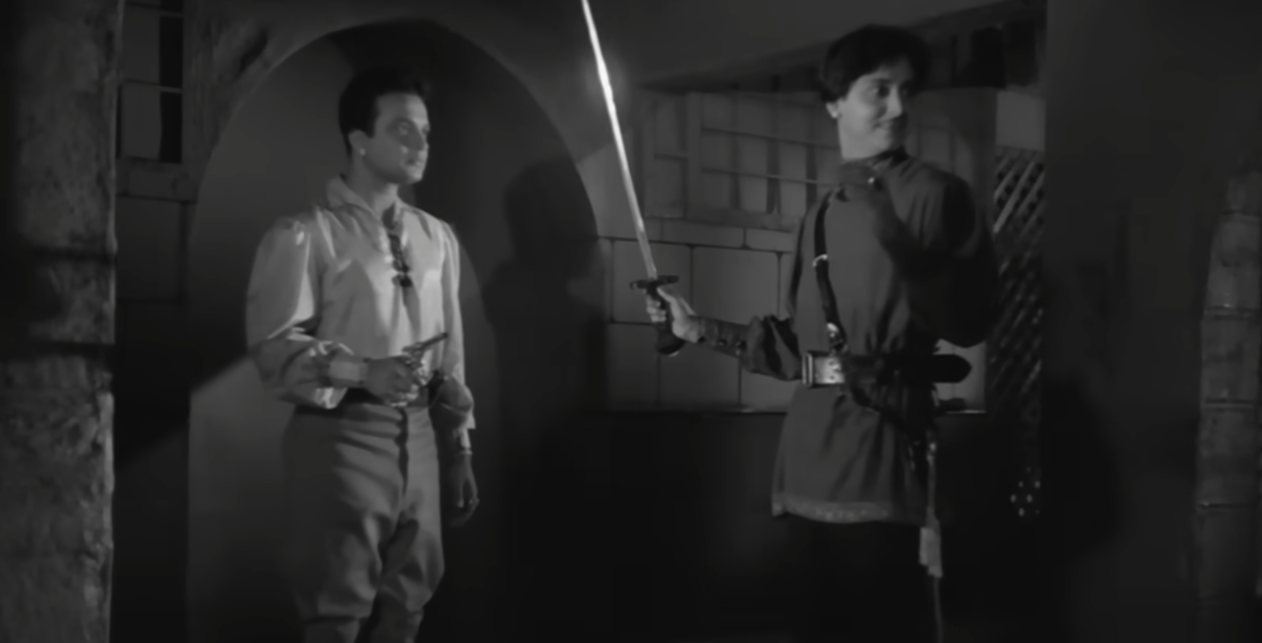
The imposter prince gun in hand
The imposter prince steps out of the dark, gun in hand. We soon realise this is an altered personality – not the adventure-loving, city-bred Gauri Shankar playing at being royalty, but someone whose borrowed royal blood seems to have taken over. He has no qualms about stabbing Mayur Vahan in the back amidst the fist fight, or stabbing Udit Singh in the belly when the unsuspecting prince opens the door to the secret chamber. Then, the dagger still bloody in his hand, he enters the chamber where the real Shankar Singh is held captive. The two Uttams now share the same room, the same space. The Imposter advances slowly, while the real prince is frozen in place, unarmed, unable to run or call for help. The audience is left to wonder – will the imposter kill the real Shankar Singh and usurp the throne of Jhind? Having tasted ‘royalty’ once, is he unwilling to give it up? A voiceover of the imposter’s thoughts confirms that suspicion.
The spell breaks with Mayur Vahan’s voice, followed by a gunshot. Mayur Vahan falls dead at the threshold of the dark chamber. The evil is finally vanquished. The story snaps back onto its predictable track. Tapan Sinha deserves credit for conjuring these moments of genuine darkness rising from somewhere deep in the human mind. But as a filmmaker who understood his audience, he knew the Bengali audience was not ready for a truly diabolical turn in an otherwise pleasant, romantic adventure.
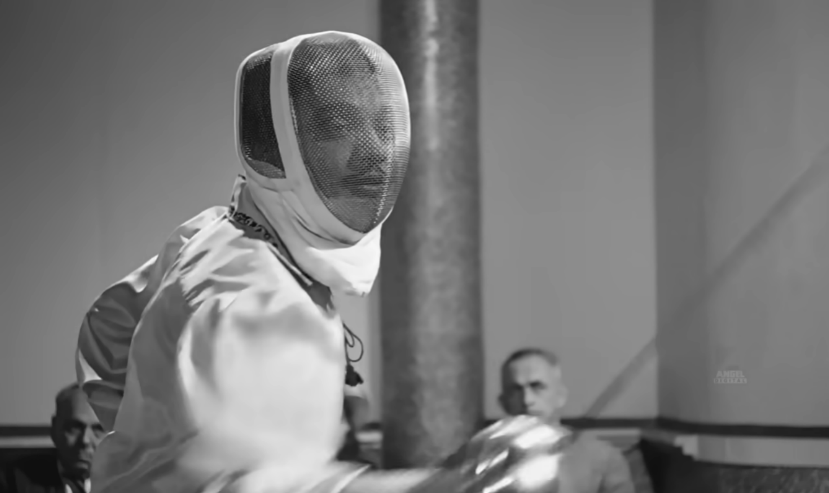
Uttam Kumar as Gauri Shankar, fencing in Jhinder Bondi
It is to Uttam Kumar’s credit that he built these dark moments on screen with such conviction. Shifting between the terrified, paralysed Shankar Singh and Gauri Shankar on a killing spree, he created moments on the Bengali screen that remain unmatched to this day. These moments are arguably a high point of Uttam’s career.
Uttam rarely played a double role in his career, but he shared the screen with Soumitra Chatterjee in eight more films. The next film, Aparichito, arrived eight years later. Directed by Salil Dutta, and based on a story by Samaresh Basu, Aparichito takes the dark undercurrent at the end of Jhinder Bondi and makes it the spine of the entire narrative. Here, Ranjan’s schizophrenic character, where a loving embrace can turn into a strangling grip, drives the narrative from beginning to end.
Ranjan (Uttam) is a scoundrel who moves through high society. He is charming, daring, and reputed to be a reckless womanizer. He becomes obsessed with socialite Sunita, an orphan raised – and effectively ‘kept’ by Priyo Das, a business magnate with political ambitions. Wrapped in material comfort, Sunita feels trapped. At a raucous New Year’s party on Park Street, as the clock strikes midnight and the lights go off, Ranjan spirits Sunita away to a desolate resort by the sea. They declare love for each other.
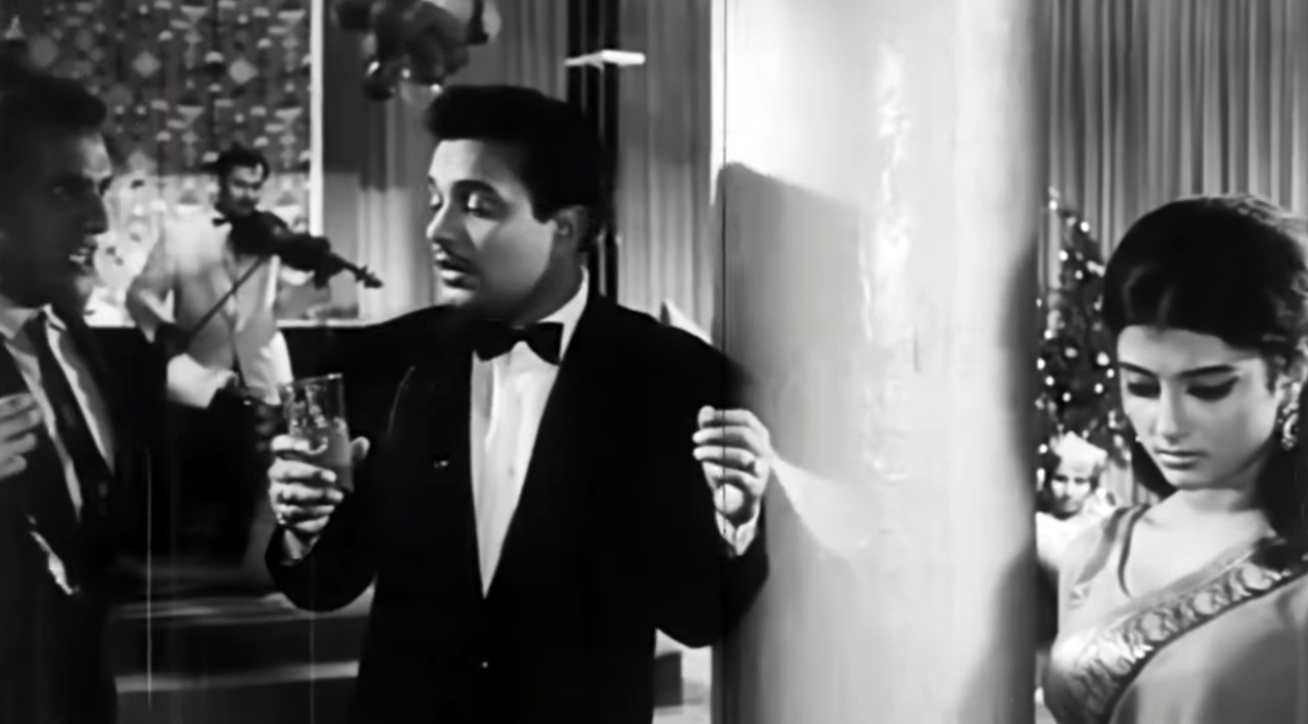
Uttam with Utpal Dutta and Aparna Sen in Aparichito
Into this world of scoundrels, dealmakers, kings and kingmakers, enters Sujit (Soumitra Chatterjee) – innocent, untarnished by sin, untouched by life’s compromises. He is just recovering from a chronic nervous ailment that leaves him in a precarious mental state. He cannot see through people’s facades, but he can look into their eyes and read their souls.
Soumitra and Uttam play two vulnerable men with diametrically opposite temperaments. Ranjan is fiercely independent and single-minded in his pursuit of the woman he desires; Sujit is free of desire or ambition but full of compassion. Despite their differences, the two strike up a friendship; Ranjan finds a sympathetic ear in Sujit and calls him ‘bandhu’, friend. Sujit tells him plainly, “Your desire is very aggressive.” Sunita, caught between the two, cannot decide whether to give in to Ranjan’s desire or reciprocate the purity of Sujit’s feelings. Much of Aparichito’s narrative rests on Sunita moving back and forth between them.
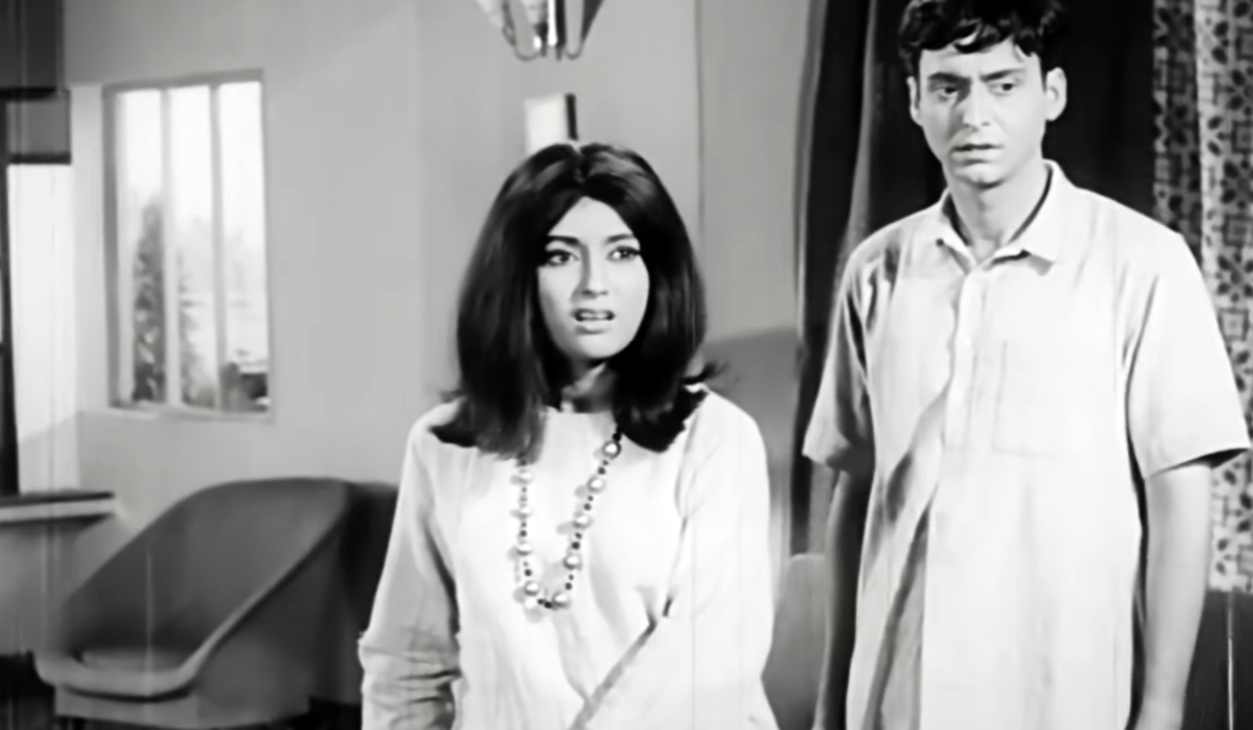
Aparna Sen and Soumitra Chatterjee in Aparichito
Aparichito plays as a psychological thriller of sorts, in which all three characters are quietly damaged, each shaped by their traumatic, parentless childhood. They oscillate between sanity and folly, between stability and collapse. Uttam excels as the anti-hero Ranjan; his predatory gaze, his coiled movements, his brash manners. Yet, there is something magnetic about his presence. The audience sympathies stay with him because of his looks, his loyalty to Sujit and the surprising restraint he shows when he finally takes Sunita home as his wife. In a kurta pyjama by the pond, he seems briefly ready to settle into a quiet domestic life. But alas! It is not to be. Sunita leaves him a second time, this time to help Sujit set up house in Murshidabad.
The three characters play out their tangled lives against a backdrop of greedy, corrupt, power-hungry men. In their own way, each is a loser and a misfit in a twisted world. Ranjan makes one last attempt to reach his ‘bandhu’ but Sujit, withdrawn entirely into himself, no longer recognises him. Sujit’s doctor calls it the result of collective sin. “Sin?” Ranjan laughs, unrepentant to the end. Aparichito is not a morality tale that offers acceptance of a mistake, repentance or restored equilibrium. Its world stays broken, rotten to the core. From behind the bars, Uttam’s Ranjan sees that rot more clearly than anyone, and he laughs at it.
In 1972, Salil Dutta cast Uttam and Soumitra together again in the superhit Stree, based on Bimal Mitra’s novel of the same name. Uttam plays Madhav Dutta, a pleasure-loving, self-indulgent zamindar, and a quintessential example of feudal decadence. Into his estate comes the young photographer Sitapati (Soumitra Chatterjee), seeking a foothold in the big city.
Sitapati is a rare photographer protagonist in the entire canon of Bengali cinema, and the act of taking photographs yields some of the film’s most striking visual moments. Madhav takes an immediate liking to the young man, and takes him under his wing. On Madhav’s affectionate insistence, Sitapati leaves his sister’s home and moves into the estate, becoming Madhav’s companion on nocturnal escapades to ‘rescue’ damsels in distress. He dutifully photo-documents Madhav’s nightlife. By day, he observes Madhav signing papers, consulting lawyers, and giving orders to his employees. He understands that Madhav is surrounded by sycophants and opportunists who exploit him at every turn. In this way, Sitapati becomes both comrade and conscience keeper.
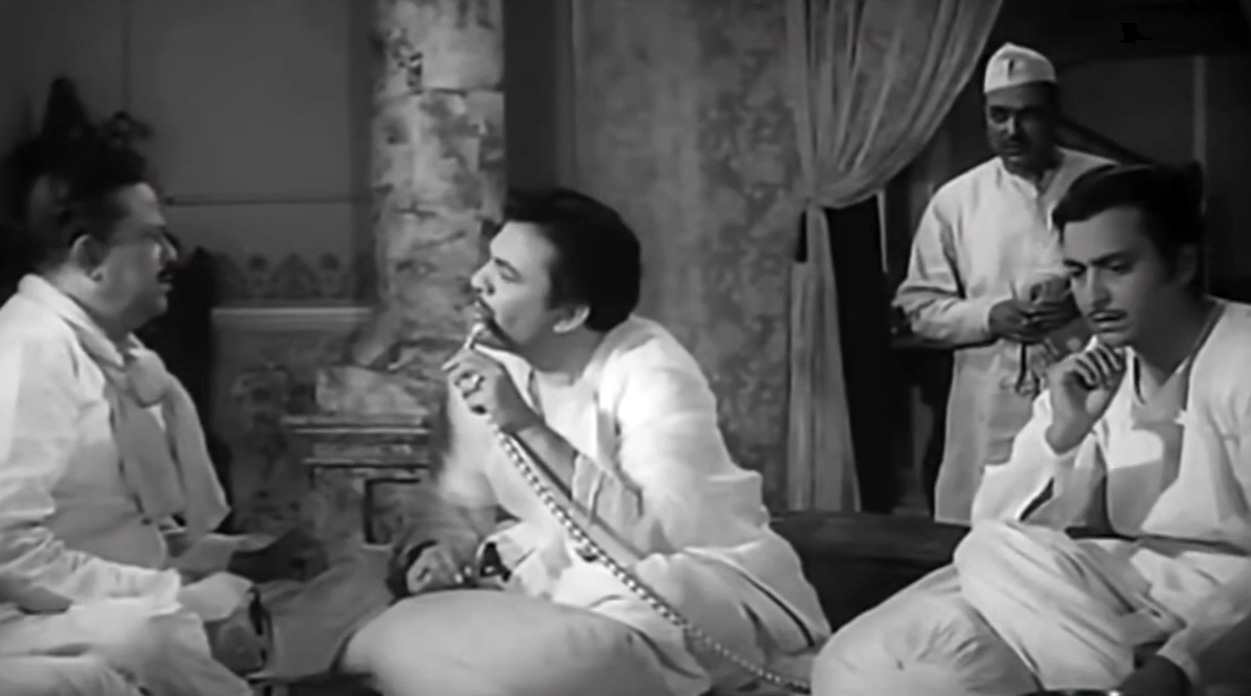
Bhanu Banerjee, Uttam Kumar and Soumitra Chatterjee in Stree
As Madhav and Sitapati, Uttam and Soumitra play off each other beautifully. Madhav, always at the centre of attention; Sitapati, the quiet observer just outside it. Yet, Madhav repeatedly pulls Sitapati into the spotlight, making him perform a self-composed kheur (a bawdy, profanity-laced song genre) and dance the khemta. Sitapati even sips alcohol from Madhav’s goblet, though he never matches Madhav’s level of intoxication.
Quiet and almost self-effacing as he is, Sitapati’s narrative arc turns out to be far more dynamic than Madhav’s. He must navigate a widening set of Satpati’s demands and expectations – his affectionate brother-in-law’s wish that he not desert their humble home, Madhav’s demand for companionship, Madhav’s wife Meenu’s demand for something more intimate – and his character transforms accordingly. Madhav, by contrast, stays loud, boisterous, fun-loving, and largely unbothered through the film’s first two acts. It is only in the final act that he undergoes an abrupt transformation one that drives the narrative to its tragic close.
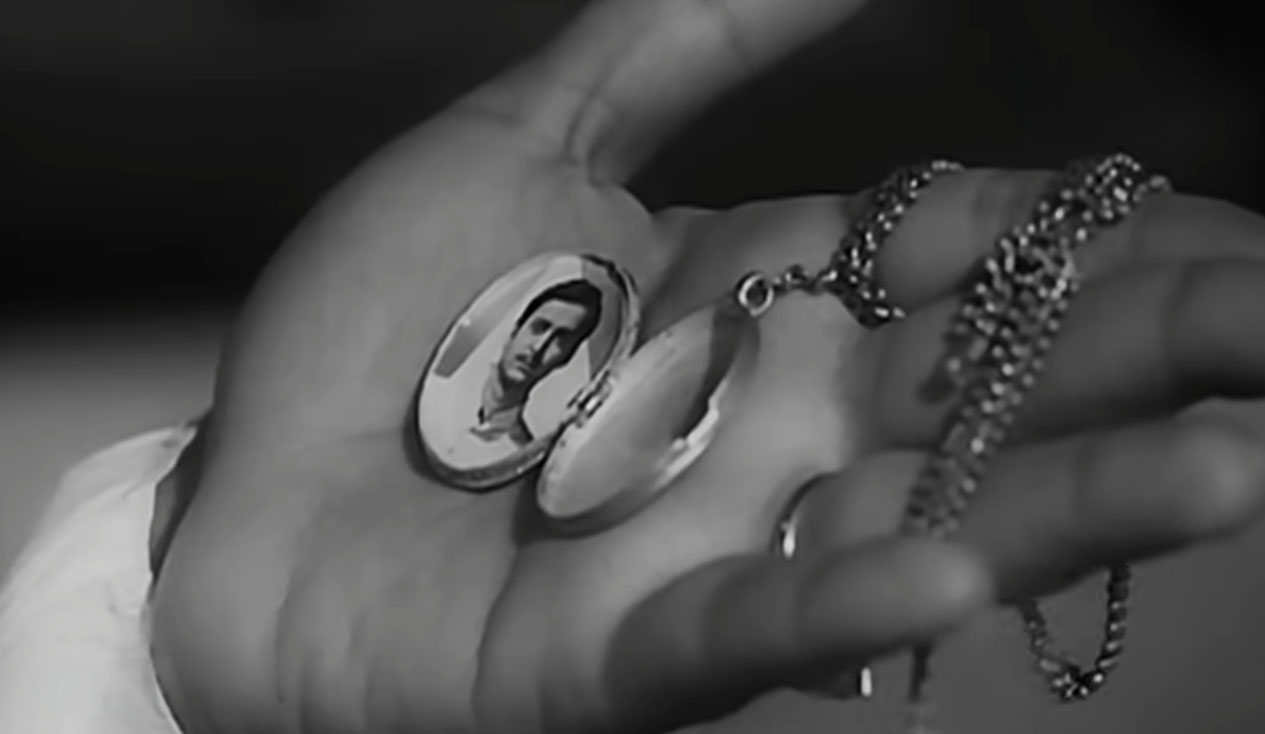
The locket bearing Sitapati’s picture
The trigger is a locket bearing Sitapati’s picture, found among the possessions of Madhav’s now-dead wife Meenu. Sitapati himself has gone missing, leaving no one to answer the “why” and “how” tormenting Madhav. Small half-forgotten scenes begin to fall into place, and Madhav starts to doubt whether his son Vrindavan is even his own. In a fit of rage and frustration, Madhav strangles Meenu’s pet parrot, which keeps repeating Sitapati’s name.
Outside, the nation gains Independence. The Union Jack comes down, and the Indian tricolour goes up. Sitapati, arrested earlier during a political rally, is released. He is physically and mentally broken, his days clearly numbered. He surrenders himself to the loving care of his sister and brother-in-law. But Madhav arrives, gun and pendant in hand. The dying Sitapati confirms at last that he had indeed given the pendant to Meenu many years earlier. As he breathes his last, Madhav shoots him, and then, reaching home, turns the gun on himself.
None of the three principals live to see Independent India. But the next generation does; orphaned, disenfranchised of property, but free to start afresh.
Zamindari decadence has been a recurrent theme in Bengali cinema. But in Stree, Uttam Kumar takes its on-screen portrayal to a whole new level, raising the bar for everyone who followed.
Across a handful of landmark Bengali films, Uttam and Soumitra have held up a mirror to Bengali society for their audience – one in which viewers could see characters etched in nuanced shades of resilience and vulnerability.

Whether you are new or veteran, you are important. Please contribute with your articles on cinema, we are looking forward for an association. Send your writings to amitava@silhouette-magazine.com

Silhouette Magazine publishes articles, reviews, critiques and interviews and other cinema-related works, artworks, photographs and other publishable material contributed by writers and critics as a friendly gesture. The opinions shared by the writers and critics are their personal opinion and does not reflect the opinion of Silhouette Magazine. Images on Silhouette Magazine are posted for the sole purpose of academic interest and to illuminate the text. The images and screen shots are the copyright of their original owners. Silhouette Magazine strives to provide attribution wherever possible. Images used in the posts have been procured from the contributors themselves, public forums, social networking sites, publicity releases, YouTube, Pixabay and Creative Commons. Please inform us if any of the images used here are copyrighted, we will pull those images down.