Stay tuned to our new posts and updates! Click to join us on WhatsApp  & Telegram
  Channel
& Telegram Channel & Telegram Channel 




Filmmaker Ranjan Ghosh’s Adamya is a story of dissent, disillusionment and indomitable will, set against the unforgiving landscape of the Sundarbans. In this conversation with Ratnottama Sengupta, Ranjan reflects on the film’s political and human questions, its journey across international film festivals, and the creative conviction that drives independent cinema.
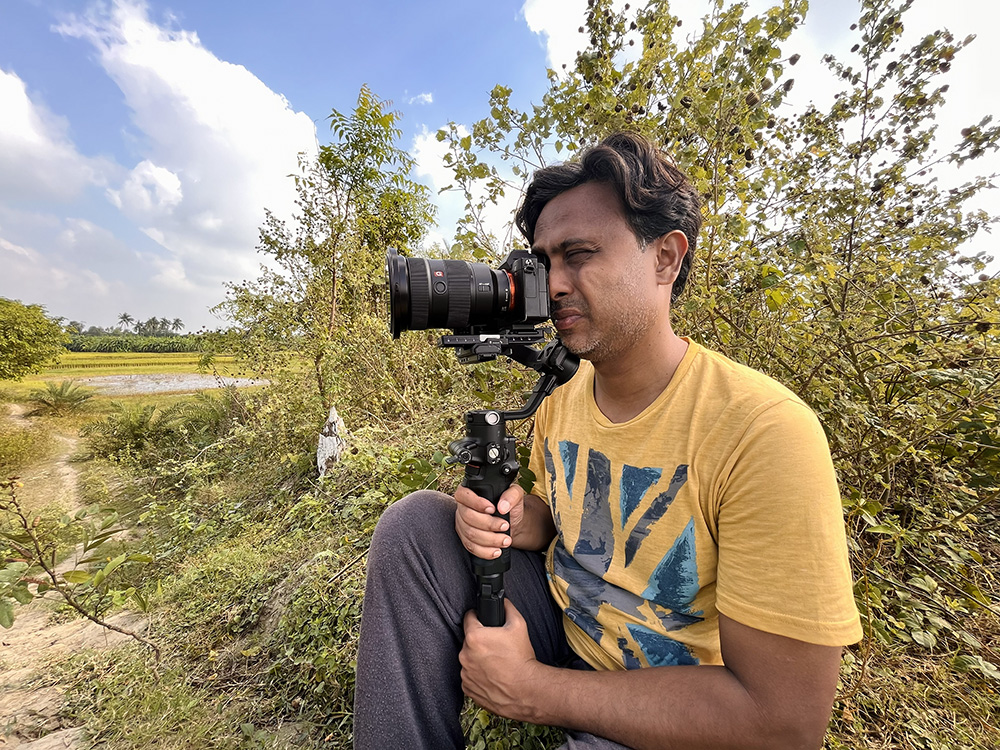
Filmmaker Ranjan Ghosh shooting on location
Two months saw Ranjan Ghosh travel to London, New York, Berlin, Melbourne. Truly irrepressible, this young filmmaker from Kolkata. That, of course, is borne out by Adamya, which has taken him to the international film festivals in these citadels of cinema.
And what is the film about? It’s about Palash. About his botched up attempt at political assassination. About the manhunt he must survive. About his fugitive days and nights in the dreary terrain of the deserted Sunderbans. About inhuman endurance and indomitable will…
But the Adamya is not only about the protagonist essayed by Aryuun in an incredible debut. Breathing life into the narrative is the writer-director Ranjan Ghosh. The DoP, Arkaprabha Das. Editor Kaushik Ray. The sound architect Adeep Singh Manki. Producers Anjan Bose and Bajrang Agarwal who trusted the creative energy of the five-film-old young man with a lean and hungry budget of lakhs, not crores. In a film designed, textured, and envisioned for initiated eyeballs, not for millions of masses.
So I ventured to ask Ranjan about all of these – starting with the dream run across four continents…
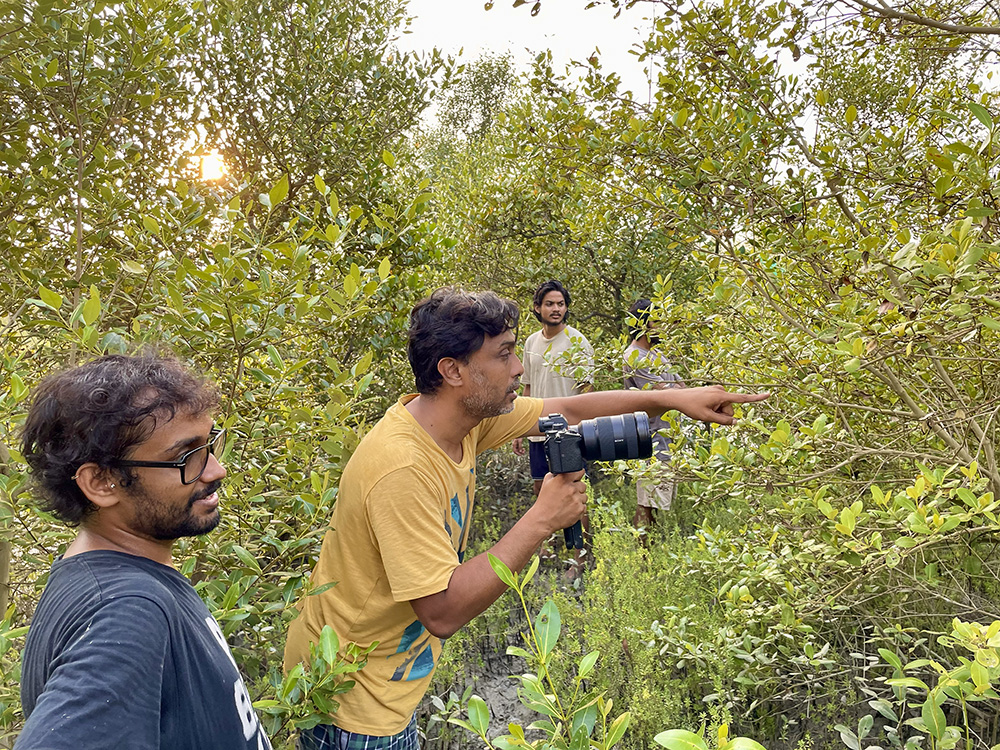
DoP Arkaprabha Das, Ranjan Ghosh and Aryuun
Ratnottama Sengupta: What are the gains of international exposure for a film like Adamya?
Ranjan Ghosh: I think the first gain is conversation. And for Adamya, conversation is perhaps more important than conventional success.
When you make a film in Bengali, rooted in the Sundarbans, dealing with a very specific political and social landscape, there is always a danger that it will be understood only through its immediate geography. International exposure allows the film to step outside that geography. Suddenly, a viewer who may know nothing about the Sundarbans can respond to Palash’s isolation, his idealism, his disillusionment, his questions about collective belief and his struggle to understand where he stands between revolution and extremism. Those questions are not exclusively Indian. The geography is local; the anxieties are human. The film’s selection at the New York Indian Film Festival, for instance, placed it before an audience and a programming ecosystem specifically interested in independent, regional and diaspora cinema.
The second gain is contextual distance. At home, a political film can very easily be consumed as a statement about today’s politics, and audiences may immediately try to locate the filmmaker on one side or another. Outside India, that immediate political shorthand is sometimes less dominant. The film can be examined as a work about ideology, power, alienation, resistance, nature and the individual. That distance can be extraordinarily useful.
And then there is the question of Indian cinema itself. I didn’t want Adamya to travel merely as “a Bengali film.” I wanted it to travel as a piece of Indian cinema that happens to be Bengali. The Cinemas of India: FIPRESCI-India Film Festival, for example, is particularly meaningful to me because its very premise is to place films from different Indian languages and cultural landscapes within one contemporary cinematic conversation. Adamya being included alongside films from Malayalam, Marathi, Hindi, and several less-heard Indian languages makes that conversation possible.
There is also a very practical gain: visibility for the people who made the film. Adamya was made without the conventional machinery associated with a large production. Its principal performer, Aryuun Ghosh, was not an established name carrying an established market. So when the film travels, it is not simply my name travelling. Aryuun’s performance travels. Arka Prabha Das’s cinematography travels. The hard work of Arjo Giri, Sourya Madraji and Shubham Dutta travels. At NYIFF, Aryuun was nominated for Best Actor alongside much more established performers, which is an extraordinary thing for a young actor from a film of this scale. He subsequently received two acting honours during the film’s festival journey, which gives that exposure an additional dimension.
And festivals create something that a conventional release often cannot: people sit in a room with the filmmaker and argue with the film. At NYIFF, there was a post-screening Q&A; similar conversations have happened elsewhere. Someone from another cultural background may ask a question that makes you see a scene differently—not because they have discovered the “correct” meaning, but because they have discovered a meaning you hadn’t considered. I value those encounters enormously.
There is also a long-term gain that is difficult to quantify: the film acquires a life beyond its release window. A theatrical release can be extremely brief for an independent film. A festival selection creates an archival trail. It puts the film into conversations among programmers, critics, academics, filmmakers, students and audiences. My first film, Hrid Majharey, continued to find such lives in academic and international contexts years after its release. I have come to understand that a film’s journey doesn’t necessarily end when its theatrical run ends.
And finally, international exposure gives me something as a filmmaker that I perhaps value most: perspective.
You spend years making a film. You know every compromise, every accident, every failure, every decision. Eventually you can become too close to it. Then you take it somewhere thousands of kilometres away, sit in a darkened theatre, and watch strangers respond to it. Suddenly you are no longer the person who made the film. You are one member of the audience.
That is an extraordinary privilege.
So, I don’t measure the international journey of Adamya simply by the number of festivals or awards. The real gain is that the film has begun a conversation that I could never have had while I was writing it. I made Adamya in the Sundarbans, but I don’t want its questions to remain there. I want them to travel.
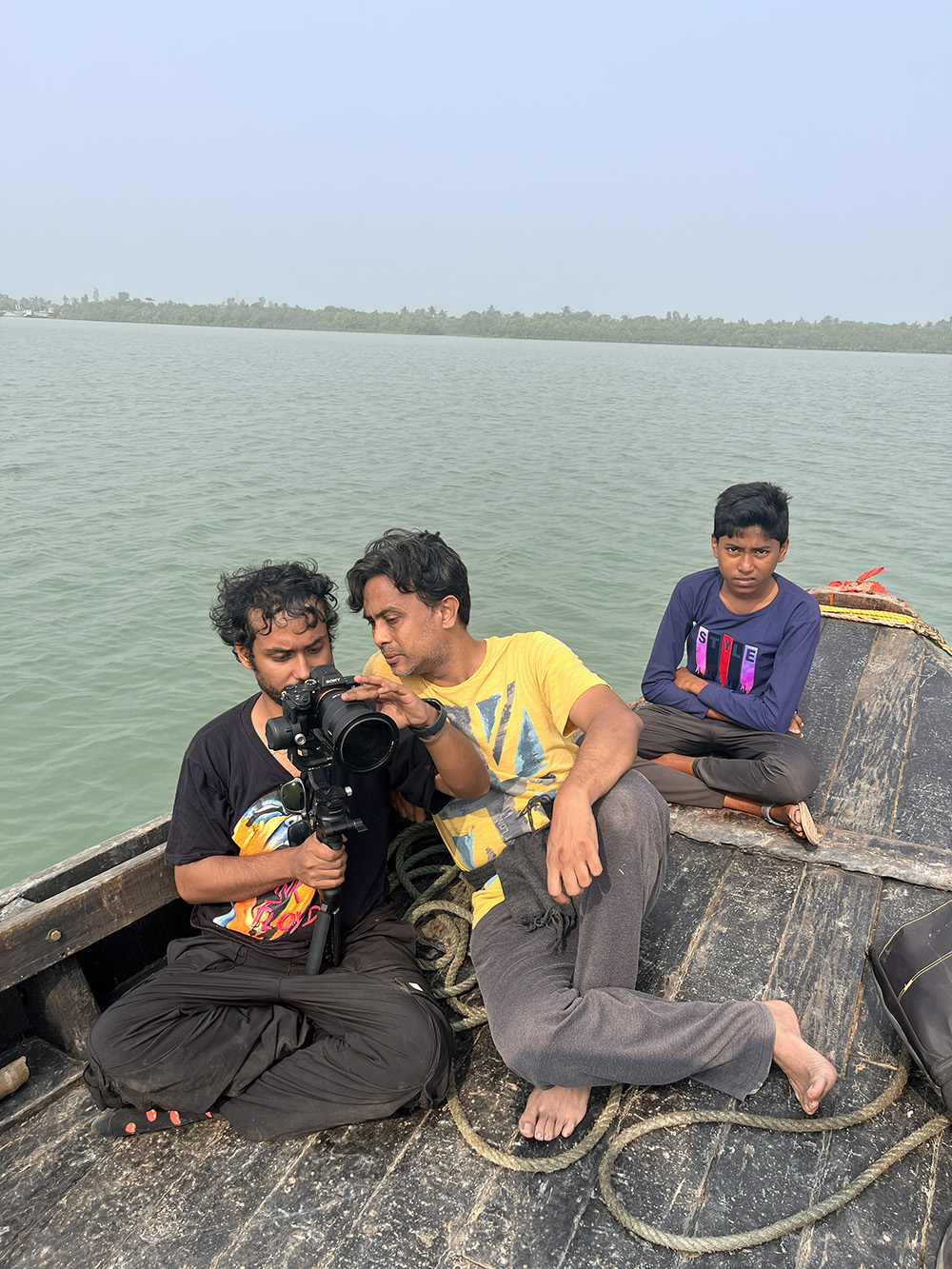
Preparing for the shot
Ratnottama: At the special screening ‘Aparna Sen Presents’, you described your mentor as a Debutante in this role of a Presenter. What’s significant about this?
Ranjan: I used the word debutante very consciously, and perhaps a little mischievously. When someone like Aparna Sen steps into the role of a presenter for the first time, it is not a mere label—it is a reconfiguration of authorship, of responsibility, of faith. For me, the significance lies in the inversion of hierarchy. Here is a filmmaker who has shaped my cinematic consciousness—whose gaze has influenced not just how I see cinema, but how I see people—choosing to stand behind my film, not above it. That act, in itself, is profoundly political and deeply emotional. In India, we are used to lineage being declared loudly. But this was lineage expressed through trust. She wasn’t presenting Adamya to lend it legitimacy—it already had to earn its own. She was presenting it because she believed in its necessity. So yes, she may be a “debutante” in the formal sense, but the gesture carries decades of artistic conviction. It is not a beginning—it is an extension of a conversation we have been having for years.
Ratnottama: Manik Babur Megh (winner at KIFF) was presented by Anirban Bhattacharya. Homebound (India’s entry for Oscar) by Martin Scorsese. Boong (winner at BAFTA) by Farhan Akhtar. Shekhar Kapur, Gulzar – they have also presented films they’ve not been professionally attached to. Why is the trend catching up? Is this a form of celebrity endorsement?
Ranjan: It would be reductive to call it mere celebrity endorsement, though of course, visibility is a part of it. When Martin Scorsese presents a film, or when Farhan Akhtar or Shekhar Kapur or Gulzar associate themselves with a project, they are not just lending their names—they are lending their curatorial voice. Cinema today is drowning in content. Algorithms decide visibility. In such a landscape, the idea of a “Presenter” becomes almost like a human algorithm—a trusted sensibility guiding audiences toward something they might otherwise miss.
I think what’s happening is a shift from endorsement to advocacy. The Presenter is saying: “I am willing to stand in front of this work and say—this film matters.” Historically, if you think of how Satyajit Ray introduced world cinema to Indian audiences through writing and programming, or how festivals curate films, this isn’t entirely new. What’s new is that this curatorial instinct is now being formalized within the credit structure of a film. So yes, it helps the film reach more people. But more importantly, it creates a lineage of taste.
Ratnottama: Adamya is your 5th film – after Hrid Majharey, a homage to Shakespeare; the Rong Beronger Kori, a treatise on money and relationship; Ahaa Re! a fun love story bridging two neighbouring countries; and Mahishasur Mardini – an experiment merging the forms of cinema and theatre. All your films are thematically different but this is your first ‘political’ film. Why did you choose this difficult (to sell) subject?
Ranjan: All cinema is political. Even choosing not to engage with politics is a political stance. My earlier films may not have appeared overtly political, but they deeply engaged with questions of class, identity, and human contradiction. Each of those films had layered politics. Mahishasur Marddini has been termed a feminist film tackling misogyny, though I think it is more humanist than feminist. Adamya simply removes the veil.
The question is not why I chose this subject—the question is: why now? We are living in a time where the idea of dissent is being systematically reframed. Where narratives are controlled, simplified, weaponized. As a storyteller, I felt an urgency—not to provide answers, but to complicate the questions. Yes, it is difficult to “sell.” But I don’t begin with the marketplace. I begin with discomfort. If a story disturbs me enough, it demands to be told. And Adamya disturbed me.
Ratnottama: You’ve majored in Screenplay writing and have written/ cowritten/ scripted for nationally awarded names like Aparna Sen, Aniruddha Roy Chowdhury, Prakash Jha. Name five screenwriters who will be remembered for their contribution in this role?
Ranjan: That’s a dangerous question because it demands exclusion. But let me attempt it, thinking not in terms of popularity but enduring influence.
These are writers who didn’t just write films—they altered how films think.
Ratnottama: Why do screen writers want to become directors at the earliest instance? Is Javed Akhtar the only exception?
Ranjan: Because writing is an act of control and purity, but turning it into cinema runs the risk of compromise. A screenwriter lives with a story in its most pure form. Then it passes through actors, producers, editors, market forces—and inevitably, something shifts. The desire to direct often comes from a longing to protect the integrity of the original impulse. But directing is not purity—it is negotiation. I wouldn’t call Javed Akhtar an exception. I would call him someone who understood the power of authorship within collaboration. He didn’t need to direct because his voice was already unmistakably present. The real question is: do you want control, or do you want conversation? Cinema demands the latter.
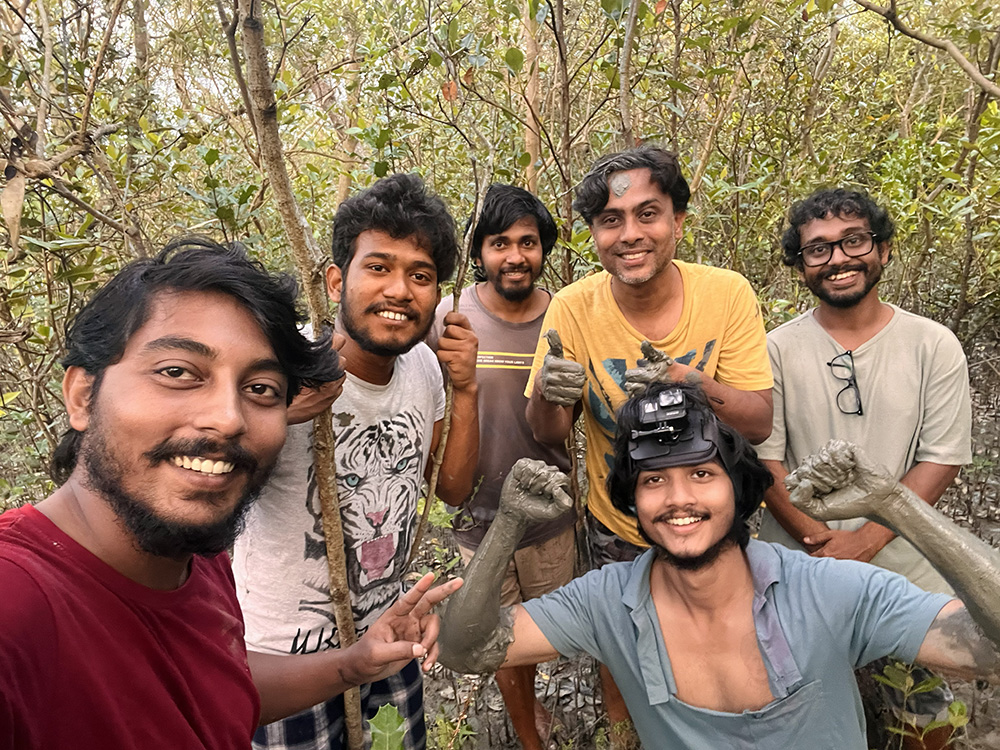
With the Adamya team on location
Ratnottama: Tell us about the production of Adamya. And that’d start with the producers (including yourself), go on to the scripting, the casting, the location, the filming – and the financing till its release.
Ranjan: Adamya did not begin as a “project.” It began as a disturbance. I think that’s the most honest way to describe it. This has got to be in detail.
The Producers: Building a Film on Faith
The film wasn’t produced in the conventional manner. All three of us – myself, Anjan Bose and Bajrang Lal Agarwal came together at different stages to realize the film. But more than names, what mattered was alignment. This was not a commercially safe film. It had no conventional selling points—no stars, no formula, no guarantee of recovery. So, we, the producers were not just financiers—we were co-conspirators in risk. The production banners—Aurora Film Corporation, Channel B Entertainment and Kinetoscope Films—gave us a structural spine, but the real engine was belief. And I think that is crucial: Adamya could only be made in a space where fear of failure did not override the need to tell the story.
The Script: From Memory to Minimalism
The concept was evolving within me over the last ten years or so—only I wasn’t aware of it. I would be affected by the way our world, our country, our culture, even our neighbourhoods were changing. I would often wonder if Sukanta Bhattacharya were to write Deshlai Kathi’, what would happen to him or to the poem? If Bhagat Singh were to be reborn, how would he be received in today’s world? All of this was cooking inside.
And then, I’ve been wanting to create a single-character film for the longest time. On a visit to the Sundarbans, I found the exact setting that I was looking for, and after returning from the trip, I found the concept of Adamya. It almost came and hit me! The narrative—of a young man, Palash, caught in the aftermath of a failed political assassination—was never meant to be a thriller in the conventional sense. It was a state of being. The real writing challenge was: how do you sustain tension when you strip away spectacle? And the answer lay in silence.
Casting: Finding a Face That Can Withstand Silence
Casting Aryuun Ghosh as Palash was perhaps the most critical decision. This is not a performance built on dialogue or dramatic expression. It is built on internal weather. Aryuun had to carry the film almost like a burden—physically and emotionally. Around him, a seasoned actor like Senjuti Mukhopadhyay, and newbies like Sourya Madrajee, Arjo Giri and Shubham Dutta appear almost like fragments of memory or conscience.
I was not interested in “casting”, I was interested in creating presences that haunt the protagonist as emotional bindings. I think, for this film, Aryuun and the rest of the cast were in perfect harmony. Except for Senjuti Mukherjee, all these actors were new (with some theatre exposure). Over four months, I had enough time and opportunity to guide them through the screenplay and the moments.
Location: The Sundarbans as a Living Organism
We chose the Sundarbans not as a backdrop, but as a collaborator. The geography of the film—its waterways, its dense mangroves, its constant sense of threat, the sea beach—mirrors the psychological state of the protagonist. There is something profoundly unsettling about the Sundarbans. It is beautiful, but it does not welcome you. It reminds you, constantly, that you are not in control. That tension literally became the film’s grammar.
Filming & Cinematography: Restraint as Aesthetic
The cinematography by Arka Prabha Das was built on one principle: do not beautify struggle. We resisted the temptation to turn the landscape into spectacle. Instead, we allowed the camera to observe—to linger, to wait. Natural light, long takes, and an almost documentary-like patience shaped the visual language. Sound, too, played a crucial role. Silence, ambient noise, distant threats—they became narrative tools.
Production Scale: Minimalism as Necessity
This was an extremely controlled production. A small crew, limited resources, and a highly focused shooting plan. Not out of choice initially—but eventually, it became the film’s strength. When you remove excess, you are left with essence. And that essence is what defines Adamya.
Financing: Fragile, Uncertain, Necessary
Financially, the film existed in a precarious space. There were moments when the film could have easily collapsed because of logistical realities. But sometimes, fragility sharpens intent. Every decision becomes deliberate when resources are scarce.
Release: Letting the Film Find Its Audience
Adamya released theatrically on 13 February 2026. We did not open wide. The trailer launch itself was unconventional—held at the school Aryuun studied over twelve years, in resonance with Sukanta Bhattacharya’s birth centenary—because I wanted the film’s journey to remain rooted in memory and ideology rather than marketing spectacle. The film grew organically. Through conversations, through word of mouth, through people who felt something and wanted others to feel it too.
Industry Support
I must mention a few names from the industry who stood beside me from the very beginning. Seniors like Atanu Ghosh, Srijit Mukherji, Indrasis Acharya were beside me from day one along with my comrades Arjunn Dutta, Amitabha Chaterji and Abhinandan Dutta. Filmmakers Subrata Sen, Anil Kuriakose, Tathagata Mukherjee, Manoj Michigan and so many veterans like Sohag Sen and Sujoy Prosad Chatterjee spoke about Adamya and generated an audience. The man himself, Prosenjit Chatterjee, came over to watch the film on his own, such was his magnanimity. While Rituparna Sengupta unveiled our trailer and poster, Sudipta Chakraborty sent all her students to watch the film, besides giving us a sumptuous treat at her place… The list of gratitude is endless.
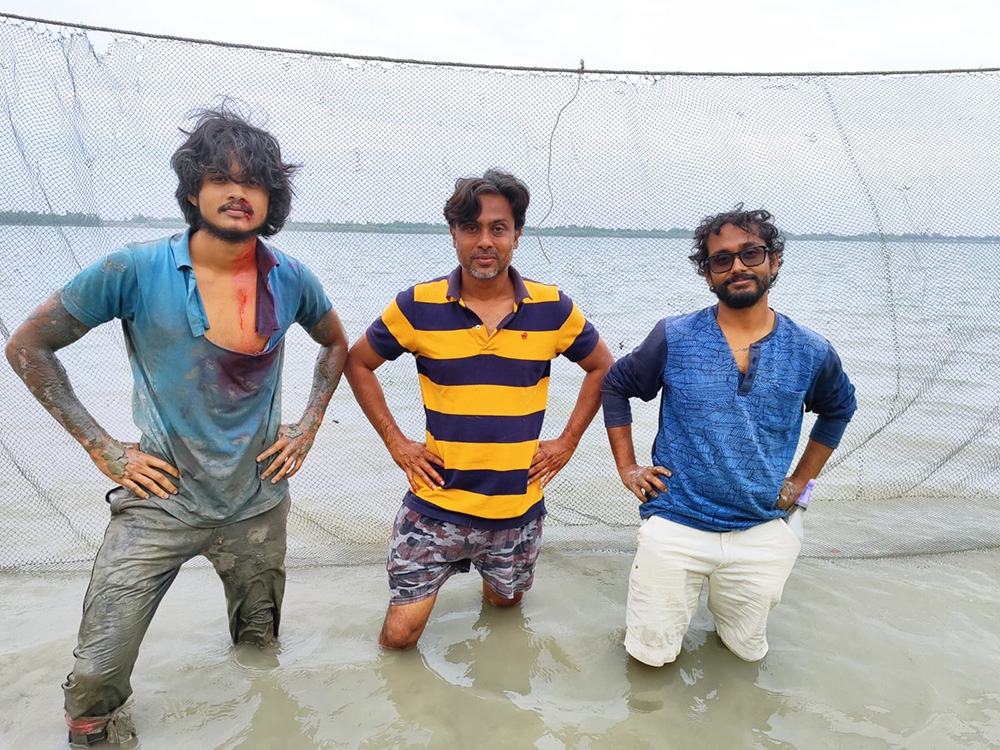
Debutante actor Aryuun Ghosh (L) with Ranjan Ghosh and Arkaprabha Das
Ratnottama: Normally, ‘violent rebellion’ is an absolute No-no as a subject on the Indian screen (read: commercial world). Did any political commitment prompt the narrative?
Ranjan: Commitment is a strong word. I would say conscience. I did not set out to make a film advocating violence. I set out to understand the conditions that make violence inevitable for some. We often judge actions without interrogating contexts. Adamya attempts to sit within that discomfort. If there is a political position, it is this: human beings are not born into extremity—they are pushed into it.
Ratnottama: Do I notice a touch of – a doffing your hat to – ‘Mother’? Does that come from your personal attachment?
Ranjan: Yes, and I’m glad you noticed. The idea of “Mother” in Adamya is not sentimental—it is elemental. It is the origin, memory, loss, belonging. Growing up, the figure of the mother was always both intimate and mythic. In Bengali culture, that duality is unavoidable—from the personal to the political. So yes, it is deeply personal. But it is also cultural, almost archetypal. Adamya is probably my only cinematic letter to Maa. Till date.
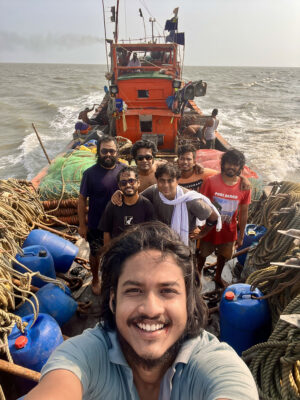
On the trawler
Ratnottama: What has helped you most in your growth in cinema – Whistling Woods? AD to Aparna Sen? Or your own experience as a director?
Ranjan: Each of these gave me something different. Whistling Woods gave me grammar. Working with Aparna Sen gave me gaze. My own journey gave me doubt. And doubt, I think, is the most important. Because once you become certain, you stop searching.
Ratnottama: Tell me about the Sunderbans – and your experience of shooting three key scenes.
Ranjan: The Sundarbans is not a location you “use.” It is a place that tests you. We shot the entire film there, and every day we were reminded of our insignificance. The tides don’t follow your schedule. The light changes without warning. There is a constant sense of vulnerability. But that vulnerability was essential. The film needed that unpredictability—that quiet threat beneath stillness. There were moments when we had to stop shooting and simply wait. And in that waiting, the film found its rhythm.
Ratnottama: The Festival Circuit, theatrical release, OTT platforms, Press & Social Media: Your experience, then and now.
Ranjan: You know… When Pather Panchali had released, it travelled slowly, carried by word of mouth and critical advocacy. There was patience in how cinema found its audience. Today, everything is immediate. Visibility is both easier and more fragile. Festivals still matter—they create a space for cinema to be seen without noise. Theatrical release, especially for independent films, is increasingly difficult but still magical. There is nothing like a collective viewing experience. I experienced it in a new light with Adamya. OTT platforms democratize access, but they also risk flattening the experience—films become “content.” Press and social media are double-edged. They amplify, but they also reduce. For me, the journey from leaving the merchant navy to making Hrid Majharey, and now Adamya, has been about holding on to a certain slowness in a fast world. Because cinema, at its core, is not about speed. It is about attention.
International outings of Adamya:
* UK Asian Film Festival, London
* New York Indian Film Festival, NY
* Indo-German Film Week, Berlin
* Indian Film Festival of Melbourne
(Pictures used are courtesy Ratnottama Sengupta)
More Must Read in Silhouette
Uttam Saw Bengali Cinema Revive and Was Pained by Its Fall Again
‘Swimming Against the Tide’: In Conversation with ‘Aahana’ Director Promita Bhowmik

Whether you are new or veteran, you are important. Please contribute with your articles on cinema, we are looking forward for an association. Send your writings to amitava@silhouette-magazine.com

 Ke Jaino Go Dekechhe Aamay: The Songs of Soumitra
 Ahaa Re: If Food be the Music of Love, Cook On…
 Sonata – A Celluloid Tribute to Loneliness that is Out of Sync
 60 Years of Pather Panchali and Some Questions on Indian Cinema
 Suttee: Retelling the Myth
 Revisiting Swet Patharer Thala: Woman, Widowhood And Work
Silhouette Magazine publishes articles, reviews, critiques and interviews and other cinema-related works, artworks, photographs and other publishable material contributed by writers and critics as a friendly gesture. The opinions shared by the writers and critics are their personal opinion and does not reflect the opinion of Silhouette Magazine. Images on Silhouette Magazine are posted for the sole purpose of academic interest and to illuminate the text. The images and screen shots are the copyright of their original owners. Silhouette Magazine strives to provide attribution wherever possible. Images used in the posts have been procured from the contributors themselves, public forums, social networking sites, publicity releases, YouTube, Pixabay and Creative Commons. Please inform us if any of the images used here are copyrighted, we will pull those images down.