Stay tuned to our new posts and updates! Click to join us on WhatsApp  & Telegram
  Channel
& Telegram Channel & Telegram Channel 




Film scholar Shoma A. Chatterji revisits Uttam Kumar’s ‘negative’ roles on his centenary, tracing how Bengal’s beloved matinee idol played villains without losing his hero’s magnetism.

Uttam Kumar in Bagh Bondi Khela
Uttam Kumar’s name is inseparable from the idea of the Bengali screen hero. For nearly three decades, he was the industry’s biggest draw, the romantic lead that audiences queued for, and an institution unto himself. Yet, the actor who came to define matinee charm in Bengali cinema also deliberately chose to play against type – portraying men who lied, betrayed and killed, without quite losing the magnetism that made him a star in the first place. As Bengal marks his birth centenary, it is worth visiting Uttam’s lesser-discussed ‘negative roles’ in which he was, more often than not, both hero and villain – a duality that few actors of his stature attempted, and fewer still pulled off with his combination of reluctance and conviction.
A ‘negative’ role in cinema is defined as a character who opposes the protagonist, acts as the villain, or displays harmful, evil, or morally grey behaviour. Such characters typically drive the story’s conflict by creating obstacles for the protagonist. But Uttam Kumar, the numero uno of Bengali cinema and its leading man par excellence, was a ‘hero’ in the story and screenplay, and a ‘villain’ in the sense that audiences kept hoping he would turn over a new leaf. Most of these films had no separate ‘villain’ character at all. Notions of ‘negative’ and ‘positive’ have evolved with time, and are no longer as fixed as they once were – but Uttam’s performances, as these films show, remain timeless.

Uttam Kumar Kamal Mitra in Shesh Anko
The first ‘negative’ role Uttam played, in my viewing experience, was in Shesh Anko (The Last Act, 1963), adapted and Indianized from the British thriller Chase a Crooked Shadow (1958), directed by Michael Anderson. He is the hero of the film – the polished, sophisticated, rich and romantic Uttam Kumar we were accustomed to, but the polish here is a diabolic disguise, deliberately concealing a man who kills his wife in cold blood and makes it look like suicide by claiming she was mentally unstable.
The denouement arrives just as he is getting married to his young girlfriend Soma (Sharmila Tagore), and his double-edged performance in that scene is so devastating that we, half in love with Uttam, are genuinely shaken. Throughout the film, Sudhangshu (Uttam Kumar) is haunted by the sound of a rushing train, heard only on the soundtrack. The slow, steady unravelling of this suave, supremely confident man into a nervous wreck is handled so convincingly that it reveals the depth of talent he was still growing into.
Directed by Haridas Bhattacharya, Shesh Anko was a mainstream, well-made film, a textbook thriller for its time. But many of Uttam’s fans could not perhaps accept him in a negative role with no redeeming positivity at all – a man who feels no guilt for his heinous crime, who keeps up a confident façade even when his ‘dead’ wife confronts him at his own wedding.

Uttam Kumar, Sabitri Chatterjee, Kamal Mitra and Dipak Mukherjee in Shesh Anko
The film’s many jump-cuts blend seamlessly through superb editing, backed by the brilliant performances of the supporting cast. Reportedly, it took Haridas Bhattacharya a long time to persuade Uttam to take on a wholly negative role. Even so, Uttam insisted that the manner in which he killed his first wife in the script needed to be changed. The director reluctantly agreed, but the two never worked together again.
What set Uttam Kumar apart as an actor was a screen presence so stylised and distinct that it never resembled any other actor in Bengali cinema – romantic hero, a conflicted everyman, an ageing patriarch or villain. With experience, he refined not just his vocal delivery but his body language, facial expressions, diction and costume, adapting each to the character he played – even while shooting two or three films simultaneously. He was the undisputed king of Bengali cinema.

Uttam Kumar, Subrata and Anjana Bhowmik in Roudra Chhaya
In 1973, Uttam starred in Roudra Chhaya directed by Sachin Adhikari. Uttam plays Pyari Mohan, an orphan raised by a Christian priest, who grows up into a mafia goon with a Rs 3,000 police bounty on his head. Fleeing after a dacoity, he lands in a small town and works his way up from overseer to manager at a business he doesn’t realise until much later is owned and run by his biological father. New friends influence a change in his lifestyle, and he turns over a new leaf. He falls in love with Kausalya, but his past catches up with him just as he plans to leave. He is killed in a police crossfire.
This is Uttam at his most uncomfortable, nothing like his familiar, polished, educated, sophisticated, city-bred image. His crude dress, his Bengali, heavily tinged with a Bihari dialect, and rough body language are not convincing at all, and he lacks the confidence he would become famous for. This is arguably one of the weaker films of his career.
Fast forward to 1975, when Uttam was at the peak of his stardom as the most successful star-cum-actor in Bengali cinema. Though still firmly associated with heroic leads, he was now mature enough to hone his skills in roles as varied as Sanyasi Raja (Pijush Basu), Agniswar (Arabindo Mukhopadhyay) and Ami Shey O Sokha (Mangal Chakraborty). Nearly all his releases that year were thumping box-office hits. Among these, perhaps the most unambiguous villain, who was also the hero, was in Pijush Basu’s Bagh Bondi Khela, based on Prafulla Roy’s novel Prothom Tarar Alo, with the director collaborating on the screenplay with the original writer.
From the opening scene to the climax, the protagonist, Bhabesh Banerjee (Uttam) is a selfish, self-centred wife-abuser who counts every piece of fish and mutton bought from the market and abuses his wife (Samita) if she hides a piece or two for their son Raju, or Bhabesh’s young sister. The film opens with Bhabesh receiving his now 25-year-old son, Raju, ostensibly to bequeath him his massive empire, but in reality, to use him as a pawn for a political launch.

Bhabesh receiving his now 25-year-old son, Raju (Bagh Bondi Khela)
We later learn that the wife had eventually starved herself to death rather than live off his earnings from the flesh trade and girl trafficking. After her death, he had sent his young son away to his maternal uncle’s home and severed all ties with the boy.
Fifteen years later, the strikingly handsome Bhabesh, now in his fifties, lives in a small town in a palatial mansion that he wrested away from its rightful owners, with a dozen servants at his beck and call. He remains a womaniser and a drinker, though he covers his tracks carefully. He is surrounded by a bevy of chamchas whom he treats poorly but who stay on for the ‘benefits’ he promises them. Uttam is very stylish – cigar at an angle, metal rim glasses, stylishly tailored dhoti-punjabi and shawl, a convertible car.

Stylish Uttam with the cigar at an angle
Uttam had a distinct style of smoking differently in every film, and his voice here matured from the loud villainy of his youth into something more polished – it was one of the most refined ‘ageing villain’ performances in mainstream Bengali cinema. That Uttam Kumar was willing to take on such an unambiguously negative role alongside his usual romantic, music-driven films speaks to his confidence and appetite for risk.
It was also a big marketing risk, but it paid off. He proved himself a genuinely versatile actor capable of drawing audiences to the theatres, whether he was the hero, villain or something in between – though this critic did not fully agree with the climax where Bhabhesh shoots himself after his son and his second wife expose his vile tricks and hand him over to the police.
Bagh Bondi Khela was released in theatres on 19 December 1975, coinciding with Christmas. The film ran for over 170 days in theatres, becoming both a huge commercial success and, over the years, a cult favourite for its suspense, story, screenplay, soundtrack and performances. It is widely regarded as Uttam’s finest appearance as an anti-hero.
It’s worth noting that Partho Mukherjee, as Raju, cuts a sorry, diffident figure opposite Uttam’s towering presence – the contrast perhaps helped cement Uttam’s turn as one of Bengali cinema’s most memorable screen villains.
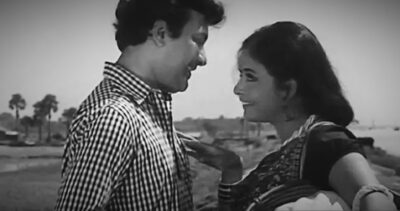
Uttam and Supriya Devi in Bonpolashir Podaboli
As a villain, even in the rare instances he played a mafia figure, Uttam remained suave, sophisticated and supremely handsome. Even had he wanted to, he was incapable of convincingly playing a rough-and-tough goonda. He took on a period character in Tapan Sinha’s Jhinder Bondi (1961), and a subtler, low-key husband in Jotugriha (1964). But aside from literary adaptations like Khokababur Protyabartan (1960) and Bonpolashir Podaboli (1973), based on a Ramapada Choudhuri novel, in which his character, Udas, turns into a killer after what he perceives as a betrayal in love, he rarely let his suave, sophisticated, urban image break, regardless of whether he was playing a rustic or a semi-literate man. His innumerable fans adored him regardless, and most of these films were substantial box-office successes.
Bengali film history, however, records Uttam’s first negative role as Kuhak (1960), directed by Agradoot and based on a story by Samaresh Bose inspired by Charles Laughton’s noir classic The Night of the Hunter (with notable changes in the film’s climax). The film opens with a handsome Sunando (Uttam) in jail, mesmerising his fellow inmates with devotional songs (composed and sung by Hemanta Mukhopadhyay). Although convicted of attempted murder, his innocent looks and beautiful keertans make him seem incapable of any crime. After his release, he joins a travelling folk theatre (jatra) troupe that arrives in Kanchanpur, where the villagers, charmed by his enchanting voice, are convinced he is truly godly, and begin addressing him as ‘Thakur’.
But once a crook, always a crook. When Sunando learns that Rs 30,000 has gone missing from the jatra group’s collections, he sets out to find the loot. Swarno, the unmarried sister of his prison friend Ganesh, falls in love with him without any idea of his criminal past. Sunando’s central dilemma becomes a choice between his greed for the hidden treasure and his longing for a settled, happy life with Swarno. The discomfort is visible in Uttam’s performance throughout – an early, somewhat awkward step towards what would become his rise to stardom. The film did not do well commercially, and it is widely believed that his audience did not like him as a thief.
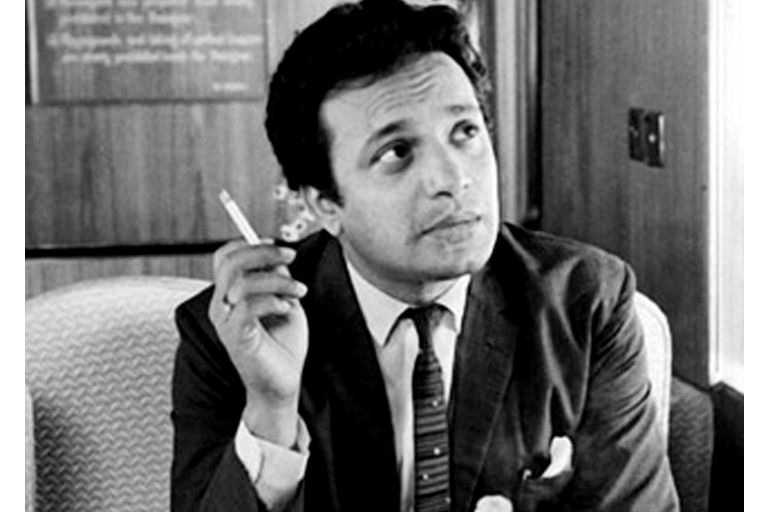
Blending negative and positive traits in Satyajit Ray’s Nayak
Three things stand out about Uttam’s body of work: first, many of his finest films were adapted from rich Bengali literature, from Rabindranath Tagore to Subodh Ghosh, and he excelled in these performances. Second, out-and-out negative roles are rare in his filmography, countable on one hand. Third, most of his characters are in shades of grey, blending negative and positive traits, a quality brilliantly exemplified in Satyajit Ray’s Nayak (1966), a performance that surprised Ray himself. In Stree (1972), based on a famous Bimal Mitra novel, he largely plays a zamindar married to a beautiful girl from a poor family; his villainy surfaces in his act of revenge against an already-dead man, when he discovers that the son he thinks is his was fathered by a humble photographer, played by Soumitra Chatterjee. He shoots himself in the end, closing an otherwise powerful story on a tragic note.
Films from this period – Bicharak (1959), Abak Prithibi (1959), Shuno Baranari (1960), Raja-saja (1960), Mayamriga (1960), Khokababur Pratyabartan – had already established him as a versatile actor who could move fluidly between conflicting moral registers and diverse social types. One villainous role I did not like at all – and neither did I like the film – was Kalankini Kankaboti (1981), based on a novel by Nihar Ranjan Gupta, originally directed by Piyush Bose. It featured Uttam Kumar and a very young Mithun Chakraborty in their first film together, but suffered from a complicated, hole-ridden story and weak execution. Bose died during production, and Uttam himself took over the directorial reins. But his own death partway through left the film with a tame, difficult ending. All the same, it went on to become a big box-office hit.
Viewed together, these films chart something rarer than mere ‘range’. It reveals an actor secure enough in his own myth to keep puncturing it. Uttam Kumar never needed a villain’s role to prove his talent. Yet he returned to moral ambiguity again and again, from the reluctant thief of Kuhak to the self-destructive patriarch of Bagh Bondi Khela. A century after his birth, it is this willingness to risk audience affection rather than merely earn it that keeps his negative roles feeling less like detours and more like the fullest measure of his artistry.

Whether you are new or veteran, you are important. Please contribute with your articles on cinema, we are looking forward for an association. Send your writings to amitava@silhouette-magazine.com

 Nayak in the Classroom: A Before-and-After Study
 Uttam Kumar: The Changing History of the Bengali ‘Dada’
 Dear Deceiver: Agni Pariksha versus Chhoti si Mulaqat
 Partnership of the Two Titans — Uttam & Soumitra
 Grief in Two Keys – Amanush and Dooriyaan
 Revisiting the Treacherous Valley of Oblivion: A Critical Reading of Hrad
Silhouette Magazine publishes articles, reviews, critiques and interviews and other cinema-related works, artworks, photographs and other publishable material contributed by writers and critics as a friendly gesture. The opinions shared by the writers and critics are their personal opinion and does not reflect the opinion of Silhouette Magazine. Images on Silhouette Magazine are posted for the sole purpose of academic interest and to illuminate the text. The images and screen shots are the copyright of their original owners. Silhouette Magazine strives to provide attribution wherever possible. Images used in the posts have been procured from the contributors themselves, public forums, social networking sites, publicity releases, YouTube, Pixabay and Creative Commons. Please inform us if any of the images used here are copyrighted, we will pull those images down.