Stay tuned to our new posts and updates! Click to join us on WhatsApp  & Telegram
  Channel
& Telegram Channel & Telegram Channel 




Lopamudra Banerjee meets poet-turned-filmmaker Promita Bhowmik in Kolkata, discussing her journey from academia to cinema, and her debut film Ahana: The Light Within.
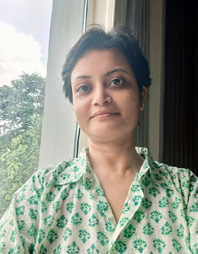
Promita Bhowmik
Promita Bhowmik is a young, talented Bengali poet and writer-turned-filmmaker. Lopamudra Banerjee, writer, translator, and editor happened to know Bhowmik for a few years through her writing circle on Facebook. During Banerjee’s last India trip in July-August 2025, she could meet Bhowmik in person for a detailed tête-à-tête at a South Kolkata cafe on a drizzling afternoon. At that time, Bhowmik was busy with the release of her debut Bengali feature film Ahana: The Light Within, which, by then, had been showcased in various international film festivals (including Dadasaheb Phalke Film Festival, Berlin Film Festival where it premiered) and was critically acclaimed. The conversation centered on her entire journey, from the academia to writing and eventually filmmaking.
Lopa Banerjee: Promita, your career started in the academia, as much as I know. In your past interviews which I had the opportunity to read, I gathered that you studied Bengali literature, right?
Promita Bhowmik: Actually, I was initially a medical student at RG Kar Medical College for a year, and then it occurred to me that studying literature was my true calling. With that passion beckoning me, I left RG Kar. All throughout my career, I’ve been a topper. Contrary to the stereotype fostered in our society, I intended to pursue Bengali literature, since I strongly wished to learn my own vernacular Bengali language and literature, my own culture, and read it in-depth. I believe literature is something very deep, very intense and layered.
I wanted to pursue the root of Bangla literature, the history of Bengali cinema and also the history of the indigenous theatre of Bengal since my formative years. That doesn’t mean that I would be unaware of other languages and culture but the primary focus was on knowing my own language, literature, and culture.
Lopa: So did your Bengali roots prompt you to pursue Bengali literature?
Promita: Yes, Bengali language, my own mother-tongue was something that has always been very close to my heart. The truth is, these days I get the opportunity to do work in other languages. I have even got to know that if I do films in other languages, somebody else will produce it. But I maintain that I will toil hard, but I want to do it in Bengali only. Anyway, coming back to my education, I studied Bengali literature in Jadavpur University, Kolkata, while going through the admission process all by myself at the tender age of 18.
Lopa: At that age, you probably need a great deal of mental strength to accomplish it, right?
Promita: Yes, you can say I decided what was right for me and what I wanted to do in life when I was just 18. It was all about swimming against the tide, especially when all my family members had the opinion that pursuing medical studies was the best option, since I belonged to a middle-class family. However, things started changing when I started becoming a topper at the university. Around that time, everybody was more or less convinced that I was doing good, especially when I became a Gold medalist in Jadavpur University, qualified for the All-India based NET exams, and got an opportunity to pursue my PhD. However, I used to write since my formative years during my school days, and got published regularly since I was 16 years old.
Lopa: Do you remember your first piece of writing, or where was it published?
Promita: Honestly, I don’t remember! I was writing since I was very, very young, almost four or five years old. Perhaps my folks at home will be able to tell what it was. I could create rhymes in my own mind instantly. Poetry was inherent within my being. My school magazine published a piece of mine when I was studying in class VI, but the first publishing break happened when I was 16 years old, when ‘Kobiteertho’, a Bengali journal published my poem. And when I was 18 years old, a story of mine was published in the Bengali journal ‘Dibaratrir Kabya’. Interestingly, everyone who used to read my short stories remarked that there was a cinematic element in them.
Since a long time, I had a particular affinity towards writing dialogues, or scripts. Initially, teaching was my career choice; I received a research fellowship at Jadavpur University, and thereafter I got the opportunity to teach at Loreto College.
Lopa: So, did the transition from being a faculty or educator to a filmmaker happen around the same time?
Promita: When I was teaching at Loreto College around 2016-2017, it occurred to me— “What would I do with my life?” After a period of conscious deliberation, I was convinced about pursuing filmmaking. I used to convert my writings into concrete scripts; it was a learning experience for me. Around this time, I also got the opportunity to write a poetic drama or verse play, that got published in a journal and received effusive praise.
Then it occurred to me that since I am also writing plays, why couldn’t I write film scripts successfully? Since I didn’t go to a film school, I thought of myself as purely a self-taught person. I used to read various famous scripts, and then, I had the opportunity to read Bergman’s script. Reading scripts by eminent writer-directors inspired me greatly.
I pursued some very useful courses—including cinematography, editing, sound designing, et al. I discovered then, that for a director, technical acumen is very important. We have progressed a lot today in terms of technology; in Kolkata only, there are various brief courses and also workshops and master classes which I pursued.
Then I thought of starting my work independently. I created a poetry film, a couple of short films, and in between these pursuits, I consciously decided to leave my teaching job. It was a great blow to my family, and a mammoth decision for me. Naturally, this profession that I chose to pursue is full of financial uncertainly, I had accepted that, and didn’t cow down. The fact is—I never wanted to just survive, I wanted to ‘live’.
Lopa: Wow, that’s a precious line you just mentioned! That touched my heart.
Promita: You know, I have met many people in my life who may have gained a lot of material wealth, but at the end of the day, they are utterly depressed. There is a great vacuum in their lives stemming from a lack of fulfilment. I didn’t want that for myself, so in order to live life on my own terms, there would be some risks involved. But then, there is a risk in everything that one does, isn’t it?
Lopa: Yes, it actually depends on the perspective we develop, the way we perceive life, right?
Promita: Absolutely, and I am a strong believer of destiny. Whatever is bound to happen, will actually happen. I have immense spiritual faith, and this faith makes me believe in my capabilities. This faith actually eggs me on, and then my perseverance, hard work pays off. I believe sheer talent is not enough, one also needs to practice his/her craft a lot.
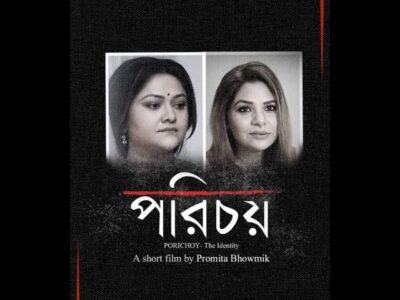
Porichoy poster
Lopa: Now that we already talked about the struggles that led to your journey, your milestones, I would love to know about your poetry film, which followed after your first documentary film. What was the name of the film, its theme and its journey like?
Promita: I did my first poetry film just before the world was in the grip of the Covid pandemic, during January-March 2020. Apeksha, the film dealt with the theme of eternal waiting, and the film was based on one of my poems with the same theme. It went to a few film festivals abroad. This initiative naturally had no commercial value, but was born out of sheer passion. During 2019-2021, my transition from documentaries to short films happened organically, and during this phase, I was preparing myself in the craft of filmmaking and script writing. Then, Porichoy, my first short film happened with two fine Bengali actresses, Sudipta Chakraborty and Konineeca Banerjee.
Lopa: Sudipta Chakraborty also is the heroine of your first feature film Ahana: The Light Within. How did you meet these two actresses?
Promita: Well, somebody familiar to us whom I call ‘Didi’ went along with me. When I approached veteran Bengali actress Madhabi Mukhopadhyay, I called her number and she herself picked up the call and said: “I’ve never done short films before!” But then, seeing that a young woman like me has approached her all by herself, she asked me to come over so that she can hear the script. “But if I say ‘no’, don’t get upset, as I’m not familiar with short films,” she said. But then, eventually she was convinced after conversing with me, and later on became very open with me. I’ve really got a lot of affection from her. She used to call me at her home when we had discussions over a cup of tea. It bloomed like a personal relationship, unlike other professional ones. Sudipta and Konineeca were very professional and supportive towards my work.
And since these two short films went to renowned film festivals, there was considerable media attention and my name started spreading quickly. You know, in India, we have only one Oscar-nominated short film festival in Bangalore, and my film happened to be the only short film featured there. I attended that festival in-person. The auditorium was named after Satyajit Ray (just like the one at ICCR, Kolkata), and honestly, people there are very enthusiastic about Bengali films, and Ray, the great filmmaker. Thereafter, I tried quite a number of times to approach producers for feature films, but the fact that I was a woman went against me, somehow.
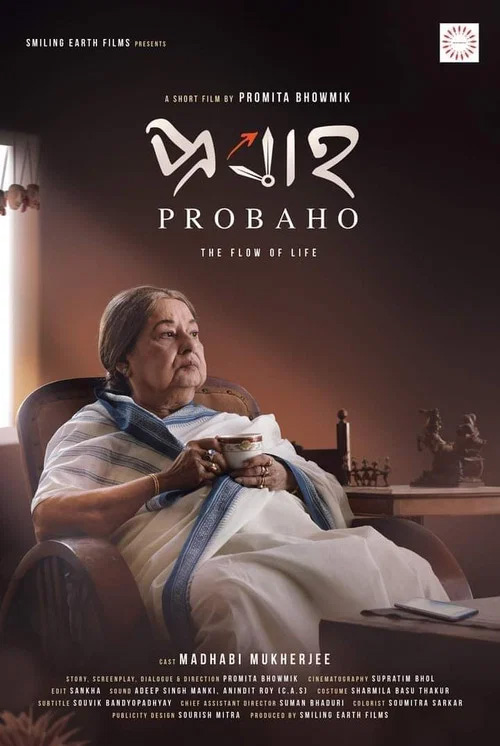
Probaho: The Flow of Life, another critically acclaimed short film by Promita Bhowmik
Lopa: Do you mean that stereotypical belief, and the taboo that works in the psyche of the male-dominated industry?
Promita: Yes, that notion, and above all, the skepticism, “Is a woman singlehandedly capable of doing this?” This appeared very illogical to me. A director is called ‘The captain of the ship’, and that might be applicable for a male director.
Lopa: Even that idea is a patriarchal concept somehow, isn’t it? The captain of the ship can’t be a woman, it’s always a man, necessarily. But some women have broken the mold and emerged as strong directors. Aparna Sen, for example, is a pertinent example, who broke this stereotype.
Promita: Yes, women are doing so many great things in the whole world, then why not direction or filmmaking? People are vastly aware of all these changes, but still the taboo is there, somehow. But if a woman as a filmmaker is making a film, there is a unique world of her experiences and her feelings, which probably a man wouldn’t be able to portray.
Lopa: Yes, true, not every male filmmaker can portray those nuances like Rituporno Ghosh did.
Promita: Absolutely. And on the other hand, a woman also might not be able to portray the nuances of a man’s mental world. I don’t mean to say here that I will always create women-oriented films, but till now within the periphery of work, the stories I have portrayed and the messages I wanted to give are essential. My next project is also women-centric, it’s in my thoughts, and I will work towards that once Ahana, my debut feature film is released in Kolkata.
Lopa: Do tell us about both your Bengali short films, Porichoy and Probaho, both of which I have seen on YouTube. What are the prevalent themes in both of them, and the recognition and critical acclaim they received?
Promita: In the first film Porichoy, two women who were old friends meet each other after a hiatus of 15 years; both now belong to the extreme opposite sides of the social strata. One is a homemaker, while the other’s identity is not revealed in the beginning, but later, one gets to know she is a sex-worker. This meeting of both friends brings us closer to the question of ‘self-identity’, whether one is a mother, a wife, a sister or something beyond the box, and how that identity is manifested. It is open-ended, like many short films these days. One might not like the idea of one of the characters being a sex-worker, but I personally think as a filmmaker, the onus is on me to portray the truths of humans belonging to any social strata, and even the marginalized, since I am creating a piece of art.
The film was showcased in many festivals in India, like Mumbai, Delhi and various cities in South India, besides, it was featured abroad, in Germany, UK, and USA. There is a whole list in YouTube, with five and a half lakh views in total, and the views are increasing every day. It has received a huge number of comments there, and I sincerely wish there are open conversations on this topic, so that it will keep relevant. There are sex workers around us, and their position in society cannot be denied altogether. The woman in my film is doing her work with dignity, without any feeling of shame regarding her profession.
Lopa: This means you have directed the audience towards a hard-hitting reality, and they will process the theme with their own unique perspectives, isn’t it?
Promita: Absolutely so. Talking about my next short film Probaho, it had Madhabi Mukhopadhyay as the lead role, and she was the only character in the film. It is set against the backdrop of Covid pandemic, in which she lost her husband, her offspring and thus, becomes the only survivor in her family. But even after the onslaught of the pandemic, she has the hunger to love herself and live life on her own terms. The message I wanted to convey through the film was that life is still beautiful in spite of the excruciating struggles, loss and nothingness. The quest for living is the dominant theme of that film.
Honestly, many senior citizens have told me after watching the film that it has inspired them to live life afresh in the post-Covid world, with new perspectives. It is a great achievement for me as a filmmaker. It has fetched me many coveted awards—at least 20-25 awards from various countries, for which I feel very honoured! So these two short films have literally inspired me to transition into feature filmmaking! But having said that, there’s a whole lot of difference between making short films and making feature films.
Lopa: Your journey with feature filmmaking must be an organic one, and the seed was being nurtured in your mind and developed later on. So your transition from making short films, receiving awards and recognition to making the feature film Ahana: The Light Within, was the culmination of a bigger dream with a much bigger canvas. What were the challenges or constraints in making this debut feature film, and what was your feeling after completing this project?
Promita: I wrote the story of the film first, and then converted it into a film script, and this process of writing was entirely mine. But since the budget of a feature film is a lot more, that was the main challenge. You know how expensive it is to make a film in Kolkata. So I took the decision to approach a few houses, including a really big one. They all liked the script, but since it was out-and-out a woman-centric film, the production houses turned me down even after committing with a positive response initially. It was such an excruciating journey, which itself could be a film!
Anyway, eventually I realized that this process of waiting was never-ending, and I myself had to step in now. Then I accumulated my savings, and also approached a few like-minded friends, including writers whom I knew, had an affinity towards art, culture and good cinema. By that time, I had finished the pre-production work with my team, with my own money. I started the shooting with a lot of risk and with my own investment, turning into an independent producer. But if you ask me now, I have enjoyed this whole process of producing the project; I took it as a challenge and then realized that in this way, I can retain full control and full creative freedom.
After’s the film’s shooting was finished, and the trailer been made, I started looking for a co-producer to collaborate with me and eventually found someone around January-February 2024. That was during the last leg of the production, but even that part was challenging financially. Sending it to the Censor Board of India, to multiple festivals requires money, which is quite draining, especially to the international festivals, considering the fact that I already invested so much in the project. Hence, finding a co-producer helped a lot in this respect, though I took upon myself almost the entire responsibility of the film, including managing the film festival rounds, the submissions, handling the social media, et al. It is round-the-clock work.
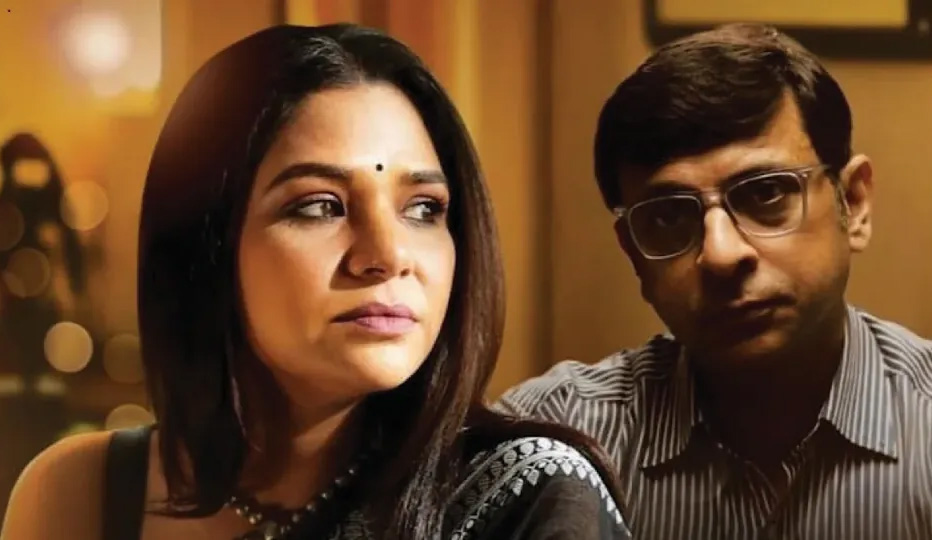
Promita’s debut feature film Ahana: The Light Within, that received many international recognitions
Lopa: This is why I say it is a one-woman army! Tell us the theme of Ahana: The Light Within, your inspiration in making the film, and also about your cast and crew?
Promita: Ahana is the story of a writer who moves along in her life with her struggles and tribulations, constraints that originate from the sphere of her family and her outside world, touching upon the various taboos and systems fed by patriarchy. There is also a very sensitive issue at the core of the film, that of male infertility. I wrote the original story sometime in 2018-19, when I suddenly saw the emergence of many infertility clinics in Kolkata. Prior to that, the issue of infertility, by and large, seemed to be handled by gynecologists alone. It was perceived as quite a common issue; however, when all those clinics cropped up suddenly in various pockets of Kolkata, I tried to find out the root cause behind it.
I had quit the medical field long back, but I had some friends pursuing the medical profession—they discussed with me the issue, the psychological counselling, and other aspects of the scenario. I researched the issue and spoke to various doctors, psychologists, and then, wrote the story based on the insights I developed. Till then, no Bengali or Hindi film I knew, explored this particular theme, i.e. male infertility. I wrote the story and screenplay, investing a lot of time in the process. It was a self-taught exercise for me, without any mentoring involved. But I would maintain here that when I am delving into a social issue in a film, it needs to be well-researched, otherwise the proper message won’t be portrayed to the audience.
In 2021, during the Covid times, I registered the script in Screenwriters Association in Mumbai, where I was already a member. Since then till December 2023, when I could actually start the shooting, it was a great learning curve — doing the groundwork, accumulating money for the production, et al. My team members were great to work with, and very cooperative.
A unique fact about my film is, there is no background music. You can say it is very experimental, as no BGM movies are very rare in the whole world, and almost nonexistent in Bengali movies. This film is made entirely with natural sound design. In Kolkata, while most films are made with dubbing, I made it with sync sound, which is used in Mumbai and also internationally. Obviously, there are some songs, though they are without music, to give it a realistic feel. There is a Rabindra Sangeet in the middle of the film, and in the ending, there is a folk song by Lalon Fakir.
My lead actors are Sudipta Chakraborty and Joy Sengupta, two well-known faces, besides there is Soumya Sengupta, Senjuti Roy Mukherjee, Sukriti Lahari, all of whom are eminent actors of theatre in Kolkata. There are some actors who are debuting with this film who have acted in short films or theatre before (like Priyabrata Sen Sarkar, Sunipa Deb, Payel Rakshit etc). I wanted to cast those fresh faces who have a flair for acting or theatre, and who are interested to do quality work.
Also, there is Bashabi Ghatak, daughter of the legendary actor Bhanu Bandyopadhyay, who had acted in a film as a child actor fifty years back, and my film Ahana was her comeback film. I really enjoyed a lot working with her. I knew her personally for quite some time, and I met her again at a familiar gathering. I was observing her from a distance for a role in my film and then after a point, I went up to her and asked her if she would be interested to play the role. At first, she was reluctant, and said: “I did films fifty years ago…I don’t think I can do it anymore!” But I tried to convince her that she could give it a try. Eventually, she agreed and it worked out quite well.
Besides, my entire team—the cinematographer, editor, sound designer, colourist were extremely professional people. The film will be releasing in Kolkata on 5 September, and I am keeping my fingers crossed.
Lopa: What are your insights about the acceptance of Bengali cinema worldwide?
Promita: I would mention here that though my film received awards internationally and though I also wanted to make films in Bengali, every film has its own language of expression. As much as I hope the audience in Kolkata will accept it, I also hope the audience internationally will also accept it. It’s a matter of their perspectives, actually. I want to spread the richness of Bengali culture and language all over the world through my films; that’s the purpose behind sending it to various film festivals. It’s just not about receiving laurels and accolades, but the affinity I have towards my own language and culture since my childhood. I want to honour the history and rich legacy, the milieu of our own Bengali cinema and theatre, our indigenous roots in this way. We are still talking about Satyajit Ray, Mrinal Sen, the legendary filmmakers, but at the same time we need to build up the path for new filmmakers, so that 50 years down the line, another repertoire of films is created.
During the trailer and poster launch of Ahana: The Light Within, Promita Bhowmik with lead actor Sudipta Chakraborty
Lopa: What are your other interests apart from writing and filmmaking?
Promita: I am invested emotionally in a lot of greenery-related initiatives, and surrounded by greenery always. My production house is named ‘Smiling Earth Films’ and I have founded a small organization named ‘Smiling Green Foundation’. We donate plants, medicinal plants, and then we grow plants too. I have adopted plants and worked with the Rotary International. I am actively involved in Green Meditation, Green Therapy etc. as I have tremendous passion for all these. I spend most of my time at home with my plants, and I believe my plants also respond to me with all their senses. I like to call myself a ‘tree mother’.
In Newtown, there is a rotary garden where I had adopted a ‘Krishnachura’ tree two years back; since then, I take care of the tree and also financially invest in it all through the year. People also say that I am a green activist, but honestly, I think we won’t survive on this earth if the greenery goes away, right?
Lopa: That’s really a beautiful thought, Promita! Today we got to know a bit about your writer self, your journey with filmmaking. I also got to know about your forthcoming book of poems translated into English by Nandita Samanta in Kolkata. However, my final question to you is about today’s age of social media. More than writing books, today we write content for social media. Since when were you actively writing on social media, and how important do you think it is in spreading relevant information about your writing and your filmmaking?
Promita: I started doing Facebook in 2012 and my old account in Facebook lasted from then till 2020, and then unfortunately it got hacked. I opened a new account and since then, I’m actively using it as a useful platform to promote my works. Every platform has both its positive and negative aspects, and it is upon us to leverage its benefits mindfully. I have formed meaningful friendships, and most importantly, I think independent filmmakers and writers like us, who don’t have the budget to recruit a PR team, can easily reach out to our audience through sharing in the social media. But the flipside is, these days, we are judged by the number of our social media followers, which is utterly wrong.
But all said and done, the positives outweigh the negatives, and a window to communicating with the greater world is opened. The world indeed has shrunk, and we get to know a lot of things via social media, which is very pertinent. We can get access to all kinds of news instantly, without waiting for the newspaper to publish it. Of course, this doesn’t diminish the impact of newspapers, but the dissemination of news of any kind is so easily possible globally. Honestly, I have gained a lot of friendships through this platform who have stood by me during my crisis situations. My poems and literary writing, my films have resonated with people all over the world, in spite of our physical distance, that is an extremely positive and beautiful feeling.
Lopa: But what is your thought on trolling that is also going strong all over the internet?
Promita: Yes, trolling is also part of internet culture. If we can get over it and leverage the benefits of social media, then why not? The bottomline is, we can get connected with like-minded people through social media and without spending money, we can reach out to our requisite audience. People are doing live programmes for their books and films in Facebook, Instagram, YouTube from their homes and reaching out to the masses, that started during Covid and since then, there has been no looking back.
Lopa: Thanks so much for this meaningful conversation we had, and may it reach out to a lot of people! Lots of wishes for your film Ahana, and your ongoing journey with books and films.
More Must Read in Silhouette
Director’s Chair – Hindi Cinema’s Golden Age: In Conversation with Manek Premchand
Life in Metaphors: Portraits of Girish Kasaravalli – In Conversation with OP Srivastava

Whether you are new or veteran, you are important. Please contribute with your articles on cinema, we are looking forward for an association. Send your writings to amitava@silhouette-magazine.com

 Chetan Anand: Exploring the Unconventional to Make Landmark Films
 Lata Mangeshkar Sings for Madan Mohan
 An Open Letter to Byomkesh Bakshi
 Rajinder Krishan — Hum Kuchh Nahi Kehte (Part 1)
 The Moulding of a Master: Bimal Roy and Tapan Sinha
 Coveted Merchandise From Cult Films Go Under The Hammer At Online Auction Today
Silhouette Magazine publishes articles, reviews, critiques and interviews and other cinema-related works, artworks, photographs and other publishable material contributed by writers and critics as a friendly gesture. The opinions shared by the writers and critics are their personal opinion and does not reflect the opinion of Silhouette Magazine. Images on Silhouette Magazine are posted for the sole purpose of academic interest and to illuminate the text. The images and screen shots are the copyright of their original owners. Silhouette Magazine strives to provide attribution wherever possible. Images used in the posts have been procured from the contributors themselves, public forums, social networking sites, publicity releases, YouTube, Pixabay and Creative Commons. Please inform us if any of the images used here are copyrighted, we will pull those images down.