Stay tuned to our new posts and updates! Click to join us on WhatsApp  & Telegram
  Channel
& Telegram Channel & Telegram Channel 




The whip remains, but the ‘dada’ changes. Piu Mahapatra explores how Uttam Kumar’s elder-brother roles across four decades mirror the changing Bengali family, and a changing Bengal.
The term ‘dada’ has a close and intimate relationship with the Bengali culture. ‘Dada’, the call goes far beyond the boundaries of the family relationship and often, in Bengal, is a popular way to address even a stranger. We may say that even though ‘Babu’ and ‘Ji’, the usual dialect of addressing people or acquaintances in other states of India, have a definite warmth and respect, but probably the Bengali ‘dada’ bridges the distance of awe and honour effortlessly. The role of ‘dada’, the elder brother, in a Bengali family has changed over time from pre-independence till now because of multiple socio-economic-political changes.
The Bengal Famine of 1943 and the disruption of Partition in 1947, leading to displacement and unemployment, affected the traditional joint family structure of the Bengali household. This, in turn, led to the growth of nuclear families. That very change also impacted and altered the authoritative, protective role of the elder brother in a family. Bengali cinema, particularly 1950 onwards, reflects this very social and cultural transformation. Uttam Kumar’s journey as an actor also captures this change beautifully. From the youthful romantic hero to the responsible elder brother to a more playful companion-cum-advisor, Uttam Kumar’s evolving screen persona shows us a fascinating way of looking at how the idea of the Bengali ‘dada’ changed and reshaped over time.
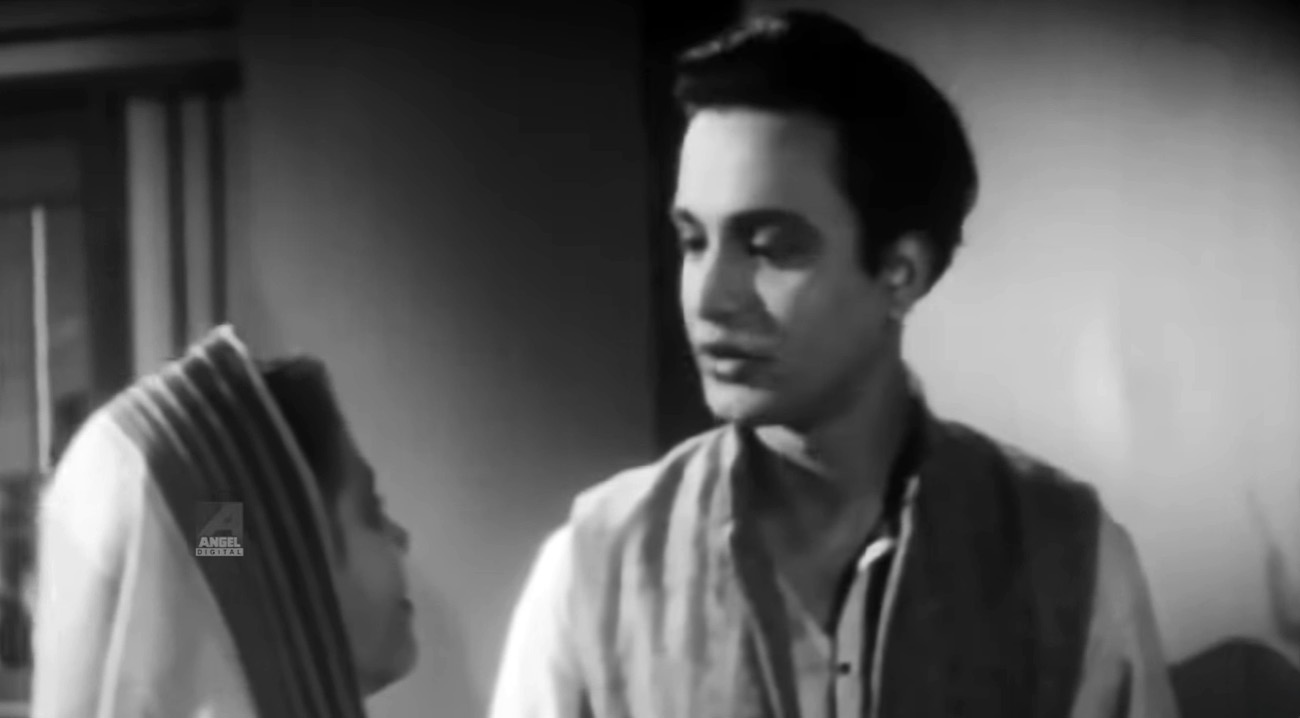
Basu Paribar
Sukhen as ‘dada’ in Basu Paribar (1952)
Made just five years after Partition, Basu Paribar belongs to a Bengal still living with the after-effects of famine, partition and the continuing refugee crisis that went on even in the 60’s. In this atmosphere of social and economic uncertainty, the role of the ‘dada’ was changing in life as well as in cinema. The film was released in Bengal on 11 April 1952, directed by Nirmal Dey where Uttam Kumar played the role of Sukhen, elder brother to a younger Satyen. It was the first successful film of Uttam Kumar and a turning point after a string of failures.
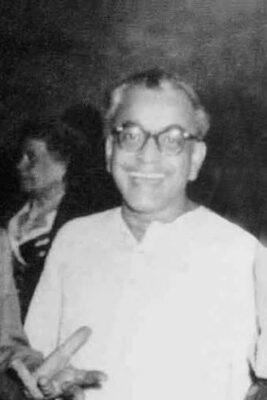
Nirmal Dey
In the film, Uttam Kumar remains the submissive, obedient and ever-caring son towards his parents, while being an authoritative and sacrificing guardian for the rest of his four siblings, the youngest of the two being almost close to a generation apart from him. It appears that the Bengali audience wanted an ideal son, a hero on the big screen, to keep them hopeful amidst this turmoil, uncertainty and the shift in the belief of the traditional values and morals. Hence, the brutal act of physically punishing the immediate younger brother, Satyen, at the slightest hint of an accusation against the ‘dada’ authority, is presented almost as an act of unquestioned moral certainty.
Uttam Kumar, in many ways in this film, remains the elder brother who has assumed the father’s authority. This becomes even more interesting because the actual father, is physically present but restrained in a wheelchair. Except in a few overtly dramatic outbursts, he is largely kept away from the active drama. Perhaps the director uses the father as a symbolic figure of the strong moral values of an earlier generation which even though respected but is steadily changing and reshaping under the needs and pressures of a modern society. It subtly suggests the beginning of a moral and social shift, with Sukhen stepping in to carry the values, discipline and responsibility that the father can no longer actively enforce.
The changing values of the time are subtly hinted at in Sukhen’s dialogue, particularly in his attitude towards his younger sister, Sujata. He openly acknowledges a woman’s right to participate in the responsibilities of the household and lovingly encourages her to step out of the home and find a job, so that she can contribute to the family’s financial needs. This small but significant moment hints at an emerging Bengali middle-class culture in which women’s education and economic independence were gradually becoming more visible. At the same time, his attitude towards his younger brother is different. He does not feel the need to explain or justify his decisions or actions taken for the welfare of the family. His authority as the elder brother is unquestioned. This creates an interesting contradiction in the character Uttam Kumar played.
Perhaps because the ‘dada’ character of Basu Paribar is almost impossibly idealised and somewhat removed from everyday reality, his portrayal demanded a heightened sense of drama. Uttam Kumar’s dialogue delivery is marked by powerful modulations of the voice, particularly during moments of conflict and emotional outbursts, it often appears intensely theatrical.
His acting carries the rawness of a young actor and the naive and highly dramatic throw of his dialogues are very prominent and appears unrealistic in comparison to the other co-actors like Sabitri Chatterjee as Achala (Satyen’s lover), Bhanu as money lender, Srikumar and even Jiban Bose as Achinta, the co-worker of Satyen. Interestingly, this very theatricality, which is also evident in the father’s character played by Pahari Sanyal, can be considered as a contributing factor to the larger-than-life image of Sukhen, the ideal son and the almost impeccable, ideal ‘dada’, that the film presents.
Utpal, the ‘dada’ of Dui Bhai (1961)
Almost a decade after Basu Paribar, Uttam Kumar appears again in the role of an elder brother Utpal with a younger one, Kamal. By 1961, he was already established as ‘the romantic hero’ of Bengali cinema with his super hit films such as Sagarika, Harano Sur and Saptapadi.
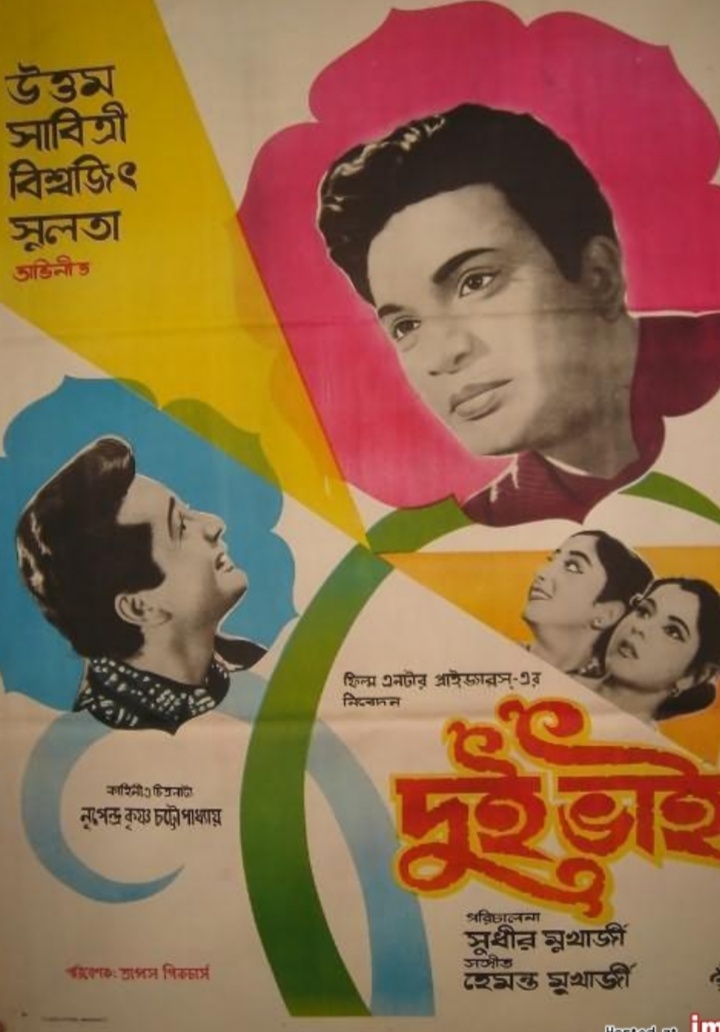
Dui Bhai poster
Orphaned at a very young age and betrayed by relatives, Utpal has once again assumed the role of protector for his younger sibling. He is almost a father figure to Kamal, carrying the responsibility of providing, protecting and even making decisions for him. His strong beliefs, however, can appear almost ‘old school’ when seen against the younger generation and when viewed at today’s time. This becomes the central point of conflict between the two brothers.
What is particularly interesting is that Uttam Kumar, although firmly established as a romantic hero by then, plays Utpal who is shy, stern and sometimes even rude and ruthless towards the opposite sex. The angry, unromantic hero and the protective ‘dada’ exist within the same character, but the latter continues to dominate.
Madhuri, the young refugee, is a particularly strong female presence in the film. Her character carries the strength and pride of someone who is struggling to survive homelessness and financial downfall. Interestingly, this female character is a striking opposite face of the ‘dada’ character played by Uttam Kumar. Madhuri is the young sister, ‘bon’ who is the sole care giver of her ailing big brother. Where Utpal is stern and withholding, Madhuri is poised and unafraid to challenge him. Her dialogue about being a refugee and not being ashamed to ask for favours is significant because it challenges the way the orthodox Bengali society perceived the new migrants in their urban world. Madhuri’s relationship with Kamal also brings another dimension into the conflict between the older and younger generations.
Sabitri Chatterjee as Sabita is equally interesting. She is naturally drawn towards Utpal’s personality, but she is not simply a passive woman standing beside the hero. She has the strength to challenge him and remind him that the world around them is changing. Her dialogue, “The home without doors is like a prison,” becomes particularly significant. It challenges Utpal’s idea of protection for his younger brother and raises the question of whether protection can itself become a form of confinement.
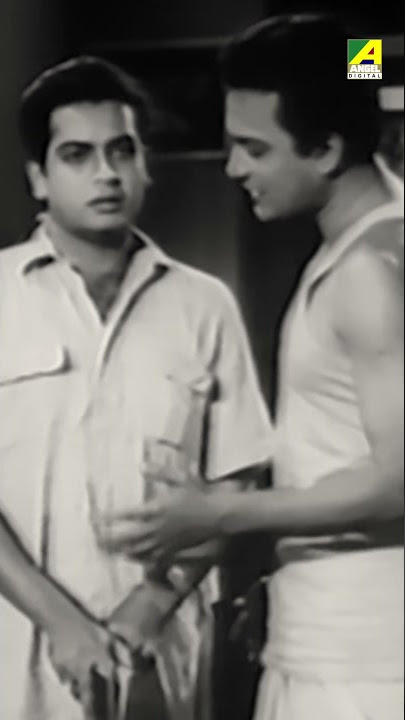
Biswajit and Uttam Kumar in Dui Bhai
Perhaps this was the society that the director of the film, Sudhir Mukhopadhyay was trying to portray. A society that was still orthodox and preferred to have one character holding the flag of traditional values, while the younger generation was becoming increasingly independent and open in values and stronger in their acceptance. Kamal represents this new generation. While studying, he passionately participates in social movements, acts on stage freely in theatre against female characters, interacts with women with ease and confident to build a life beyond the home and his elder brother. He represents a generation that is beginning to consider women as equals and to value their freedom of expression and financial independence.
Utpal, the ‘dada’ therefore, becomes the traditional moral centre of the family, but while Sukhen’s authority had been absolute, Utpal’s is something he must keep earning. The younger brother has a voice of his own. The conflict is not just restricted between choosing the moral right over wrong, rather it is between two different ideas and values where both can be right in their own way. This makes the film enjoyable as the characters are more subtle and complex.
The whip returns in Dui Bhai, but this time in an attempt to discipline his younger brother. But Utpal is unable to complete the act with the same brutality. Instead, he hurts himself rather than truly hurting the person he loves. The moment becomes a much more mature representation of the relationship between the two brothers. The old authority is still present, but it is beginning to crack under the pressure of affection, changing values and a younger generation that refuses to remain submissive. The relationship is no longer simply about obedience; it is about negotiation.
Uttam Kumar’s performance also shows a remarkable evolution. The arrogance and rigidity of Utpal are much more controlled than what we see in Basu Paribar. His emotional outbursts are more restrained, more natural and much closer to reality. The charisma and physical appeal are now fully groomed, but they do not overpower the character. Instead, Uttam Kumar uses his star presence to make Utpal’s authority believable.
His charm, looks and screen presence now have the assurance of a man fully in command of his own superstar image.
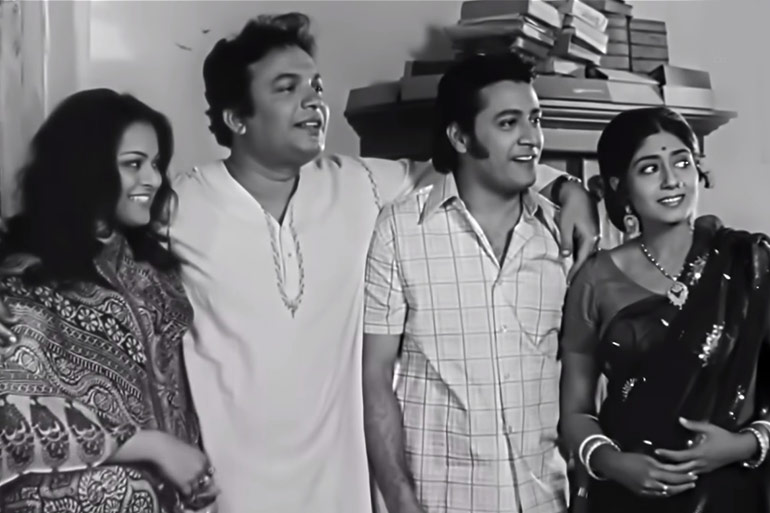
Mithu Mukherjee, Uttam Kumar, Ranjit Mullick and Sabitri Chatterjee in Mouchak (Pic: Bongodorshon)
Nitish, the ‘dada’ of Mouchak (1974)
By 1974, when Mouchak was made, Bengal was different from what it was during Basu Paribar and also Dui Bhai in the two preceding decades. The middle-class educated Bengali family has become more settled with secure jobs, regular pay cheques and much smaller and more self-contained family units. The elderly parents are not necessarily sharing the same household space in Mouchak, as seen in Basu Paribar.
Unlike Basu Paribar or Dui Bhai, Mouchak is not a film of conflict or satire. It is a candid, happy comedy about a well-to-do Bengali middle-class family. Yet, even within this light and humorous world, Uttam Kumar continues to occupy the familiar position of the elder brother. As Nitish Roy, he is still the acting guardian of his younger brother, Sitesh. Uttam Kumar is the guide, the protector and the saviour who steps in to rescue his younger brother from one comic situation after another. Even though Nitish is shown as somewhat fearful of his wife, the fear is built more for comedy than as an expression of respect or equality between partners. This, perhaps, hints at the feudal inclination that continues to exist within the apparently progressive Bengali middle-class families. The relationship may appear more informal and modern on the surface, but the underlying gender hierarchy has not completely disappeared.
A romantic comedy, the plot creates an unusual crisis for the younger brother, Sitesh. His new job gives him unwanted attention from the fathers of young women who see him as the perfect prospective groom. Sitesh is therefore constantly trying to escape the marriage proposals from various corners of his new life in a small town, where he also finds the woman of his life. Young, educated Neepa, the probable lover of Sitesh reminds us of the two heroines of Dui Bhai. Both were bold but probably Neepa and Leena, the eager prospective bride are a lot more aggressive and forthcoming in expressing their emotions to the man. Compared to the strong, confident and almost alpha-male presence of Uttam Kumar as the elder brother, the younger brother Sitesh, appears docile and less masculine. Perhaps this also reflects a changing Bengali audience of the 1970s, who still liked to see the authority of the elder brother, but now wanted that authority to be more open, affectionate and accommodating towards newer customs and changing social relationships.
The affection between the brothers is much more prominent here. Instead of the strong orthodox distance that we see in Basu Paribar, Nitish is a friendly brother who is completely comfortable in indulging his younger brother to share a cigarette. What might once have been seen as audacity is gradually becoming a gesture of intimacy between the two brothers. The ‘dada’ is still the authority, but he is no longer distant.
This is also where Uttam Kumar’s presence becomes particularly interesting. Although Sitesh is technically the young hero of the romantic plot, Uttam Kumar often becomes more prominent than the hero himself. He is repeatedly called upon to save Sitesh from the persistent fathers of prospective brides, from difficult situations at work and from the complications created by his relationship.
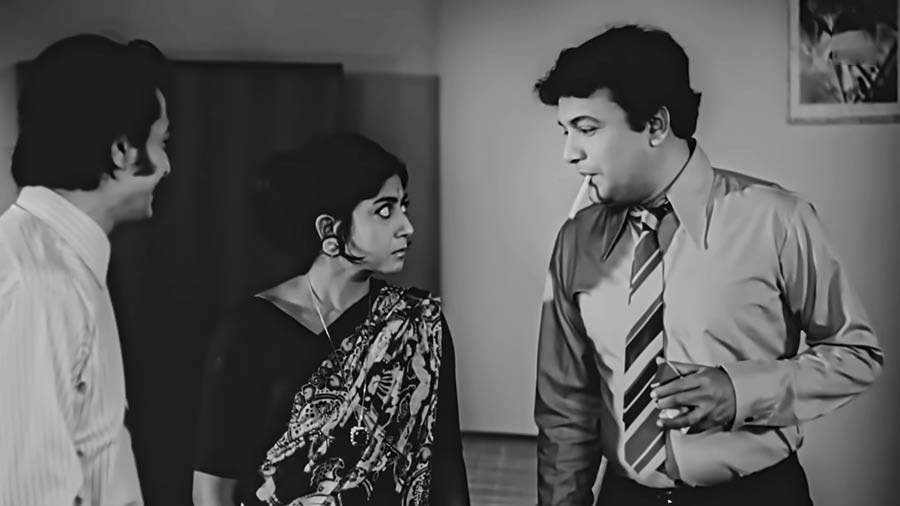
Nitish is a friendly brother who is completely comfortable in indulging his younger brother to share a cigarette
The comedy also touches upon some very real social issues of that time. Beneath the laughter lies the anxieties and pressures of the fathers of the unmarried girls and the social expectations attached to marriage. The dramatic dialogue, “The eternal tragedy of the fathers of unmarried girls,” spoken by one of Sitesh’s young colleagues, brings out this particular social anxiety. The film also points out that the dowry and caste systems exist even within families that consider themselves progressive and educated.
Uttam Kumar’s acting, which has matured and transformed considerably by this time, is still loud and often stylized. But in Mouchak his theatricality becomes part of the comedy. His dialogue delivery, timing and punch lines are no longer simply expressions of authority, but they successfully generate humour. We laugh along with Uttam Kumar rather than simply accepting his authority.
As mentioned before, it appears that the director has more faith in Uttam Kumar’s pull than in his official leading man, the young Ranjit Mullick. Even when he is not the central romantic hero, the camera repeatedly gives him prominence. His song sequence with Sabitri Chatterjee and his presence during the ‘gaaner lorai’, the local club stage performance involving Sitesh and his young lover, are examples of how the film continues to place Uttam Kumar at the centre of the screen.
Amusingly, the ‘dada’ in 70’s has to pick up the whip once again at the end. Just as in Basu Paribar and Dui Bhai, the familiar symbol of the elder brother’s authority reappears. But this time it is entirely transformed by the comic tone of the film. The whip is no longer terrifying, rather it becomes part of the comedy and is used to save the relationship with the prospective bride’s father. It seems as if every Bengali household in these films has a whip or a stick somewhere in home, ready and handy for the ‘dada’ to put his younger brother in place, be it in the early 50’s or the two decades that followed.
Kali Dutta, the ‘dada’ in Dhanni Meye (1971)
In chronological order, Dhanni Meye, although falls within the era of the 1970s, was released three years earlier than Mouchak. However, as this film represents, in my view, the finest of the four in terms of Uttam Kumar’s acting, and hence it will be more appropriate to discuss it at the end of this article on the ‘dada’.
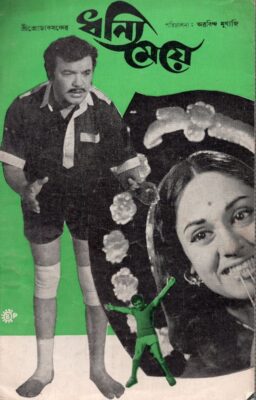
Dhanni Meye poster
In Dhanni Meye, Uttam Kumar plays Kali Dutta, the elder brother of Bagla.
Like the previous films where either the father is disabled or hardly present, Kali Dutta, who also loses his father at a very early age, takes up the entire responsibility of raising his younger brother. But unlike Dui Bhai, the age difference between two brothers in Dhanni Meye is wider and hence the ‘dada’ is almost a father figure in this film.
Even the way Uttam Kumar is introduced in the film, praying to the Almighty in his home, bending almost on all fours, and struggling to get up because of his arthritis, is anything but heroic. His screen personality, the moustache, posture, poses and attire have no hint of his star image.
Uttam Kumar, the elderly ‘dada’ has allowed himself to age and appear completely natural in the role. His arthritis is acted in small, natural movements like holding his back, rubbing the sides of his body which make him look and behave much more like an ordinary Bengali man in his late forties. These details bring the star closer to the audience. For a star of such a high stature, this is an interesting and perhaps quite difficult journey.
In fact, the entire cast of Dhanni Meye is natural in their delivery, with perfectly timed punch lines. The comedy is neither forced nor overdone. The conflict and restlessness of society, shown in Dui Bhai, changes in the 1970s. In Dhanni Meye, director Arabinda Mukhopadhyay chooses football as the centre of the story. The family conflict is no longer about survival or the authority of the traditional family. Instead, it is about pride, passion and obsessive love for a football club in a hilarious comic tone.
In this role, as elder brother Uttam Kumar, apart from his younger brother has another form of love in his life which is football. Once a player and now a lifelong supporter, he is uncompromising about the game. This adds an interesting dimension to Uttam Kumar’s ‘dada’ roles. He has the same commanding tone but where Sukhen commanded and Utpal negotiated, Kali Dutta simply charms.
The whip resurfaces again during the final time — only now it is in another man’s hand and Uttam Kumar steps in to stop the brutal act. This is perhaps the most interesting transformation of these four films. In Basu Paribar, the whip represents moral authority that brooked no appeal. In Dui Bhai, it represents an authority that had started to negotiate rather than command. In Dhanni Meye and Mouchak, this very whip becomes authority that had been disarmed, literally and figuratively. The ‘dada’ is still there, still powerful and still protective, but the same gesture that once disciplined now has to ask permission. Uttam Kumar’s ‘dada’ persona becomes more human, approachable and realistic.

Whether you are new or veteran, you are important. Please contribute with your articles on cinema, we are looking forward for an association. Send your writings to amitava@silhouette-magazine.com

Silhouette Magazine publishes articles, reviews, critiques and interviews and other cinema-related works, artworks, photographs and other publishable material contributed by writers and critics as a friendly gesture. The opinions shared by the writers and critics are their personal opinion and does not reflect the opinion of Silhouette Magazine. Images on Silhouette Magazine are posted for the sole purpose of academic interest and to illuminate the text. The images and screen shots are the copyright of their original owners. Silhouette Magazine strives to provide attribution wherever possible. Images used in the posts have been procured from the contributors themselves, public forums, social networking sites, publicity releases, YouTube, Pixabay and Creative Commons. Please inform us if any of the images used here are copyrighted, we will pull those images down.