Stay tuned to our new posts and updates! Click to join us on WhatsApp  & Telegram
  Channel
& Telegram Channel & Telegram Channel 




On July 20, 1980, Uttam Kumar had given an extensive two-hour-long (recorded) interview to Ratnottama Sengupta, presumably his last press interview. The Mahanayak passed away on July 24, 1980.
As our tribute to the icon, we republish this interview which first appeared in print on August 22, 1980 in Screen.
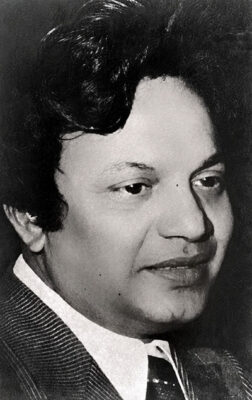
Uttam Kumar (Photo courtesy Screen)
“You know Madam, I generally don’t give interviews,” Uttam Kumar had said something I knew very well by then, for it was over a year and a half since my first attempt to interview him. This reluctance – or refusal – to give interviews was known to all journalists. And was ascribed to many things: his arrogance, his busy schedule, his image-consciousness, his self-consciousness and so on. So, when some days ago I did get to interview him, I thought I was lucky. Now, writing some days after his death, I know I had been in luck: had he not made that exception on that day, I would never have got to interview the ‘Mahanayak’.
Uttam Kumar was not just a star. He was not just a very good actor. Nor was he just an image. He was all this and much more: He was a legend. And trite as the expression is, it is the only way in which one can describe the phenomenon of Uttam Kumar without a whit of exaggeration. No other actor in the annals of Bengali Cinema has been adored the way he was. When he went to a wedding, even the pundit stopped chanting the mantras to admire him. If he went to a dinner at a friend’s, hundreds of fans tried to gate-crash. He was the heartthrob of millions of women. To young and old alike, he was the ‘Guru.’ The mass hysteria he caused inspired Poet Achintya Kumar Sengupta to write the memorable poem, Uttam Kumar.
And what had it meant to be ‘Uttam Kumar’? How did it affect his personality? Did the charisma essentially change the person, Arun Kumar Chatterjee, the actor who assumed the name of Uttam Kumar? These were the questions with which the conversation started that morning.
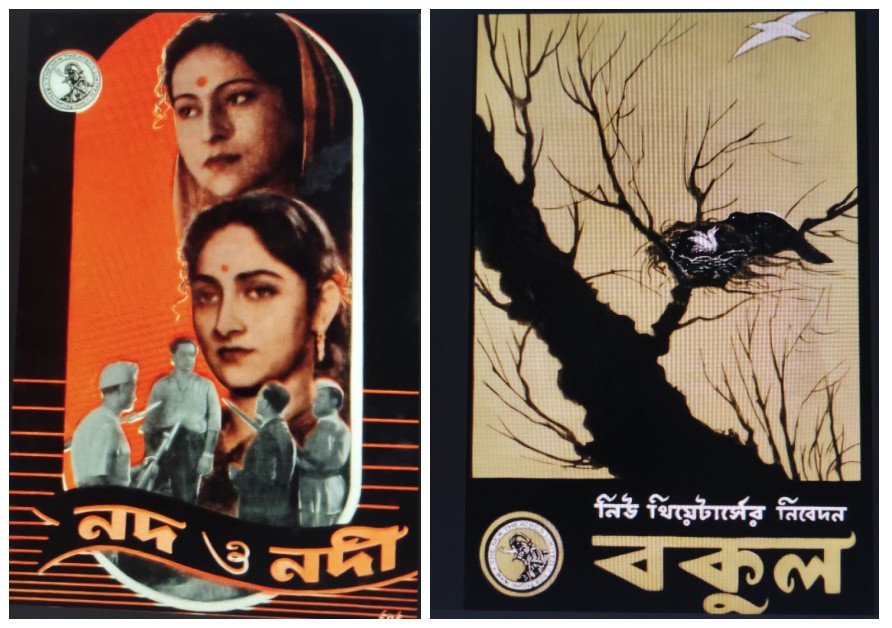
Two of Uttam Kumar’s early films Nod O Nodi ((1953) and Bakul (1954) (Photo courtesy: New Theatres)
Acting was a hobby
“Well, honestly, when I started acting, I did not take it seriously. It was not a career to me. It was more of a hobby. As a child, I had a keen desire to be a good actor – especially in films. I used to act in school dramas and also in my college days. I had to give up studies because of circumstances and take up a job at the Port Trust. There we had a recreation club which used to stage dramas along with its other activities. I used to participate in them, too.
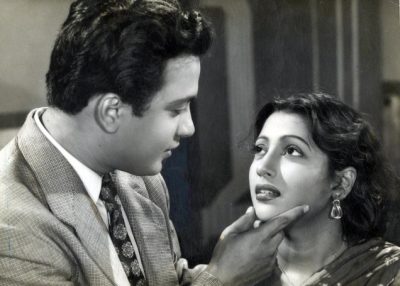
Uttam Kumar and Suchitra Sen in Sagarika
“Then I started doing small roles in various films. I was lucky to get noticed by Pahari Sanyal. Through him I got a chance to work in a New Theatres film. Gradually I started getting good roles. At that time, there was a lack of good actresses on the Bengali Screen. Then Suchitra Sen came on the scene and we started working together. After Sharey Chuattor, the pair became very popular. It clicked with the audience in an amazing way and actually changed the condition of Bengali Films.
“When I started acting, Bengali films were going through a phase exactly like today’s. Everyone was drawn to Hindi films and no one wanted to see Bengali films. Gradually the situation reversed. People not only started to see them, they would await their release. And an Uttam-Suchitra film was a special attraction. Individually also, we had a good market and a large fan following. I didn’t realise when we had become so popular.”
The popularity decided his career: Arun Kumar Chatterjee gave up his job at the Port Trust and devoted himself to being Uttam Kumar. As the years went by the number of films starring him increased and, with each film, he gained greater maturity as an artiste till, in 1968, he won the Bharat Award for his portrayal of the “Firingee Kabi” in Antony Firingee.
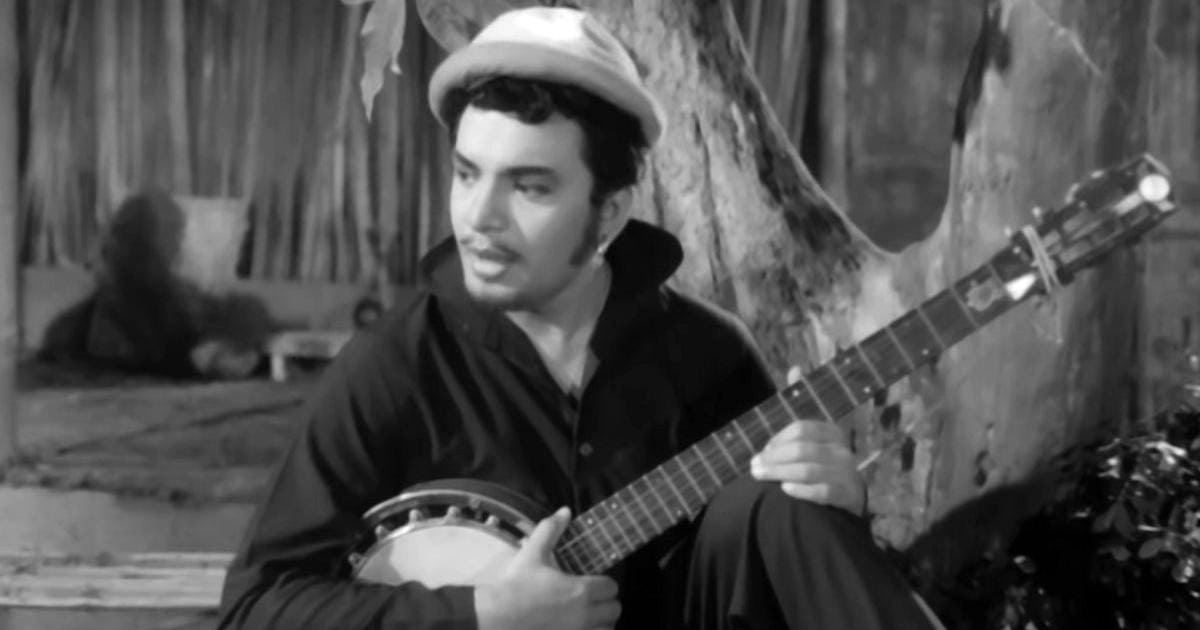
Uttam in the title role in Antony Firingee
Instinctive Actor
Uttam Kumar was an instinctive actor. But he polished what came naturally to him with studied details. With perseverance and hard work he gained such mastery over the art that he could portray any character effortlessly and could give more to a role than even the director could ask for. The servant Raicharan of Khokababur Prottaborton, the loyal Bhootnath of Saheb Bibi Golam, the converted missionary doctor of Saptapadi, the romantic lover of Harano Sur, the vagrant Srikanta of Rajlaksmi-Srikanta, the mentally disintegrating brother of Nagar Darpane, the popular singer of Deya Neya, the licentious husband of Stree, and the famed actor of Nayak: Uttam could play all these with equal ease and aplomb. This cemented his position on the Bengali Screen. The heroines changed – but the actor continued to charm generations of cine-goers.

Uttam Kumar and Suchitra Sen at an event
“How do you feel about this popularity?” I had asked.
“Well, I enjoy it all right. I do relish it. But often it crosses the limits of adulation and becomes a hysteria. Then it is a hazard. They not only touch you – they pinch you and pull you and tear your clothes. Sometimes they break the wind screen of your car. It becomes a strangulation.”
“Does the image restrict only your private life? Or does it also restrict your artistic expression?”
“Yes, it does restrict my acting also. It stops me from projecting a character as I would like to, or think would be best, if it goes against the set image of Uttam Kumar. Because, if it is very different from what the viewers expect of Uttam Kumar, they reject it. I did a different sort of role in Bagh Bandi Khela. They didn’t accept it. They praised the acting, but the film didn’t do well. At times, I want to play a scheming villain – a really vicious character. But I know it will not be accepted by the people.”
Thus the artiste within him suffered because of his image. Probably that is why, when I asked him, “Which character have you enjoyed doing most?” he replied, “None.”
“Not a single one?”
“Well, I have enjoyed doing some portions from some films. But that is about all.”
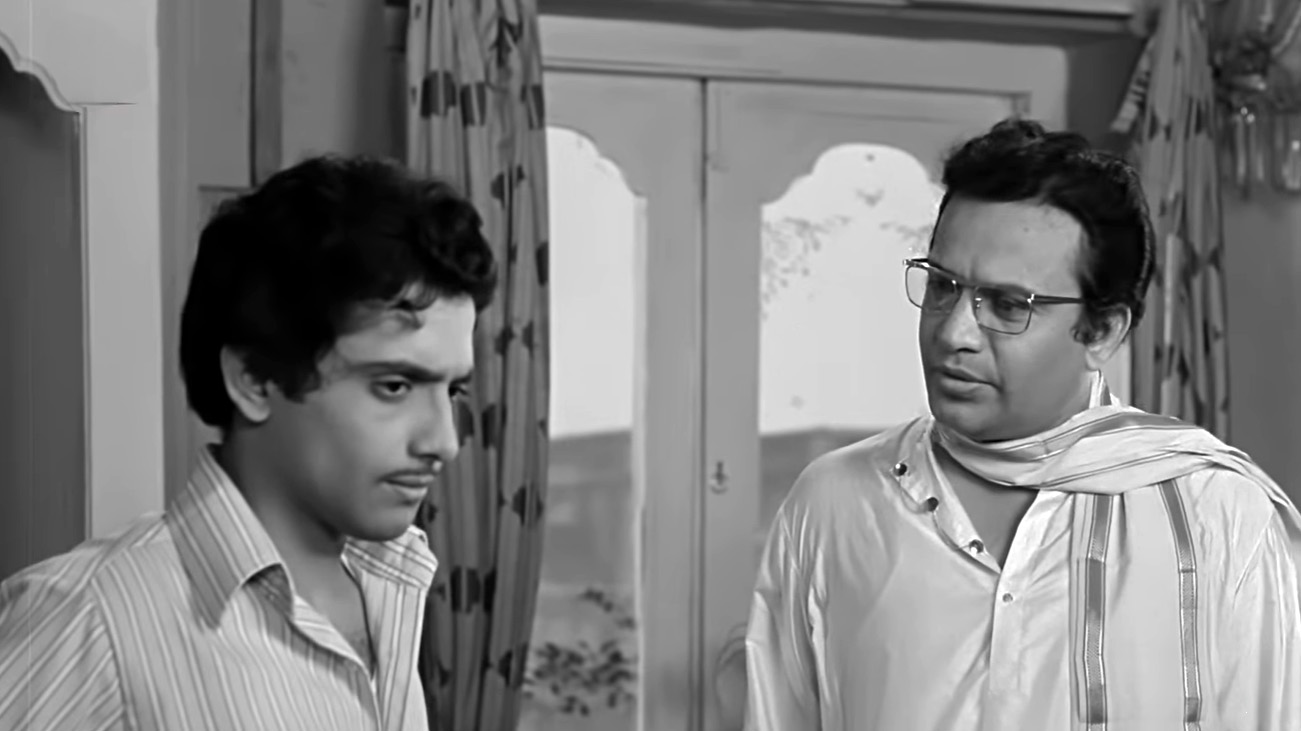
Partha Mukherjee and Uttam Kumar in Bagh Bandi Khela
No Similarity
“Not even Nayak? That performance was acclaimed the world over. The character and the actor complemented each other. Was it drawn in your image?”
“Yes, I did enjoy playing Nayak. But I don’t find any similarity between the character and myself. Rather, there are certain things which even an ordinary person does not do. In our everyday life, how often do we carry our own bags and baggage? Was it necessary for the actor to carry his luggage? Perhaps it was a cinematic licence the director had taken. As was the actor’s going to the dining car for his meals.
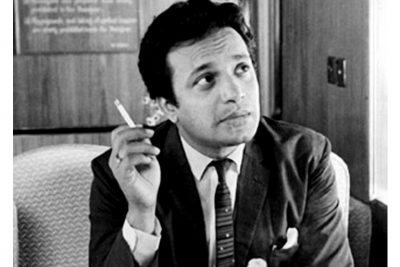
The star Arindam in the train’s dining car, in Nayak
“Besides, it’s not clear to me what the character’s frustration was due to. Why does he feel so frustrated? Is it because lately his films have been less successful? All these days his presence alone was sufficient for a film to be a box- office hit. Now that isn’t working. Does that mean his career is coming to an end? Is that the reason? Well, I can’t understand it or relate to it.”
“Well, then, when you produced a film, why didn’t you produce one that you yourself would enjoy doing?” I had asked.
“I didn’t come across any such story then. Besides, you know it’s the total atmosphere that matters. Today no one gives much time or thought to his work. If you go to a studio, you’ll hear discussions on every topic under the sun, from football to market price to underground politics – everything except films. How can any work of quality be produced in such an atmosphere?
“And everyone is in such a hurry. An actor is expected to be ready to give a shot as soon as the word ‘ready’ is uttered. ‘Arre baba, can you be ready by merely taking a glance at the sun and blinking your eyes once or twice? The assistants don’t have the patience to read out the dialogue to the artistes. And the directors want to do the maximum amount of work in the minimum amount of time. They are not as interested in gaining job satisfaction as they are in making money.”
Lack of Sincerity
“And today’s journalists also lack sincerity. Many don’t follow the chain of events in a film. For example, in Dui Prithibi, the elder brother is estranged from his younger brother who has strayed into the path of evil, as well as from his parents and sister who are dazzled by his wealth. Once, when he visits his parents, the younger brother makes some vulgar comments involving the elder brother who then slaps him. Now, a critic has commented about this scene: ‘It seems the elder brother had gone there only to slap his brother!” Tell me, is this proper criticism? Just to criticise they’ll say anything. Without any hesitation they reject everything.
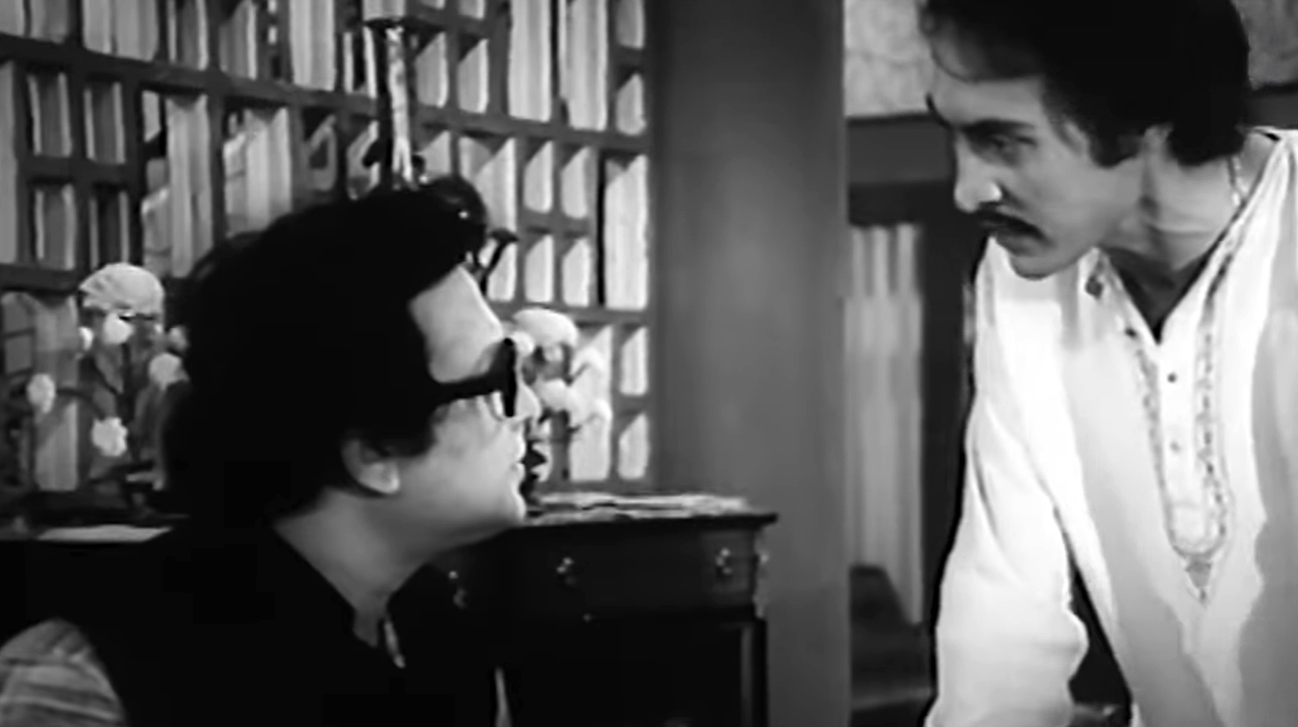
The faceoff between the brothers in Dui Prithibi — Uttam with Victor Banerjee
“But what is worse, in the case of certain filmmakers, they have no criticism whatsoever to offer. Ray, for instance, gets only rave reviews from the critics. Except for some honourable exceptions, most have only flat praise for him. But tell me honestly, is there never anything in his films – or in the films of Mrinal Sen and Ritwik Ghatak – which call for criticism? Where does the integrity of the critics disappear then?
“At this moment in time, I’m suffering from a deep sense of frustration. There is no sincerity, no dedication in the people around me. The result is the terrible state we are in today.”
Uttam then talked about the days when he was a newcomer. “I was an apprentice then. I still consider myself an apprentice. But, to continue with what I was saying. I was an apprentice and the directors helped me to learn and improve my acting. They helped me to adapt myself to the medium. To know what my defects were. To walk, to deliver the dialogue, to analyse a character, everything. I first learned to analyse a character from Nirmal De, the director of Basu Paribar and Chapadangar Bou. So many other directors have helped me!”
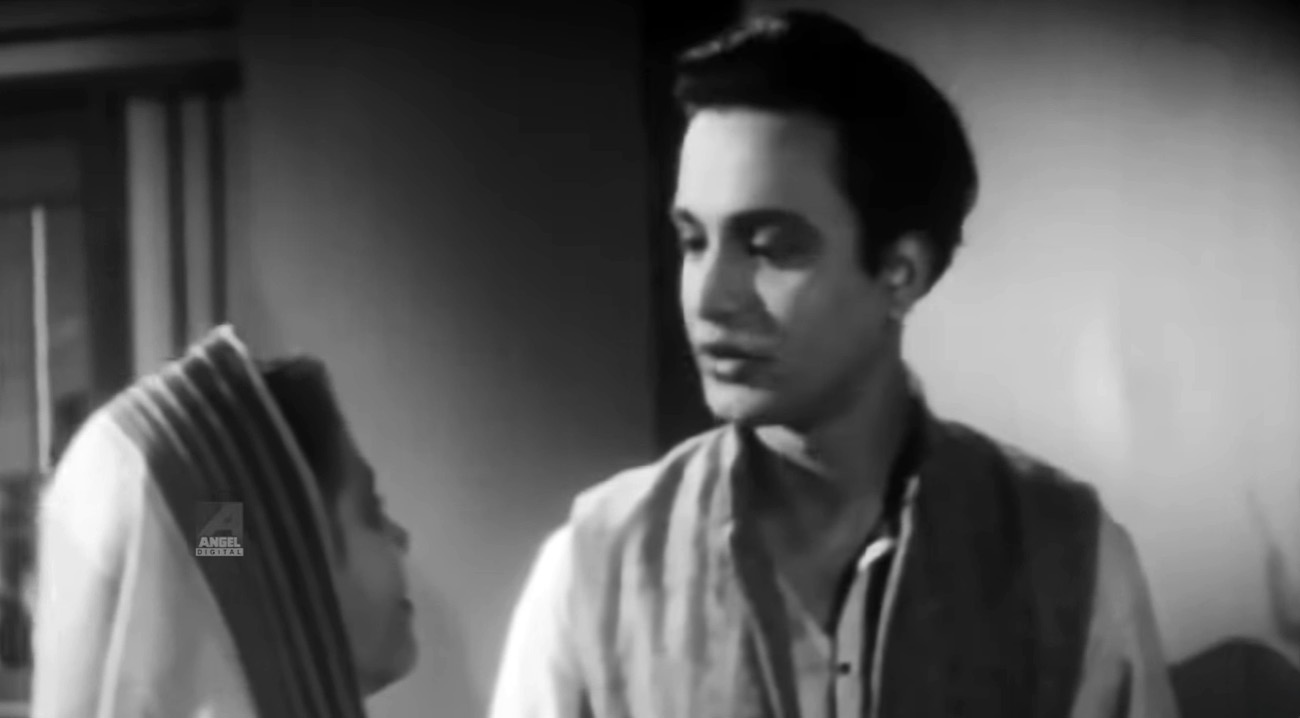
A young Uttam in Basu Paribar
Treatment of Talent
“A good artist is not born just like that. An artiste has to be cultivated. His talents have to be drawn out. I know it is difficult to come by fresh talents. But it isn’t as though there is no actor who could mature into a really good artiste. Unfortunately, no one today has the time to back a new artiste. Nor the inclination. For, if you encourage someone who, you feel, holds the promise of blossoming into a good artiste, everyone around you – your colleagues, the industry people, everyone will joke about it. They will smile knowingly or make sly comments. Then even you will feel unsure of your choice. So no one wants to bother about a new artiste.
Barring a few like Ray, Sen, Tapan Sinha, Tarun Majumdar and some of the new directors, most people want to take only established artists. They will take them whether they suit the role or not. But everyone cannot be good for every kind of role and when it doesn’t work out well, they blame the actor and say he is no good. Why blame the artiste? You are unable to build up the story. You are unable to create an intensity in the drama. You are unable to enthrall the audience. And all your failings you try to pass on to someone else. This is wrong.”
In Dui Prithibi, Uttam had selected a fresh talent, Victor Banerjee. “When we decided to take Victor for the role, he had worked only in Shatranj Ke Khiladi. I felt he suited the role. When I rang up to inform him, he was in London. He came back and did the role and did it remarkably well. He has been accepted by the audience now, and he is coming up. This is very heartening.”
Lifelong President
Dui Prithibi is the second film of the Shilpi Samsad, an institution for helping destitute artistes. Uttam Kumar was the lifelong president of the Sansad. He had directed its first film, Ban Palashir Padabali. The second film was being directed by Pijush Bose. After his death, Uttam took up the responsibility. At that time, he was completing another film, Kalankini Kankabati.
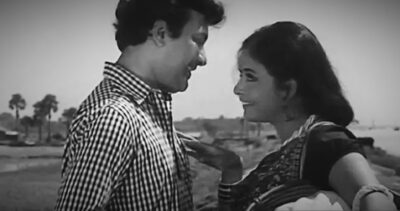
Uttam and Supriya Devi in Ban Palashir Padabali
Talking about direction led him to talk about the Bengali film scene. “We are lagging far behind our times,” he observed. “The world has moved forward – but we have remained where we were 50 years ago. Our cinema is still not cinema – it is a modified version of Jatra or Theatre. When are we going to wake up to the fact that cinema is a different medium? Look at Ray’s films – they are cinema. Take Shatranj for example. It’s true the film did not do too well here. But everyone who saw the film was overwhelmed. Nothing was overdone – everything was perfect.
“But what are most Bengali films today? The same old story, some sentimental dialogue, some songs, but they are not even integrated into the situation. The characters are loose and nebulous. You cannot identify with any of them. They have set patterns. If Uttam Kumar is to play the elder brother, then the elder brother must be very broad-minded and must make sacrifices. The characters break into song for no rhyme or reason. And all this is because today there is a general lack of philosophic understanding of life. If you are seeking drama, you don’t have to look far. It is present in our everyday life. If you are just a little perceptive, you will easily note that.
“Our creators today have lost this perceptive outlook on life. The directors are merely eking out a living. The screenplay is generally loose and sketchy. And the stories are more and more concoctions of set formulas. New Theatres films were also theatrical but they had substance – if nothing else, each had an original story. But today our films present the same situations over and over again.”
“But can’t an artiste of your standing do anything about it? Can’t you tell producers that, unless they choose a good story, you won’t do the film?” I had asked.
For a Living
“You see, one has to live on. One has not only to keep going but also to maintain the status quo. Most films are bad. But most artistes do them because they have to live on.”
“Certainly, you have an advantage that other artistes don’t have: To most producers, your name is synonymous with success at the box office. So what do you do?”
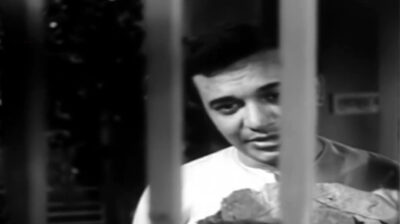
Uttam in Nishipadma
“So, I am somewhat choosy. I try to do only those films which hold the promise of originality, at least in treatment. However, you will agree that sometimes it misfires. Like Aro Ekjon did. It was fairly good. Maybe in some parts the intensity was great while in some other parts it was too little. On the whole, it was quite a good film. So too was Pankhiraj. Both misfired. These things happen. Quite often you like a film but it flops. Then, often you don’t like a film and you are surprised by its success. Like the film Nishipadma. Technically, it was a bad film. Bad camera work, bad sets, everything was substandard. It is still a puzzle as to why it became so popular. A song became a big hit – and that, probably was the reason. Sometimes, such things happen.”
“Which, according to you, was the best phase of Bengali cinema?” I asked him.
“The years between ’54 and ‘68-69,” he said. “Not that all the films made during this period were very good or of an exceptional quality. But most of them were decent. Fairly good. There was a lot of excitement and expectation about Bengali films. The release of a new film was a big affair. Nowadays you don’t realise when a film is releasing and when it is being withdrawn. Often a film completes its run before you realise that it is in the theatres. So, I’d say that up to ’68-69 we had the best phase. Thereafter we glided into decadence and degeneration.”
“On looking back at the period, I find that most directors then picked up the best from Bengali literature and based their films on them. Do you think that was a reason for their being generally good?”
Creative Writers
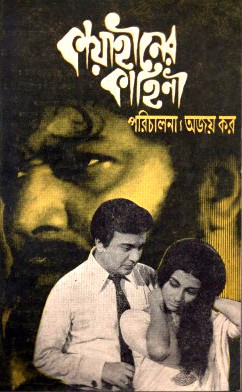
Poster of Kayahiner Kahini, based on a novel by Nabendu Ghosh. (Photo courtesy: Ratnottama Sengupta)
“Yes, to an extent, that was a reason. Thus, the filmmakers used to choose the best form of literature. Now many of our literary writers write keeping popular articles in mind, hoping it will be made into a film. Some characters are formed with Uttam Kumar in mind, some are formed with Soumitra Chatterjee before their eyes, and so on.
“Most writers today are creating stories and novels only to meet the demand of the publishers. Given the rate at which they produce for the puja issues, what can the standard of their writing be? How can that literature blossom into a good film?
“It makes me sad to think that there are ever so many things they could write about. So many things have happened in our times – in the last decade itself. One could make a film on Calcutta in 1971. I myself could make one on Tollygunje of ’71. My experiences – what I have seen and been through – could form the subject.”
Uttam had decided to make another film – though not on that subject. “I will myself direct it,” he told me, “and I’ll try to make a good film.” He was on the lookout for a good story for he believed that “the two fundamental requirements for a good film are a good story and a good director. If a good story is handled well, I’m sure it will do well. I know it from my own experience.”
His First Love
Uttam Kumar’s first appearance on the Hindi screen was in his own film Chhoti si Mulaqat. It didn’t do well. But his second film Amanush was a big hit. In the next few years, he spent a lot of time in Bombay working in Anandashram, Kitaab, Dooriyaan, Bandie and Plot No 5. Some days ago, he had returned after completing a schedule for Manmohan Desai’s Desh Premee. I asked him what his experiences in Bombay were?
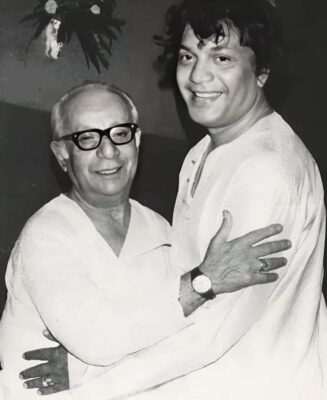
Sushil Majumdar, Director of Lal Pathore, with Uttam Kumar, his co-actor in Chiriakhana, Dui Prithibi and other films (Photo courtesy: Sanjay Mishra Collection)
“I have enjoyed working there. The studios and laboratories are well equipped. And they are very methodical. They have a professional approach to their work. They are concerned with having some light-veined entertainment. They are all out to earn money. If you try to find a logical development of the plot you will be in trouble. So it’s best not to try it.”
But then, Uttam’s first love was the Bengali screen. He had been attached to it for more than thirty years. He saw the screen change from one of mediocrity and indifference to one of glory and success. And he also saw it degenerate into one of stagnation and decay.
“Our condition is worse than it ever was. Nobody wants to watch Bengali films. Not only are the films bad, the theatres also are terrible. The carpets are worn out, the seats are broken, the walls are peeling off, the screens are filthy, the sound system is so bad that you can’t hear a word. The exhibitors don’t spend a paisa on maintenance. The producers are the worst sufferers. They suffer at both ends. Work in the studios is delayed because of lack of equipment. All the studios are in a sad state. We have fewer than half the variety of lenses used in India today. The cameras are generations old. And there are so few of them that often, we have to spend hours waiting for one.”
Uttam Kumar was too attached to the industry to take the degeneration passively. “We must move the Government to see that the minimum work of maintenance is carried out. The government takes a fat portion of the collection. So it is its duty to the people to see that they get at least the minimum of comforts.”
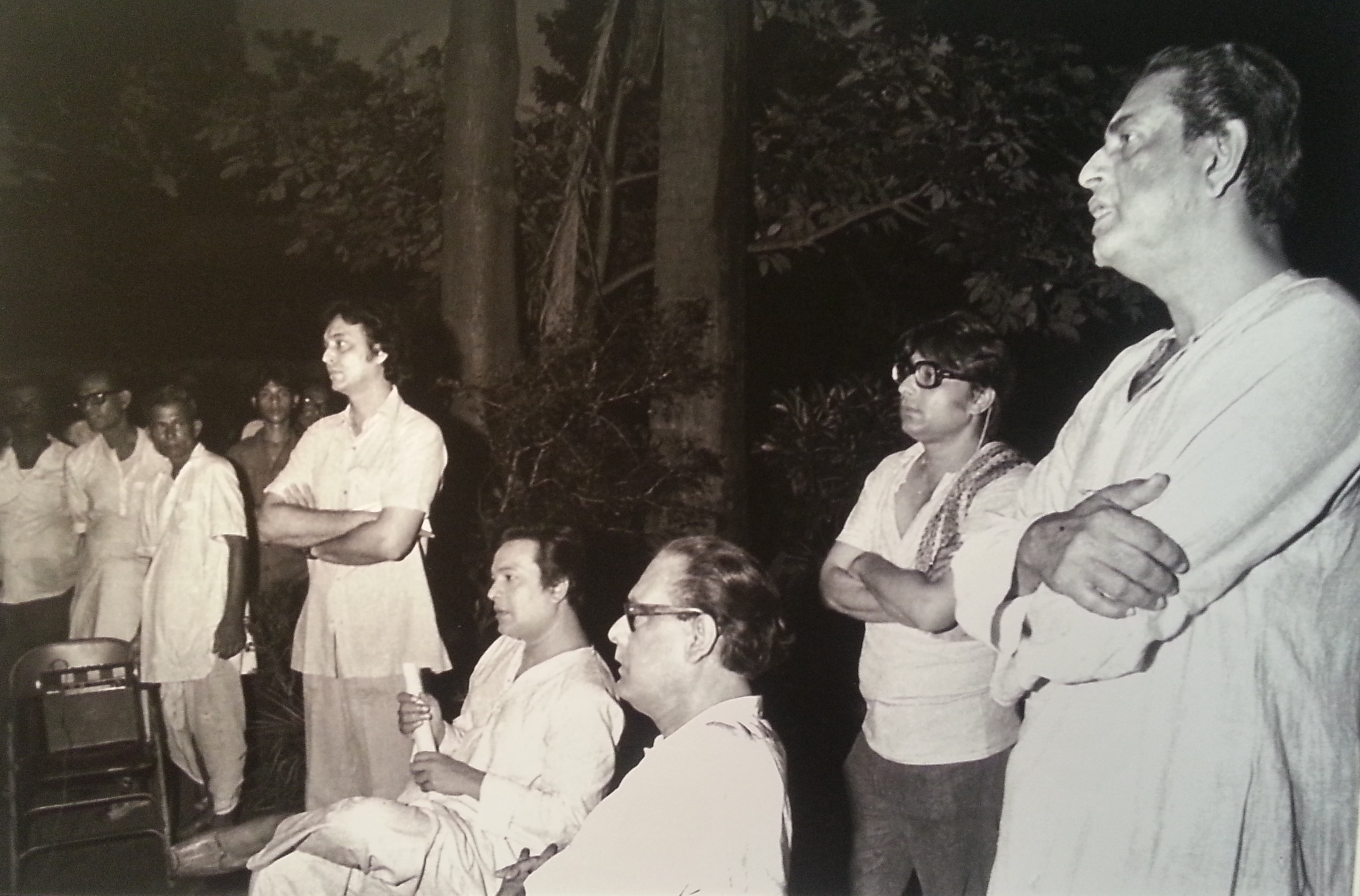
Soumitra, Uttam Kumar, Hemanta Mukherjee and Satyajit Ray in a meeting to protest against regular power-cuts that affected the film industry (Photo courtesy: The Society for the Preservation of Satyajit Ray Archives)
There is Hope
Just a few days before this interview, Uttam had met the Union Minister for Information and Broadcasting, V P Sathe. “I told him, ‘Do something about our studios.’ At least give us loans so that we can buy some equipment.’ Sathe has promised to do his best. Let’s see what happens.”
“Are you optimistic about the Bengali Cinema?” I had asked.
“I’m never pessimistic,” he had answered. “For, as long as there is breath, there is hope. Our efforts have been yielding results. We have succeeded in making the State Government – irrespective of which party is ruling, Congress or CPM – aware of our woes. It has been showing interest and taking steps to solve the problems. So let’s keep trying and hoping for the best.”
The Nayak was getting late for his shooting. So I quickly brought the interview to an end. I didn’t have the time to ask the last question I had on my mind: What would Uttam Kumar do if there comes a day when the name doesn’t work any magic?
Now, without having asked the question, I have got the answer: There never will come such a day.
More Must Read in Silhouette
Uttam Kumar: Leaving a Mark in his Few Hindi Films
Two Legends and Their Lives: Uttam Kumar Suchitra Sen
Making of Uttam Kumar: The Star, The ‘True’ Bhadralok
Eyi Path Jodi Na Shesh Hoy: The Immortal Songs of Uttam-Hemanta

Whether you are new or veteran, you are important. Please contribute with your articles on cinema, we are looking forward for an association. Send your writings to amitava@silhouette-magazine.com

 Dear Deceiver: Agni Pariksha versus Chhoti si Mulaqat
 Brando, Bogart, Paul Muni and Beyond — Understanding Uttam Kumar
 Nayak in the Classroom: A Before-and-After Study
 Uttam Kumar: The Changing History of the Bengali ‘Dada’
 Partnership of the Two Titans — Uttam & Soumitra
 Grief in Two Keys – Amanush and Dooriyaan
Silhouette Magazine publishes articles, reviews, critiques and interviews and other cinema-related works, artworks, photographs and other publishable material contributed by writers and critics as a friendly gesture. The opinions shared by the writers and critics are their personal opinion and does not reflect the opinion of Silhouette Magazine. Images on Silhouette Magazine are posted for the sole purpose of academic interest and to illuminate the text. The images and screen shots are the copyright of their original owners. Silhouette Magazine strives to provide attribution wherever possible. Images used in the posts have been procured from the contributors themselves, public forums, social networking sites, publicity releases, YouTube, Pixabay and Creative Commons. Please inform us if any of the images used here are copyrighted, we will pull those images down.


































































Excellent is less for this! Great work.
I have never come across an interview of Uttam Kumar like this before. Anecdotes about him are plentiful, but it is quite revealing to get him here as a ‘thinking man’—a man deeply concerned about his art, intertwined with an equal concern for the future of Bengal’s film industry as a whole. There are hardly any words adequate enough to appreciate Ratnottama Sengupta for offering such a remarkable piece of work.