Stay tuned to our new posts and updates! Click to join us on WhatsApp  & Telegram
  Channel
& Telegram Channel & Telegram Channel 




OP Nayyar, the legendary music director, is known for his bold, uninhibited and foot-tapping music, as well as his soulful melodies. Kunal Desai explores the creative process behind OP Nayyar’s music to understand how he created the brilliant compositions that have kept listeners captivated for more than half a century.
“I remember we used to have four-hour shifts and then overtime, but he never used to take more than two and a half to three hours for recording. Three hours and a song is packed up. One day, I asked him, ‘Nayyar Saab, you never have a second take. If you do more takes, you can have a better song recording.’ He replied, ‘Yes, I can have, but the freshness which I get in first take will be lost,'” recalled musician and arranger Kersi Lord about the composer of stubborn willpower and delicate heart, OP Nayyar.
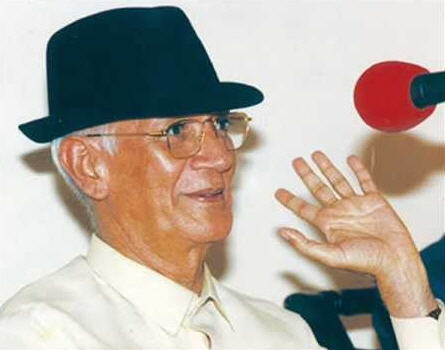
OP Nayyar (Pic: Google Image Search)
OP, as he is fondly remembered, was truly an unconventional composer. He was a man of his own rules, an artist par excellence, a connoisseur of sophistication, and a compassionate human at heart.
When we try to look what OP Nayyar contributed to the film’s music and lives of people, some interesting insights come across. Since the beginning of talkies, the music landscape of Indian films, especially Hindi films, has been changing almost every few years. The period of early 40’s to mid 50’s could be described as a musical and cultural amalgamation of many genres and styles. Composers like Ghulam Mohammad, Anil Biswas, Naushad, Shankar Jaikishan and OP Nayyar have contributed to this landscaping with their own innovations. Before focusing on what OP did, it is important to understand how such cultural shifts impacted people’s lives. The only and most powerful medium responsible for shaping the thinking of people in the country was films. The audio-visual storytelling and messages conveyed through such stories were impacting what people believed and eventually how they behaved.
While Hindi film music was already influenced by path-breaking innovations by composers like RC Boral and Pankaj Malik and was being polished by legendary Ghulam Mohammad, Anil Biswas, and Naushad, the undertone of films remained understated and subtle. Perhaps it was still under the influence of the belief systems of society of 30’s and 40’s. This subtlety reflected in music too. Naushad, Shankar Jaikishan and C Ramchandra had pulled the film music out of the classical mold and made it consumable with light, popular and hummable tunes for audiences. Still, the mood remained subtle. This pedestal was changed by OP Nayyar. His music in films like Aar Paar, Baazi, Mr and Mrs. 55, CID changed the way music sounded. It was bold, uninhibited and foot tapping. OP was in some way the OG of counter-culture in Indian film music.
On the one hand, he was so strict about his rules that many great artists and musicians had to return from his recording because they arrived late. On the other hand, he could never see musicians in misery. He often helped musicians and rewarded them also for their exceptional performance during recordings.
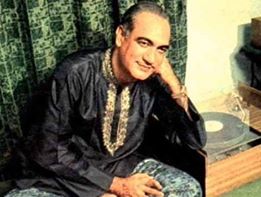
OP Nayyar
There are many stories of his colourful personality, but the most important point was that he remained a commercially successful music director for almost two decades without using the voice of Lata Mangeshkar. This was indeed an achievement in itself.
The work of every composer of any genre, whether it be films, symphony, or classical, always reflects their style, persona, and thinking process. OP was never an exception to this. His upright, upbeat, and stubborn nature helped him carve a niche in film music. Moving away from the contemporary trend and creating one’s own signature style that remained popular for more than two decades was not a small feat. Somewhere, the creative process is always entangled with artists’ tastes and choices too. In this area, OP was a prince. Suave, smartly conducting himself, and being fond of the finest whiskeys and cuisines reflected his class. This class made his music also enchanting. Smart. How could music be smart? Well, making music with lateral thinking was what made his music smart. Let’s explore how.
Let us peep into the creative process of OP Nayyar’s music and see how he made that brilliant music which has kept the listeners captivated for more than half a century now.
When OP began, there were some stalwarts such as Naushad, Shankar Jaikishan, Roshan, Sachin Dev Burman, Madan Mohan, etc. who had already paved their way into music making. Here was a new man in the room, without any formal training in music, as he claimed, and without having assisted any big music director. He had made some basic rules for his arrangers that he never compromised. All his contemporary composers resorted to Goan music arrangers for arrangement and background music. These arrangers were formally trained Western musicians. Their grip over string instruments was commendable. This helped composers in a big way to decorate their tunes with beautiful string scores.
Arrangers used techniques like creating obbligato, i.e., counter-melodies on bass instruments like cello and viola, while the harmony was played on violins. This contrasting sound had a notable impact in the interludes. Also, they used to create harmonised strings.
Let’s understand this. In the era of live music recording, when there used to be a 70, 80, or a 100-piece orchestra, the string section used to be the largest one. There were three to four rows of violinists playing scores written for them. When the composer sought a harmonised sound, the scores for each row of violinists were written with little variation. They had to play the same tune, but the pitch of the tune, or the sound of the tune for every row was different. When all of them played together, a harmonised sound of violins was generated, which sounded lovely. An example of this sound can be the intro music or prelude of the song Tera mera pyar amar (Asli Naqli).
OP never did this. Rarely in his songs, we find heavy violin obbligatos or harmonised strings. In the outdoor songs where he had ample opportunity to use lush orchestration with a flurry of violins, he chose not to go that way. It worked. The audience liked this simplicity alongside the grandeur of sound created by others.
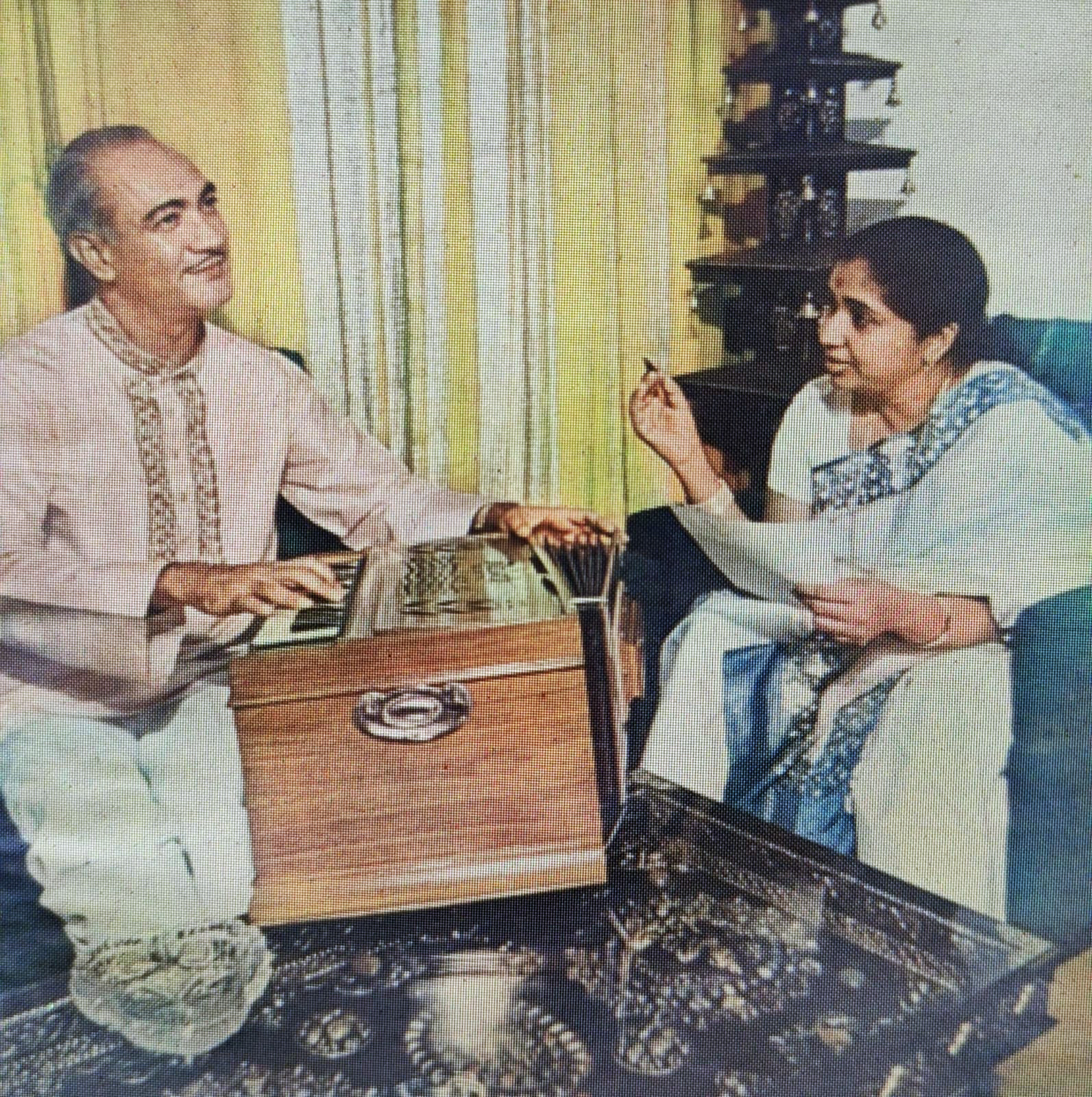
OP Nayyar and Asha Bhosle (Pic courtesy: SMM Ausaja Archives)
OPN had unwavering faith in the power of his tunes. When the system and style of harmonic arrangement with a large orchestra was becoming popular, he composed some songs that had neither a wide variety of instruments nor different interlude tunes. Still, these songs became popular and are cherished even today. When we observe carefully, we notice these elements, and yet those songs sustained themselves just on the strength of the melody. Let’s look at a few examples.
Leke pehla pehla pyar (CID, 1956)
Majrooh Sultanpuri / Shamshad Begum, Asha Bhosle, Mohd Rafi
Mid 50’s when the music arrangement was being influenced heavily by Jazz and Blues with string harmonies, OP Nayyar composed this song with just harmoniums, clarinets, and flute for interludes and dholak for rhythm. The rest of the magic was done by Shamshad Begum and Rafi’s renditions. The strength of the song was its melody, the tune.
Kabhi aar kabhi paar (Aar Paar, 1954)
Majrooh Sultanpuri / Shamshad Begum
The song has the same interludes for all the verses or antaras and a simple Punjabi theka of Keherwa taal on dholak. The power of the melody and singing of Shamshad Begum makes the song immortal.
Aap ke haseen rukh pe (Baharen Phir Bhi Aayengi, 1966)
Anjaan / Mohd Rafi
This beautiful composition is all about the expression of love. To enhance the impact of poetry, the composer relies solely on melody, with minimal orchestration. Brush on drums, interludes and fillers on piano, harmonies on flute and strings, and the impactful voice of Mohd Rafi are the main elements of these lovely songs.
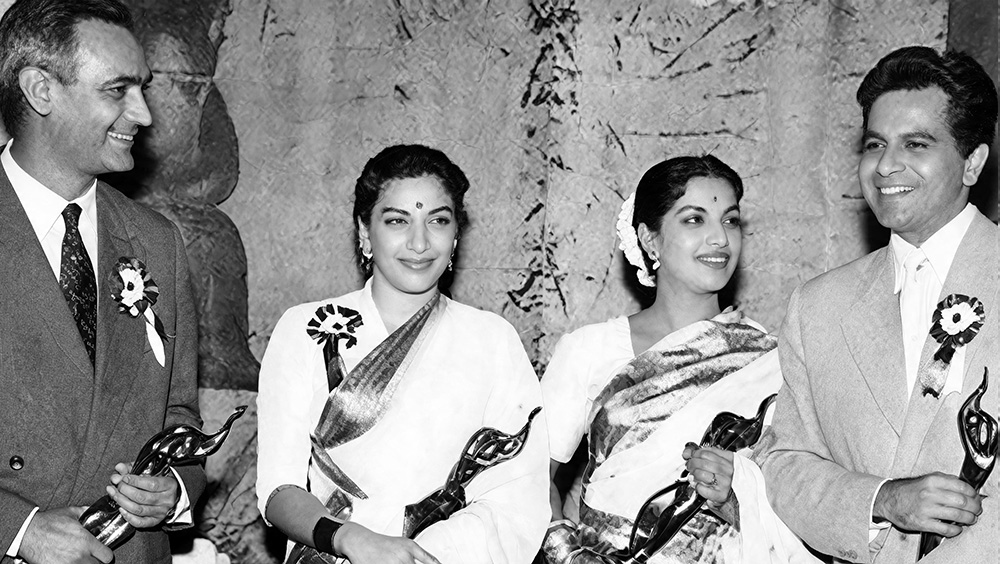
OP Nayyar with Nargis, Shyama and Dilip Kumar
There is no second thought about how the music directors of our Hindi films have evolved the sound of instruments over decades by blending two or more instruments of the same as well as different families. It is either a clarinet with a flute or using two clarinets together on different frequencies, or an accordion with a trans accordion, etc. Still, the charm of solo or single instruments in songs has never faded away. OP Nayyar has consistently used solo instruments prominently in his songs. His skilled use of solo instruments has enhanced the grace of sound. Let’s take a few songs, for example.
Isharon isharon mein dil lene wale (Kashmir Ki Kali, 1964)
S H Bihari / Rafi and Asha Bhosle
Bridges are melodic passages played on instruments between vocal sections. These bridges are very important, as a well-crafted small three-note or five-note bridge can enhance the melody to a great extent. OP Nayyar composed these bridges on solo instruments brilliantly in this song. In the first antara, Mere dil ko tum bha gaye, he used rubaab for the bridges. In the second antara, Mohabbat jo karte hain woh a single violin is used for the bridge. Its fluid and sweet sound intensifies the romance of the lyrics. Again, rubaab is used in third antara, Mana ke jaan-e-jahaan. This composition demonstrates how a composer conveys the emotional content of the lyrics through optimal instrumentation.
Lakhon hai yahan dilwale (Kismat, 1968)
S H Bihari / Rafi
If a tune of an interlude is catchy enough to enhance the sweetness of the song, its repeated use in the same song also does not matter. OP Nayyar and Shankar-Jaikishan both proved this logic successfully in multiple songs. This song is also another example of OP’s excellent musical taste. Almost all instruments in it are used solo. Right from the lead electric guitar, which plays the prelude and interlude tunes, accordion, which is used only once in the mukhda, and the flute, which is used for fillers in both antaras. However, the most important element is the use of solo violin in the interlude as harmony along with the guitar. The continual flowing sound of the violin complements the staccato (single) notes of the guitar. A classic and proven sound design.
Hai duniya usiki (Kashmir Ki Kali, 1964)
S H Bihari / Rafi
A very interesting highlight of this song is that the saxophone follows the tune of the sign line, i.e., sthayi, in the interludes, and the tune of the second verse, i.e., antara, is different from the first and third. The variation of music can also be in the tune, keeping the interludes the same. This is lateral thinking.
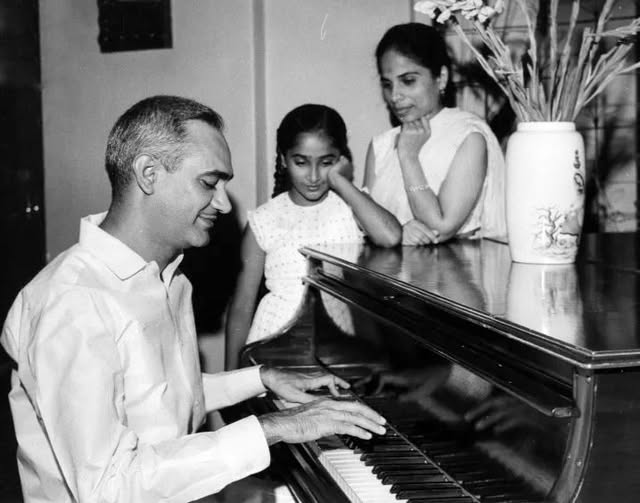
OP Nayyar with his wife Saroj Mohini and daughter in 1962 (Pic: Facebook)
The mid-50s to early 60’s was a period when music directors largely emphasised the grandeur of the melody section of the orchestra. Rhythm was mainly on dholak or tabla for mukhda and for interludes and sometimes for antara, contra bass or bongos were used. Of course, there were exceptions, but this pattern was largely observed in practice. OP Nayyar used a heterogeneous mix of Instruments. He used dholak, bass, bongos, and snare drums along with castanets in the same song. In many places, he made the castanet a primary instrument, which typically was used as a secondary percussion instrument. There are some interesting examples of his placement of rhythm instruments differently.
Boojh mera kya naam re (CID, 1956)
Majrooh Sultanpuri / Shamshad Begum
This song is a beautiful example of the cultural blend of instruments. The castanets, which are Spanish percussion instruments and predominantly used for dance numbers, were blended with the Indian dholak.
Aaiye meherban (Howrah Bridge, 1958)
Qamar Jalalabadi / Asha Bhosle
This is one of OP Nayyar’s most memorable and hit compositions. Its rhythm build-up consisted of bongos, dholak, Chinese blocks, contrabass, and tambourine; and in the antara, the pacy beats resume Indian Keherwa theka on dholak. Considering the prevailing trends of the time, this was indeed a brilliant experiment.
Meri neendon mein tum (Naya Andaz, 1956)
Jan Nisar Akhtar / Shamshad Begum and Kishore Kumar
This song depicts the taste of the composer in Indian classical music. The song has soft Waltz beats on double bass in the sthayi and interludes, but in the antaras, the beautiful and intricate taal dadra takes over on tabla, which enhances the melody.
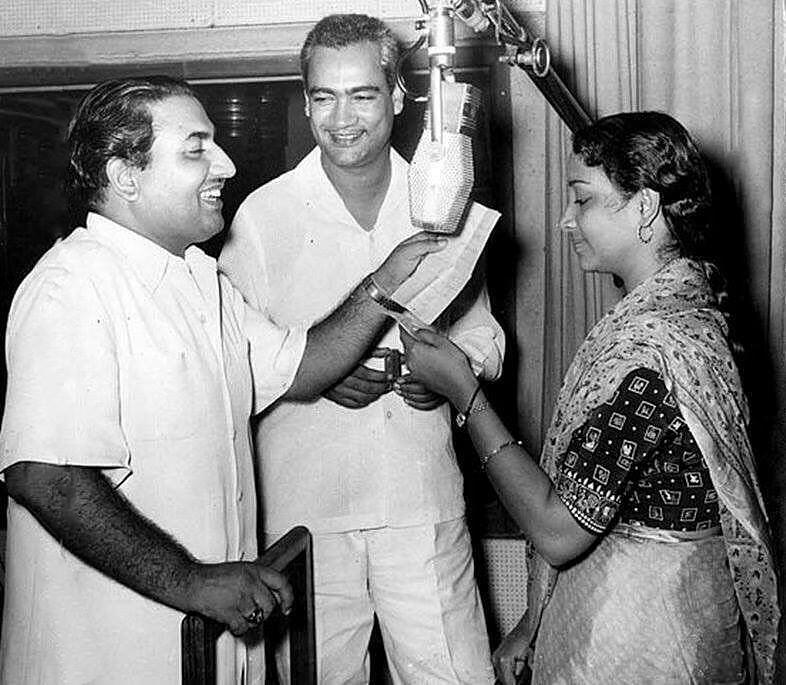
Rafi, OP Nayyar and Geeta Dutt (Pic: opnayyar.org)
OP Nayyar has uninhibitedly acknowledged that he had never received formal music training, and this was his biggest strength. Whenever a formally trained musician composes music, his systematically acquired knowledge and the grammar of the craft usually become his guiding light. Knowingly or unknowingly, the principles ingrained in his mind seldom allow him to make radical changes in the generally accepted practice of composing.
However, OPN did not have any preconceived notions. His way of composing music pieces had one peculiar style and that was using staccato notes. Let’s understand what a staccato note is. When a set of notes is played one by one, like a little child plays ‘Happy Birthday to You ’, it is called staccato. Trained musicians play notes in succession so that the tune sounds more fluid and melodious.
Imagine if a composer composes an interlude using staccato notes in a film song, how would it sound? Exactly the way the prelude or intro music of Boojh mera kya naav re on flute sounded. In one way or another, OP Nayyar used this style in many of his songs.
Let’s check out a few more songs where the staccato notes are beautifully used in music pieces.
Thandi hawa kali ghata (Mr and Mrs 55)
The prelude music that plays the tune of the song Thandi hawa kali ghata aa hi gayi jhoom ke on mandolin has staccato notes.
Zara haule haule chalo more saajana (Sawan Ki Ghata)
The interludes of this song are composed with staccato notes on a clarinet-and-flute combination called Tutti, with a background harmony of soft violins. This combination of staccato notes with continual harmony makes a soothing effect.
Dil ki awaz bhi sun (Humsaya)
The interludes of this song also use the same beautiful combination of staccato notes on piano and continual melody on strings. But here both piano notes and strings are in succession, and the contrasting sound of both styles sounds brilliant.
Ae ji dil par hua aisa jadoo (Mr and Mrs 55)
This is a prominent example of how staccato notes can be used in quick succession to create lovely music. The song’s connecting bridges in melody also have staccato notes. It goes like this –
Ae ji dil par hua aisa jaadu <staccato notes on flute>
Tabiyat machal machal gayi,
Nazarein mili kya kisi se <staccato notes on flute>
ke haalat badal badal gayi <staccato notes on flute>.
The interludes also follow the same pattern of notes. To compose a fun song, OPN used this technique of staccato very cleverly.
Ae ji dil par hua aisa jadoo (Mr and Mrs 55, 1955) OP Nayyar / Majrooh Sultanpuri / Mohd Rafi
Blues is a genre of Western music, typically identified by the use of half notes in the progression of the melody. A very close and similar reflection in Indian classical music is found in ragas like Todi, Marwa, Lalit, Puriya Dhanashree, Aahir Bhairav, etc., wherein the notes have a progression of half notes in their melodic passages. Some examples to understand this concept are Raina beeti jaaye, wherein the notes of beeti jaaye have a half-note progression. Typically, the use of half notes in such melodic phrases creates either an intense romantic effect or a sad effect. Such an effect is generated not only due to the use of only one half note but also due to the contextual note progression before and after the half note. The whole melody thus becomes a musical reflection of a somber mood.
OP Nayyar used the half note progression in his happy, romantic, and peppy songs in such a way that it enhanced the mood to the next level. This was his signature composing style. No other composer could have done it so beautifully. Some brilliant examples are –
Jaata kahan hai deewane (CID) the note on deewane
Bahut shukriya badi meherbani (Ek Musafir Ek Haseena) the note on Meri zindagi mein
Tum jo huve mere humsafar (12 O’Clock) the note on Mere humsafar
Hoon abhi main jawan (Aar Paar) the note on jawaan
A typical Hindi film music director’s responsibility is to compose songs as per the situation. From the beginning, once the tune is selected by the filmmakers, it was the composer who teamed up with lyricist, musicians, arrangers and sound recordists to compose and record the songs. The final output was always dependent on the composer’s creativity, with few exceptions. Those who were creative and had faith in their experiments made wonders. O P Nayyar was one among such artists. It would be very interesting to have a look at a few of his songs that had his touch of brilliance.
Haath aaya hai jabse (Dil Aur Mohabbat, 1968)
SH Bihari / Mahendra Kapoor and Asha Bhosle
This song is an expression of OP’s flamboyant style and nature, apart from its brilliant composition. He had always stood by his beliefs and philosophy, and that’s what is reflected in just one line of this song, which says Roshni zindagi mein mohabbat se hai, Varna rakha hai kya chandani raat mein. This was 1968, when it had been just twenty years since India gained independence. A girl having a conversation with her beau and giving him confidence was not a very usual thing. Here, the composer had his songwriter pen Ab na ghabrao manzil ki duri se tum, tum akele nahin, Main bhi hun saath mein.
Savere ka suraj tumhare liye hai (Ek Baar Muskura Do, 1972)
Indeevar / Kishore Kumar
In Hindi films, there are numerous examples of songs that are in the classical mould but filmed in a party scene. But this was 1972. Films were now processed in color. The effect of counterculture from the West had already slipped into the daily lives of people. A new breed of composers had started making rock-n-roll and brass-based party songs. However, for OP Nayyar, his conviction was supreme. For a party scene where the estranged lover expresses his agony through a song, OP had composed a beautiful song based on Raag Yaman Kalyan and set it on five beats Jhap Taal. The result was phenomenal. The song enhances the grace of the occasion and maintains the dignity of the girl in scene.
Pukarta chala hoon main (Mere Sanam, 1965)
Majrooh Sultanpuri / Rafi
Typically, an outdoor song with a romantic mood was composed with vibrant music and open throat singing by singers. Such was the expression expected by the filmmakers and audience. They wanted their hero to sing his heart out in picturesque settings for his love. OP thought differently. He made Mohd. Rafi sing this song in a rather softer tone and composed song with fewer instruments like mandolin, guitars, flute and soft strings harmony and his conviction had won. The song has become iconic today.
This is just a glimpse into the amazing music repertoire of the composer.
OP Nayyar was a phenomenon in itself. As an artist and composer, he never compromised on his terms to the extent that, when the taste and trend of music started changing in the early seventies, he refused to change his style and eventually slowed down. However, his work and contribution to film music offer much for young musicians to learn. He was a new wave in the soundscape of film music and left an enduring impact through his songs.
Pukarta chala hoon main (Mere Sanam, 1965) OP Nayyar / Majrooh Sultanpuri / Mohd Rafi
More Must Read in Silhouette
Discovering Guru Dutt Through His Films
Salil Chowdhury – A Continuum of Art

Whether you are new or veteran, you are important. Please contribute with your articles on cinema, we are looking forward for an association. Send your writings to amitava@silhouette-magazine.com

 Flashback 50 Years (Part II): OP Nayyar Hits of 1966 – Bahaarein Phir Bhi Aayengi
 Jan Nisar Akhtar – Of Romance and Hope
 Musically Yours, 1963
 The Incomparable Music Of S D Burman Transcends Generations
 ‘Deewana Mastana Hua Dil’ – Mesmerizing Music of SD Burman-Majrooh (Oct 1 Anniversary Special)
 Asha Bhosle: From Shadow to Spectrum
 Silhouette Magazine publishes articles, reviews, critiques and interviews and other cinema-related works, artworks, photographs and other publishable material contributed by writers and critics as a friendly gesture. The opinions shared by the writers and critics are their personal opinion and does not reflect the opinion of Silhouette Magazine. Images on Silhouette Magazine are posted for the sole purpose of academic interest and to illuminate the text. The images and screen shots are the copyright of their original owners. Silhouette Magazine strives to provide attribution wherever possible. Images used in the posts have been procured from the contributors themselves, public forums, social networking sites, publicity releases, YouTube, Pixabay and Creative Commons. Please inform us if any of the images used here are copyrighted, we will pull those images down.