Stay tuned to our new posts and updates! Click to join us on WhatsApp  & Telegram
  Channel
& Telegram Channel & Telegram Channel 




From his electrifying performances on the Marathi stage under the guidance of Vijaya Mehta to his unforgettable roles in Hindi and Marathi cinema, Nana Patekar has defied every attempt at categorisation. Sharvari Khatavkar traces his evolution as a versatile actor, his return to his Marathi roots, and his compassionate work beyond the screen, offering a glimpse of the intensity, conviction and humanity that define the man and the performer.
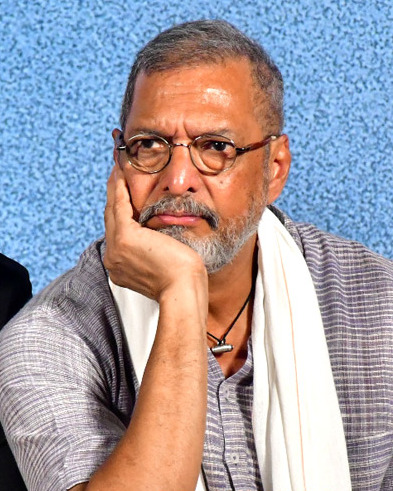
Nana Patekar (Pic: Wikipedia)
Nana Patekar began his career as a theatre actor under the tutelage of thespian theatre director-actor Vijaya Mehta. His role as Sattar dalal in Hamidabai chi Kothi, Digu in Mahasagar and Gulabrao in Purush gave him recognition in the early 1980s.
Hamidabai chi Kothi – a play based on the novel written by Anil Barve and directed by Vijaya Mehta, took the audience through the changing times in music and the lack of appreciation of classical and semi-classical genres post-independence. The protagonist was the tawaif. But characters such as Lukka dada (Ashok Saraf), his punter Sattar dalal (Nana Patekar), Saida (Bharati Achrekar) and Shabbo (Neena Kulkarni) were equally important. The play was released in 1978.
Mahasagar – was centred around the character of Digu, an insurance agent who loves to watch the elite lifestyle through his college friends, Ghanshyam and Sumi, but realises that money is not the ultimate goal in life, and that it does not bring happiness. The entire play was directed from the ‘point of view’ of this character. He talks to the audience, directs them to think in a certain way, and expresses his strong opinion between the dialogues – an innovative way to keep the audience connected to the plot. Nana’s versatile performance as Digu will be remembered by generations to come.
But the role that established Nana as a confident actor was the character of Gulabrao in Purush, a character who is hated throughout the play. Dirty politics, the link between the sugar lobby of Maharashtra and the industrialists, the debilitated education system, and the suffocation of the common man – these social challenges were the core of this play. Nana, playing the politician who is accused of rape and is yet arrogant and defiant, gave goosebumps to the audience. His entry itself was power-packed – the audience sat silent, stunned by just the sound of his chappals. Of course, Nana gave all the credit of his performance to Vijaya bai. It was her visualisation of the character that made the original character powerful.
Purush was released in 1982. It ran triumphantly for 2000 shows.
Both Mahasagar and Purush were based on novels by legendary novelist and playwright Jaywant Dalvi. In Mahasagar, Dalvi wanted to present a middle-class person’s point of view on the life of the elite. And in Purush, the character was a representative of a society where women’s voices were taking charge, yet not fully. Nana was a budding artist, a fast and gifted learner. His characterisation of Gulabrao gained him decisive roles later in the Hindi film industry.
The Angry Character of Hindi Cinema
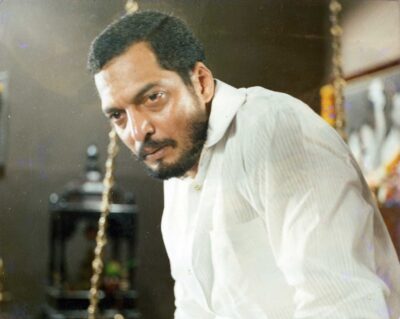
The powerful Anna in Parinda
Amitabh Bachchan may be called the ‘angry young man’ of Hindi cinema. But Nana Patekar was that angry character in Hindi movies, who made the audience restless through his gaze, facial expressions, and ease in delivering dialogues, sans the song and drama around the character.
In Parinda and Agni Sakshi, we saw the hysterical side of the human character through his performances. Prahar showcased the internal struggle of a retired army officer trying to find balance between the deteriorating value systems in society and his training as an officer, and his search for his own identity in the changing times. He had undergone rigorous military training for three years before they started shooting for Prahar. Madhuri Dixit, who was at the peak of her career, agreed to go without her regular make-up for the role of Shirley just because the film was written and directed by Nana Patekar.
But can Nana Patekar be confined to only negative roles or serious ones? Certainly not! His major cinematic successes in Hindi were slapstick comedies like Welcome and Welcome Back! To those who had seen him as an actor in Marathi theatre, him doing such films was a shocker. But that is what made him a versatile actor. He never became typecast in Hindi.
The character artist in him could be seen in Ab Tak Chhappan and Khamoshi – The Musical.
Return to Home Pitch
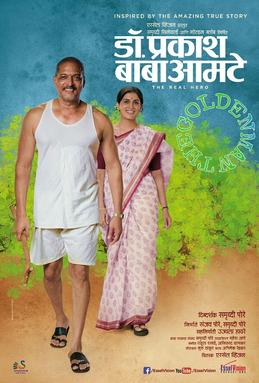
Dr. Prakash Baba Amte – The Real Hero (2015) poster
Among Nana Patekar’s many National and Filmfare Awards and other accolades for his work in Hindi cinema, his performances in Marathi cinema stand out as some of his greatest triumphs. His work in Dr Prakash Baba Amte – The Real Hero (2015) and Natsamrat (2016) earned him Maharashtra State Film Awards for both films.
Nana shouldered the responsibility of portraying the character Dr Prakash Amte (the doctor and educator son of Dr Baba Amte), like nobody else. People of Maharashtra respect the Amte couple for their work. Knowing that every scene in the film would be watched closely by Dr Prakash Amte and his wife themselves, it was a very difficult task. But he did it brilliantly.
The character of Ganpatrao Ramchandra Belwalkar as Natasamrat (King of Theatre) has been portrayed by many a stalwart actor on the Marathi stage before Nana. He had admitted frankly on several occasions that his understanding of the character was based on the acting by Dr Shriram Lagoo, Datta Bhat and Satish Dubhashi for Natasamrat. Yet, he made Natasamrat immortal in Marathi cinema. Powerful dialogues, marked by linguistic excellence and penned by the legendary novelist and playwright V V Shirwadkar, better known as Kusumagraj, demanded to be delivered with the necessary punch, intensity and emotional depth. Nana Patekar’s commanding performance rose to the challenge, giving every line its full dramatic force while capturing the anguish, pride and vulnerability of the character. He was not a man of many retakes. He would get his shot ‘okayed’ in the first take itself!
Nana Patekar, The Philanthropist
Nana was known to be the man of the soil. He, along with actor Makarand Anaspure, founded ‘Naam Foundation’ as a response to the apathy towards the devastating conditions of farmers of Maharashtra, caused by droughts and a constant water crisis.
He donated his entire remuneration he obtained for his performance in the movie Paathshaala to five different charitable organisations.
He had served in the Maratha Light Infantry regiment during the Kargil War in 1999.
Final Farewell
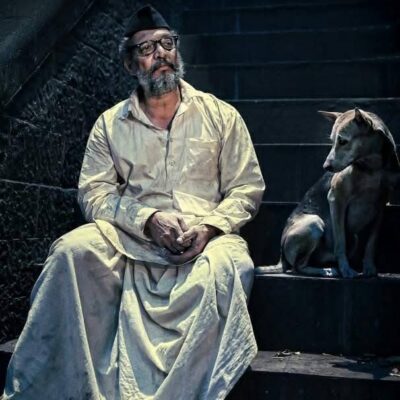
Nana Patekar in and as Natsamrat
Vijaya Mehta shared one incident about the play in her autobiography – Jhimma:
“Nana became a popular actor in Hindi cinema after the success of Gulabrao (Purush). People used to come to watch just Nana on stage. His entry got a thundering applause, even whistles! Dialogues of other actors like Chandrakant Gokhale, Usha Nadkarni and Rima Lagu could not be heard properly in this. It had become difficult to maintain a balance of joy of the play with popularity!
Nana had himself come up with a solution. Just before the play began (after the third bell), he used to come on stage and address the audience in his typical graceful style:
I am Nana Patekar. Whoever has assembled here to watch me, may please do so, along with shouting and whistling. Once the curtain rises, this should stop. If this continues, it will be an insult to Chandrakant Gokhale, Rima Lagu, Usha Nadkarni and other actors in the play, as well as that section of the audience which has come here to watch the play. It will be my insult too! Remember, the person whom you see in the play is not Nana Patekar. He is Gulabrao. Kindly do not disturb the flow of the play. Whoever does not like the play, may please go. Do not disturb others.
Interestingly, Nana’s audience used to sit obediently like good kids. In my career, I have seen many kinds of relationships between the actors and their audiences. This was one of its kind.”
More Must Read in Silhouette
Om Puri – The Luminance of a Natural Actor
Asit Sen: The Director Who Became an Unforgettable Comedian
Traversing the Two Worlds of Mainstream and Art: Shashi Kapoor’s Unexampled Journey

Whether you are new or veteran, you are important. Please contribute with your articles on cinema, we are looking forward for an association. Send your writings to amitava@silhouette-magazine.com

 Common Threads Between Bollywood’s Queens of Hearts
 Beyond Apu: 20 Favourite Film Roles of Soumitra Chatterjee Launched
 Nathicharami: A Journey of Self-exploration
 Guide, The Film: Perspectives – A Very Well-Crafted Treasure of a Book
 Srikanth: A Biopic with Heart and Hope
 I Can Act in Any State of Mind: Soumitra Chatterjee Interview
Silhouette Magazine publishes articles, reviews, critiques and interviews and other cinema-related works, artworks, photographs and other publishable material contributed by writers and critics as a friendly gesture. The opinions shared by the writers and critics are their personal opinion and does not reflect the opinion of Silhouette Magazine. Images on Silhouette Magazine are posted for the sole purpose of academic interest and to illuminate the text. The images and screen shots are the copyright of their original owners. Silhouette Magazine strives to provide attribution wherever possible. Images used in the posts have been procured from the contributors themselves, public forums, social networking sites, publicity releases, YouTube, Pixabay and Creative Commons. Please inform us if any of the images used here are copyrighted, we will pull those images down.


































































Powerfully written about a powerful man. Nana was not just a powerful actor. He was a man of this soil who used his contacts, money and fame to bring justice to the farmers. Sharvari has brought out his versatility in acting in a way that allowed me to reminisce the various roles of Nana Patekar.
Very well penned Sharvari as always!