Stay tuned to our new posts and updates! Click to join us on WhatsApp  & Telegram
 Channel
& Telegram Channel & Telegram Channel 




Vinod Kapri speaks about Pyre – a film about an elderly couple in one of the almost-deserted villages in the Himalayas. A Silhouette interview by Amitava Nag.

Vinod Kapri’s Pyre is a film about an elderly couple in one of the almost-deserted villages in the Himalayas. It is about their daily life, the hardships of living in such a difficult terrain and an arduous wait for their estranged son. Evocative, deeply sensitive and extremely nuanced, Pyre is undoubtedly one of the most cinematic Indian films of the last few years.
Silhouette Editor Amitava Nag speaks to its director Vinod Kapri about the film and its making.

Vinod Kapri
Amitava Nag: You have mentioned that Pyre was inspired by a real-life encounter during a trek in Munsiyari. What about that meeting convinced you this story needed to be told?
Vinod Kapri: I travelled to Munsiyari in 2018 with Ashok Da. During that trip, I met an elderly couple who had around 30–40 goats. The woman was unwell, and the man told me something that stayed with me. He said that as long as he had his goats, his wife would survive. The goats were his source of income, and that income enabled him to arrange for people to carry his wife downhill whenever she needed medical attention.
I also asked them what their biggest worry in life was. The husband said, “My biggest worry is who will take care of her if I die before her. She cannot go into the forest and cut wood.” His wife had an equally simple but deeply moving worry. She said, “I worry about who will feed him because he doesn’t know how to cook.”
I found these answers extraordinary. Two people who had spent their lives together were not worried about themselves. Their biggest fears were about what would happen to the other person after one of them was gone.
It was such a simple expression of love, but it also revealed the extraordinary vulnerability of people living in remote mountain communities.
I kept thinking about that couple. What does companionship mean when you have spent an entire lifetime together? What happens when old age, loneliness and circumstances leave you with nobody but each other?
That encounter stayed with me for years. Eventually, it became the emotional starting point for Pyre. I felt this was a story that deserved to be told, not because it was extraordinary in its circumstances, but because it was universal in its emotions.
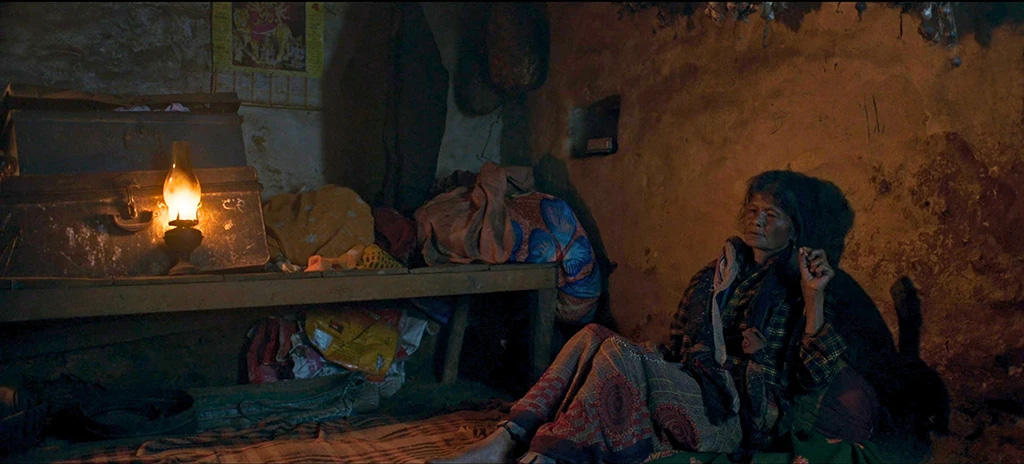
Amitava: Why did you cast local non-actors Padam Singh and Hira Devi? How did you find them?
Vinod: I must have met and considered almost 40–50 people before I found Padam Singh and Hira Devi. They were not professional actors. Padam Singh was a retired Army havildar, and both of them came from the same mountain region.
I was not looking for people who could act. I was looking for people who could simply be themselves in front of the camera. I wanted their faces to carry the experiences of their lives, their silences to feel natural and their relationship to have the familiarity that comes from spending decades together.
Hira Devi was initially hesitant. She wasn’t sure whether she wanted to do this. Eventually, her son persuaded her.
We spent time building their comfort with the camera. We rehearsed scenes and recorded those rehearsals on mobile phones, so they could gradually become familiar with the process.
What you see in Pyre is not two people trying to imitate elderly characters. It is two people bringing their own lived experiences, physicality and emotional truth to the screen. I think that is what gives the film its authenticity.

Amitava: The title Pyre carries immense weight. How did you direct your lead actors through such emotionally difficult scenes?
Vinod: I never wanted Padam Singh and Hira Devi to feel that they were performing something emotionally demanding. In fact, my approach was almost the opposite.
There was also something interesting about their own lives. Padam Singh had no children, and Hira Devi had lost her husband 24 years earlier. They were living with circumstances that, in many ways, echoed the emotional situation of the film.
I simply told them that they did not need to worry about acting. They just had to live their lives the way they normally did. I wanted them to be themselves, to behave naturally and to bring their own experiences into the film.
The situation in the film is heartbreaking, but I didn’t want to manufacture heartbreak through dramatic acting, loud dialogues or exaggerated expressions.
For me, the most powerful emotions are often the ones people don’t express. A look, a pause, a small gesture or simply sitting next to someone can sometimes communicate much more than a long emotional monologue.
The title Pyre, or Chita, is deliberately stark. But the film is not about death as much as it is about life, companionship and the fear of being left alone. I wanted the audience to discover that emotional weight gradually.

Amitava: The film has a naturalistic rhythm, with everyday sounds, arguments, rain and thunder. How did you design its meditative pacing?
Vinod: I think the biggest mistake one can make while telling a story about loneliness is to rush through it.
Pyre is about two people who have spent 28 years waiting for their son. Imagine what 28 years of waiting does to two human beings. It becomes part of their everyday existence. It enters their conversations, their silences, their arguments and even their routines.
I wanted the audience to experience time rather than simply watch a story unfold.
I also deliberately wanted rain, thunderstorms and lightning to become important characteristics of the film. I have grown up in Uttarakhand, and since childhood, whenever I am there and it starts raining, with thunder and lightning, I have this overwhelming feeling that the world is going to end in the next few seconds.
The mountains can make these natural elements feel incredibly powerful and frightening. I wanted the audience to experience that same feeling.
The bickering between Amma and Bubu, their small disagreements, the sounds of the house, the rain, the thunder and the surrounding landscape are not merely atmospheric elements. They are part of their lives.
I deliberately resisted the temptation to make every scene dramatic. Life does not come with background music or dramatic punctuation. It moves at its own pace. I wanted the film to respect that rhythm.

Amitava: Tell us about your collaboration with cinematographer Manas Bhattacharya.
Vinod: Manas Bhattacharya understood very early that the mountains in Pyre could not simply be beautiful backgrounds. They had to become an integral part of the storytelling.
We did not want to photograph the Himalayas like a conventional travel film. Their beauty is undeniable, but they can also be intimidating, indifferent and isolating. The landscape had to reflect the emotional world of Amma and Bubu.
Our visual approach was deliberately restrained. In many scenes, we chose to hold a single shot without cutting. I wanted the characters to enter the frame, move through it and sometimes leave from the other side, without the camera interrupting their lives.
I felt that whatever was happening to Amma and Bubu was already so devastating and dramatic in itself that it did not need additional drama created through excessive cuts or editing.
The camera had to observe them, give them space and allow the audience to spend time with them. We wanted the audience to feel physically present in their world.
Manas brought enormous sensitivity to this process. What makes his contribution particularly special is that he came on board because he fell in love with the script. He did an extraordinary amount of work for the film, almost without charging anything.
That kind of commitment is rare, and I remain deeply grateful to him.

Amitava: Shooting at over 7,000 feet in the Himalayas must have presented enormous technical challenges. What were the biggest hurdles?
Vinod: Actually, we did not shoot Pyre in Munsiyari. We shot the film in Berinag, which is my native village. It is also the village of Padam Singh and Hira Devi.
The entire film unit stayed in the village throughout the shoot. We lived there without basic facilities, including proper toilets. It was a very different experience from a conventional film production.
The biggest challenge was the terrain. Every day, we had to walk three to four hours to reach our shooting locations. This was not something we could avoid. The locations were in remote parts of the mountains, and reaching them was an everyday challenge for the entire crew.
Weather was another major challenge. Mountain weather can change very quickly, particularly when you are working with natural light.
And then there was the leopard.
There are a lot of leopards in that region, and the danger was always present. During the shoot, we had a dog named Sheru who stayed with us throughout. He became part of our little film family. After we completed the shoot, we came to know that Sheru had been killed by a leopard.
That news was heartbreaking. We have dedicated Pyre to Sheru.
I think these experiences became part of the film’s journey. We did not want to recreate the mountains. We wanted to live in them, work in them and allow them to become part of our story.

Amitava: How did you collaborate with Mychael Danna on the music for this deeply local Kumaoni story?
Vinod: One of the things I was very conscious of was that Pyre should never lose its local identity while trying to become universal.
I had been following Mychael Danna’s work and was particularly drawn to his sensibilities. He is a Canadian composer, but he has a remarkably rooted understanding of Indian culture and sensibilities.
Apart from his Hollywood projects, he has been associated with some wonderful films connected to India, including Life of Pi, for which he won the Academy Award, as well as Monsoon Wedding, Water and Fire.
I wanted someone who could understand the Indian emotional and cultural landscape, while also giving the film a universal musical appeal.
I did not want the music to explain the emotions to the audience. I wanted it to complement them. There are moments when music can deepen an emotion, but there are also moments when silence is far more powerful.
For me, the challenge was to ensure that the score respected the stillness of the mountains and the intimacy of the relationship between Amma and Bubu.
Mychael’s contribution gave the film an emotional dimension that I am extremely happy with.

Amitava: Pyre is an independent and self-funded film. How did budget constraints affect the production?
Vinod: First, I would like to clarify that Pyre was not a crowdsourced film. It was an independent film, completely produced by me.
I exhausted virtually all my savings to make this film. I even had to sell my car and a plot of land to finance the production.
There were obvious limitations. We could not operate with the luxury of a large studio production or an unlimited shooting schedule. We had to plan every resource very carefully.
But I have never believed that limited resources necessarily mean limited imagination. Some of the most interesting creative decisions emerge when you are forced to think differently.
The challenges did not end when the film was completed. In fact, the next big challenge was getting it to international film festivals. We did not have a sales agent or an established international distribution network. We simply started submitting the film, and it began getting selected on its own merit. The awards followed.
Looking back, it has been an extraordinary journey for a film made with such limited resources. It certainly wasn’t easy, but I would not trade the independence and creative freedom we had for anything.

Amitava: How has your background in broadcast journalism influenced your filmmaking?
Vinod: I spent two decades in journalism, working with news organisations including Zee News, Star News, India TV and TV9.
Journalism teaches you to observe people. It takes you into places and situations that you would probably never encounter otherwise. More importantly, it teaches you to listen.
Over the years, I have met people from different walks of life, heard their stories and witnessed situations that have stayed with me.
I think that instinct has naturally travelled into my filmmaking.
I am drawn to stories that emerge from real lives. I am interested in ordinary people placed in extraordinary circumstances, but I don’t want to sensationalise their experiences.
Whether it was Pihu, 1232 Kms or Pyre, my starting point has always been a human story. I think my journalistic background has made me more attentive to the small details of human behaviour. And cinema, for me, is ultimately about those details.

Amitava: Has the international festival journey helped Pyre’s domestic theatrical release? What challenges did you face?
Vinod: The international festival journey certainly brought recognition to Pyre. The film travelled to several prestigious festivals across Europe, North America and Asia, and won 18 international awards, including several Best Film awards.
But, honestly, that recognition did not make its theatrical release in India any easier. In fact, the situation was quite frustrating. No OTT platform was willing to acquire the film, and no studio was ready to come forward and release it theatrically.
I was deeply troubled by this contradiction. Here was a film receiving international recognition, winning awards and being appreciated by audiences and filmmakers, yet we could not find a platform or a studio willing to take it to Indian audiences.
At one point, I was almost hopeless about the film’s future.
Then my partner, who is now also a producer of Pyre, Arindra Roychowdhury, stepped in. He got in touch with Suresh Joshi, a London-based businessman. When Suresh watched the film, he loved it so much that he felt it deserved a theatrical release. He believed in the film and wanted audiences to experience it in cinemas.
So, in many ways, Pyre is getting its theatrical release today because of two things: the international recognition it received, and the persistence of Arindra, who refused to give up on the film, along with Suresh’s vision and determination to take it to the next level.
We are extremely happy that the film is doing so well after its theatrical release.
And today, I sometimes feel that perhaps it was a blessing in disguise that no OTT platform acquired the film earlier. Had that happened, it might never have received the kind of recognition, audience response and love that it is receiving today. There is something truly special about audiences discovering this film together in a cinema hall.

A still from Pihu
Amitava: Your films Pihu and 1232 Kms also explore isolation and survival. What draws you towards such characters?
Vinod: I don’t consciously sit down and decide that my next film must be about isolation or survival.
I think I am drawn to people who find themselves in situations where the usual support systems disappear. People who are pushed to the margins, sometimes by circumstances and sometimes by society.
What interests me is how human beings respond when they are left with very little.
In Pihu, it was a child trapped in a situation she could not understand or control. In 1232 Kms, it was migrant workers undertaking an extraordinary journey during a national crisis. In Pyre, it is an elderly couple confronting loneliness, ageing and the uncertainty of what lies ahead.
These are very different stories, but they share an interest in human resilience and vulnerability.
I don’t think cinema always needs larger-than-life heroes. Sometimes, the most extraordinary stories belong to people whose lives the world barely notices.
I want to tell those stories.

A scene from 1232 Kms
Amitava: Tell us something about your next project.
Vinod: I currently have four or five scripts ready, but I haven’t yet decided which one I will take forward as my next film.
I am still weighing my options and trying to decide which story I feel most strongly about at this point.
But one thing I can say with certainty is that my next film, too, will come from the Indian Himalayas.
I think there are still so many stories from that region waiting to be told. And I would love to continue exploring that world through cinema.

Whether you are new or veteran, you are important. Please contribute with your articles on cinema, we are looking forward for an association. Send your writings to amitava@silhouette-magazine.com

 Dadamoni: Playing God
 Performativity and Politics: Ray and Ghatak
 Jagte Raho: A Night of Truth
 Two Legends and Their Lives: Uttam Kumar Suchitra Sen
 Why Stories Work: Indepth Analysis and Insights into the Extraordinary Power of Stories
 15 Park Avenue: Mithi’s Magic Mind – A Human and Scientific Exploration
Silhouette Magazine publishes articles, reviews, critiques and interviews and other cinema-related works, artworks, photographs and other publishable material contributed by writers and critics as a friendly gesture. The opinions shared by the writers and critics are their personal opinion and does not reflect the opinion of Silhouette Magazine. Images on Silhouette Magazine are posted for the sole purpose of academic interest and to illuminate the text. The images and screen shots are the copyright of their original owners. Silhouette Magazine strives to provide attribution wherever possible. Images used in the posts have been procured from the contributors themselves, public forums, social networking sites, publicity releases, YouTube, Pixabay and Creative Commons. Please inform us if any of the images used here are copyrighted, we will pull those images down.