Stay tuned to our new posts and updates! Click to join us on WhatsApp  & Telegram
  Channel
& Telegram Channel & Telegram Channel 




Amitava Nag looks at five films — Champadangar Bou (1954), Agni Pariksha (1954), Harano Sur (1957), Marutirtha Hinglaj (1959) and Bicharak (1959) — that showcase Uttam Kumar’s staggering range as a thinking actor and help define his career.
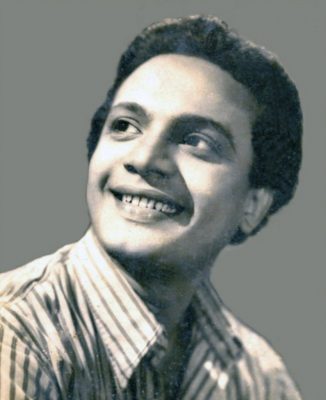
Uttam Kumar
Few decades shaped Bengali cinema as decisively as the 1950s. It was a period when post-Independence Bengal was negotiating the trauma of Partition, the pressures of urbanisation, the decline of the landed aristocracy, and the emergence of a new middle-class culture. Bengali cinema mirrored these transformations through films that moved fluidly between literary adaptations, social melodramas, romances, psychological dramas and historical narratives. At the centre of this cinematic renaissance stood Uttam Kumar, whose emergence fundamentally altered the language of Bengali popular cinema.
It would not be an exaggeration to say that, within a short span, Uttam would conjure the Bengali mind like none of his predecessors. So, it would be a grave injustice after nearly seven decades if, even if popular culture attempts to do so, we reduce Uttam Kumar to just a romantic hero opposite Suchitra Sen.
In this article, we will look at five films — Champadangar Bou (1954), Agni Pariksha (1954), Harano Sur (1957), Marutirtha Hinglaj (1959) and Bicharak (1959) — that showcase his staggering range as a thinking actor and help define Uttam’s career.
The Bengal of the 1950s was only emerging from the misfortunes of the previous decade. The first blow had come in the form of the Bengal Famine (1943-44), followed by the devastation of the Partition in 1947 and the consequent displacement of millions of refugees. West Bengal was a young, newly-formed state. New ideas and inspirations were shaping up — in 1951 the first IIT was set up at Kharagpur, less than 150km from Kolkata; Visva Bharati, the institute with a difference founded by Rabindranath Tagore, got the status of a Central University the same year, along with the Government College of Art and Craft; IISWBM, the country’s first management institute, was set up two years later while Jadavpur University became a fully developed State University in 1955. Yet, as the small, medium and large-scale industries drifted away from the banks of the river Hooghly, food and habitat crises deepened. The Bengali soul was battered and bruised. In this milieu, cinema, along with theatre, became one of the principal cultural spaces where these anxieties and hopes could find solace.
Unlike Hindi cinema, which increasingly favoured spectacle and musical extravaganza, Bengali cinema maintained a close relationship with literature. Adaptations from the works of literary stalwarts such as Tagore, Sarat Chandra Chattopadhyay, Bibhutibhushan Bandyopadhyay, Tarashankar Bandyopadhyay and others ensured that actors had opportunities to portray psychologically layered characters.
Uttam Kumar’s growth as an actor coincided perfectly with this literary and social environment. Even as he ventured into increasingly varied psychological and social roles, Uttam never lost the emotional accessibility that endeared him to mainstream audiences. This balance became one of his defining strengths.
Among Uttam’s early achievements, Champadangar Bou, adapted from Tarashankar Bandyopadhyay, remains one of the most revealing examples of his versatility. Unlike the sophisticated urban romantic persona that would later become associated with him, here he inhabits the rhythms of rural Bengal.
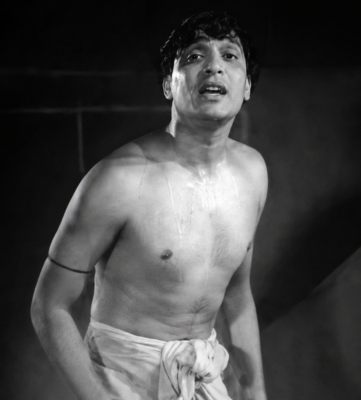
Uttam Kumar as village simpleton in Champadangar Bou
The film comes at a formative moment in his career — just a year after Sharey Chuattor (1953) established him as a romantic lead, and the same year as Agni Pariksha, which cemented his stardom opposite Suchitra Sen. Here, in yet another film of Nirmal Dey after Basu Paribar (1952) and Sharey Chuattor, Uttam plays Mahatap, the irresponsible younger brother in a joint family drama, his nature in deep contrast to his stern elder brother Setap.
Champadangar Bou explores social relationships within a traditional village community where honour, land, family prestige and interpersonal conflicts shape everyday life. Uttam consciously suppressed his emerging star persona and rendered Mahatap with restraint. Notably, for the first time, this was a morally ambiguous role — a charming, feckless young man with a hint of inappropriate devotion to his sister-in-law Kadambini, resulting in a familial scandal. It must be noted that the film revolved around Kadambini, her inner conflict and resolution; hence Uttam’s histrionics needed to be harnessed in the right measure. Portraying a village youth, clad in only a dhoti for most of the film, not only do Uttam’s physical gestures match the character’s local and social positioning, but his dialect and hurried delivery also correspond to his milieu.
What strikes the viewer is not emotional intensity but restraint. Uttam repeatedly eschews the obvious dramatic gesture, allowing Mahatap’s uncertainty to emerge through hesitation rather than declaration. Many actors, early in their careers, attempt to dominate scenes through overt emotional display. Yes, he is outspoken at times because the character demands that he be temperamental, fickle-minded. But, within the mores of rural patriarchal social realities, Mahatap is equally vulnerable. With ordinary gestures, silences and muted expressions, Uttam underplays Mahatap’s character.
Uttam’s performance is an endorsement of his staggering range beyond his matinee-idol charisma, which was yet to show its finest colours. Nabajanma (1956), directed by Debaki Bose, comes immediately to mind as a comparison. Here too, Uttam plays a village youth, a simpleton whose affection for his childless sister-in-law is misinterpreted by the family. But, in Bose’s film, Uttam’s character, a kirtan singer, gets the backing of lilting songs to uplift his image to that of a misunderstood hero. Mahatap’s uniqueness is that the character doesn’t get this necessary fillip from either the scriptwriter or the director, and yet shines through.
In the years to come, Uttam would anchor many of his characters with a subtlety generally unseen in the works of several Bombay superstars with whom he was compared. Through Mahatap, Uttam established that he was as much a character actor as a romantic hero. The act of subsuming his star image into a character would achieve greater sophistication in later years, as Uttam mastered his craft.
The Uttam–Suchitra (Sen) pair first appeared in the comedy riot Sharey Chuattor where they were duly noted, but the focus of the film lay elsewhere. Their on-screen chemistry led producers to cast the duo in films such as Ora Thake Odhare, Maraner Pare, Sadanander Mela and Grihaprabesh, the very next year (1954). If Champadangar Bou revealed Uttam Kumar the actor, Agni Pariksha created Uttam Kumar the superstar. Based on a story by Ashapurna Debi, the film, directed by Agradoot, transformed Bengali romantic cinema and formally established the Uttam–Suchitra pairing as Bengali cinema’s most legendary one.
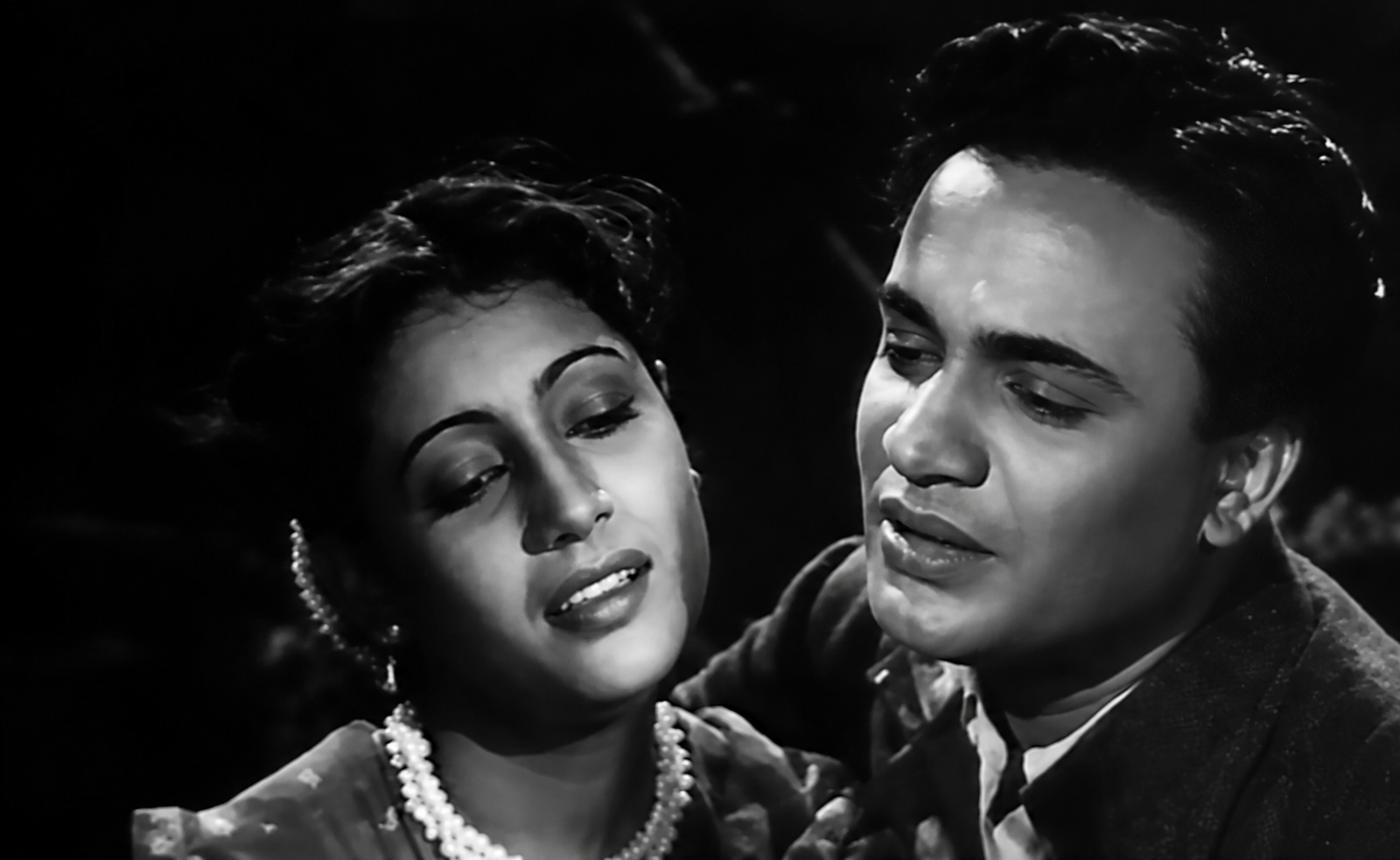
A patient and empathetic companion – Uttam Kumar in Agni Pariksha with Suchitra Sen
The narrative revolves around a childhood marriage that resurfaces unexpectedly in adulthood. Beneath its romantic framework lies a serious engagement with questions of identity, women’s consent and the conflict between tradition and modernity.
Unlike in some of his previous films, here Uttam plays an engineer who has inherited vast wealth. This social difference and the behavioural traits envisioned by the director enabled Uttam to be less extroverted than he had been in some of his earlier characters. Instead of Mahatap’s conflict-ridden angst, Kiriti is patient and warm. He is a gentle man who is more caring than pursuing, attentive, yet not intense. It would not be wrong to say that this element of unhurried naturalism is what Uttam brought to Bengal’s silver screen. Heroes before Uttam, most notably Pramathesh Barua, despite his naturalistic acting, were mostly declamatory; the roles and dialogues theatrical and melodramatic. In Uttam and Suchitra, the camera found a genial sophistication that highlighted not only the warmth of their togetherness but also transferred that warmth to their audience.
Through Kiriti, Uttam balanced his character’s confidence with emotional restraint. He complemented it with his romantic gaze, a hesitant expression of unrequited love and gentle humour — traits that would go on to define Uttam’s brand of onscreen masculinity in Bengali cinema, quite different from what one found in Hindi or Tamil cinema. Unlike Barua or Asit Baran, Uttam developed a soft voice for his dialogue delivery, especially for romantic scenes. Through pauses, silences and an affectionate tone, Uttam developed a unique style of romantic acting that he only changed much later [while doing the elderly roles in the 70s].
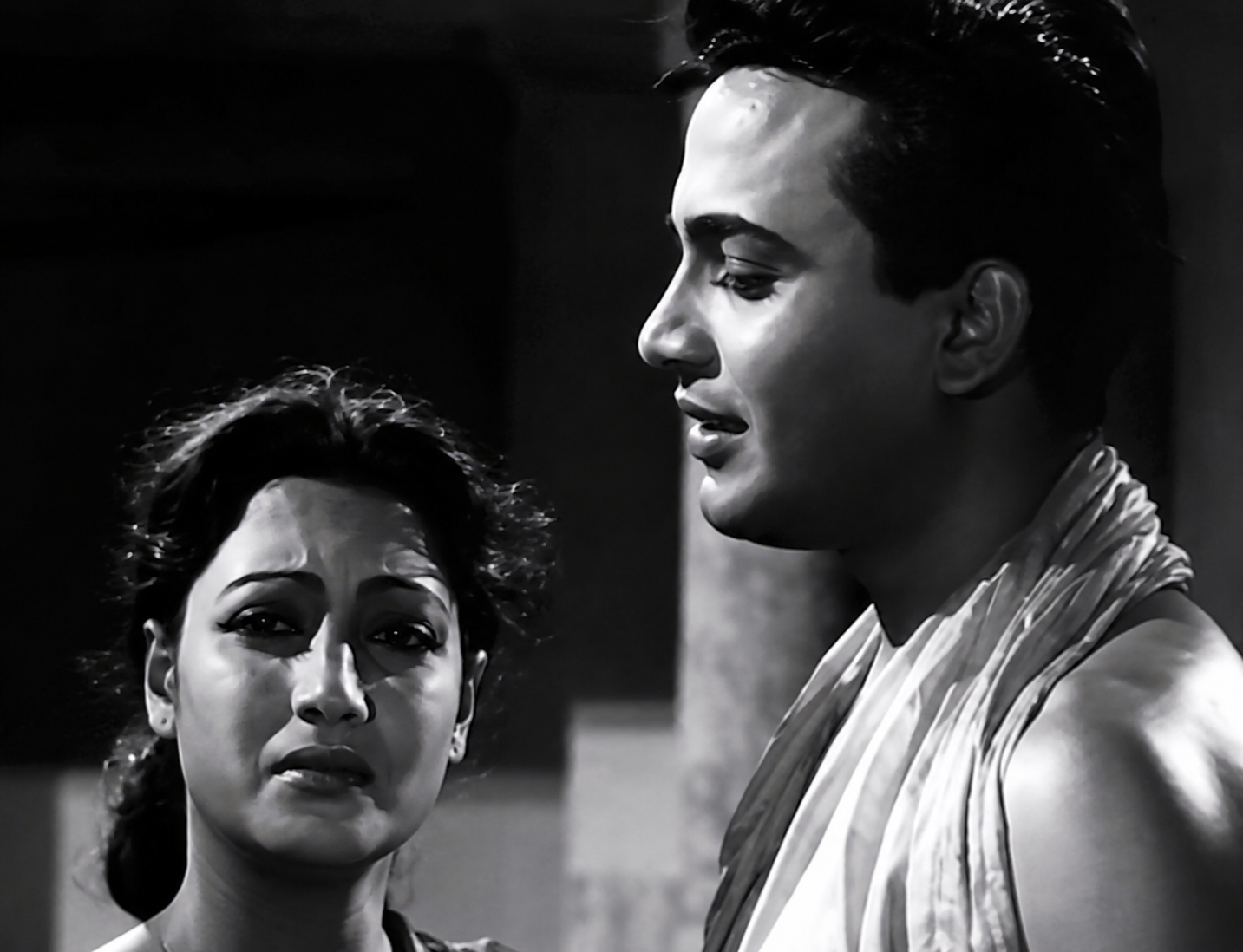
In Uttam Kumar and Suchitra Sen, the camera found a genial sophistication
In 1967, when Uttam made his foray into Hindi cinema as a producer and hero, he chose Agni Pariksha as a template to fall back on. Alas, Uttam couldn’t fathom the shift from a cultured Bengali articulation to a pan-Indian penchant for excess in the intervening years. Chhoti Si Mulaqat was a resounding flop. It drained Uttam financially and left him a broken man.
However, it would be unkind and even incorrect to say he couldn’t produce a successful film. Ten years before his ill-fated venture into Hindi films, Uttam had formed his own production company, Alochhaya Production Pvt. Ltd. His first film Harano Sur was Bengali cinema’s biggest box-office success in 1957; it won the Certificate of Merit for the third-best feature film in Bengali at the 5th National Film Awards, 1958.
Directed by Ajoy Kar and starring Uttam Kumar and Suchitra Sen, Harano Sur was loosely based on Random Harvest (1942). Borrowing the basic theme of memory lost and regained, Kar successfully moored it to a distinctly Bengali cultural experience. To the Indian mind, the film may well recall Kalidasa’s ‘Abhijnanashakuntalam’ involving Shakuntala and King Dushyanta, in which a similar narrative of memory and identity is the focal point.
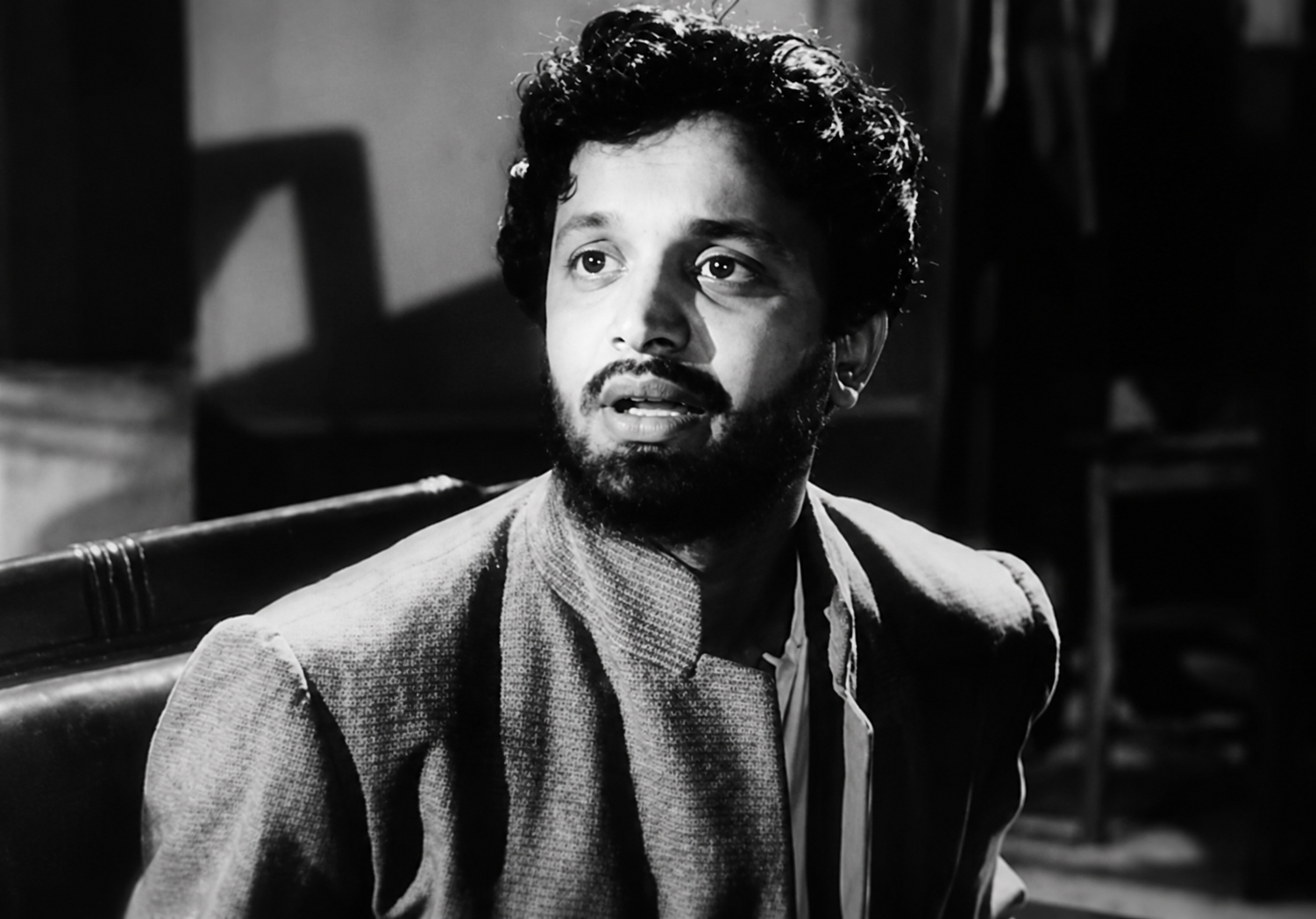
A man who has lost his memory – Uttam Kumar in Harano Sur
Like Agni Pariksha, Harano Sur is essentially a film from a woman’s perspective — her sacrifice, ordeal and endurance in a socio-familial space where she is not subservient to man. This must be noted as one of the defining facets of Bengali cinema and culture. It also helps us understand the role of the hero and the representation of his masculinity, which is significantly different from one that was generally depicted in mainstream Hindi cinema.
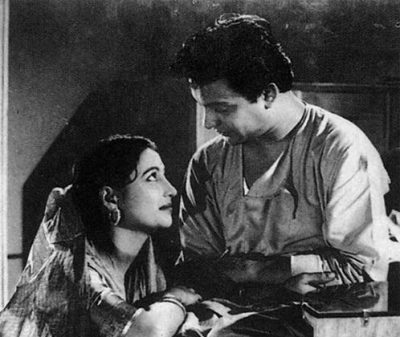
The quintessentially romantic hero
In playing essentially two different characters in the two halves of the film, Uttam could convey, with equal perfection, the confusion and fragility of Aloke while suffering from amnesia as well as his confident and worldly self when he regains his memory and moves to Kolkata.
Ajoy Kar, who was primarily a cinematographer, lent his photographic eye whenever he directed. In his cinema, right from Jighansa (1951), there was the masterful use of chiaroscuro reminding us of Hollywood films. In Harano Sur, he would extend this low-key lighting to make the cinematography more evocative. Also, unlike in Agni Pariksha, for example, in Harano Sur, Kar’s camera would hold Uttam’s face in close-up more, illustrating the latter’s understanding of cinematic close-ups and his ability to express his emotions through facial articulation.
While Uttam’s romantic stardom ascended with his pairing with Suchitra Sen, it is with the other heroines, notably Sabitri Chatterjee, that he would venture into uncharted territories. As early as 1959, Uttam’s refusal to remain confined to romantic stereotypes was demonstrated in several films such as Bicharak, Abaak Prithibi (1959) and Gali Theke Rajpath (1959). The last two paired Uttam with Sabitri as his love interest. That same year, in Marutirtha Hinglaj based on Abadhuta’s celebrated eponymous travelogue and directed by Bikash Roy, Uttam paired once again with Sabitri. He played Thirumal, a role for which he almost entirely eschewed glamour.
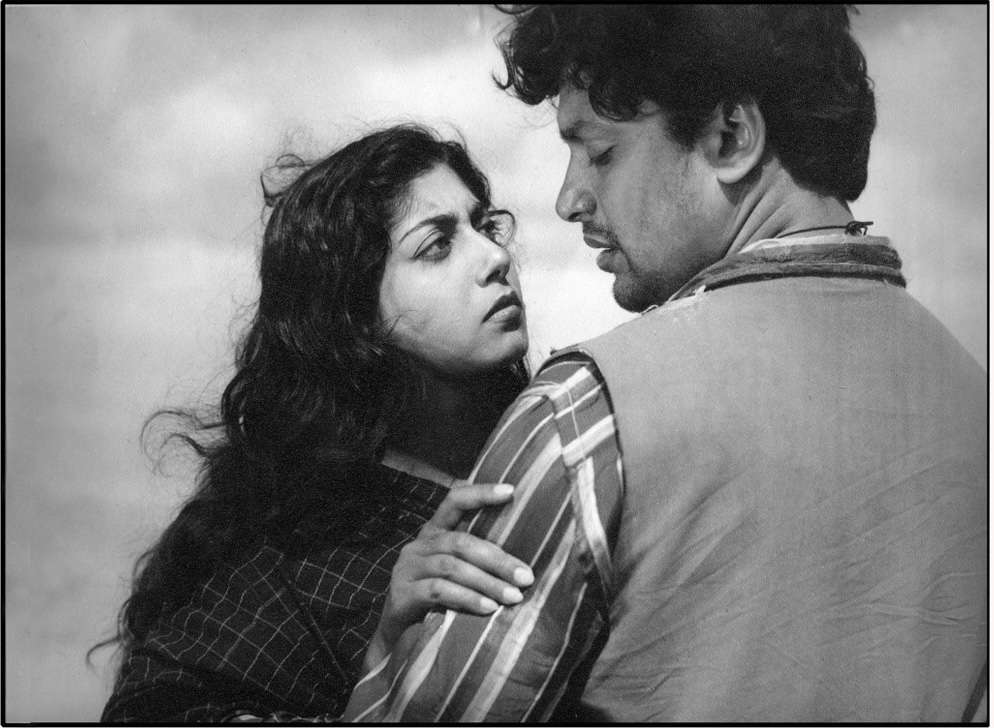
The vulnerable and impulsive Thirumal – Uttam Kumar in Marutirtha Hinglaj
Marutirtha Hinglaj narrates the story of the arduous pilgrimage to the sacred shrine of Hinglaj, situated in present-day Balochistan. It explores the boundaries of faith, the limits of human suffering and endurance and redemption from mortal sins. The journey, as depicted in the film, across the harsh desert is strenuous —both physically and spiritually.
Thirumal is psychologically scarred, restless and impulsive. His eyes convey an inner conflict he is trying to flee.
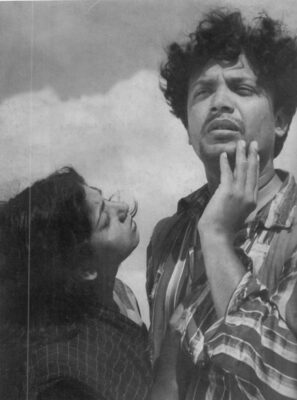
Thirumal’s eyes convey an inner conflict he is trying to flee.
While Uttam had perfected an understated style of acting for his romantic roles, he had to forgo the gentle introspective inwardness in his characterisation of Thirumal. As Thirumal, Uttam brings energy and expression, which is typically not the Bengali ‘bhadralok’ prototype.
Interestingly, Uttam’s introductory scene in the film occurs slightly late; the camera focuses on his back throughout. In this scene, he is shown fighting with one of the desert thugs. It successfully establishes Thirumal’s character — physical, contradictory, vulnerable. A decade later, Satyajit Ray would use the same trope to introduce the superstar in Nayak (1966) — the camera focusing on the rear of Uttam’s head to set a tone of introspection and inscrutability. Importantly, Thirumal is a violent man. He tries to kill his lover Kunti, his emotional and mental balance disturbed, and dies in the end — qualities that are not exactly befitting the image of a matinee idol.
Marutirtha Hinglaj has an ensemble cast. Uttam’s finesse as an actor lies in never trying to overshadow his other co-actors with his charisma. He was comfortable playing character roles that were far removed from the conventional mould to which directors had confined him.
While Harano Sur established Uttam’s psychological sophistication as an actor, Bicharak, made two years later, confirmed his ability to portray moral ambiguity. Harano Sur traced the two avatars of the hero — revolving around a very common trope in commercial cinema, memory lost and regained. The actor had to traverse two mental states to make the character believable. In Bicharak, the contrast was different — it was between two ages: one young, shy and romantic; the other, mature, successful and reflective. Directed by Prabhat Mukherjee and adapted from a novel by Tarashankar Bandyopadhyay, Bicharak departs from the romantic persona that had made Uttam Bengal’s most celebrated star. In the younger role, Uttam could deliver, as in several of his earlier films, a brand of serio-comic acting which endears the hero to the public and makes him fallible. But in Bicharak, Uttam’s success as an actor lies in the older character, that of a judge haunted by the possibility that he may himself have committed a moral crime many years earlier.
The brilliance of Uttam’s performance lies in rendering Gyanendra, the judge, as an ambiguous character. Gyanendra is neither innocent nor guilty; it’s his moral dilemma that places him somewhere between intention and action. Hence, it is never fully revealed whether he consciously desired his wife’s death or whether he had merely failed to overcome a fatal moment of hesitation, fearing for his own physical safety when their house was on fire.
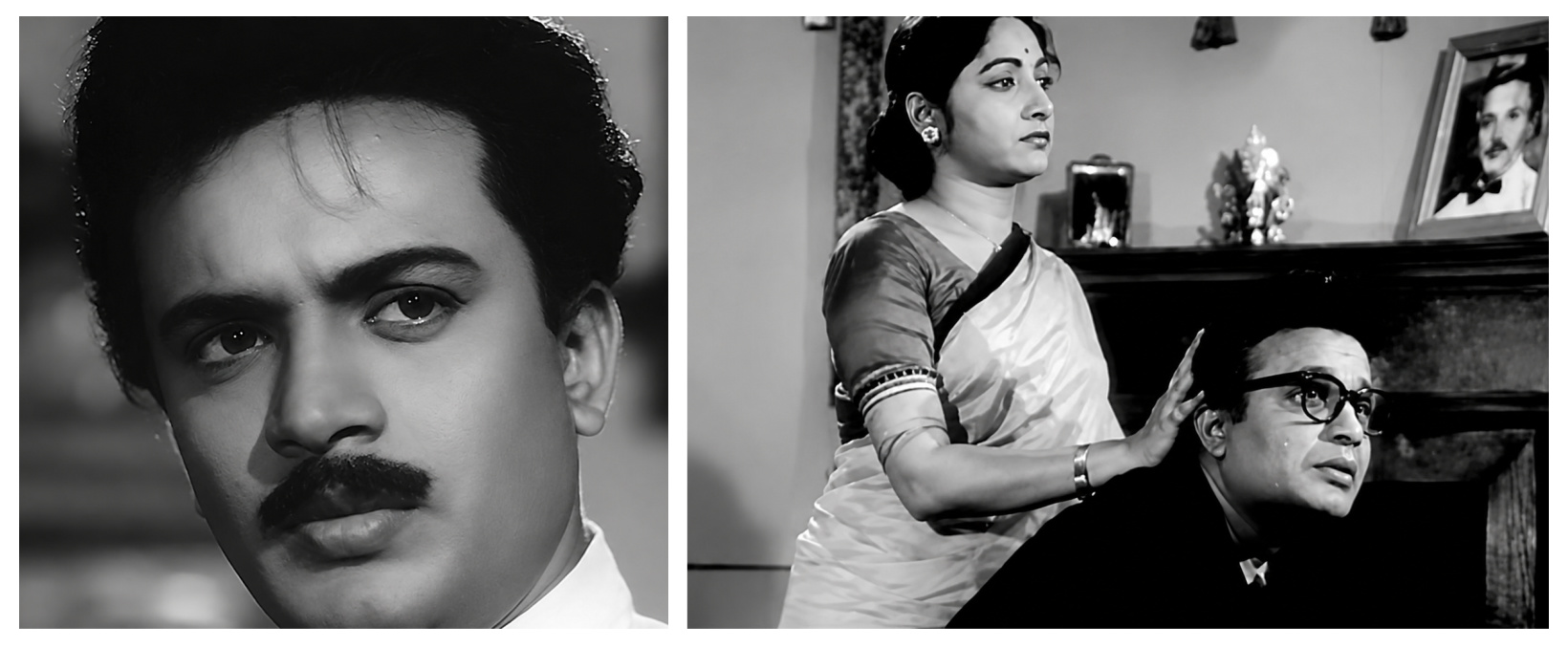
The two stages of life as the young and the middle-aged – Uttam Kumar in Bicharak
Credit must go to the director’s vision and to Uttam’s restraint in resisting the temptation to burst out when overcome by guilt. Uttam used restrained facial expressions, prolonged silences and thoughtful pauses to express both his quandary and his inner conflict. It must be noted that the hallmark of Uttam’s histrionics in the 1950s was the restraint with which he could pursue a heroine or face the mirror with equal elan.
We must also remember that an actor is ultimately a director’s puppet, as famously mentioned in Ray’s Nayak. So, any acting – good, mediocre or poor – is indirectly the responsibility of the director conceiving the character, as well as the actor’s vision in fleshing it out. However, it is an actor’s choice to select roles, whether it is to maintain the status quo or to challenge it from time to time. With Bicharak, in the very first decade of his career, Uttam showed signs of breaking away from a stereotype as a romantic hero.
This cannot be emphasised enough. From Raj Kapoor, Dilip Kumar and Dev Anand in Hindi cinema to Gemini Ganesan in Tamil, Akkineni Nageswara Rao in Telugu, and Prem Nazir in Malayalam cinema — none of the romantic heroes of the 1950s could muster the courage to play characters far advanced from their physical age, nor could they pull it off with such dignity and creative expertise. In retrospect, it seems quite extraordinary that Uttam thought of portraying a character almost twice his age when he was in his early 30s.
He did it again in Khokababur Pratyabartan (1961).
Taken together, these five performances make one point difficult to ignore. Uttam Kumar did not merely become Bengal’s greatest romantic star during the 1950s; he quietly expanded the range of what a popular Bengali screen actor could be. He consistently rejected theatrical declamation in favour of conversational realism. Yes, there had been realistic acting on screen before him, but the examples, including that of Yogesh Chowdhury, were few and far between. Among the heroes, though Barua didn’t have any ties to the stage, it was with Uttam that realistic dialogue delivery dawned on the Bengali screen. Indeed, in that decade and in the two that followed, Uttam did act theatrically many a time, but that only proves the inability of the director or screenwriter to leverage Uttam’s natural talent to communicate through gestures and facial expression.
To understand the Bengali psyche is to understand the brand of romance that Uttam projected on screen — masculine dominance making way for emotional reciprocity. More importantly, as these films showcase, Uttam could move effortlessly between rural realism and urban sophistication, from court-room moralism to psychological ambivalence, from village youth to a judge in the city. This versatility is probably unseen on the Indian screen, before and after Uttam.
As these films disappear and surviving prints become increasingly unfit for proper viewing, we are reminded of the damage wrought by the era’s self-appointed ‘serious’ film societies and magazines. For the film society intelligentsia, mainstream Bengali cinema scarcely merited serious attention. Ignoring the fact that film aesthetics are far from monolithic, their critical gaze fixated on European auteurs, leaving little room for sustained engagement with the changing dynamics of Bengali popular cinema. They also remained curiously silent about Uttam Kumar’s evolution as an actor, rather than merely a star. It was only after Satyajit Ray cast him in Nayak that these self-styled intellectuals seemed to awaken to his talent. Yet, as with so many Ray films, the acclaim flowed first to the director and only then to the actor.
But through these films and many more, Uttam Kumar demonstrated, almost single-handedly, that stardom rests not merely on glamour but on his ability to step inside the intricate emotional, social, and ethical dimensions of being human.

Whether you are new or veteran, you are important. Please contribute with your articles on cinema, we are looking forward for an association. Send your writings to amitava@silhouette-magazine.com

Silhouette Magazine publishes articles, reviews, critiques and interviews and other cinema-related works, artworks, photographs and other publishable material contributed by writers and critics as a friendly gesture. The opinions shared by the writers and critics are their personal opinion and does not reflect the opinion of Silhouette Magazine. Images on Silhouette Magazine are posted for the sole purpose of academic interest and to illuminate the text. The images and screen shots are the copyright of their original owners. Silhouette Magazine strives to provide attribution wherever possible. Images used in the posts have been procured from the contributors themselves, public forums, social networking sites, publicity releases, YouTube, Pixabay and Creative Commons. Please inform us if any of the images used here are copyrighted, we will pull those images down.