Stay tuned to our new posts and updates!
Click to join us on WhatsApp


Arthshila Patna is much more than a contemporary art gallery. It is a thoughtfully designed cultural space where visual art, literature, architecture, and conversation come together in perfect harmony. Every floor offers something new to discover, making the visit less about admiring artworks and more about reflecting on the ideas, emotions, and stories they quietly unfold.
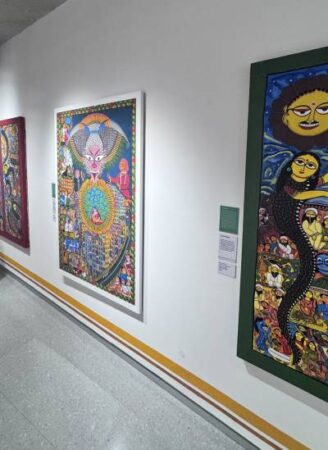
Every corridor at Arthshila leads to a new way of seeing.
Some places impress you the moment you step inside. Others reveal themselves slowly, asking for patience before they leave an impression.
Arthshila belongs to the latter.
I walked in expecting to spend an hour browsing a few galleries. Instead, I found myself wandering from one floor to another, stopping longer than I had planned before paintings, installations, and sculptures that seemed less interested in providing answers than in beginning conversations.
Perhaps that is the finest compliment one can offer an art gallery. It does not tell you what to think. It simply gives you enough to think about.
At a time when our attention is constantly pulled in different directions, spending an afternoon in a place that quietly encourages observation feels almost unfamiliar. There are no flashing distractions demanding your attention. Instead, there is space to pause, absorb, and return to an artwork because it continues to reveal something new.
That quiet rhythm defines Arthshila Patna. It transforms a gallery visit into something more personal, where every visitor is free to discover a different meaning within the same work of art.
Arthshila Patna invites you to slow down
Spread across five thoughtfully designed levels, the building unfolds like a carefully composed narrative. A performance theatre, an open-air amphitheatre, and three dedicated gallery floors coexist within the same space, creating an environment where different forms of artistic expression naturally complement one another.
Unlike galleries that overwhelm visitors with sheer volume, Arthshila allows each exhibition enough breathing room. The generous layouts encourage slow movement, making it possible to spend several minutes with a single artwork without feeling rushed by the space itself.
There is something deeply refreshing about that.
We have become accustomed to consuming everything quickly, whether books, films, photographs, or even entire cities. Art asks for the opposite. It rewards those willing to linger, to notice details, and to revisit an image after walking away from it.
Arthshila understands this beautifully.
Rather than directing visitors along a fixed path, it allows them to wander naturally between floors, discovering moments that feel entirely their own. One person may find themselves captivated by a striking installation. Another may stand silently before an abstract painting, searching for meaning that refuses to arrive immediately.
Both experiences feel equally valid.
Arthshila Patna reminds us that contemporary art is deeply human
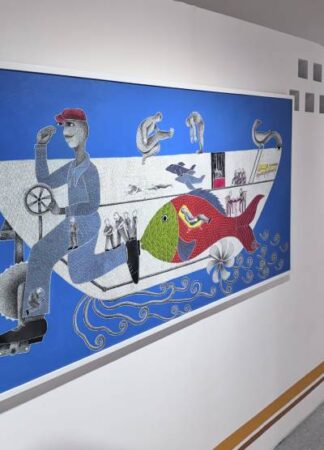
Every canvas begins a conversation that continues in the mind.
For many people, contemporary art still carries an unnecessary reputation for being difficult or inaccessible. There is often a fear that every artwork demands specialised knowledge or an “expert” interpretation before it can be appreciated.
The exhibitions at Arthshila gently challenge that assumption.
Featuring works by several prominent contemporary artists from across the country, the galleries explore themes that touch everyday life in surprisingly intimate ways. Nature appears not merely as landscape but as something increasingly fragile. Gender diversity and equality emerge through stories that celebrate identity rather than reducing it to debate. India’s cultural diversity is represented not through stereotypes but through deeply personal artistic expressions rooted in memory, tradition, and lived experience.
The result is an exhibition that feels remarkably generous.
It never insists upon a single interpretation. Instead, it leaves room for visitors to bring their own experiences into conversation with the artworks.
That openness is what makes the experience memorable.
You may admire one painting for its colours while someone else responds to the emotions hidden beneath its surface. Neither response is more correct than the other.
The gallery quietly reminds us that art has never been about agreement. It has always been about dialogue.
When architecture becomes part of the experience
One of the most striking aspects of Arthshila is that the building never competes with the artworks, yet it constantly enhances them.
Natural light, open interiors, carefully planned transitions between galleries, and thoughtfully designed spaces create an atmosphere where moving through the building becomes an experience in itself.
Every staircase feels like a pause between chapters. Every new floor offers a different rhythm. The galleries breathe instead of crowding the visitor, allowing each exhibition to establish its own mood before leading naturally into the next.
Without realising it, you begin walking more slowly.
And perhaps that is exactly what good architecture is meant to do.
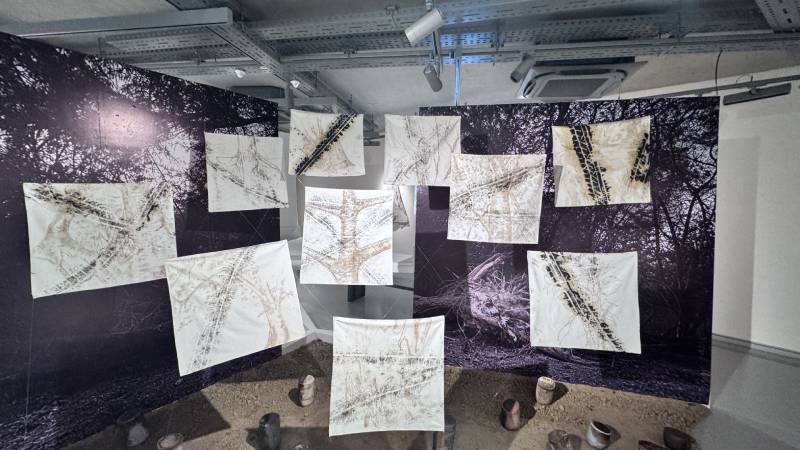
Art, nature, and memory merge into a single immersive experience.
A bookstore that quietly becomes part of the story
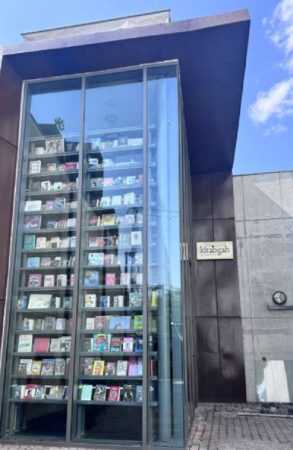
Kitabgah invites you to linger long after you’ve finished browsing.
Every memorable cultural space seems to have a corner that persuades you to stay just a little longer. At Arthshila, that corner is Kitabgah.
Constructed almost entirely with towering glass panels, the bookstore feels bright, airy, and wonderfully unhurried. It is not simply a place to buy books. It is a place to browse without purpose, to pick up a title out of curiosity, to flip through a few pages, and perhaps leave with an author you had never heard of before.
The transparency of the glass walls gives the space an openness that mirrors the spirit of the gallery itself. Just as the artworks invite multiple interpretations, the shelves encourage exploration without expectation. There is no pressure to rush through the aisles or search for a particular title. The joy lies in the act of discovering.
In many ways, Kitabgah extends the conversation begun in the galleries. The paintings provoke questions, and the books quietly offer countless paths through which those questions might continue to unfold.
For anyone who believes that art and literature are inseparable companions, this little sanctuary feels like an experience in itself.
Arthshila Patna proves that conversations often continue over coffee
There is a reason cafés have always found a home beside bookstores, theatres, and galleries. Creativity has a habit of lingering, and conversations need a place to breathe.
Roots Café provides exactly that.
After wandering through exhibitions that invite reflection, sitting down with a cappuccino feels less like a break and more like the final chapter of the visit. The transition from gallery to café is seamless. The mind is still occupied with colours, forms, and ideas, while the body finally slows down.
Some visitors discuss their favourite artworks with friends. Others sit alone, watching the world pass by through the windows. Both experiences feel equally complete.
It is easy to underestimate how important such spaces are. Art rarely reveals itself all at once. Sometimes it takes a quiet conversation over coffee, or even a few moments of silence, before an artwork begins to make sense.
Roots Café understands that the experience of art does not end at the gallery door. It simply changes form.
Why spaces like this deserve our attention

Some artworks stay with you long after you’ve left the gallery.
Across India, conversations around culture often revolve around celebrated museums, historic monuments, and internationally recognised institutions. While these undoubtedly deserve admiration, equally important are the newer cultural spaces that are quietly reshaping how people engage with contemporary art.
Their significance lies not only in the artworks they exhibit but in the communities they cultivate.
A student visiting out of curiosity. A family spending an afternoon together. An artist searching for inspiration. A reader wandering into a bookstore after exploring a gallery. A traveller looking for something beyond the usual tourist itinerary. All these journeys intersect in places like Arthshila.
That is what makes such spaces valuable.
They remind us that culture is not confined to history books or preserved behind glass. It is living, evolving, questioning, and constantly inviting participation. It belongs as much to first-time visitors as it does to seasoned art enthusiasts.
Perhaps the greatest achievement of a gallery is not that it displays remarkable art, but that it encourages people to look at the world a little more carefully after they leave.
When you leave, the gallery comes with you
The most memorable journeys are rarely measured by the number of photographs we bring back. They are remembered because they alter the way we notice ordinary things afterwards.
That was the lasting impression Arthshila Patna left on me.
Long after the exhibitions were behind me, I found myself thinking about the questions they raised, the stories they hinted at, and the quiet confidence with which they allowed every visitor to arrive at their own understanding. The paintings remained inside the galleries, but the conversations travelled home with me.
Perhaps that is what distinguishes a meaningful cultural space from an ordinary attraction. One entertains you for an afternoon. The other gently changes the way you see the world.
In the end, Arthshila Patna is not simply a destination for people who appreciate contemporary art. It is a place for anyone willing to slow down, embrace curiosity, and rediscover the simple pleasure of looking a little longer. And in an age where almost everything competes for our attention, that invitation feels more valuable than ever.
More Must Read in LnC
Sahir Ludhianvi: The People’s Poet
Main Dekhoon To Sahi Duniya Tumhe Kaise Sataati Hai
Those Songs Were Made from the Soul: A Musical Cab Ride
Ghazal, and Its Place in Music


Got a poem, story, musing or painting you would like to share with the world? Send your creative writings and expressions to editor@learningandcreativity.com
Learning and Creativity publishes articles, stories, poems, reviews, and other literary works, artworks, photographs and other publishable material contributed by writers, artists and photographers as a friendly gesture. The opinions shared by the writers, artists and photographers are their personal opinion and does not reflect the opinion of Learning and Creativity- emagazine. Images used in the posts (not including those from Learning and Creativity's own photo archives) have been procured from the contributors themselves, public forums, social networking sites, publicity releases, free photo sites such as Pixabay, Pexels, Morguefile, etc and Wikimedia Creative Commons. Please inform us if any of the images used here are copyrighted, we will pull those images down.