Stay tuned to our new posts and updates!
Click to join us on WhatsApp


Ratnottama Sengupta traces the social impact of Vande Mataram! – the 150-year-old salutation that inspired resistance to the Raj, and continues to inspire jubilant Gen Z.
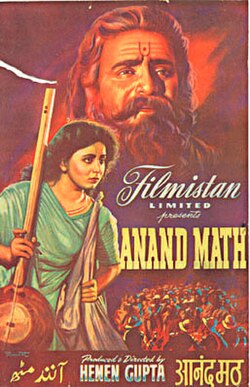
Anand Math (1952) poster
In November 2025, Anand Math was screened as part of the Kolkata International Film Festival. It so happened that the year marked the centenary of Pradeep Kumar (1925-2001), who played the pivotal role of Jivanand in the classic film directed by Hemen Gupta. I remembered it most for the song by Lata Mangeshkar set to music by Hemant Kumar. As I stepped up to introduce the movie, I was reminded that the screening was to celebrate 150 years of Vande Mataram.
These two words, coined 150 years ago, had reached hearts, touched souls, and fanned the love for freedom. And once that was attained, the salutation continued to resonate in the hearts of the children of the motherland and recharged the soul of a resurgent India.
That evening I’d gone home and sat leafing through Eka Naukar Jatri/ Journey of a Lonesome Boat, the autobiography of my father, Nabendu Ghosh. Let me to recount a passage where he takes us back to his preteen years.
“Those days two related words would course through my mind every waking hour – Swadesh and Vande Mataram.
In Bankim Chandra’s Anand Math, the patriotic Santan Dal used to sing this anthem. I too considered myself a Santan – Son – of Mother India. Because, by then, I had mastered the reading of newspaper every morning. Thus I was aware that Bharatvarsh was rising to claim Independence and the British Imperialists were bent upon curbing the desire with iron hand. The nationalists were being thrown into prison, or even sent to the gallows. So I would sing only to myself, ‘Vande Mataram! I salute thee, O Mother! You are the strength in my arms, You spell Devotion in my heart. Yours is the icon I’ve installed in every temple…’
Vande Mataram. The mere slogan was as powerful a weapon for every Indian who dreamt of ousting the Britishers – as was Gandhiji’s Khadi, or Sarat Chandra’s novel Pather Daabi.”
—xxx—
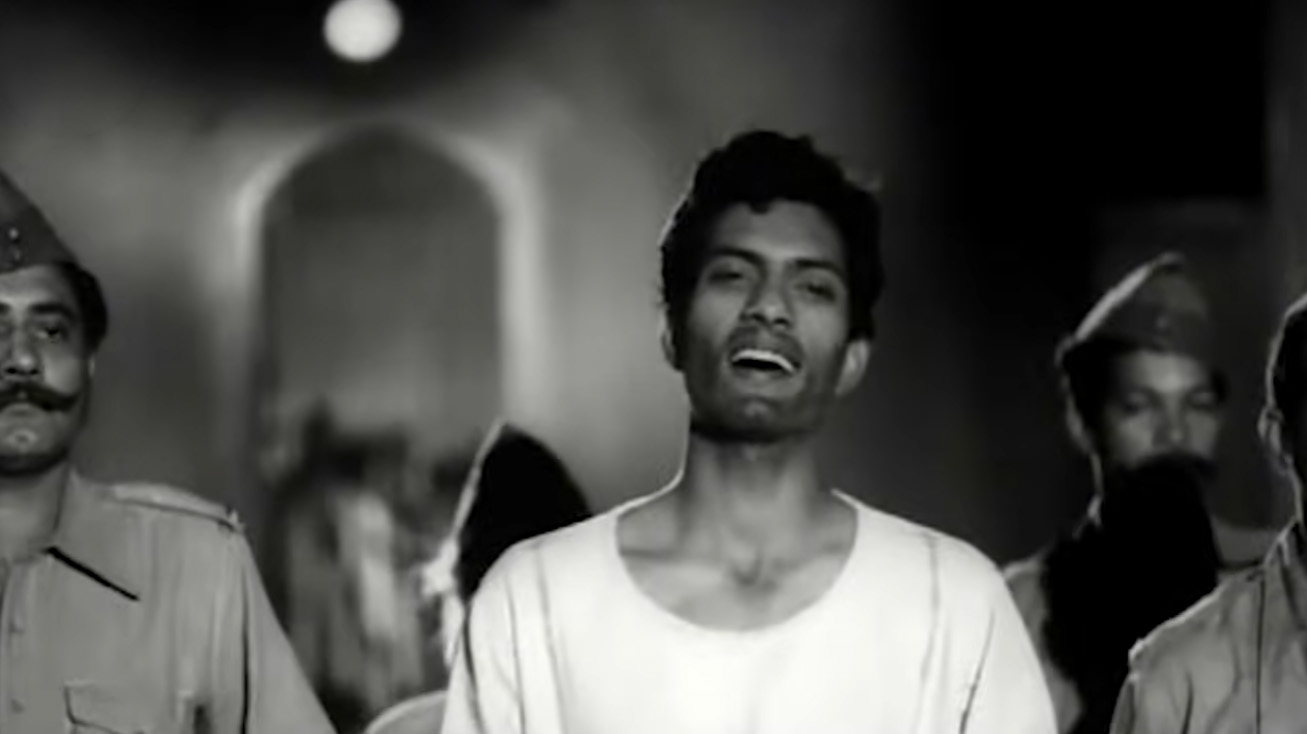
A freedom fighter singing Mat ro Mata while being taken to the gallows (Bandini)
Independence was the one goal everyone around him wanted. In Bandini, Bimal Roy recounts the sacrifices made by nationalists who believed, “I am fortunate that I could serve the Motherland – Mat ro Mata!” The British Imperialists were bent upon curbing their desire with an iron hand. They were throwing everyone uttering the slogan into prison. People would even go to the gallows singing Vande Mataram! That slogan continued not only after Independence. To this day it inspires everyone.
I had always heard my mother saying, “Such a precise and graphic description of the land! Sujalam sufalam malayaja sheetalam shasya shyamalam Mataram!
I bow to you, O Mother!
Rich with waters, fruits and flowers,
Caressed by fragrant winds,
Green with fields of grain
You are, O Mother!
Shubhra jyotsna pulakit yamini, Fulla kusumita drumadal shobhinim
Suhasinim, sumadhura bhashinim
Suhadam varadam Mataram…
Moonlit nights and blossoming trees
Charm with their smiles…
Sweet are the words they speak.
Bliss, and boons,
You shower, O Mother!
Much later, when I was internationally recognised as an art critic and curator of merit, standing in front of Abanindra Nath Tagore’s ‘Bharat Mata’, I realised that the iconic painting was a visual representation of this very description of Mother India. The four-armed goddess clad in saffron holds the Vedas in one of her arms. In the other arm, she holds high a piece of woven cloth – khadi, or the handloom textile for which India was so revered. Her lower arms hold a sheaf of grains, and a garland of rudraksha, the symbol of sacrifice.
—xxx—
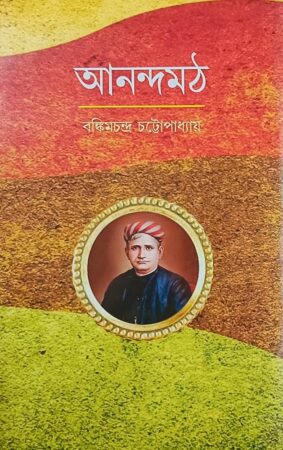
Anand Math in Bengali written by Bankim Chandra Chattopadhyay
When Bankim Chandra Chattopadhyay wrote Anand Math, he wore the dual hat of a District Magistrate and a Collector in a British-ruled administration. So how could he author a novel that became a war cry against colonial rule?
To seek the answer, we must go back to one December evening in 1873. Bankim Chandra was returning home in his palanquin. The palanquin bearers inadvertently cut through a patch of green where a certain Colonel Duffin was playing cricket. Enraged by this “insufferable affront” the British official dragged the high-ranking government official out of the palanquin and physically assaulted him in front of a crowd. Instead of accepting the public humiliation Bankim Chandra, who had earlier taken on an indigo planter, filed a lawsuit against Duffin. He resisted every pressure to drop the charges and stood his ground, forcing the Colonel to apologise in an open court.
This unthinkable defiance by an Indian official had two fallouts. It sent shockwaves through the Imperialists. And it turned Bankim Chandra into a Santan – Son of Mother India!
—xxx—
Published in 1882, The Abbey of Bliss itself was a war cry against colonial rule. The novel was built on the Sanyasi Rebellion that was an early resistance by displaced peasants, Hindu ascetics and Muslim fakirs – to the heavy taxation and oppressive policies of the East India Company during the devastating famine of 1770 – “Sattarer Manwantar”. The six stanzas of Vande Mataram were woven into the novel. The immortal lines of the poem gave vent to the angst in the heart of Bankim Chandra. And it moved the minds and touched the lives of his countrymen who stood up against the imperialists. Across the nation, the slogan of ‘Vande Mataram!’ became the rallying cry – a badge of unity and resistance. It was sung at Congress Conferences; it was chanted at gatherings; it became the last cry even by those walking up to the gallows. It became the foremost expression of love for the motherland, especially after the Partition of Bengal in 1905.
When he scored a century, artist Bhabesh Chandra Sanyal (1902-2003) had pointed out to me that “the Partition of 1905 was the first of the three partitions this subcontinent would be subjected to, in less than 70 years.” Ostensibly, it was done to streamline the administration of the largest Presidency in British India. Effectively, it enforced a wedge between the Hindus and Muslims who had together, shoulder to shoulder, fought the British in Barrackpore, before the fire of ‘Mutiny’ spread to Meerut, Lucknow, Jhansi, Delhi…
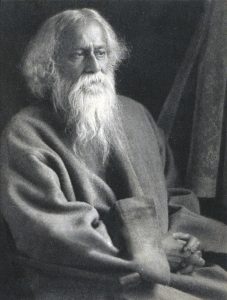
Rabindranath Tagore (Pic: Wikipedia)
In 1905 Rabindranath Tagore set out from the Tripura House on Ballygunge Circular Road in Kolkata, singing Vande Mataram! He had set the song to Raga Malhar when he first recited it in 1896, at the Annual Convention of the Indian National Congress (INC). Repeatedly he sang it, at Congress sessions, at Prabhat Pheris, at protest marches. Soon it gathered political momentum, until the partition was annulled in 1911. That year the Capital of the Raj was shifted to Delhi. By then, the stirring notes of nationalism had raised the ire of the foreign rulers so much that the uttering of the two salutary words was outlawed.
The prohibition achieved the opposite of the result they desired. It fuelled the protests further. Sri Aurobindo Ghose translated it, published it, and launched an English weekly, crying out Bande Mataram, loud and clear, from its masthead. Ghose’s confederate, the young Khudiram Bose (1889-1908), who was hanged for a bombing that had killed the wife of a British officer, went out singing the words. And for the soldiers of the Indian National Army (INA), Netaji Subhas Chandra Bose had asked Timir Baran to score a martial rendition to be played in Singapore. The maestro who was highly esteemed for his association with Uday Shankar, composed a marching-style orchestral arrangement which was recorded in 1938.
—xxx—
Unfortunately, the song of veneration drew flak from a section of Indians. They found the six-stanza composition “overly religious.” In 1923, Pandit Vishnu Digambar Paluskar (1872-1931) had just started his inaugural recital at the Kakinada Conference in Andhra Pradesh when the chairperson, Maulana Mohammad Ali, objected to it on religious grounds. The Muslim League accelerated the objection to the invocation of Mother India as Goddess Durga. “It’s idolatry!” they cried. They refused to sing it although it was accorded the status of a National Song in 1937 – with the deletion of the later paras. Still, the objection persisted. So, despite its historical significance, after Independence it was not accepted as the National Anthem. The honour went to Rabindranath Tagore’s Jana Gana Mana, written in 1911 (where too the later paras of the full poem, ‘Bharat Bhagya Vidhata’ were not sung). Because it was more unifying. However, in 1950, President Rajendra Prasad restored its status as a National Song, though this did not find inclusion in the Constitution of India.
—xxx—
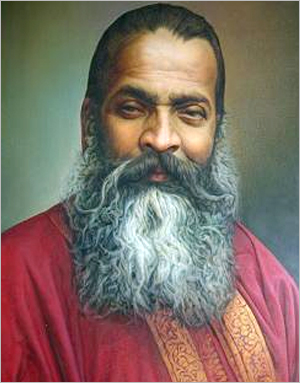
Pandit Vishnu Digambar Paluskar (Pic: Nashik.com)
As far as it concerned Rabindra Sangeet, purists and institutional boards insisted on strict adherence to Tagore’s original score, “to retain the mood of the text”. However, his score for Vande Mataram was not sacrosanct. Other maestros of the Raga music rendered it in Kedar, Sarang, Durga, Kafi, Desh, Hamsadhwani. *Vishnu Digambar Paluskar had rendered it in Raga Kafi. In the same raga, Pandit Omkarnath Thakur of Gwalior gharana recorded it in 1936 for Columbia Records, and he sang it on All India Radio on the historic day we gained Independence. Bharat Ratna Ravi Shankar (1920-2012) had created a choral version for AIR in Desh raga. This was played after the signature tune for decades, winning UNESCO’s laurel.
*The first musician to be decorated as Bharat Ratna, M S Subbulakshmi (1916-2004) teamed with musicologist Dilip Kumar Roy (1897-1980) to record a 78 rpm. It featured Vande Mataram in Ragamalika on one side and the reverse had Dhana dhanye pushpe bhara, the other famous celebration of love for the motherland written and composed by Dwijendralal Roy. This Vande Mataram by MS and DK not only used a different raga and tempo for the successive stanzas. It also blended in Hindustani and Carnatic features for expressing the fluid emotions. Years later, she recorded a soulful rendering of Nalirmani neerum, the Tamil lyrics written by Subramanya Bharathi.
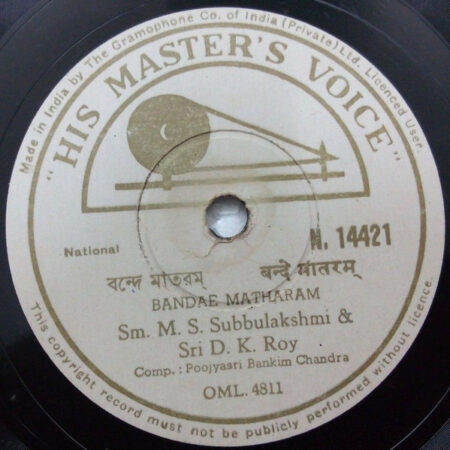
Bandae Matharam by MS Subbulakshmi and DK Roy
* Doyen of Jaipur-Atrauli gharana Mogubai Kurdikar (1904-2001), disciple of Alladiya Khan and mother of Kishori Amonkar, rendered it in Raga Khambavati without any percussion accompaniment.
* The Kirana giant Pandit Bhimsen Joshi (1922-2011) rendered it in his inimitable style in Raag Desh. It was a monumental part of Parliament’s commemorative session on the midnight of 14th August 1997. In the same raga the recital by Sangeet Martand Jasraj (1930-2020) of Mewati gharana is powered by passion. He interprets the patriotic anthem as a meditative offering.
* On August 14, 2020 another maestro of Hindustani music, Bhajan Sopori (1948-2022) infused love for the motherland through his mellifluous rendition on the hundred strings of santoor and lit up the dark days of Covid.
* “I get goose bumps whenever I play the song,” Pandit Vishwa Mohan Bhatt (born 1950) said to this writer. The creator of Mohan Veena has given several rousing recitals, mostly at the end of his concerts, on several international forums too. “I played it in Geneva, in a programme hosted by UNESCO for World Peace. But I must add, I was stirred by Prime Minister Modi’s unique concept of 150 artistes across the country playing the theme at the same time in January, to mark 150 years of Vande Mataram.”
* To me, Bharatbala’s 1998 production is the most outstanding recreation of our times. Shubha Mudgal’s powerhouse performance, Jai Jai Mataram combines the national anthem with the national song and gives body to the energy of a resurgent India.
—xxx—
* Perhaps the most cherished is the singing by Lata Mangeshkar for Anand Math (1954). It was set to music by Hemant Kumar. Subsequently, the composer also set to tune Kavi Pradeep’s balladic song in Jaagriti (1954) –
Aao bacchon tumhen dikhaye jhaanki Hindustan ki,
Iss mitti se tilak karo yeh dharti hai balidan ki!
Come children, let me show you a glimpse of India,
Adorn yourself with its soil – it’s a land of sacrifices…
* Bande mein tha dum! This guy had guts! He served the Motherland… With this, Lage Raho Munnabhai (2006) gave a new twist to the mantra by directly connecting Vande Mataram with Gandhiji. The Mahatma was always moved by the national hymn, so in the movie, the salutation recurs every few lines, to remind us that our fight to uphold truth and non-violence – the ideals of Bharat Mata – still continues.
* Vande Mataram was the title of a Telugu movie Vauhini Pictures produced in 1939. B Nagi Reddy had directed the social drama set against the industrialisation of India. Such is the power of these words that, almost half a century later, Vijayshanti made another super hit in 1985 with the same title. It unfolded around an idealistic young teacher who opens a school in a rural village but faces stupendous opposition when he tries to educate the children. It won two Nandi – state awards – for its storytelling and music. The massive popularity of its impactful title track had gained singer Srinivas the moniker of Vandemataram Srinivas.
* In the current century, megastar Mammootty featured in Mission Vandae Matharam (2010) with the rugged Arjun Sarja. In the investigative action thriller, an Intelligence Bureau commander and a state police officer on deputation team up to track down and eliminate a terrorist network orchestrating deadly explosions in South India. Parallelly made in Tamil and Malayalam, the film, which touched agrarian struggles too, was also dubbed into Hindi.
* Some years before Lage Raho Munnabhai Sunny Deol-starrer, Maa Tujhe Salaam (2002) was released in theatres. As Major Pratap, the hero fights local terrorists who collaborate with cross-border forces to destabilize Kashmir. The film took its title from the song A R Rahman had composed in the 50th year of India’s Independence.
* With that Bharatbala Productions number, Rahman has given a new avatar of Vande Mataram to the generation that has no need to fight the imperialists but has the same love for their motherland. The same pride that had inspired Rahman imbues the recent film Fighter (2024). It follows the brilliant actions of an elite unit of Indian Air Force aviators who stake their all in a reckless retaliatory attack across the border in the wake of the Pulwama massacre. Hrithik Roshan, Deepika Padukone and Anil Kapoor personified patriotism – and the heady notes of the same Vande Mataram anthem became the victory song of jubilant Indian cricketers and their exultant fans.
As India was approaching victory, 40,000 elated fans in Wankhede Stadium started singing the salutary song. And in 2024, when Virat Kohli brought home the T20 World Cup trophy, the entire stadium burst into the chorus of Maa Tujhe Salaam! Vande Mataram… It elevated every Indian to the pinnacle of patriotism long before the courts and magistrates could pass a ruling for its singing in schools, madrasas, and government functions.
* Today the contemporary dance group, Sapphire Creations, platforms Vande Mataram in Kolkata’s Victoria Memorial – the storehouse of our colonial past – as much as on international stages, from Singapore to USA. And an intrepid band of documentary filmmakers is celebrating International Yoga Day to the same salutary mantra – Vande Mataram!
Watch ‘Battle Cry to Victory Song’ by Ratnottama Sengupta
(The views expressed are personal)


Got a poem, story, musing or painting you would like to share with the world? Send your creative writings and expressions to editor@learningandcreativity.com
Learning and Creativity publishes articles, stories, poems, reviews, and other literary works, artworks, photographs and other publishable material contributed by writers, artists and photographers as a friendly gesture. The opinions shared by the writers, artists and photographers are their personal opinion and does not reflect the opinion of Learning and Creativity- emagazine. Images used in the posts (not including those from Learning and Creativity's own photo archives) have been procured from the contributors themselves, public forums, social networking sites, publicity releases, free photo sites such as Pixabay, Pexels, Morguefile, etc and Wikimedia Creative Commons. Please inform us if any of the images used here are copyrighted, we will pull those images down.







What a beautiful indepth article written by Ratnottoma Sengupta tracing ‘Vande Mataram’- its history, meaning, impact, relevance over the years simplifying it to the readers. So well put that makes for interesting reading. So many little facts, truths and facets of this iconic song that stirred a nation in its quest for freedom from the British. The incident of Bankim Chandra Chattopadhyay and his palanquin was a revelation. The different versions of ‘Vande Mataram’- and her preference along with the other patriotic songs and renditions by the artists enlightened me further and brought a fresh perspective and understanding of an important period in our country’s history. Many thanks and congratulations. Bravo!