Stay tuned to our new posts and updates! Click to join us on WhatsApp  & Telegram
  Channel
& Telegram Channel & Telegram Channel 




Two films, five years apart, share the same engine of diminishment, though their plotlines couldn’t be more dissimilar. Anuradha Warrier delves into what she sees as Uttam Kumar’s deliberate attempt to test two registers of suffering.
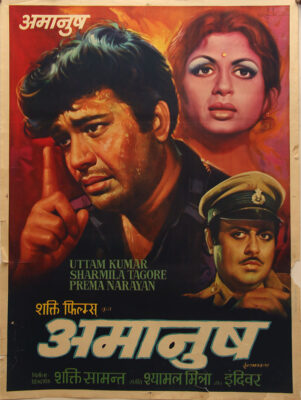
Amanush Poster (Pic: Bobby Kohli Collections)
Some actors need only stillness on screen. For decades, Uttam Kumar built his stardom on exactly that: the studied pause, an intimate glance, a grammar of romance so complete that it barely needed dialogue. It made him Bengali cinema’s most beloved leading man. It also meant that, for most of his career, no one asked enough of his talent.
In his last years, he went looking for something different, in a language not his own – a chance to be broken, not adored on screen. And he found it in two films that could not be more different from each other – Amanush (1974/75), a bilingual film, that gave him the first and only genuine Hindi hit of his career, and Dooriyaan (1979), a quiet, unglamorous marital drama that few remember and fewer still have seen. In Amanush, Uttam plays Madhusudan ‘Madhu’ Roy Chowdhary, a man driven to degradation by circumstances beyond his control. In Dooriyaan, he is Kailash, undone by his own ego.
Set beside each other, they read like two verses of the same elegy; one sung aloud in flood and fever, the other a whispered almost-conversation across a dining table. Seen together on the occasion of his birth centenary, these two films are less a footnote to Uttam’s career than a revelation of Uttam’s talent, a range that his stardom rarely required of him.
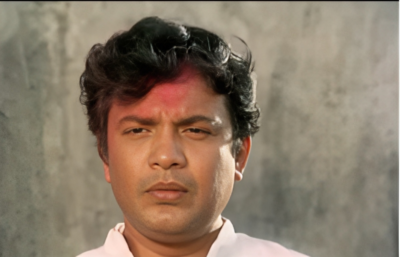
Uttam’s performance is a masterclass in restraint
Amanush wears its masala beats on its sleeve – Madhu, the son of a zamindar in a tiny fishing village in the Sundarbans, is in love with Rekha (Sharmila Tagore), a schoolteacher. His privileged life unravels when he’s accused of fathering a child and implicated in theft soon after. By the time he returns from prison, his uncle has died and Mahim Ghoshal (Utpal Dutt), the munim, has seized control of the estate. What follows is a very public ruination – disgrace, humiliation, alcoholism, and years spent as an ‘amanush’ (not-human), feared and hated by the villagers who once adored him. The ‘annadata’ of the village has become its cautionary tale.
Structurally, Amanush reworks the Devdas template: a good man pushed towards self-destruction by romantic estrangement and by the machinations of a villain the audiences loved to hate. The pitch is unapologetically melodramatic, replete with a ‘fallen’ woman modelled on Chandramukhi, songs to underline the emotion, and a flood to wash away the disgrace.
Uttam’s performance is a masterclass in restraint within a genre that demands very little of it. He does not ‘perform’ Madhu’s degradation as much as live it; the villagers see his drunkenness and loutish behaviour, never the grief underneath. Uttam internalises the grief, and lets Ghoshal’s villainy carry the film’s noise. Because the audience knows from the outset that Madhu is innocent, his suffering is automatically seen as yet another injustice. Sharmila’s Rekha is largely reactive here – wronged, she retreats; learning the truth, she returns. Amanush was driven by Madhu’s fall and rise, and Uttam essayed the role with ease. The test was to keep audience sympathy alive for two-plus hours, and he succeeded resoundingly.
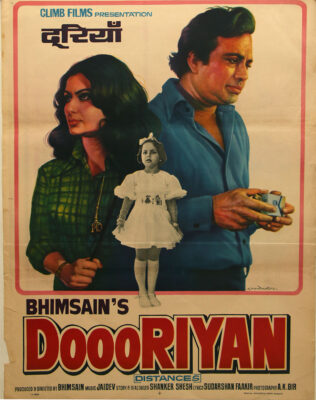
Dooriyan poster (Pic: Bobby Kohli Collections)
Five years later, Dooriyaan offers Uttam’s character no such sympathy. There is no villain scheming his ruin, no false accusations, no flood to restore honour. The marriage does not fail because of something ‘done’ to Kailash (Uttam) and Ratna (Sharmila). It collapses because two ambitious, stubborn people fail each other. He is an advertising executive; she’s a theatre artiste. Her ambition and his ego hollow their marriage from within. Where Amanush is operatic, Dooriyaan’s register sits closer to quieter studies of marital discord like Gharonda or Aavishkar.
Kailash is not innocent; his pride and possessiveness are as much a cause of the marriage’s collapse as Ratna’s ambition, and the film never lets him off the hook. That denies Uttam the one thing that Amanush handed him on a plate – automatic audience sympathy. This is genuinely the harder part to play. A star, used to being the wronged character, the adoring centre of the frame, now has to find his footing in someone who is, at least partly, the author of his own unhappiness.
Every ounce of compassion has to be earned in real time, and it is, in the film’s quietest moments – not its confrontations: a visit to his daughter, a joyride, a frightened rescue that finally breaks him. It is here that Uttam’s performance breathes; the guilt and grief are portrayed with a quiet tenderness that is lived in, not acted. Sharmila’s Ratna, meanwhile, gets the riskier part – a woman whose ambition derails her marriage, yet is granted something that Rekha never was – a legitimacy to her ambition. Ratna is allowed to want the stage and be wrong about her family at the same time. It’s a rare generosity for a film of this period to extend to its female lead.
Dooriyaan is not Amanush by any stretch of imagination, and their box-office fates are far too divergent to compare. But the quieter fate is exactly what makes Dooriyaan valuable as a companion piece to Amanush. It shows what Uttam could do once stripped of the machinery of melodrama that had built his stardom.
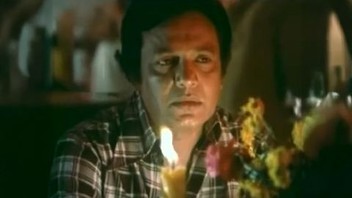
Dooriyaan’s grief plays out in a minor key; private, unresolved.
When viewed together, Amanush and Dooriyaan form something like a diptych of diminishment. Madhu loses his dignity, his honour and the love of his life; Kailash loses his marriage, and with it, his self-image. But the shape of loss is not the same, and neither are the demands that these roles make of the actor. Madhu’s grief may be internalised, but his ruin plays out in full public view. His eventual exoneration is staged as spectacle, with the whole village watching. The audience is invited to grieve with him, and exult in his redemption.
Kailash gets no such empathy. The story insists that he share the blame for his own suffering, so sympathy has to be built scene by small scene. Dooriyaan’s grief plays out in a minor key; private, unresolved, the kind of grief that ends not in the catharsis of a flood, but in the absence of a child and the quiet devastation of a father piecing tenderness out of a wreckage of his own making. One is a performance of legible suffering, engineered for catharsis; the other, a performance of self-awareness.
It is worth noting Sharmila’s complementary work in both films. In Amanush, Rekha’s arc is defined largely by her relationship to Madhu; in Dooriyaan, Ratna’s grief is shaped by her own choices, and she’s made to bear its burden. That small, telling asymmetry says as much about the two kinds of stories being told as it does about either performance.
None of this is really about a great Bengali star failing to conquer the Hindi film industry – that was never the point. What matters, a hundred years after his birth, is this indisputable fact – within a five-year span, at an age when most leading men were coasting comfortably on image, or retreating into character roles, Uttam Kumar delivered two performances that asked almost opposite things of him. One dialled a man’s grief up loudly enough to flood the screen; the other, a father buying his estranged daughter ice cream, turned the volume down until tenderness was all that filled it. Grief, in both cases, registered as entirely believable. If Amanush shows why he was, for decades, Bengali cinema’s most-beloved leading man, Dooriyaan, seen by far fewer people and remembered by fewer still, is the quiet evidence of something far more important: that underneath the matinee idol was a very serious actor, capable of grieving in whatever key the role demanded, and of making even its quietest moment heard. On his centenary, I think that range, not the box-office fate of either film, is what’s worth celebrating.

Whether you are new or veteran, you are important. Please contribute with your articles on cinema, we are looking forward for an association. Send your writings to amitava@silhouette-magazine.com

Silhouette Magazine publishes articles, reviews, critiques and interviews and other cinema-related works, artworks, photographs and other publishable material contributed by writers and critics as a friendly gesture. The opinions shared by the writers and critics are their personal opinion and does not reflect the opinion of Silhouette Magazine. Images on Silhouette Magazine are posted for the sole purpose of academic interest and to illuminate the text. The images and screen shots are the copyright of their original owners. Silhouette Magazine strives to provide attribution wherever possible. Images used in the posts have been procured from the contributors themselves, public forums, social networking sites, publicity releases, YouTube, Pixabay and Creative Commons. Please inform us if any of the images used here are copyrighted, we will pull those images down.