Stay tuned to our new posts and updates! Click to join us on WhatsApp  & Telegram
  Channel
& Telegram Channel & Telegram Channel 




How did Arun Chatterjee become ‘Uttam Kumar’? Partha Pratim Ghosh looks beyond the star appeal and natural talent to trace a relentless journey of observation, self-correction, discipline and an obsessive quest to master the art of camera acting.
In Satyajit Ray’s Nayak (1966), there is a scene where the protagonist Arindam Mukherjee, a successful film star crafted by Ray to be quite similar to Uttam Kumar himself, reflects on great Hollywood actors — Brando, Bogart, Paul Muni — and wonders whether even these legendary performers were merely puppets in the hands of their directors. The question leads towards a comparison between an actor’s artistic space in theatre and cinema. The conversation that ensues is also about the mysterious relationship between an actor’s creative intelligence in a movie and a filmmaker’s cinematic vision.
In Nayak, Ray was also deconstructing the image of Bengal’s greatest matinee idol, and revealing how a star transcends stardom to become a creative artist.
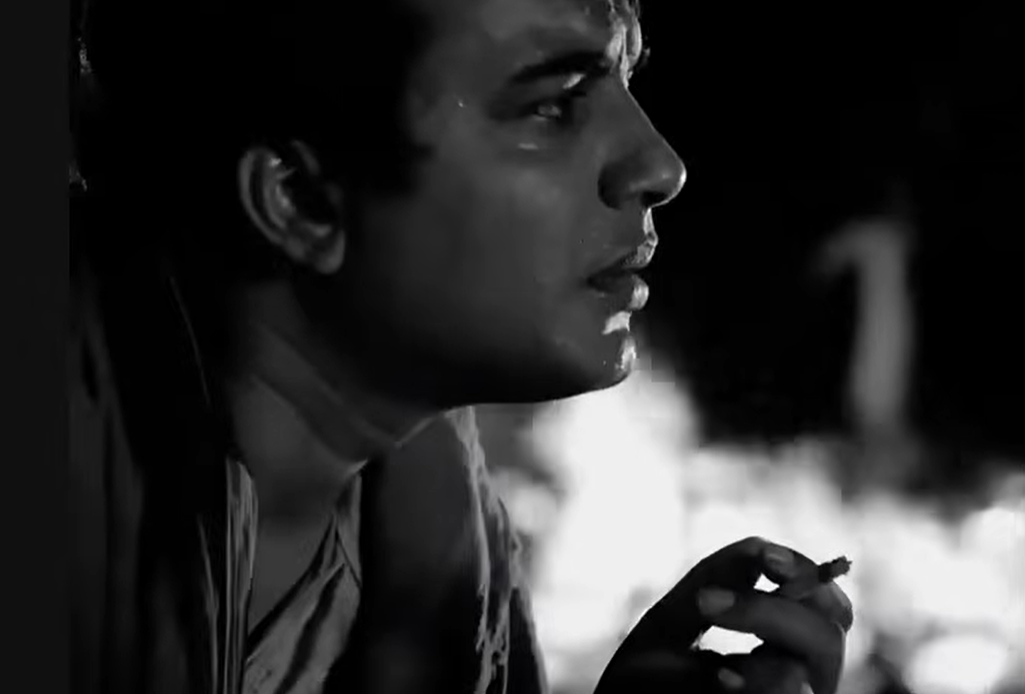
“Brando, Bogart, Paul Muni – are all of them puppets?” Uttam Kumar in Satyajit Ray’s Nayak
The arrival of Satyajit Ray with Pather Panchali in 1955 created a completely new wave in Bengali cinema, which developed two parallel streams. One was led by filmmakers like Ray, Ritwik Ghatak, Mrinal Sen, Tapan Sinha, and later, Tarun Majumdar — filmmakers who explored social reality, human complexity and cinematic language with international awareness. The other was carried largely on the shoulders of Uttam Kumar, sometimes in collaboration with gifted directorial craftsmen like Nirmal Dey, Ajay Kar or Aravinda Mukherjee, who created a popular cinema deeply connected to Bengali emotional life, but mostly with directors of comparatively lesser calibre.
It would be incorrect to see these as opposite worlds. Both responded to Bengali culture in different ways. Ray, Ghatak and others addressed the intellectual and social anxieties of Bengal; Uttam Kumar became the emotional mirror of ordinary Bengali viewers.
But the question remained: was Uttam only a star?
Satyajit Ray answered this question in Nayak. Ray considered Uttam a major screen presence even before they worked together. He recognised the qualities that made Uttam different — ease, confidence and a complete absence of theatricality.
When Uttam entered Bengali cinema in the late 1940s, the shadow of Pramathesh Barua was still looming large. Barua and Kanan Devi’s screen chemistry was legendary, but it belonged to a different era, one in which the emotional vocabulary of cinema was closer to theatre — intense romantic gestures, dramatic pauses and a certain aristocratic melancholy.
Kumar was among the first to modernise film acting, setting a new standard, not only for himself but also for his contemporaries. His hero was not a distant, larger-than-life figure; he was the educated middle-class Bengali bhadralok who could be seen in the narrow lanes of North Kolkata, in mess houses, college corridors, offices, railway compartments or family drawing rooms.
This was one reason his arrival matched the aspirations of post-independence Bengali society. He became the dream figure of a generation searching for romance, dignity and emotional escape amidst social uncertainty.
Ray later wrote that Uttam belonged to the breed of instinctive actors. He did not intellectually dissect every psychological layer of the character. Yet he constantly surprised the director with small, spontaneous actions that enriched the scenes.
But was Uttam only an instinctive actor? A much deeper study may reveal that Ray was not perhaps fully correct in his evaluation of Uttam’s acting methods.
If we look at Uttam Kumar’s total filmography, consisting of nearly 250 films, many of them inaccessible and also forgettable today, except for a handful that still shine and deserve repeated viewing, it is not difficult to understand how Arun Chatterjee gradually created ‘Uttam Kumar’, not merely through his external looks, star appeal and natural talent, but through method acting, relentless observation, self-correction, discipline, and an almost obsessive desire to evolve and master the language of camera acting.
Quite surprisingly, while memoirs and anecdotes about him are plenty, serious discussions on his film acting remain relatively scarce.
To explain how sincere Uttam was in preparing himself for a role, Ray, Tapan Sinha and Tarun Majumdar have shared revealing experiences. All of them agreed that Uttam was always present on the sets ahead of schedule. He sat quietly, almost withdrawing himself from his surroundings, deeply concentrating on his role and dialogues.
For Jhinder Bondi, Uttam practised horse riding for a month. He also studied fencing under the tutelage of Massey Taylor, a trained practitioner. Unlike his heroine Suchitra Sen, who preferred complete seclusion, Uttam often shed his heroic image, and mixed freely with the cast and crew during breaks and after shooting.
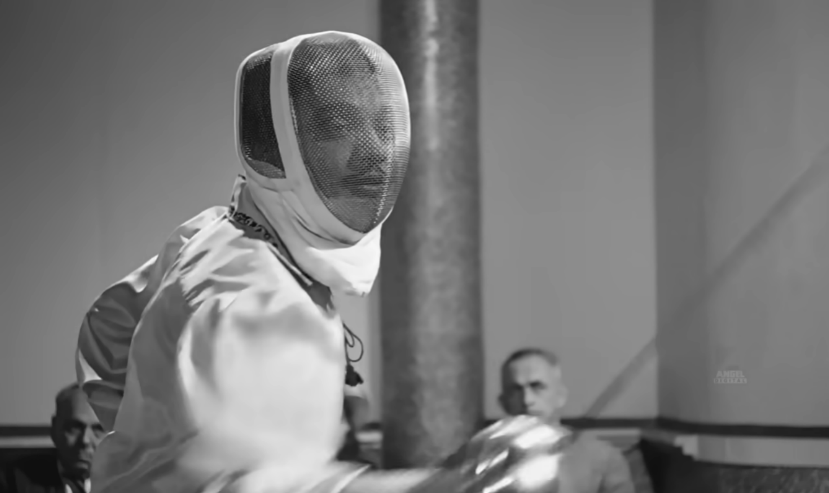
Uttam Kumar as Gauri Shankar, fencing in Jhinder Bondi
This carefree mingling with people across social strata and economic class was perhaps one of the reasons why Uttam Kumar could so easily and creatively instil life into any character he portrayed.
If Uttam had one true instrument as an actor, it was his face. A slight movement of the eyes, a pause before a reply, a change in breathing pattern could reveal more than a long speech.
In Saptapadi (1961), there is a remarkable sequence where the camera remains fixed on Uttam’s face for several minutes as he reads a letter. In the voice-over, we hear his father’s words, while on screen we witness the almost imperceptible transformation of his expression. It is a distinctly Bergmanesque moment, recalling the prolonged close-ups of Winter Light (1963), Persona (1966) or Cries and Whispers (1972), where the human face itself becomes the landscape of emotion. Here, the camera registers the slightest disturbance of the mind.
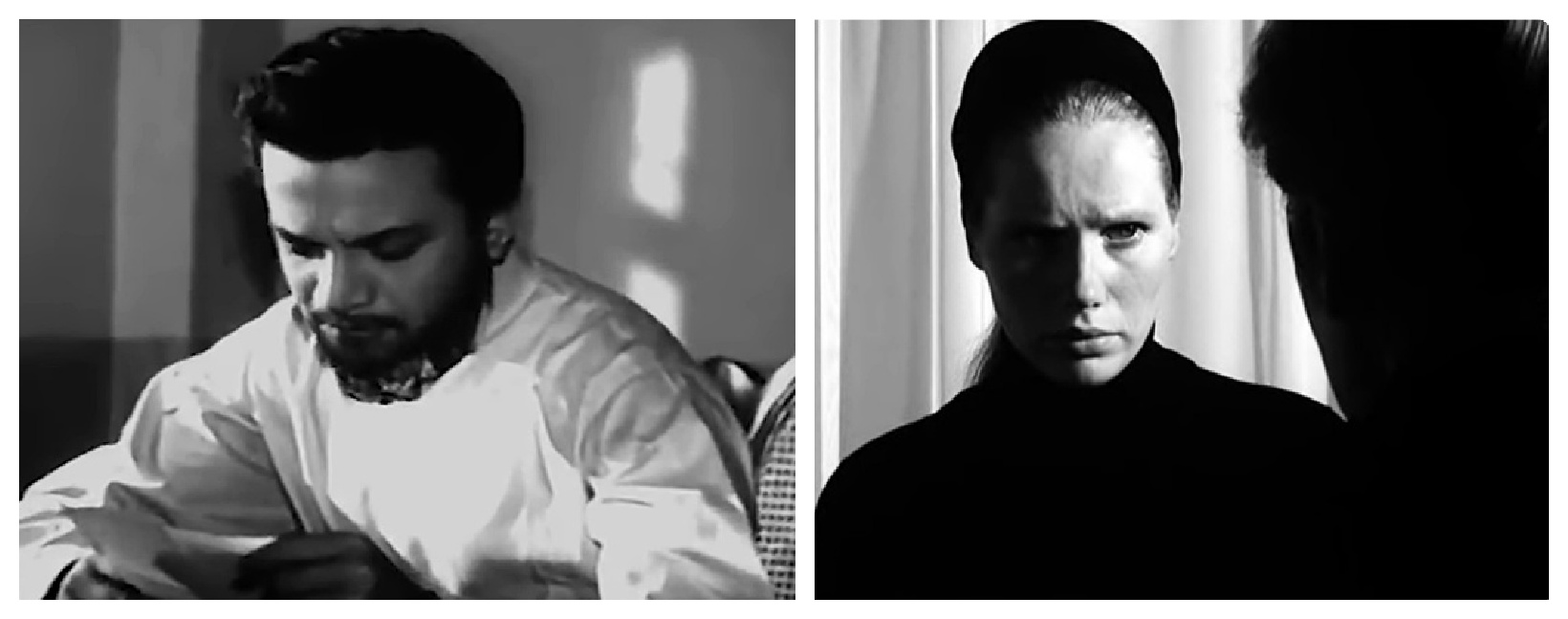
(L) Close-up of Uttam’s face while reading a long letter in Saptapadi
(R) Close-up of Liv Ulman’s face while listening to a long dialogue in Ingmar Bergman’s Persona
The famous Othello sequence in Saptapadi also demonstrated that Uttam had completely understood the difference between stage acting and cinema acting. He did not merely recite Shakespeare; he internalised the character’s emotional turmoil and expressed it through controlled intensity.
In Nayak, Uttam Kumar acted as himself, but Chiriakhana (1967), made almost immediately afterwards with Satyajit Ray, revealed another dimension of his craft. In the latter film, he had to disappear into a ‘thinking’ character. As Byomkesh Bakshi, he had to shed his familiar romantic image and adopt a different acting style.
Jatugriha (1964) is another such example. The film is built on emotional distance, failed communication and the tragedy of two people who still understand each other but cannot bridge the gap between them.
The evolution becomes even clearer in films like Thana Theke Aschi (1965) and Shesh Anka (1963). These films are important because they challenged Uttam’s established romantic image at a time when Uttam Kumar–Suchitra Sen films dominated Bengali cinema. In Shesh Anka, Uttam experimented with greyer shades and moral ambiguity.
The same mature acting appears in a series of other films such as Kal Tumi Aleya (1966), Chowringee (1967), Ekhane Pinjar (1971), Jiban Jigyasa (1971),
Chhinnapatra (1972), Nagar Darpane (1975), Agnishwar (1975), etc. The greatness of Uttam’s performance as Sata Bose in Chowringee lies in his understanding that the character is not the centre of the space, but a silent observer of a larger human drama. The world of Shahjahan Hotel is filled with different lives, ambitions and tragedies. Uttam Kumar does not force himself into the centre; instead, he allows the character’s presence to grow naturally.
In Aparichito (1969), Uttam explored the darker territory of the anti-hero. The audience is forced to confront a disturbing character whose desires and weaknesses lead him towards destruction. The character’s final emotional collapse reveals Uttam’s ability to move beyond simple moral categories. He could make a flawed person human without making him innocent.
Jadu Bangsha (1974) is another example of his acting prowess. The role demanded physical and emotional transformation — the portrayal of a broken man, defeated by society and by himself. The confident romantic hero disappears completely. What remains is a tired human being carrying the weight of failure.
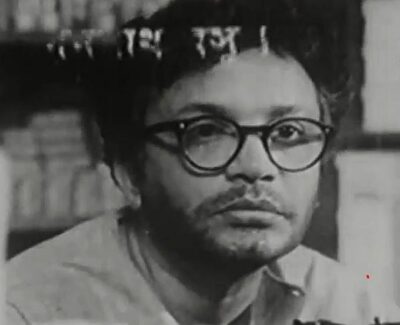
Uttam in Jadu Bangsho
Interestingly, Uttam Kumar’s extraordinary versatility repeatedly encouraged directors to cast him as doppelgangers – characters sharing the same physical appearance but possessing contrasting personalities. Films like Jhinder Bondi, Uttaraayan (1963) and Chhinnapatra are significant examples. Likewise, the protagonists of Jiban Mrityu (1967), Jiban Jigyasa (1971) and Sanyasi Raja (1975) undergo profound psychological transformations, gradually evolving into altogether different personas. Uttam negotiated these transitions with remarkable ease, distinguishing one identity from another not through superficial mannerisms but through subtle changes in voice, posture, rhythm and emotional behaviour.
It is important to note that his acting style, even in romantic roles, was not static but evolved differently with different heroines. With Suchitra Sen and Supriya Devi, charm, grace and flamboyance were his basic characteristics. But with others, it subtly transcended into love mixed with care and affection.
His signature manner of looking at his heroines was not simply a lover’s gaze; it was an entire emotional language. His eyes depicted hesitation, longing, confidence, vulnerability and sometimes even defeat.
Kumar’s trajectory closely parallels that of the great Hollywood actor Marlon Brando. Both Brando and Uttam had acted on stage, but both transformed screen acting by replacing external performance with internal conflict. Both of them created their own idiom, even while romancing.
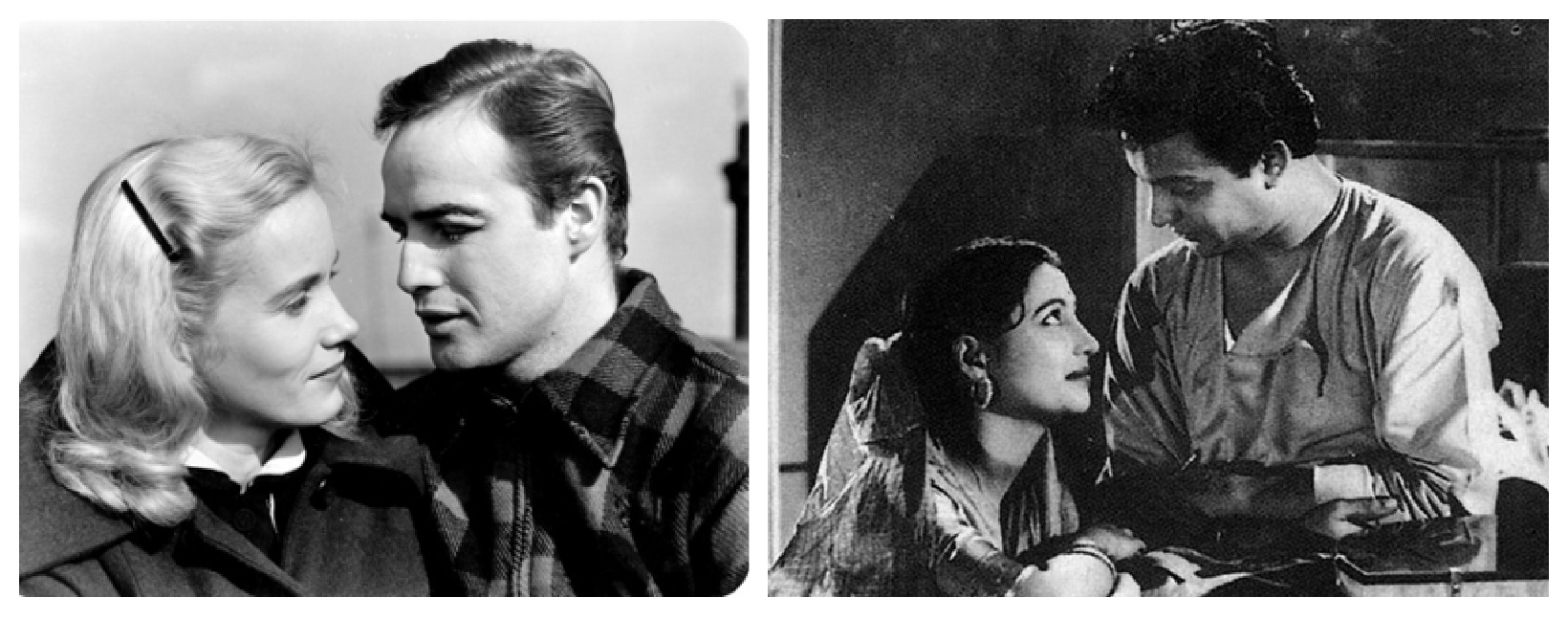
(L)Marlon Brando and Eva Marie Saint in On the Waterfront
(R) Uttam Kumar and Suchitra Sen in Harano Sur
From Tapan Sinha’s memoirs, we know that in real life, both Sinha and Uttam used to watch and discuss Hollywood films. On two occasions, he watched certain movies because Sinha had suggested them. One was William Wyler’s The Best Years of Our Lives (1946). Another was to watch the inimitable Brando in The Godfather (1972).
One of the most fascinating observations about Uttam came from Gulzar, who remembered the making of Kitaab (1977). Gulzar was impressed with Uttam’s simplicity and manners. This is important because it meant that Uttam’s screen personality and real personality existed in rare harmony. His screen heroism was not an artificial construct. His charm came from behaviour.
Gulzar also pointed out something crucial about Uttam’s inability to establish himself in Hindi cinema. The major obstacle was language. Gulzar believed that had someone trained him carefully in Hindi speech patterns, Uttam had all the qualities required to become a national star.
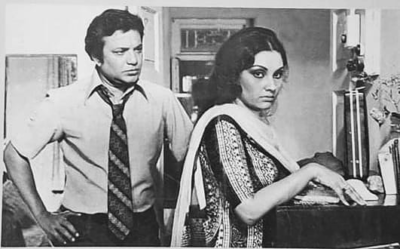
Uttam Kumar’s foray into Hindi movies – with Vidya Sinha in Gulzar’s Kitaab
This raises an interesting comparison with the Hindi film industry. Bombay cinema had its own conventions where voice, dialogue delivery and linguistic identity played a major role. Uttam Kumar’s emotional connection with Bengali audiences was extraordinary but translating that into another language was difficult. His towering presence in Bengal, however, continued until his death.
But the question remains: does his charm survive among later generations?
The answer is complicated. The cultural environment that created Uttam Kumar no longer exists. The audiences of the 1950s and 60s experienced his films collectively in packed theatres. His arrival on screen was almost an event. Today’s viewers encounter him differently — through television, digital platforms and fragmented viewing. The mythology surrounding him has weakened, but his craft and acting brilliance remain for posterity.

Whether you are new or veteran, you are important. Please contribute with your articles on cinema, we are looking forward for an association. Send your writings to amitava@silhouette-magazine.com

Silhouette Magazine publishes articles, reviews, critiques and interviews and other cinema-related works, artworks, photographs and other publishable material contributed by writers and critics as a friendly gesture. The opinions shared by the writers and critics are their personal opinion and does not reflect the opinion of Silhouette Magazine. Images on Silhouette Magazine are posted for the sole purpose of academic interest and to illuminate the text. The images and screen shots are the copyright of their original owners. Silhouette Magazine strives to provide attribution wherever possible. Images used in the posts have been procured from the contributors themselves, public forums, social networking sites, publicity releases, YouTube, Pixabay and Creative Commons. Please inform us if any of the images used here are copyrighted, we will pull those images down.