Stay tuned to our new posts and updates! Click to join us on WhatsApp  & Telegram
  Channel
& Telegram Channel & Telegram Channel 




Uttam Kumar lives on, not merely in his evergreen films, but in the hearts of generations of viewers. Through posters, tributes and memories, Ratnottama Sengupta traces the enduring phenomenon of Bengal’s Mahanayak.
Uttam Kumar. Nayak. Mahanayak. Guru.
Actor. Star. Industry. Legend. Icon.
The phenomenon that was Uttam Kumar lives on. Not in big fat tomes sitting on the shelves but in the heart of every viewer who has watched Antony Firingee, Deya Neya, Nayak, Lal Pathore, Agni Sakshi, Khoka Babur Pratyabartan, Jhinder Bondi, Agniswar, Aami Se O Sakha, Dhanyi Meye... Not just the old and very old but young entrants to the world of moving images too have unwittingly succumbed and unhesitatingly surrendered to the charisma of the actor who turned 100 on September 3.
The proof of the pudding? The multiple – and cross-country exhibitions of posters of films that featured Uttam Kumar. The repeated Facebook posts and displays of archival clicks. The array of magazines that have featured him on the cover. The wordage being published daily, for weeks – nay, months – now, in English, Bengali and Hindi. The retrospectives and homages that are being planned by international film festivals across India…
“Never say die is the lesson I have learnt from his life,” Prime Minister Modi said the other day, in a poignant homage to the thespian. “Always focused on his work, Uttam Kumar combined dignity with emotional depth,” the PM continued, admiring the actor “known for his philanthropy.”
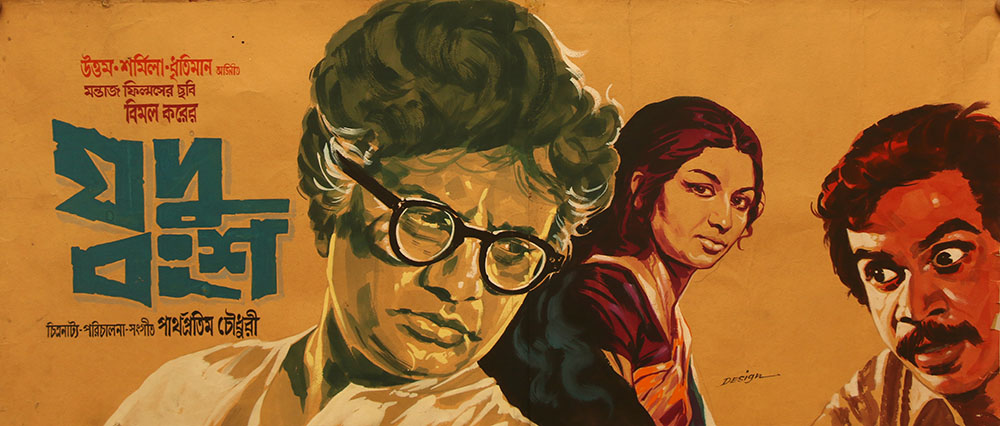
Jadu Bangsha Poster (Pic: Bobby Kohli Collections)
__________
Yes, Uttam Kumar was adored in a way few megastars have been. When he went to a wedding, even the priest stopped his chants mid-sentence to admire him. When he was invited to a dinner at a friend’s house, hundreds tried to gatecrash. And when he died, the surge of wailing humans brought to a standstill buses, cars, trams, taxis, rickshaws, and pheriwalas on the streets of Kolkata. The mass hysteria led poet Achintya Kumar Sengupta to write a poem that still preserves the massive grief – and the deep cultural impact – left by the unmatched personality who gave Bengali cinema its golden age.
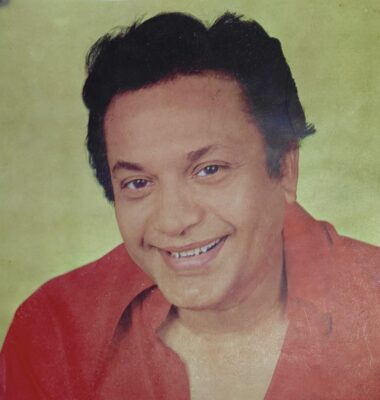
Uttam Kumar’s famous smile (Pic: SMM Ausaja Archives)
“I remember that day like yesterday although I was not even 11 years old then,” recounts Prateek Majumdar, a passionate cinephile and the author of 1975: The Year That Transformed Bollywood. “It was raining and my father was telling my grandmother that he had passed away. A gloom descended in our house which I am sure was similar to most Bengali households of that time. Because Uttam Kumar felt like one of us…”
So, what lay at the root of the Uttam hysteria? The innate magic of the man born to Chapala Devi and Satkari Chatterjee and was given the name Arun Kumar Chatterjee. The actor who started life as a clerk with the Port Trust of India, and acted in office plays. The hero who was a ‘flop master’ in his initial films but grew and grew and grew to become THE Uttam Kumar – One and Only.
The journey of the legend can be traced through the 211 films that hit the screen, beginning with Drishtidan in 1948 till Ogo Bodhu Sundari, released after his heart stopped beating one July morning in 1980, leaving many dreams incomplete. The films were directed by the biggest names of Bengal – of India, of the world, really – ranging from Satyajit Ray, Mrinal Sen, Tapan Sinha, to Nitin Bose, Sushil Majumdar, Tarun Majumdar, Ajoy Kar, to Gulzar and Shakti Samanta.
These films cast him against the top actresses of 1940s, Sandhya Rani and Sumitra Devi; of 1950s, Suchitra Sen, Sabitri Chatterjee, Supriya Devi; of 1960s, Madhabi Mukherjee, Tanuja, Sandhya Roy, Vyjayantimala; to the superstars of 1970s, Aparna Sen, Sharmila Tagore, Moushumi Chatterjee, and Jaya Bhaduri. In these films he shared the screen with illustrious actors Soumitra Chatterjee, Chhabi Biswas, Pahari Sanyal, Biswajit, Anil Chatterjee, Subhendu Chatterjee, Basanta Chowdhury, Bikash Roy, Kamal Mitra and others. The songs he lip-synced to in these films, whether by Hemanta Mukhopadhyay, Shyamal Mitra, or Manna Dey, continue to be on our lips…
Of all these iconic names, the three topmost are Suchitra Sen, Hemanta Mukherjee, and Satyajit Ray. The man who put India on the map of world cinema scripted Nayak with only Uttam Kumar in mind – causing heartbreak for his ‘Apu’, it is well known. Hemanta was the voice of the Nayak until some misunderstanding came in the way of their fabled friendship. And his pairing with Suchitra Sen? Incomparable.
__________
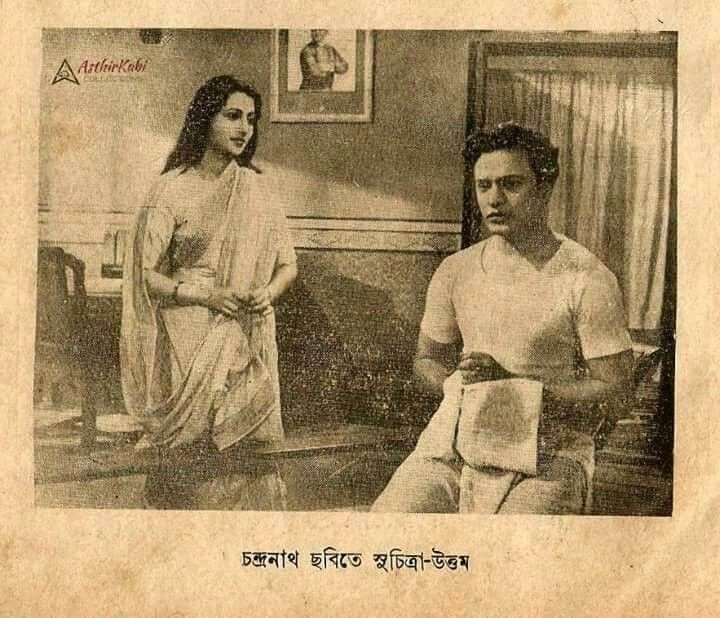
Suchitra-Uttam in Chandranath (Pic: Internet)
The undisputed Mahanayak had found his perfect foil in Mrs Sen. The two halves of the phenomenon, Uttam-Suchitra, shared unmatched popularity – and a rare camaraderie. If she was too graceful, he was disarmingly comfortable to work with. When the duo loved, all of undivided Bengal fell in love. When they teamed as man and wife, every Bengali household redefined its wedded dream. Their Pathey Holo Deri brought Eastmancolour into Tollywood. Their Chandranath netted Rs 230,138 within a week of its release in 1957. Their 30-film partnership had started with Saare Chuattar, posted landmarks like Harano Sur, Agni Pariksha, Shapmochan, Sagarika, Saptapadi, and came to a halt in 1975 with Priyo Bandhabi.
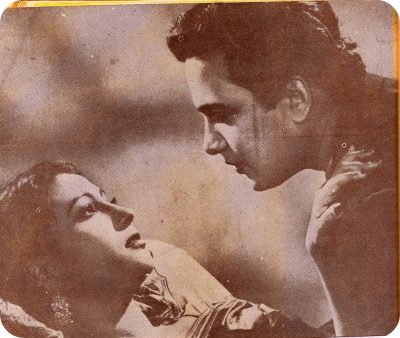
The magnetism of the screen pair is palpable
The chemistry between the two was claimed perhaps only by Nargis with Raj Kapoor or Elizabeth Taylor with Richard Burton. But unlike the others, Uttam-Suchitra had no need to get ‘physical’. Both were married when they came to the silver screen. But, confident and liberated, Mrs Sen was seldom a passive object of affection. She, of all his heroines, matched his allure, role for role. And their celebrity status kept growing, film by film. Their teaming together was never taken lightly. For, it promised the fawning millions a script with a substantial space for the lady too. The impact was such that when posters of new releases announced them in the cast, newlyweds would put off their honeymoons to watch the new release!
The magnetism of the screen pair is palpable even half a century after he travelled into eternity. The secret? Bengali society of the 50s and 60s identified completely with the star pair who could be Mr & Mrs Ghosh-Bose-Mitra. She was the eternal Radha to his contemporary Krishna. If he was a sophisticated Babu, she made nylon saris and blue sunglasses a rage. If he was a self-respecting Mahim, she could be a self-sacrificing Rina Brown. Perhaps that’s why Suchitra Sen disappeared from the public eye after Uttam Kumar’s death. On July 25, 1980, she had placed a garland around the charismatic ‘Guru,’ draped a pallu over her head and receded into the shadows.
__________
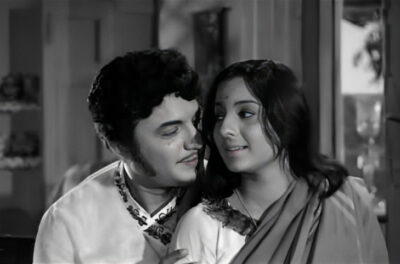
Uttam Kumar and Tanuja in Antony Firingee
How did Uttam Kumar fare against other leading ladies? Popular Bengali film magazines like Ultorath devoted pages to scan the pros and cons of the new pairing – often dismissively. But look at the numbers: He was cast in exactly the same number of films – 30 – against Supriya Devi, who played his sister in Basu Paribar but went on to be his partner; and against Sabitri Chatterjee who, it is rumoured, never married because Guru was unavailable! But perhaps his most appealing casting (after Mrs Sen) was with Tanuja – in the two biggest musicals of all times, Deya Neya and Antony Firingee. Their Rajkumari is another musical remembered till today. With Sharmila Tagore, apart from the classic Nayak, he shared a charming camaraderie in Amanush and Anand Ashram, seen in both Hindi and Bengali. His pairing with Aparna Sen was sustained through the 1970s, with Aparichito, Kalankita Nayak, Mem Saheb, Kayahiner Kahini, Jadu Bangsha…
Meanwhile, one cannot forget Arundhati Devi – together they made Jatugriha, Jhinder Bondi and Bicharak, and Shiulibari titles to remember. Nor Sandhya Roy, his unforgettable leading lady in Bhranti Bilas, Dhanraj Tamang. Nor his seven-film pairing with Mala Sinha, then a star in Bombay (Prithibi Amare Chai, Putrabadhu); or Madhabi Mukherjee (Sankhabela, Chhadmabeshi, Biraj Bou), Anjana Bhowmik (Nayika Sangbad, Kokhono Megh, Chowringhee), Arati Bhattacharjee (Stree), Kaberi Basu (Ami Se O Sakha), Mithu Mukherjee (Mouchak), Jaya Bhaduri (Dhanyi Meye), Moushumi Chatterjee (Ogo Bodhu Sundari).
But perhaps ranking above them all is Sumitra Devi, the spellbinding Chhoto Bou of his Bhutnath, in Saheb Bibi Golam!
__________
Prateek started watching these films in his late teens “and got hooked on them.” Being an avid Uttam lover, he started collecting any printed matter on the idol. “In those days, much, much before the Internet and Google, I could get information only from the film magazines,” he shares, taking us to the story of his 22-year collection of Anandalok, Prasad, Ultorath, Robbar, Poribartan, Saptahik Bartaman, Gharoa, Sunday, Star & Style, Filmfare among others. They only had to feature the icon on the cover or even an item inside. His passion didn’t stop with magazines. Books and booklets too are among the memorabilia he has hoarded.
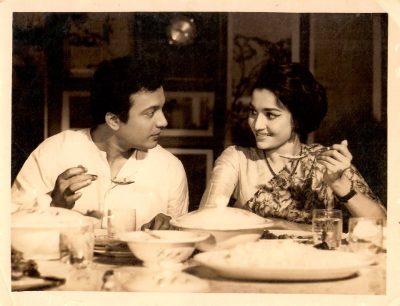
A rare photo of Uttam Kumar and Asha Parekh from the unreleased film Jhankar (Pic: SMM Ausaja Archives)
SMM Ausaja, a passionate archivist of film memorabilia, and author of The Bachchans: A Saga of Excellence, had started in Kanpur by collecting Amitabh Bachchan postcards. He is eloquent on the artistry behind film posters and the importance of preserving the legacy of this “lost art of hand-designed posters.” His collaborations with Bengali cinema’s legends – notably, Ray and Mrs Sen – highlight his dedication to this cause. “Cinema is a mighty element of Culture… And honouring it by preserving our cultural heritage is the collective responsibility of society,” he underscored, speaking at The Lens and Legacy exhibition hosted by NGMA Mumbai in April.
Last month, in an exhibition titled ‘Swaraj’, Neville Tuli’s Research Centre for India Studies mounted film posters along with vintage photographs and political cartoons, archival newspapers and forgotten objects to offer an understanding of how India came to be. “These allow you to enter history in a completely different way,” he says in a national daily. Because “an image can reveal relationships, emotions, symbols and contradictions that several pages of texts might fail to communicate.”
These exhibitions highlight another reality: Though India continues to produce the maximum number of films in the world, preserving cinema heritage – memorabilia in particular – largely depends on individual efforts. While a small country like Switzerland has a museum devoted to an ‘exile’ Charlie Chaplin, we have not wasted a thought in similarly honouring Ashok Kumar, our first superstar who steered Bombay Talkies into becoming today’s Bollywood!
__________
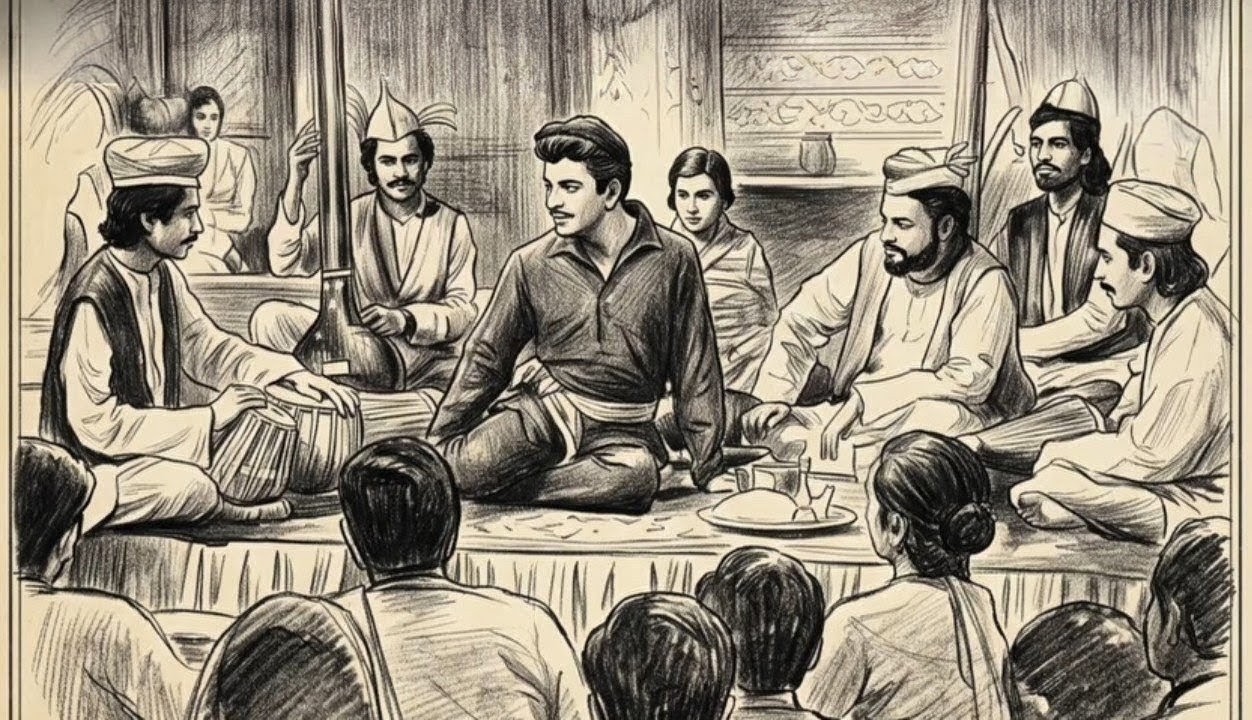
Ami je jalsaghare in art
Posters of many Uttam Kumar movies craft the visual of Aami Je Jalsaghare, a musical tribute to “Parar Dadu” of Suveendu Banerjee. The harmonium soloist brings lyrical depth to his playing of the peti that has a unique place in Hindustani music soirees. But, more than the musical reference to the immortal Antony Firingee, this Gaya gharana player wanted to offer his homage to the Centurion with whom he shares a timeless bond. “I am a resident of Bhowanipore – the neighbourhood where Uttam Kumar lived close to his cousins, my grandfather and father,” the graded AIR artiste shares. “So, I wanted to offer my best homage – my music. And what could be better than this immortal number?”
Posters of many films mentioned above comprise the exhibitions Bobby Kohli is mounting in Delhi – where he made his mark as a collector in the 1990s – and in Goa, the home to IFFI, the annual international film festival of India. Needless to add, these are part of the celebration that will mark the Birth Centenary of Uttam Kumar.
We have already seen a captivating collection at the ICCR in Kolkata, mounted by another private collector, Sudipta Chanda. Both the collections range from blockbusters to little-known films. Saptapadi, Har Mana Har, Bordidi, Grihadaha, Nayika Sangbad, Phuleswari, Thana Theke Ashchhi, Anand Ashram, Amanush, Bondi, to Putrabadhu, Lakkho Hira, Khudha feature in Kohli’s collection. Booklets, song books, and vinyl records, including one of the songs by Uttam Kumar, are among Chanda’s treasures.
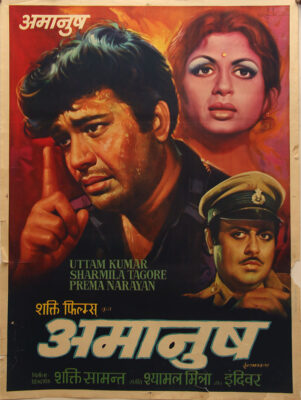
Hand-painted poster of Amanush (Pic: Bobby Kohli Collections)
What’s special about posters, you might ask. The posters not only provide us a glimpse of the films that featured the legend. They take us back in time, when many of these were hand-painted. Often the same film had different posters to drive home to viewers that the film was entering a milestone of 100 days or the Silver Jubilee week, I recall from my childhood. At times they were different so as to highlight a mood suitable for the rural audiences rather than the urban cine goers. And the songbooks? They detailed the full cast and crew and the synopsis – and, occasionally, also announced the next film of the production house, or of the star – Uttam Kumar, in this case. “Posters also offer a glimpse into the changing technology and design,” Chanda points out in a newspaper report. “Some, such as Shikar, are monochrome; some combine cut-outs of B&W stills with illustrations and lettering.” But he too prizes the hand-painted posters the most.
Bobby Kohli started off almost four decades ago, by buying what was then little more than ‘kabadi,’ junk. Years rolled on. Debasree Roy, then a child dancing on stages lit up by the presence of Uttam Kumar, is now a veteran actress boasting National awards. Video and television have given way to YouTube and OTT. All through, cinema – Bollywood, Tollywood, Mollywood – continued to grow. In numbers. In reach. In strength. Until Indian Cinema came to be recognised as the only one that can be bracketed with Hollywood. And the junk in Kohli’s trunks came to be high points of auctions as much as of archives.
So I asked Bobby Kohli a string of questions. And here’s what he said to me…
The Vision of Kohli the Collector
Ratnottama: How did you turn into a collector?
Bobby Kohli: In 1992, while visiting the Kalighat Temple in Kolkata, I was looking for old photographs. The Photography shop there did not have any photographs but, interestingly, they had lots of black-and-white stills from Raj Kapoor movies. That was my first encounter with film memorabilia. I exhibited the Raj Kapoor stills in Delhi and was surprised to see the response. It not only received rave reviews from the press, but also drew an amazing number of people to the exhibition. Collectors, dealers, ordinary fans of movies and hard core fans of film memorabilia. It opened cinema as a whole canvas, for me. That was the beginning of my journey as a collector.
Ratnottama: Did you have a special interest in cinema?
Bobby Kohli: Cinema, I think, is a very important part of every Indian. It was absorbing to talk to the people who visited the exhibition: they were like encyclopedias of cinema. They knew everything about our films: Actors, stars, the director, producer, date of release, music director, singer, etc. etc.
I was a fast learner. Slowly and steadily, I collected film memorabilia in any form. In good, bad, or ugly condition. It took a lot of time, but I got the damaged pieces restored by my artist friends. And I fell in love! With the black and white stills, posters of films, lobby cards, hand coloured stills, song booklets… I just loved them all, and over the last 35 years, I collected whatever came my way. Before I knew it, I had built up a huge collection.
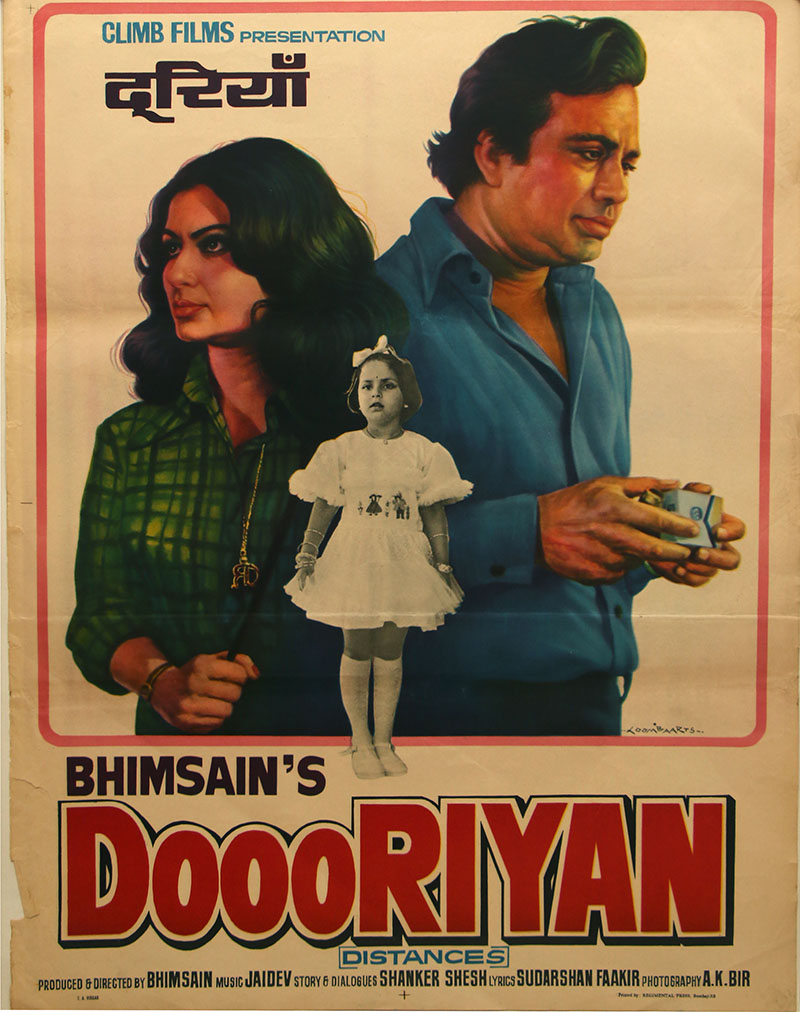
Poster of Dooriyan, combining cut-outs of B&W stills with illustrations and lettering (Pic: Bobby Kohli Collections)
Ratnottama: What is the importance of posters as opposed to, say, calendars? Are they ‘Art’?
Bobby Kohli: Film posters were put up across the cities when the films were released. Or re-released. Cinema stills were generally given to exhibitors when films were screened in theatres. After Independence, film synopses were occasionally distributed to the general viewers. But as a rule, the masses did not have access to posters and other film memorabilia. The public would generally view posters on the streets, on lamp posts and walls and billboards. And cinema stills were seen only in theatres, that too in glass-covered cupboards.
Calendars, on the other hand, were given to people at the onset of a new year – Gregorian, Vikram Samvat, or any regional variation. Mostly shops, corporate offices, big and small business enterprises distributed them as presents, for publicity and to sustain customer loyalty. Every Indian household displayed calendars featuring images of Gods, actresses, or national heroes. Some also showed landscapes, some pilgrimages, some monuments.
They were both important art forms, but I feel, neither was given the status they deserved until recent times.
Ratnottama: Do cinema posters have a longer shelf life than those of plays, or of art exhibitions?
Bobby Kohli: Yes, cinema posters do have a longer life than theatre memorabilia. Because cinema has an insatiable appeal, a huge market, and a massive fan following. The reach of theatre cannot be compared to this.
Ratnottama: When an average person buys a poster from you, does he do so for the love of cinema, for the craze of actors, or to sell it for gains?
Bobby Kohli: More often than not, an ordinary person buys purely for the love of cinema and for the actors. Cinema is so big in every Indian society. In the past, when there was no television to bring the stars home, nor video to let you see a film at will, actors were treated as gods and demigods. Especially in South India, where cutouts of film stars were like public art. This was, and still is, clearly visible in the election results. Even recently, when they are the mainstay of ads and thrive on game shows, blogs, podcasts, and other forms of social media, their popularity has not diminished. We can gauge this from every Breaking News and the craze for Selfies. But dealers and auction houses work for profit.
In 2002, Bowrings held an auction where the collection of documentarist-film historian B D Garg and JBH Wadia, founder of Wadia Movietone, went under the hammer. That triggered the interest of Neville Tuli who set up Osian’s Connoisseurs of Art. Subsequently, it helped create value for Indian cinema memorabilia across the globe. How? When Tuli started sourcing from distributors and dealers, he gave good prices. This helped small dealers financially and thereby created value for posters, booklets, and lobby cards, which earlier just had a handful of takers.
From Tuli’s auction, Shah Rukh Khan had picked up posters of Mughal-e-Azam worth nearly 7,00,000 rupees. I am delighted to add that Tuli had sourced one of these from me.
Ratnottama: Do we have a market for posters of Indian movies, including regional movies?
Bobby Kohli: Oh yes! There is a definite market for film memorabilia, including posters of Indian movies. However, the demand changes every few years depending upon the collectors.
And yes, there is a demand for regional movies too. Especially for well-known actors and classics in language cinema. Posters of Satyajit Ray movies command very high prices because he personally designed them, with the help of a very creative team, including those in the printing process. His family was among the pioneers of printing and publishing, remember? They had revolutionised half-tone and color block printing in South Asia.
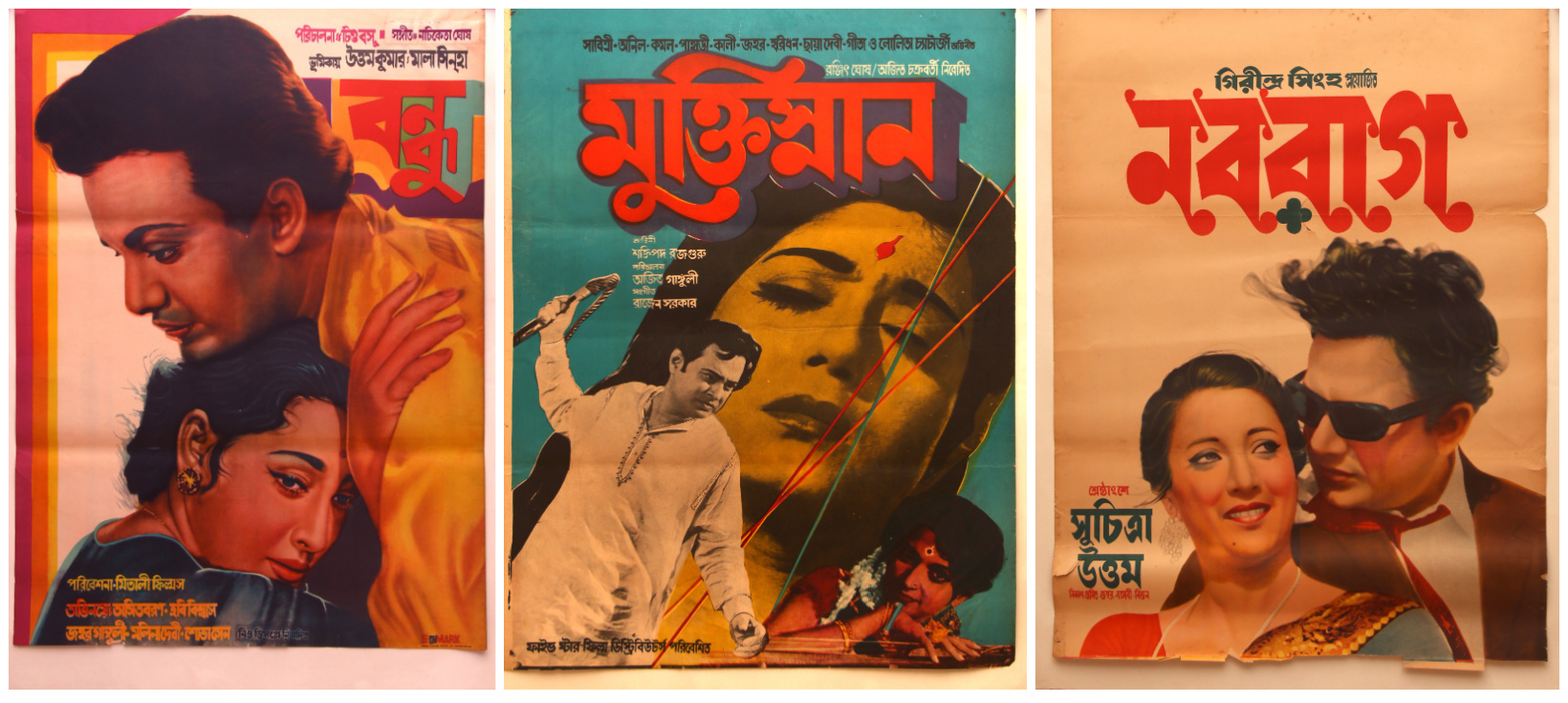
(L to R) Posters of Bandhu, Muktisnan and Nabarag (Pic: Bobby Kohli Collections)
Ratnottama: What led you to collect Uttam Kumar Posters? How do you source them?
Bobby Kohli: I had Uttam Kumar posters in my collection as I collect all types of film memorabilia. For the last few years, I asked my dealer network to get me Uttam Kumar posters to increase my collection for his birth centenary. Now it is an ongoing process.
Ratnottama: Amitabh Bachchan is the mainstay of Ausaja’s collection. Who are the other majors, heroines perhaps, of your collection?
Bobby Kohli: I think I have everybody in my collection, which is constantly growing, day by day.
Actors who have worked in a greater number of films necessarily have more memorabilia compared to those who acted in a limited number of films.
Ratnottama: Have you seen any Uttam Kumar film? What explains his evergreen appeal to you?
Bobby Kohli: I may have seen a stray Bengali movie but, honestly, I have no recollection of it. I have seen his Hindi movies, though. I find him very handsome. I love his voice, and of course his acting. He excites me. He is easily one of my favourite heroes. That is why I want to be part of his Birth Centenary Celebration.
Ratnottama: How do you preserve such a large collection?
Bobby Kohli: You’ve said it! Indeed, preserving posters is more difficult than collecting them. Because paper is very brittle, preserving them takes a lot of effort and time. As a norm, we get them in a folded form. So the first step is to open them fully, restore torn posters, then lay them flat in polythene, with a thick sheet underneath. This gives them enough strength, and they stay strong.

Whether you are new or veteran, you are important. Please contribute with your articles on cinema, we are looking forward for an association. Send your writings to amitava@silhouette-magazine.com

 An Actor Arrives: Uttam Kumar Through 5 Landmark Films of the 50s
 The Legend of Uttam Kumar
 Suryatapa – The Indomitable Self-Respect of a Woman
 Uttam Kumar: Leaving a Mark in his Few Hindi Films
 Uttam Saw Bengali Cinema Revive and Was Pained by Its Fall Again
 Eyi Path Jodi Na Shesh Hoy: The Immortal Songs of Uttam-Hemanta
Silhouette Magazine publishes articles, reviews, critiques and interviews and other cinema-related works, artworks, photographs and other publishable material contributed by writers and critics as a friendly gesture. The opinions shared by the writers and critics are their personal opinion and does not reflect the opinion of Silhouette Magazine. Images on Silhouette Magazine are posted for the sole purpose of academic interest and to illuminate the text. The images and screen shots are the copyright of their original owners. Silhouette Magazine strives to provide attribution wherever possible. Images used in the posts have been procured from the contributors themselves, public forums, social networking sites, publicity releases, YouTube, Pixabay and Creative Commons. Please inform us if any of the images used here are copyrighted, we will pull those images down.