Stay tuned to our new posts and updates!
Click to join us on WhatsApp


The Virasat Anthology of Short Stories brings together a compelling range of voices, each story offering a glimpse into lived experiences, imaginative landscapes, and the shared threads that bind us as human beings. Spanning styles, themes, and geographies, it reflects both the diversity of contemporary storytelling and its enduring emotional core. LnC speaks to Nishi Pulugurtha, the editor of the anthology.
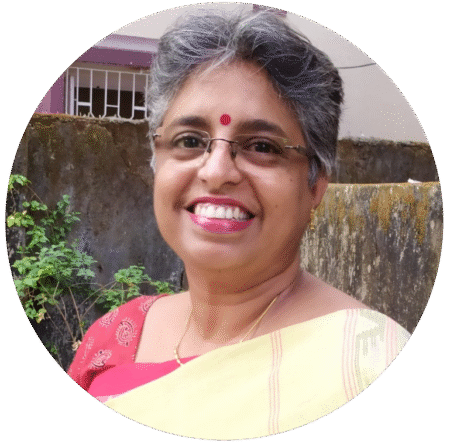
Nishi Pulugurtha
As readers, we often encounter anthologies as seamless collections with stories flowing one after another, each voice distinct yet somehow in conversation with the rest. But behind that quiet cohesion lies a deeply thoughtful editorial process.
I had the opportunity to speak with Nishi Pulugurtha, the editor of The Virasat Anthology of Short Stories, about her experience of bringing this collection to life. Our conversation moved through the origins of the anthology, the discipline of reading and selecting submissions, and the delicate balance of honouring multiple voices while shaping a unified reading experience.
What emerged was not just an editorial journey, but a reflection on storytelling itself; on empathy, diversity, and the shared threads that connect human experiences across geographies.
Every anthology begins as an idea, but rarely does it stay just that. In this case, the seed was planted through a collaborative nudge, eventually evolving into a widely shared call for stories that invited voices from different corners.
Unlike a single-author manuscript, an anthology resists uniformity. It thrives on contrast, different styles, tones, cultural contexts, and narrative experiments.
Rather than forcing balance, Nishi allowed diversity to lead. Her goal wasn’t to smooth out differences, but to ensure that, collectively, the stories offered readers a rich and engaging experience. The result is a collection where each piece retains its individuality while contributing to a broader literary conversation.
You can order your copy of The Virasat Anthology of Short Stories on Blue Pencil
In this conversation, we delve into the process of selecting and refining stories, the challenges of curation, and the insights that emerge when multiple voices come together within a single volume.
Jyoti Babel: What first drew you to the idea of curating this anthology? Do you remember when this moved from just an idea to something you really wanted to bring to life?
Nishi Pulugurtha: The entire idea was that of the Chief Coordinator of Virasat Art Publication, Shri Partha Roy’s. He asked me if I would be willing to edit an anthology of short stories. I do remember when and where we had this conversation. He said that I was free to decide and go about as I felt right. I am interested in the genre of the short both as a practitioner in the form and as a reader and translator as well. I have two volumes of short stories – The Window Sill (2021, has 20 stories) and Framed (2023 has 11 stories).
So, I suppose a short while after this I gave it some serious thought and worked out a Call for short stories. I toyed with the idea of having a specific theme but then decided against it. Once the Call for Stories was ready I began to share it on social media and with people I thought would be interested or would direct me to people who might be interested. Several people reshared the Call and that led to a wide visibility of the proposal.
Jyoti Babel: As an editor, how did you begin the process of selecting stories for the collection?
Nishi Pulugurtha: I waited till all the stories came in, till the deadline for receiving the stories was over. Then I began to read each one. I did it on a regular basis. I wanted to maintain the flow and read each entry. Also, I wanted to make sure that I had all what I had read in mind. So, I did the reading continuously and regularly. As I read I began to make my decisions. I had three folders marked – ‘Yes’, ‘No’, ‘Maybe’. I re-read the ones that went into the ‘Maybe’ folder and made my choices. The ones that found there place into the ‘Yes’ folder I re-read too as I had to make a final decision. That final decision was not a very easy one to make.
Jyoti Babel: How is editing an anthology different from working on a single-author manuscript?
Nishi Pulugurtha: It is different in that one has several voices and several styles that one is working with. Different ways of expressions as well. There are decisions that one needs to take. I had to work at a regular pace so that I was able to recall each story that I read. With a single author there is not so much variety in terms of styles in a single manuscript.
Jyoti Babel: What were you looking for in a story beyond just good writing?
Nishi Pulugurtha: A tale told well, the style and expression, the use of language.
Jyoti Babel: How did you balance very different voices while still keeping a sense of flow in the book?
Nishi Pulugurtha: Because it is an anthology there was bound to be a difference in the styles, in the contents, in the narratives. The question of balance per se was not so much on my mind. What I was hoping was that the anthology, as a whole, reads well and gives readers a nice mix of styles and narratives in the genre.
Jyoti Babel: Were there any particularly tough decisions you had to make along the way?
Nishi Pulugurtha: Not really.
Jyoti Babel: The anthology brings together writers from different backgrounds. How did that shape your experience as an editor?
Nishi Pulugurtha: It was great fun to read the way in different authors worked their way with the genre. It was a learning experience as I edited the stories. Each author brought in so much into each piece. Some stories were a breeze to read through, some needed some revisions, etc. Each of my contributors have been a pleasure to work with.
Jyoti Babel: What did you find most fulfilling about working on this collection, and what did you find most challenging?
Nishi Pulugurtha: The challenge lay in reading the stories the first time. I had to do that regularly. I needed to have the experience of being able to relate to and recall each story. I had to choose some of them and that choice had to be a judicious one. The fulfilling part was being able to read so many different voices, from so many different parts of the world. And that meant so many styles of the genre.
Jyoti Babel: Do you see these stories as reflecting the present moment, or do they feel more timeless to you?
Nishi Pulugurtha: While they do represent the times we are in there is also a timeless element in several of the stories.
Jyoti Babel: Did working on this anthology leave you with any personal reflections or shifts in perspective?
Nishi Pulugurtha: There are stories with so much empathy in them, stories that use so much of the regional languages in them, stories that speak of the human animal bonds, of the supernatural, that use of satire, that rework myths and known texts. Each of them brought so much about the human experience to the fore and that, I think, is my biggest take away from them.
Jyoti Babel: What do you hope a reader carries with them after finishing the book? If you had to describe the essence of the collection in a line or two, how would you put it?
Nishi Pulugurtha: The myriad voices, I hope reveal to readers how similar we are, no matter where we are located. In a world that is becoming increasingly fragmented, I think, we need to be constantly reminded of it. The stories talk about the human experience, of the simple bonds and stories that are a part of our lives, no matter which part of the globe we belong.
Jyoti Babel: What are you working on currently?
Nishi Pulugurtha: I am editing a volume that hopes to present the dementia experience in India – it is a book that presents first person narratives of caregivers, interviews of people working in the field, of caregivers, etc. I am also working on another co-edited volume of translated short stories.
Jyoti Babel: Thank you, Nishi, for the enlightening conversation and for sharing your thoughts with our readers. Wishing you all the very best for The Virasat Anthology of Short Stories and your future endeavours.
At its core, this anthology is about connection. These stories remind us of something simple yet profound: that across distances and differences, our experiences often echo one another. And perhaps that is what makes an anthology linger, not just as a collection of stories, but as a reflection of who we are, collectively.
The Virasat Anthology of Short Stories
Published: 15 July 2025
Publisher: Virasat
ISBN: 978-93-92281-29-7
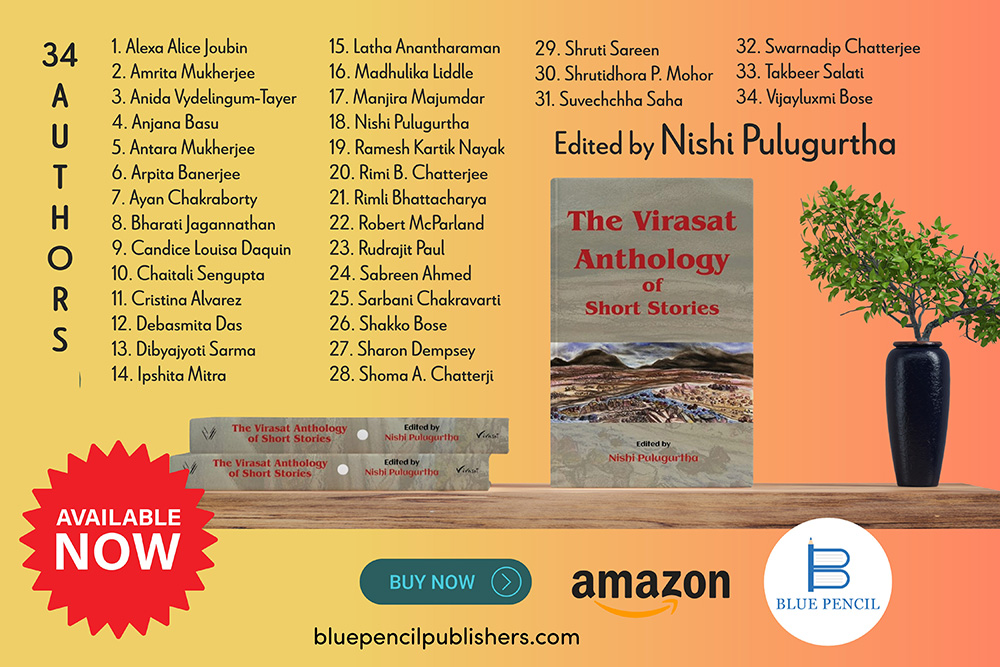
The Virasat Anthology of Short Stories
About the Editor
Nishi Pulugurtha is an academic, author and poet based in Kolkata. Her publications include a collection of essays on travel, Out in the Open; an edited volume of essays on travel, Across and Beyond; two volumes of poems, The Real and the Unreal and Other Poems, Raindrops on the Periwinkle, a co-edited volume of poems Voices and Vision: The First IPPL Anthology and a collection of short stories The Window Sill. Her recent book is an edited volume of critical essays, Literary Representations of Pandemics, Epidemics and Pestilence (Routledge, 2023). She is the Secretary of the Intercultural Poetry and Performance Library, Kolkata and is member, Advisory Board, Alzheimers and Related Disorders Society of India, Calcutta Chapter.
More to read in Interviews
Kabir — An Inward Journey: In Conversation with Debutant Author Smita Tiwari
Exploring the World of Clayfaces with Author Shiladitya Sarkar
Where Are The Lilacs – In Conversation with Author Dr. Santosh Bakaya
Beyond Apu – 20 Favourite Film Roles of Soumitra Chatterjee: In Conversation with Author Amitava Nag
In Conversation with Ramakanta Das on His Poetry Collection ‘Grass Flower’

 Worldwide Launch of The Significant Anthology
 Roots and Meanderings Review – The Cast Is Kaleidoscopic
 Foreword: ‘A New Lease of Life: Stories of Reunion’ by Sarmita Dey
 ‘Darkness There But Something More’: Up, Close and Personal With the Two Editors Dr. Santosh Bakaya and Lopa Banerjee
 Defiant Dreams: Tales of Everyday Divas – A Book Review
 Roots and Meanderings — A Collection of Ten Fresh, Engaging Fictional Narratives
Got a poem, story, musing or painting you would like to share with the world? Send your creative writings and expressions to editor@learningandcreativity.com
Learning and Creativity publishes articles, stories, poems, reviews, and other literary works, artworks, photographs and other publishable material contributed by writers, artists and photographers as a friendly gesture. The opinions shared by the writers, artists and photographers are their personal opinion and does not reflect the opinion of Learning and Creativity- emagazine. Images used in the posts (not including those from Learning and Creativity's own photo archives) have been procured from the contributors themselves, public forums, social networking sites, publicity releases, free photo sites such as Pixabay, Pexels, Morguefile, etc and Wikimedia Creative Commons. Please inform us if any of the images used here are copyrighted, we will pull those images down.