Stay tuned to our new posts and updates! Click to join us on WhatsApp  & Telegram
  Channel
& Telegram Channel & Telegram Channel 




The inaugural edition of IFFD 2026, held in Delhi in March 2026, brought film festival fever back to the capital. A Silhouette report by Anshula Mondal.
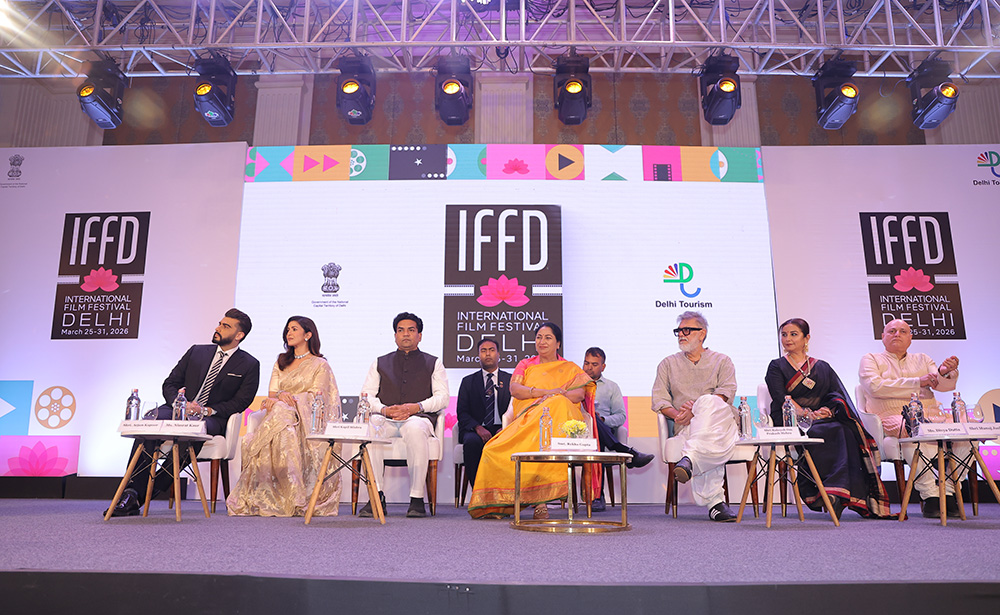
The inauguration of the International Film Festival Delhi (IFFD)
From grand tributes to overlooked legacies, the opening days of the festival reflected both the glory and the gaps within Indian cinema.
The IFFD International Film Festival Delhi, held at Bharat Mandapam from 25th to 31st March 2026, commenced on a vibrant and emotionally resonant note, setting the tone for a week-long celebration of cinema, culture, and artistic dialogue.
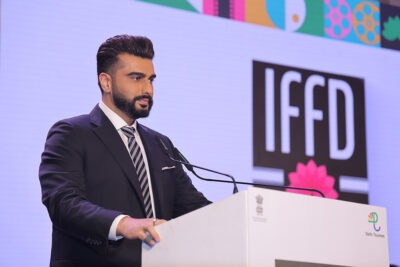
Arjun Kapoor anchoring the IFFD inauguration
Day 1: A Grand Opening of Legacy and Emotion
The inaugural evening was anchored by Arjun Kapoor and Nimrat Kaur. They introduced Delhi not merely as a city, but as a character in itself, one that shapes journeys, dreams, and cinematic identities. A series of vibrant cultural performances represented the diversity of India, spanning regions from Rajasthan and Punjab to Himachal Pradesh, West Bengal, Odisha, and Tamil Nadu.
The special invitees included a bevy of veteran actors as Hema Malini, Sharmila Tagore, contemporary stars Vicky Kaushal and Kangana Ranaut, apart from Rekha Gupta, the Chief Minister of Delhi, and the Minister of Tourism, Kapil Mishra.
A deeply emotional tribute was paid to the legendary “He Man” of Bollywood, Dharmendra. Hema Malini, receiving the honour on his behalf, expressed her emotions with grace and strength, reflecting on his inspiring journey.
The evening also honoured the extraordinary journey of Sharmila Tagore, who began her career with Satyajit Ray in Apur Sansar, back in 1959, creating an impressive body of work apart from holding on to her own enduring charisma, grace and artistic excellence and still going strong with recent films like Gulmohar. The nostalgia surrounding her presence was further amplified by memories of the runaway hit Aradhana, whose music continues to live on across generations.
The festival featured a diverse selection of films across languages, including Hindi, Tamil, Telugu, Bangla, Malayalam, Marathi, Punjabi, Kannada, Gujarati, and Bhojpuri, along with international entries in Spanish, Mandarin, and Chinese, reflecting both regional richness and global cinematic exchange.
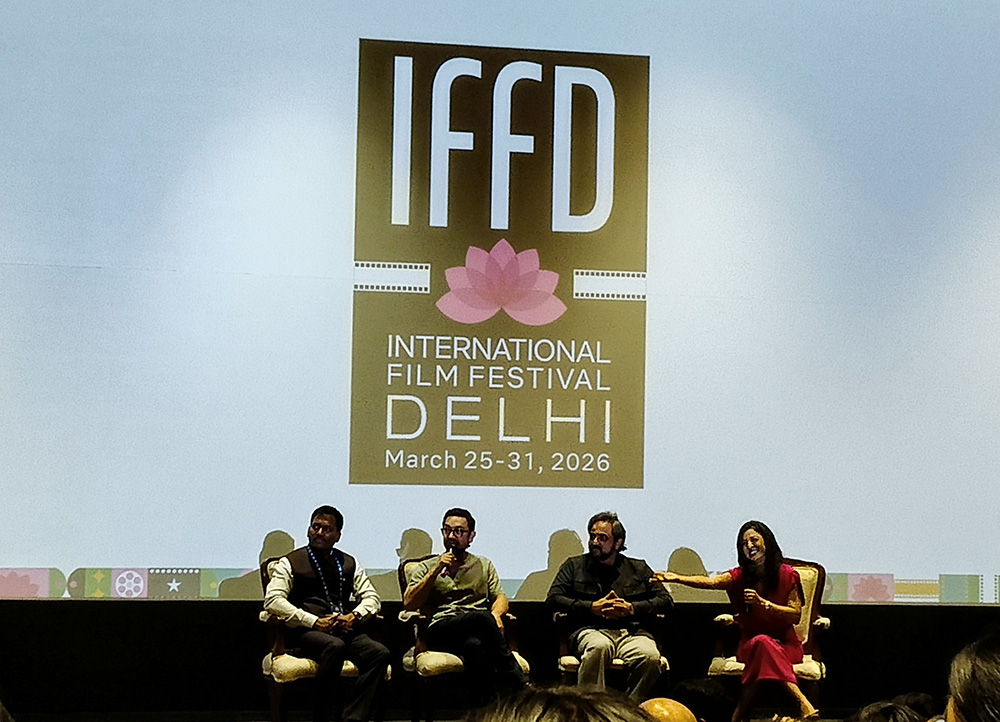
Aamir Khan at the IFFD 2026
Day 2: Cinema as Reflection, and the Silence Around Preservation
The second day began with the screening of Sitare Zameen Par, a film produced by Aamir Khan and directed by R S Prasanna, which explores how a suspended basketball coach learns, grows, and finds joy while training his specially-abled team for a tournament. The film urges audiences to rethink empathy and understanding.
Following the screening, Aamir Khan engaged in a thoughtful interaction with the audience, sharing insights into the making of the film and its underlying message. His words left a lasting impression, particularly for those who could relate to its themes. Aamir Khan said, “We are just passing on knowledge to children today. We do not help them understand how to apply it or how it makes a difference in their lives.” The film at the end with its story conveyed a very beautiful and valuable message to the audience: “Why must success always be defined by being at the top, why can being second not be a reason to celebrate?”
The Greatest Extravaganza of Cinema’s Art
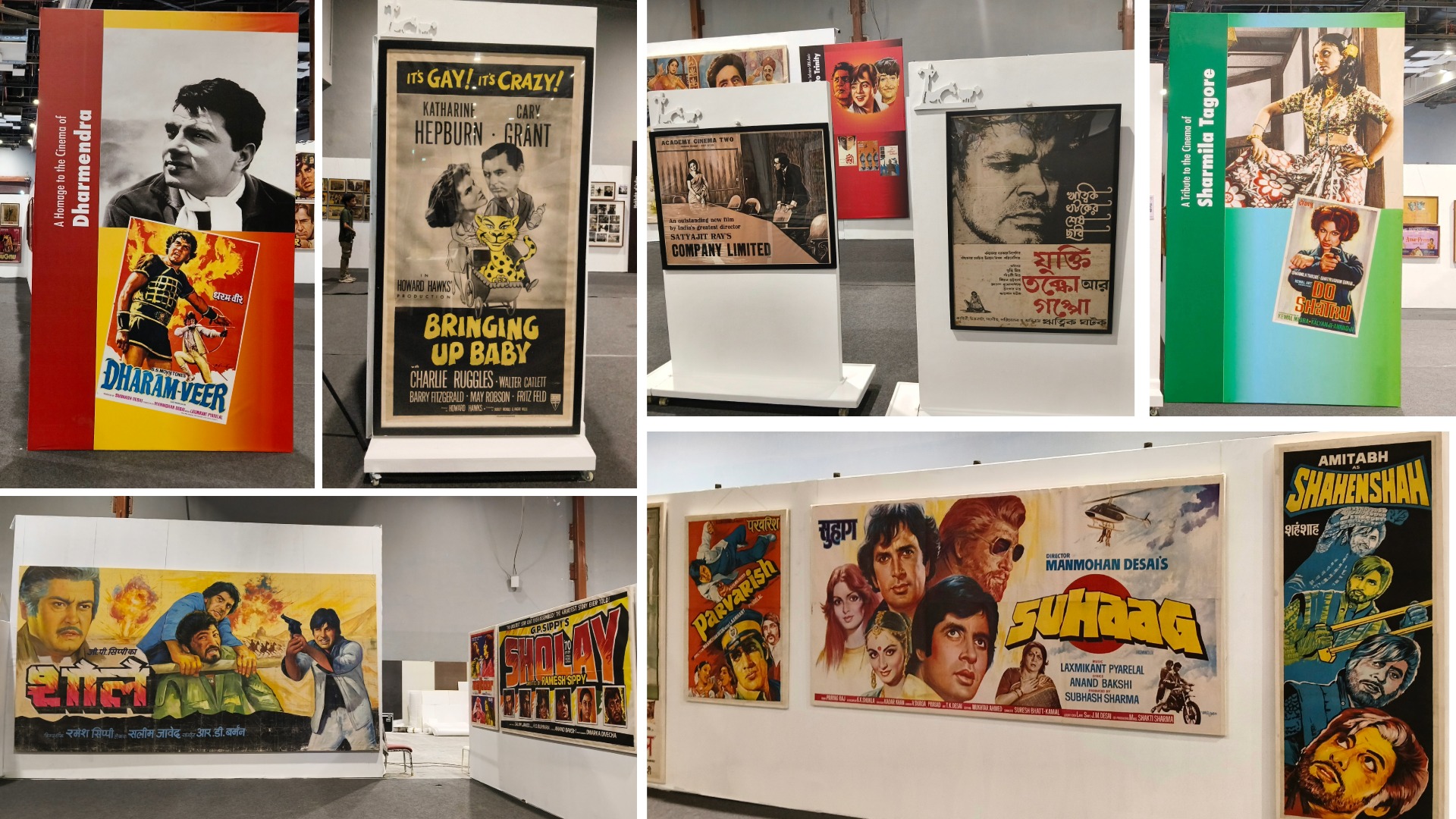
A mega exhibition of cinema memorabilia curated by the Tuli Research Centre for India Studies
Away from the main venue, ‘The Greatest Extravaganza of Cinema’s Art’, curated by Neville Tuli, author, curator, archivist and founder of the Tuli Research Centre for India Studies stood as a quiet yet powerful space preserving cinematic history.
The exhibition of vintage film art, memorabilia, publicity material and archives “celebrating cinema as a critical educational resource”, featured an awe-inspiring range of vintage hand painted posters, massive six sheeter posters (Horizontal 120 x 60 inches posters) and full sheet 40 x 30 inches posters to rare photo stills, booklets and lobby cards, commemorative trophies of films completing silver and golden jubilees and platinum discs, the exhibition displayed held invaluable pieces of India’s cinematic heritage. Along with restored film posters, archival material, dedicated sections honoured legends like Dharmendra and Sharmila Tagore. The atmosphere was further enriched by songs from classic films like Shree 420 and Pyaasa, while a full wall of rare images of Satyajit Ray offered an intimate glimpse into his filmmaking process.
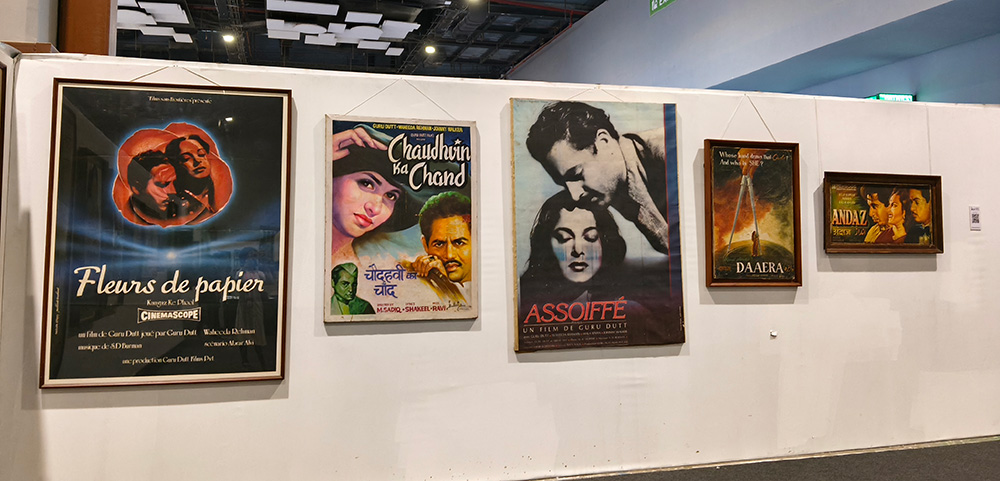
Kaagaz Ke Phool, Chaudhvin ka Chand and Pyaasa posters in English and French
Sadly, despite its significance, the exhibition, tucked away in a separate pavilion, did not get due attention. This highlighted a clear contrast between the celebration of cinema and the neglect of its preservation.
Day 2 concluded with Bhajan Clubbing by Sonam Kalra. While the concept was interesting, the execution lacked cohesion. The delay and lack of synchronization among instruments affected the overall experience.
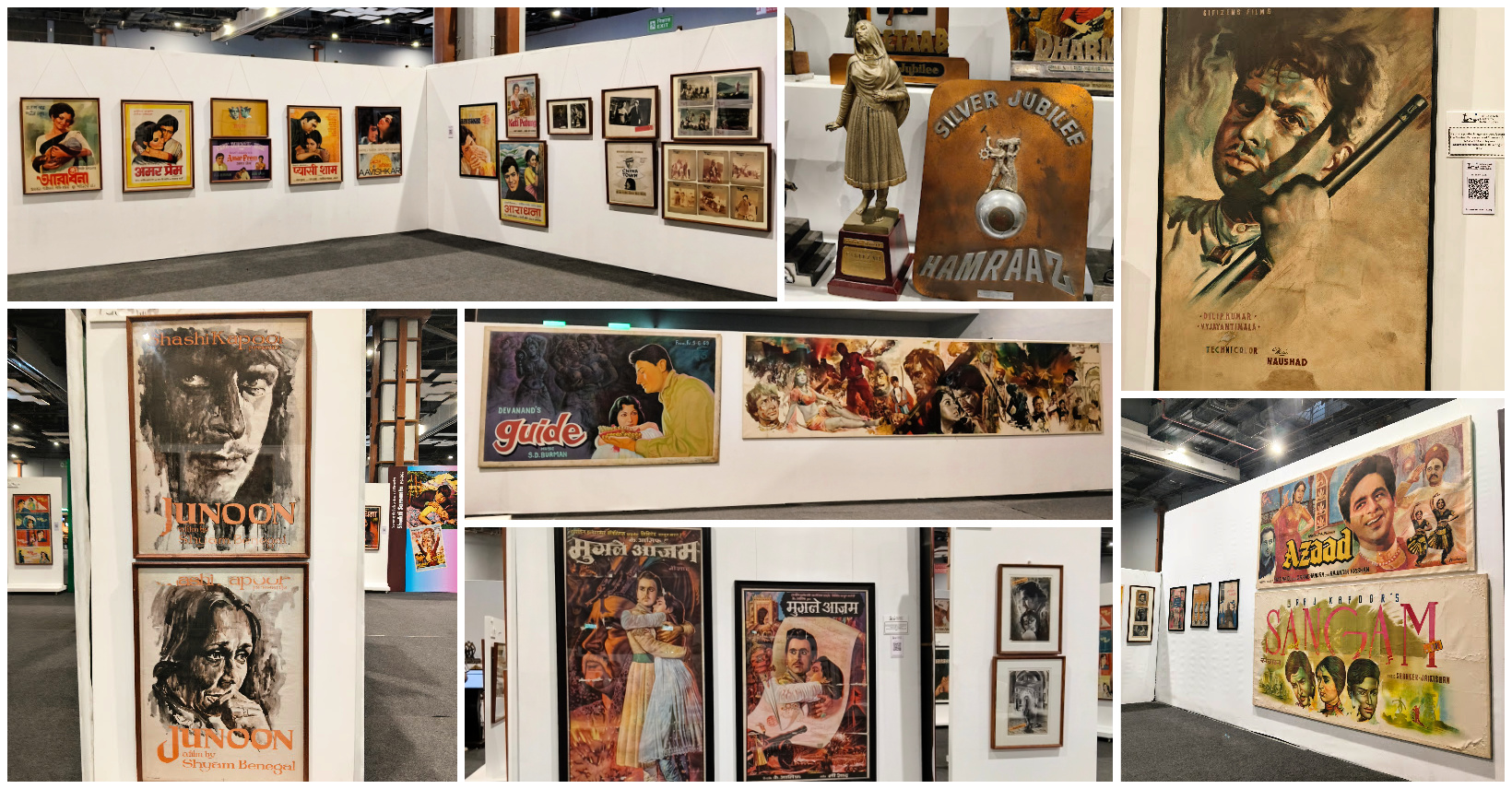
Rare vintage posters, jubilee mementos and other exhibits on display at the sprawling Bharat Mandapam
Day 3: Stardom, Stories, and a Question of Value
The third day witnessed an energetic influx of celebrities and audiences, with attendees eager to engage with their favourite celebrities and capture moments with them. The atmosphere reflected the growing momentum of the festival.
The Marathi film Baipan Bhari Deva presented a powerful narrative encouraging women to rediscover their identities and step beyond societal limitations.
The day’s masterclasses featured Boman Irani and Neville Tuli. Boman Irani shared insights from his journey in cinema and was given extended time.
During the session, Boman Irani engaged the audience through an interactive storytelling exercise. He presented a scenario of a man held captive for years who finally attempts to escape by reaching a terrace in search of a way out. He then invited the audience to participate, asking what the character should do next. As microphones were circulated, several attendees, including media professionals and film students, shared their perspectives. This interactive exchange significantly extended the session, and he was granted additional time to complete his thoughts.
In contrast, Neville Tuli, founder of the Tuli Research Centre for India Studies, was interrupted before completing his session on Cinema as a Critical Educational Resource. He was speaking about the importance of preserving cinematic heritage for future generations, a subject critical for understanding how we can preserve, archive, and curate our massive cinematic heritage. He showed the massive tuliresearchcentre.org website, where the stories of films from earlier times were written in a way easier to read for the people, with shots from the films, like one from Shatranj Ke Khiladi, a film by Satyajit Ray. Surprisingly, he was asked to conclude before his allotted time was over. He ended his talk immediately, but the moment reflected a larger concern regarding the value we place on knowledge.
An audience member raised this concern, stating that interrupting such a speaker only reinforced the issue being discussed. This echoed Amir Khan’s comment mentioned earlier, about passing on knowledge to the young minds without training them to use that knowledge. Earlier, we noticed Neville Tuli sitting on the floor among the audience, focused on his work, as the hall was packed.
Day 4: Reflection, Response, and a Shift in Perspective
The fourth day reflected a noticeable shift in response to the events of the previous day. Following what happened with Neville Tuli, there was a visible change in how the Tuli Research Centre for India Studies was being presented within the festival. Multiple posters highlighting the centre were now placed across the main building, suggesting a growing recognition of its presence after earlier concerns about its lack of visibility.
As the day progressed, film screenings from different countries and regions continued alongside masterclasses, allowing audiences to engage directly with artists and industry professionals.
One of the notable sessions featured Piyush Mishra, an actor, singer, and writer known for his contributions to theatre and cinema. He was introduced through a video montage tracing his journey from his early years to his work across different creative fields. As he stepped onto the stage, he was welcomed with enthusiastic applause.
In conversation with Mayank Shekhar, he spoke about his journey, including his time at the National School of Drama. He shared his experiences with honesty and ease, offering insights into his creative process and the way he approaches his work.
The session took a powerful turn when he performed his well known song Aarambh Hai Prachand, inspired by the Mahabharata. The performance carried a strong message of resilience and perseverance. As he sang, the audience joined in, clapping along, turning the moment into a shared experience rather than just a performance.
In Hall No. 14, located beside the Tuli Research Centre for India Studies, another section titled Waves brought together voices from different regions of India. Representatives from Punjab, Rajasthan, and Lakshadweep presented their regional film industries, highlighting the diversity of storytelling across the country.
The day concluded with the screening of Rang De Basanti, which drew an overwhelming response. A long queue formed outside the auditorium, with audiences eager to relive the experience of watching the film in a theatre setting.
Before the screening, the film’s director, Rakeysh Omprakash Mehra, addressed the audience. His presence itself created excitement, and he was welcomed with loud applause. Reflecting on the film, he spoke about its continued relevance, questioning what has truly changed over time. He pointed out that issues such as corruption and misuse of power still persist, making the film’s message as relevant today as it was at the time of its release.
Day 5: Simplicity, Substance, and Steady Engagement
The fifth day was comparatively quieter in scale, focusing primarily on film screenings and masterclasses. While it did not feature major headline moments, it reflected the festival’s continued emphasis on cinematic engagement and learning.
One of the notable sessions was a masterclass by Shekhar Kapur, where he spoke about the growing role of Artificial Intelligence in filmmaking. The discussion highlighted how technology is gradually reshaping the way stories are created and presented in contemporary cinema.
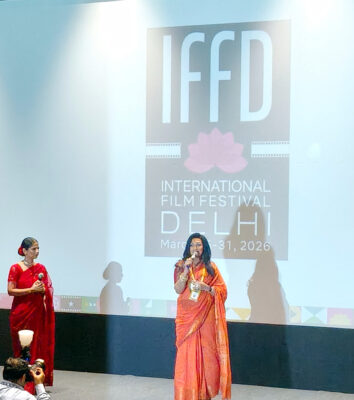
Rituparna Sengupta introducing Puratawn at IFFD
The day also saw strong audience engagement during film screenings. Two Bengali films, Bohorupi and Puratawn, drew large and appreciative audiences. While Bohorupi explored the action thriller genre, Puratawn offered a more emotional and introspective narrative, creating a contrast in storytelling styles.
Another notable screening was the bilingual Chinese film The Demon Hunters, which incorporated elements of Hindi and drew from Indian mythological themes, creating an interesting cultural intersection.
Despite being less eventful, the day maintained a steady connection with cinema. It shifted the focus away from spectacle and towards substance, reinforcing the festival’s broader purpose of engaging audiences through stories, ideas, and evolving forms of filmmaking.
Day 6: Collaboration, Craft, and Creative Reflection
The sixth day shifted focus from screenings and celebrity appearances to the deeper craft of filmmaking through a masterclass titled “Beyond the Script: How Collaboration Transforms Story.” The session brought together voices from across the industry, including Sheeba Chaddha, Shweta Tripathi, Ishita Moitra, and Anusha Rizvi, each sharing their perspectives on collaboration in storytelling.
Unlike conventional discussions, the session felt conversational and reflective, with speakers drawing from their real experiences. A recurring theme was the importance of creating a safe and open environment on set, where actors are given the space to explore their characters freely. The speakers emphasized that meaningful performances often emerge when actors feel heard and understood, rather than being restricted by rigid direction.
The conversation also touched upon the internal journey of a filmmaker. The panel highlighted the need to set aside ego, remain open to criticism, and continue evolving as artists. They spoke about the importance of patience, not only in working with others but also in understanding one’s own creative process. Staying true to one’s identity was a key idea, with an emphasis on trusting one’s voice rather than seeking external validation.
Another important aspect of the discussion was originality. The speakers encouraged aspiring creators to believe in their stories and focus on authenticity instead of imitation. As reflected throughout the session, success is not something to be chased directly, but something that follows consistent effort and honest storytelling.
Overall, the masterclass stood out as one of the most insightful sessions of the festival. It shifted the focus from performance and recognition to process and collaboration, leaving the audience with a deeper understanding of what truly shapes a story beyond the script.
Day 7: Reflection, Responsibility, and the Legacy of Cinema
The final day of the festival carried a sense of reflection, focusing on the evolving nature of cinema through an insightful session featuring renowned filmmakers.
During the discussion, Rakeysh Omprakash Mehra shared how the audience’s perception of cinema has changed over time. He noted, “In earlier times, actors were often seen as ‘poster boys’ or ‘poster girls’. People would say they were going to watch a film of Amitabh Bachchan, rather than of a filmmaker like Yash Chopra. It was only later that I realised many of the films that impacted me deeply were by the same filmmaker, which made me question what truly shaped that connection.” His reflection drew attention to the role of the filmmaker in shaping meaningful narratives beyond star power.
The session deepened further with Imtiaz Ali, who, responding to an audience question, spoke about the responsibility of filmmakers in public discourse. He stated, “Filmmakers often want to have a political voice, but they have not necessarily earned it. It is easy to say something loudly and call it a narrative or even propaganda, but without truly engaging in the social realities of the people, that voice lacks depth.”
The discussions and experiences of the day reinforced a key theme of the festival, the need to value not only performance and popularity, but also the thought, research, and intent behind cinema. As the festival concluded, it left the audience with a deeper understanding of cinema as both an art form and a responsibility.
Conclusion: A Festival of Brilliance and Reflection
The inaugural IFFD 2026 presented a compelling blend of celebration and introspection. The festival honoured cinematic legends, showcased cultural diversity, and engaged audiences with meaningful storytelling. At the same time, it has revealed gaps in how knowledge, preservation, and quieter contributions to cinema are valued.
More Must-Read in Silhouette
Reimagining India’s Cultural Tapestry: In Conversation with Neville Tuli
For the Love of Cinema – the Story Behind the Calcutta Film Society

Whether you are new or veteran, you are important. Please contribute with your articles on cinema, we are looking forward for an association. Send your writings to amitava@silhouette-magazine.com
 Reimagining India’s Cultural Tapestry: In Conversation with Neville Tuli
 Of Film Festivals and Jury Duty
 History, Rare Heritage Stars Of Osian’s Film Memorabilia Auction
 Movies and the Quest for Collective Identity in the Indian Diaspora
 Brothers versus Warrior: Why Brothers Fails to be a Knock-Out
 Brando, Bogart, Paul Muni and Beyond — Understanding Uttam Kumar
Silhouette Magazine publishes articles, reviews, critiques and interviews and other cinema-related works, artworks, photographs and other publishable material contributed by writers and critics as a friendly gesture. The opinions shared by the writers and critics are their personal opinion and does not reflect the opinion of Silhouette Magazine. Images on Silhouette Magazine are posted for the sole purpose of academic interest and to illuminate the text. The images and screen shots are the copyright of their original owners. Silhouette Magazine strives to provide attribution wherever possible. Images used in the posts have been procured from the contributors themselves, public forums, social networking sites, publicity releases, YouTube, Pixabay and Creative Commons. Please inform us if any of the images used here are copyrighted, we will pull those images down.











































































Anshula. Great work. Far from being just a ‘Report’, this is practically a “Running Commentary’ of proceedings covering a WEEK of events, displays, speeches by eminent speakers Celebrities and, not the least, a Mirror of “The IFFD International Film Festival, Delhi”.
This, is not only an “Aankhon Dekha Haal” but also reflects the effort and work put in by all those who worked for its success.
Your ‘Conclusion’ rightly highlights the need for those concerned with such matters to intensify the drive for ‘knowledge, preservation, and quieter contributions to cinema’.
Thank you so much Rajan uncle for your kind and encouraging words. It truly means a lot to me that you appreciated the effort and spirit behind the report. Your feedback is very motivating and I’m really grateful for it.
Excellent presentation. Very informative. Nostalgic too in parts. Looking forward for many more such gem
Thank you so much, Mr. Aditya Pandey. Your comment really inspires me.
Lot of critical description depth. A rare maturity in writing in presenting as it really was. Way to go Anshula.