Stay tuned to our new posts and updates! Click to join us on WhatsApp  & Telegram
  Channel
& Telegram Channel & Telegram Channel 




Through rare memories, family anecdotes, and cinematic history, Ratnottama Sengupta revisits the life and legacy of Ritwik Ghatak, revealing the man behind the legend. A Silhouette tribute in the master filmmaker’s birth centenary year.
Memories are always a source of happiness, they say. Recalling past events, incidents, happenings, bring us joy as they make us reflect on fond incidents.
But are reminiscences always comforting? Perhaps not. And yet, there’s nothing so sad as amnesia, that ailment which wipes out every memory of every moment of love and laughter. That’s a state we would not wish for our worst enemies. So, not every bit of what I will recall here may be worth boasting – still, I’m proud that I had the privilege of being a witness to all this.
____________
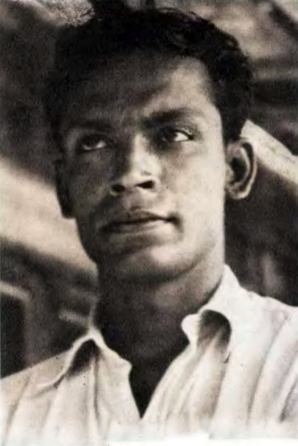
A young Ritwik Ghatak
Ritwik Ghatak. I’d heard the name ever since I was that high. Bimal (Roy) Jethu passed away in 1966. That very year Baba started visiting FTII – the Film and Television Institute of India – in Pune, to teach Screenplay Writing to the Direction students as a guest lecturer. By then, Ghatak had left FTII.
However, cinema was a subject of discussion in our home at breakfast, lunch, and dinner. Reason? Bijoy Da had come away from Delhi and joined Sudhendu Roy as assistant Art Director. Subhenda had completed his studies in Engineering and was assisting Sushil Majumdar in the making of Lal Patthar. Bacchu Da was assisting Basu Chatterjee. Amal Kaku from Patna was a regular member of Hrishikesh Mukherjee’s team.
And then there were the FTII graduates who regularly visited 2 Pushpa Colony: Vikas Desai, Aruna Raje, Kavia, Bavaria, Shyamal Sengupta… And then, next door, there were the Kashmiris who were close relatives of the Nadiadwalas. Asit Kaku, Chandrima Pishi, Collin Mesho, Paul Kaku, Nazir Chacha, Madhup Uncle – okay, I can leave them out of this recollection. But I simply cannot leave out Jethima-Basuda-Rinkidi-Joy… the immediate or extended family of Bimal Roy – which included Sudhish Ghatak.
____________
What I’ve heard
What a spell-binding storyteller he was! Sudhish Ghatak had mastered cinematography abroad and recently, I read reports that he was the only lensman to have captured on April 14, 1944 the explosion on the ‘floating bomb’ that had rocked the Bombay Dock, and its aftermath. (Parts of the reels that were confiscated by the military police were shown much later as newsreel, I read.)
On the evenings when this Jethu visited our house, even if I’d fallen asleep I’d sit up and say, “Please Jethu! Please tell me a story!” Such was his narrative power that I’d be mesmerized – and the one story he’d start with would roll into a second and a third.
On one such evening, Sudhish Jethu had talked about an Interstellar Twin of Planet Earth, where everything was ‘identical yet opposite.’ That evening Baba was also listening, all ears. Soon, the two of them were in a serious conversation about galaxies and gravity and elasticity of Time… As a result I lost interest and went back to sleep. Years, y-e-a-r-s later when Aami O Aami (the original of Me and I) was published (2003) I realised that its roots lay in that story of Galactic Twins. By then, I was well aware that Sudhish Jethu had a younger brother nicknamed Bhaba Kaka.
Storytelling, penning stories, crafting tales that talked of humans on this planet. Imagining stories about lives beyond the planet. This aptitude ran through the veins of every member of the family fathered by Suresh Chandra Ghatak. Of course, this too I had realised when I read Mahasweta Devi’s Aranyer Adhikar and Rudali and Hazar Chaurasi Ki Maa. When I learnt about her father Jubanaswa and his position in the history of Bengali literature.
When I moved to Kolkata, I got Sunetra Ghatak as a friend. Daughter of Ashish Ghatak, she left us before her time, in 2017, but before she departed, she had penned Ekdin Jeo Na Hariye/ (Do Not Get Lost Someday). For Babai, her only son, Parambrata.
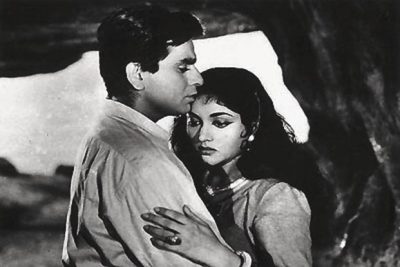
Dilip Kumar and Vyjantimala in Madhumati
One day Sunetra confirmed in a conversation with me, that all her uncles on her father’s side were great story tellers. And Madhumati was an example of this. “The story was narrated by another elder brother of my father, Lokesh Ghatak. He was a shippy. On one occasion, after he returned from a long sail, he narrated this unique death-defying love story. The moment he heard it, Bhaba Kaka said, ‘I will write this!'”
Ritwik penned the story when he was in Bombay, employed by S Mukherjee. Back home in Kolkata, he had left his wife Surama, whom he had directed in an IPTA play. Filmistan was one of the most successful houses. The job of writing scripts for Filmistan was financially gainful. But he was feeling suffocated – the 10-5 job was stifling. So he used his spare hours to rehearse the play Visarjan. But that was not enough for his restive creativity. “Will success stay out of my reach?” he would sigh. That’s when he wrote Jwala which got published in 1957. Then he settled down to drafting Madhumati.
Ritwik revered Bimal Roy like his own elder brother. On July 6, 1955 he wrote to Surama, “Bimal Da will acquire this story, he will give me an advance of Rs 500.” Love defeats ethereal death – this unique thought is what attracted Bimal Da. And the struggle of Adivasis that forms the backdrop of the love story had appealed to his social conscience. In the same letter we learn that Ritwik had written a script for Sashadhar Mukherjee about a nuclear scientist who falls asleep in a research lab and dreams that the earth is Utopia. He was very hopeful but S Mukherjee rejected the idea outright.
At this point he wrote another story, for Musafir. The three-part film featured two other stories, by Salil Chowdhury and the director Hrishikesh Mukherjee himself. The stories defined the three truths of human life: Birth, Marriage and Death.
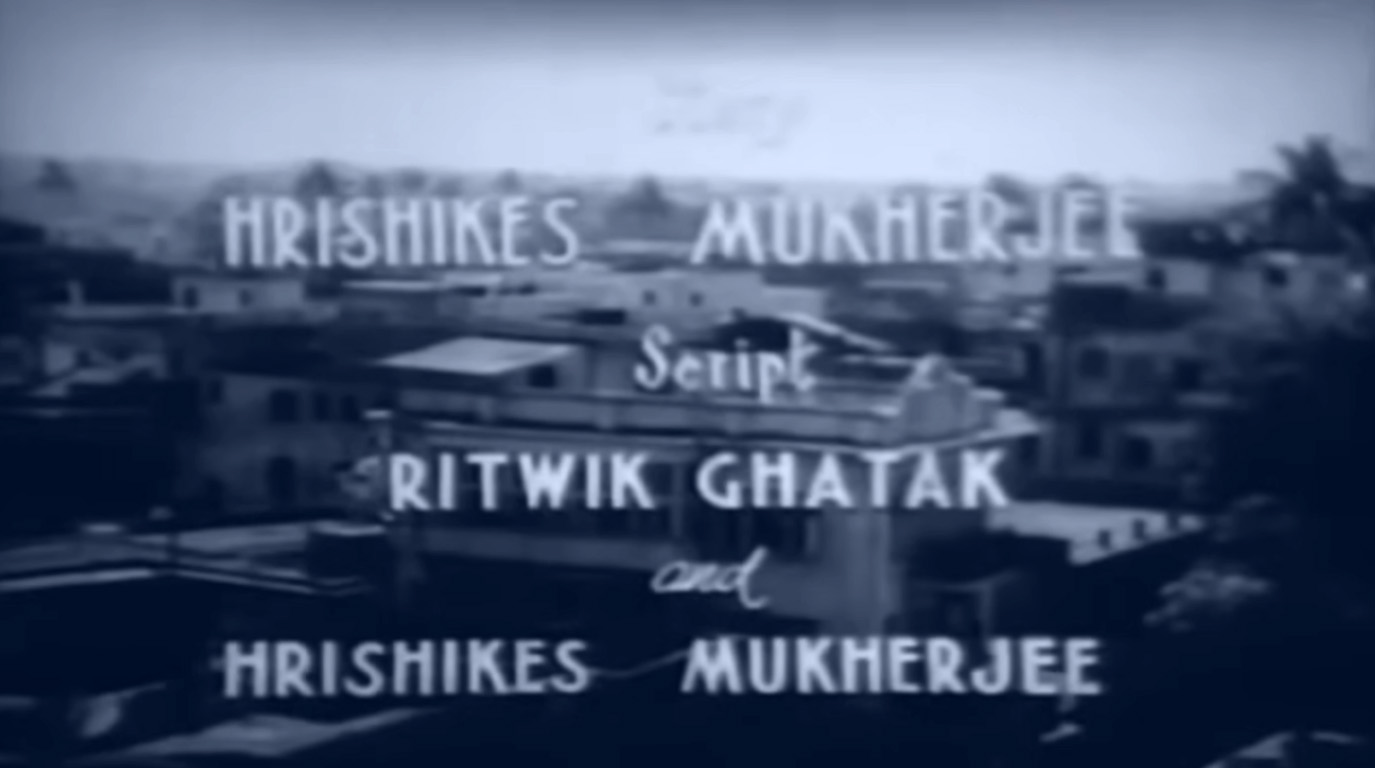
Musafir credits Ritwik Ghatak and Hrishikesh Mukherjee for script
____________
What I’ve known
Last month, in a repeat broadcast on All India Radio (AIR) of an hour-long interview captioned Ujale Unki Yaadon Ki, Nabendu Ghosh was heard telling this to his interviewer. “Once Bimal Da decided to film Madhumati, he gave me the draft and asked me to work on it. Then, with Ritwik, he went location hunting near Nagpur. There, Ritwik met his brother-in-law, Pramod Lahiri, who said to him, ‘I hear you want to make films? If you are serious, come with me to Calcutta.’ And Ritwik went directly from Nagpur to Calcutta. There he made Ajantrik/Unmechanical (1958), considered his first film, since Nagarik (1952), did not find a release until 1977. This unusual story woven around an old Ford brought him recognition and Ritwik also got to direct Bari Theke Paliye/ The Runaway (1958). So he stayed on in Calcutta.”
Nabendu Ghosh further narrates: “Bimal Da returned to Bombay and cast Dilip Kumar in the central role. Yusuf Bhai had this habit — he wanted to hear the screenplay in detail, and participate in it. I helped him to internalise it…”
Years ago, I had gathered this from two other Uncles. Jethu Dilip Gupta, the peerless cinematographer of Madhumati, and another iconic Dilip, the thespian Yusuf Khan. While Ghatak was adding to the cinematic wealth of Bengal — nay, India — Bimal Roy was structuring Madhumati. “And he could not have made a film so layered, so romantic, so visually enchanting as Madhumati based simply on a first draft. Nabendu Da was there for all the discussions and he wrote the fuller script,” both the legendary Dilips had confirmed. But the credit titles say something else!
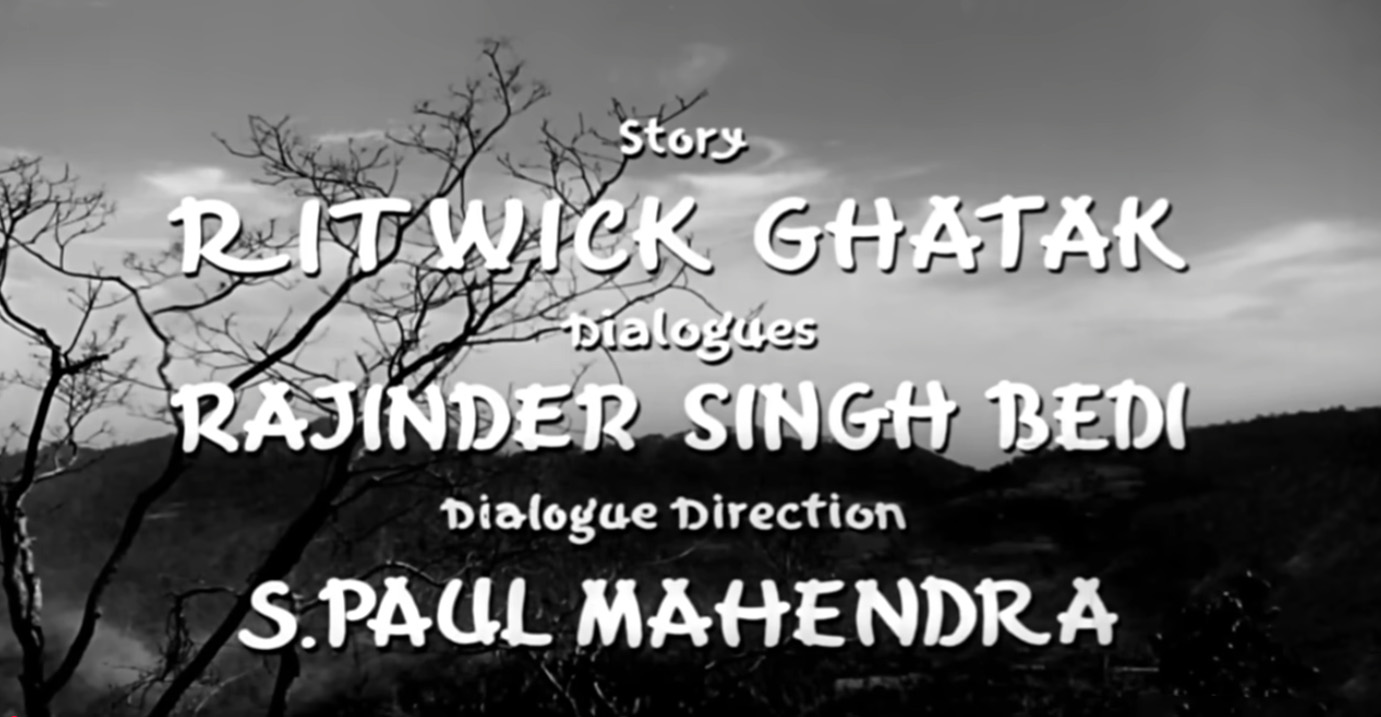
Madhumati’s credit roll
Nabendu Ghosh writes indirectly in his autobiography Eka Naukar Jatri/ Journey of a Lonesome Boat: “After Devdas — that is, after 1955 — Bimal Da did not entrust me with any screenplay. Now we were in 1958. Every month, I was drawing a salary of Rs 500 from Bimal Roy Productions. But I could earn this amount by serving Bengali literature in Kolkata. That would enhance my literary worth – and I would be spared the humiliation. So, I conferred with Kanaklata and told Bimal Da one morning, ‘I’m off to Kolkata.’
That’s exactly what I did, and a few days later I wrote to Bimal Da, ‘I have returned to literature, and I will not return to Bombay.’
Within three or four days I received his return mail: ‘As long as I am alive, you will be with me. Waste no time in contacting Subodh Ghosh and acquire the film Rights for Sujata. I’ll send you the money post haste. Then you come back to Mumbai and write down the screenplay for Sujata.’
That was sufficient to end my stay in Kolkata and return to literature. Because Bimal Da had honoured my faith. I’d seen immense possibility in the short story, Atmaja, and had asked Bimal Da to consider it for a film. He had acknowledged my ability to discern and that had pleased my ego.”
This letter now rests in my almirah. And it amazes me that, starting with Maa and ending with Bandini, Baba had penned more or less every major film of Bimal Roy. At one point in life, a journalist had asked Baba, “Why did you not claim the credit for Madhumati’s screenplay?” I’d heard Baba reply, “Bimal Da was my Film Guru. He did what he thought was right. I told him what I had to say in the matter. I have nothing more to say.”

Nabendu Ghosh speaking about Bimal Roy and his films in And They Made Classics...
____________
What I’ve witnessed…
Baba’s equation with Ritwik Ghatak was not affected by this. I vividly recall that evening in 1973. The lanky Kaku, clad in a kurta pajama, came to our house. The minute he stepped into our Goan-style bungalow, he piped in, “Nabendu Da, please pay the taxi I’ve come in. You must also arrange for me to return to Bandra after dinner.”
There was a purpose for the dinner that evening. The Hindi version of Lal Patthar had released that year. Baba had scripted the Raaj Kumar-Hema Malini Raakhee-Vinod Mehra starrer, and my cousin Subhendu was assistant to its director Sushil Majumdar.
At this point, Bina Jethima mentioned that Bhaba Kaka was in Bandra, finishing a screenplay which he planned to shoot in Bangladesh. The moment he heard this, Subhenda wanted to meet him and join him as AD. Don’t forget: that was a time when Mani Kaul-Kumar Shahani-Adoor Gopalakrishnan, after graduating from FTII, were putting their stamps on the Indian screen in the new style of filmmaking – and all of them were swearing by ‘Ghatak’. Subhenda was dying to work with him – and this was finalized over dinner that evening.

Ritwik Ghatak in Jukti, Takko Aar Gappo
Joy distinctly remembers the writing of the screenplay for Jukti Takko aar Galpo/ Reason, Debate and a Story (1974). “Maa was vociferously admonishing Bhaba Kaka, saying: ‘You do remember that you have a wife and children waiting for you at home, don’t you? You better stay right here and prepare a script.’ Bhaba Kaka touched her feet and pleaded with her not to be furious. And when she calmed down, he promised not to leave until he had completed the script. At that point in time, we were staying in the Godiwala Bungalow, and, along with his assistant, Bhaba Kaka stayed in this cottage at 6 Mount Mary Road – where we now live.”
Joy also recalls that “After Bhaba Kaka left, the boy who went in to clean the quarters came out muttering, his nose creased, ‘Kitna khali bottal re baba! How many bottles can a man drain out!’”
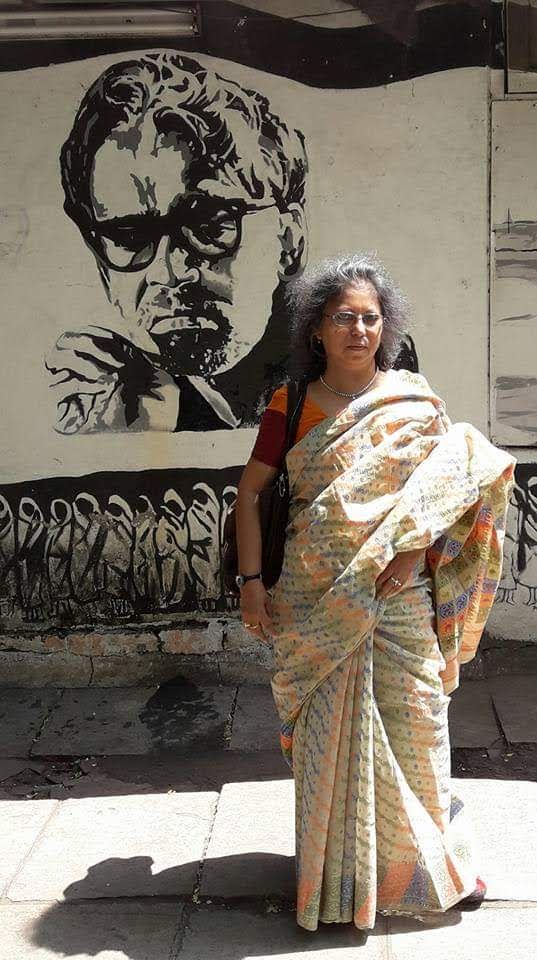
To conduct a Film Appreciation class, Ratnottama Sengupta was in FTII, which continues to revere Ritwik Ghatak, who was Vice Principal (1966-67) and taught Direction full six decades ago. Among his students were Mani Kaul, Kumar Shahani, Adoor Gopalkrishnan, and John Abraham. During the brief stint, he was involved in the making of Fear with staff and students.
When Jukti Takko Aar Gappo was completed Ritwik Ghatak went to FTII to screen it for the students. By then my brother Subhankar was a student there. Kundan Shah, Ketan Mehta, Hariharan, Ravi Ojha, David Dhawan, Vidhu Vinod, Suresh Oberoi, Rakesh Bedi were all his batchmates. Let me quote from Dada’s reminiscences: “Jukti Takko was playing on the screen. We were eagerly watching Ghatak’s new film. When it ended, only a handful of us were in the auditorium. We circled the director. He looked this way and that, then asked, ‘Nabendu Da’s son – is he here? Subhankar! Let’s go to your room and chat.’
“We went to my room. My friends and other students also joined us. Filmmaking. Cinema. Contemporary. Classic. We talked about it all. That evening, in the course of the adda we understood why Ghatak gave so much importance to melodrama. We learnt why his films owe their aesthetics to Indian traditions rather than European experiments. After a lot of exchanges he said, ‘I realise that most of you did not care for Jukti Takko… Do you know why? Because I have not succeeded in exacting what I had planned to!’ These words rang out like a lament. But imagine how significant a teacher he was to be able to confess this to his students.
“And then, after a pause he said, ‘I’ll make another film to heal the Partition wound.'”
That film never happened. In 1976, even before Subhankar graduated from FTII, Ghatak had travelled to the other world. Jukti Takko.. released a year after that.
____________
The Ghataks had an exceptional ability to spin a yarn. Ritwik wrote the script of Jukti Takko… at one go. Joy witnessed that. But when he started filming it, he did not care to follow every letter of the script. This I had learnt from my cousin, Subhenda.
And from my poet friend Kamalendu, I gathered that a producer once accosted him, “You’re saying you want to do a film. Do you have any script ready to be filmed?”
“Of course! Here it is…” Ritwik said and took out a ream of papers. “Listen…” he said and started reading out from it. Without a pause, he kept reading one page after another. Once he finished, he did not put them back in his bag. The producer realised that there was not a scratch on the virgin sheets: he had the script complete to the last detail in his head.
____________
Mid 1990s. Along with Mahasweta Di, I had gone to Dhaka for a literary meet organised by Sahitya Akademi. One morning Didi said, “I was born in this city – and I am dying to visit the house. Will you come along?”
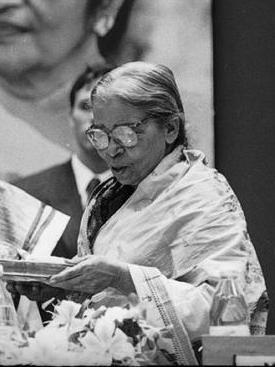
Mahashweta Devi (Pic: Wikipedia)
The organisers had a car ready for us. When we reached 16 Jinda Bahar Lane we found a number of policemen in the building. Some were sleeping in beds with mosquito nets, some were lounging around clad in lungis. It was a police quarter – just as it was before 1947. The house was rented out to the police for a princely sum of Rs 16. After the Partition, it was labelled an ‘Enemy Property.’ So this same amount was deposited, on a monthly basis, in the national treasury – till the day we visited Mahasweta Di’s birthplace!
I had another reason for visiting the house: it was the ancestral home of Sankho Chaudhuri. When I moved to Delhi in 1986, I had the good fortune of interacting closely with the sculptor who was the architect of the Garhi Studios in the Capital and also of the M S University in Baroda. Sankho Da’s brother Hiten Chaudhuri had produced Biraj Bahu. The Sarat Chandra story was scripted by my father for Bimal Roy.
In other words, Manish Ghatak had married the sister of Sankho Chaudhuri. And so, as was the custom even 50 years ago, Dharitri Devi had gone to her parents’ house to give birth to her daughter, the celebrated author (Mahasweta Devi) who was bestowed the Magsaysay, Jnanpith, Padmashri and Padma Vibhushan for her activities to empower the Shabar and Lodha tribals of India’s hinterland.
Manish Ghatak’s father was a District Magistrate. As such, he was transferred every few years – and he had come to West Bengal long before the Partition. So why did Ritwik emerge as the Poet of the Partition? Why was he so agitated by the barbed wire fencing when the borders were marked out?
I got the answer to this when I met Pratiti Devi in Dhaka of 1999. She, too, was born on 4th November 1925, in Rajshahi. Her father was Suresh Chandra Ghatak, and her mother Indubala. Which means? She was Ritwik’s twin sister. “Baba left Dhaka when we were three months old. Medinipur, Jessore, Mymensinh, Kolkata, North Bengal – Baba would go from one place to another, and so would we.” It was through all these transfers that Ritwik had internalised the pain of being uprooted. But the word ‘Partition’ became a cruel reality when Pratiti Devi was repatriated to Dhaka from Kolkata.
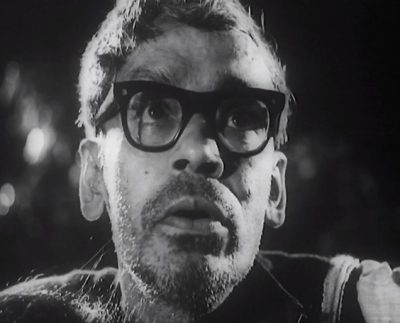
Ritwik Ghatak as Nilkantha Bagchi, a broken intellectual in Jukti Takko Aar Gappo
Allow me to quote her: “I am NOT a refugee. My father-in-law Dhirendra Nath Dutta was a member of the Economic Council of East Pakistan. He had fought to retain Bengali as the language of the newfound nation. His family kept working for social betterment – by establishing schools, colleges, hospitals, in Chittagong, Noakhali, Dhaka…”
Pratiti Devi was nicknamed Bhabi, Ritwik was Bhaba. Inseparable they were, in their mother’s womb, and after their birth. In all their antics – until she got married. She lived to be 93. Before she breathed her last, she had come to Kolkata for a documentary that was to capture her life’s journey. At this meeting, she told me, “East Bengal, West Bengal – only when the two arms are joined will it be Bangladesh! This is what Bhaba tried to say through Jukti Takko…
“I represented East Bengal for him. He simply could not accept this division!”
____________
In conclusion
Talk about reincarnation in cinema and you arrive at Madhumati. It was a super hit not only in terms of commercial success. “It resonates so much in people’s heart and mind that even 50 years after its release it is showing in some hall or the other, in some or the other part of India,” Vyjayantimala once said to me. Even after colour entered the small screen, the B&W romance would regularly regale viewers. Countless viewers. Throughout India.
In later years, and in Hollywood too, we see the imprint of Madhumati in The Reincarnation of Peter Proud. And in its Hindi ‘reincarnation’ Karz. In the Kannad, Yugpurush. In the Tamil Enakkul Aruvan. In the runaway success, Om Shanti Om…
That’s not a one-off. Take a look at Walt Disney’s Love Bug. The 1968 production revolved around a car that had a mind of its own. A decade before that, Ritwik had breathed life into Jagaddal – a four-wheeler with human traits. A car that shared its joys and sorrows with its owner like any human being. So enticing was this concept that, in 1990s, ‘ketchup man’ Colonel Kapoor was inspired to make Batuni – about a sentient car called Herbie, short form for ‘heroine to be.’
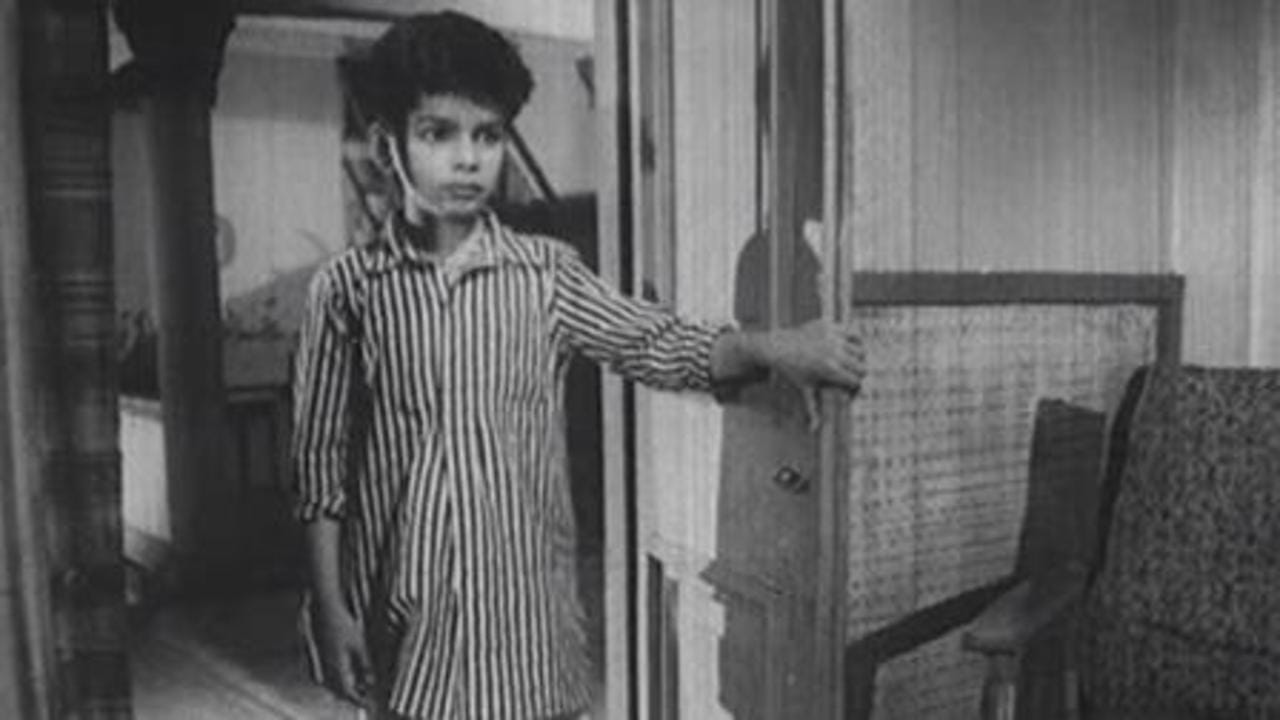
A scene from Bari Theke Paliye
Again, Bari Theke Paliye was structured around a boy who’s running away from home to a city far away. This runaway casts a long shadow on 400 Blows, the defining film of the French New Wave wherein an adolescent boy misunderstood by his parents and teachers runs away from both. Truffaut’s debut film got him the Best Director award at Cannes 1959 and a nomination for the Oscar. Ritwik? Alas! He remained cloud-capped.
But wait. Robert Altman’s Nashville released in 1975. Two years before that Ritwik had given us Titas Ekti Nadir Naam. A conglomeration of characters who delineate the laments of the uprooted, this movie pulsates with the beauty of the tongue they speak. Their distinct traits had not an iota of the West. Was that the reason why Ritwik remained untouched in the festivals away from India?
And still, can we truthfully say that Ghatak was a cloud-capped star?
Years after he exited the earth, Anup Singh brought to the screen Ekti Nadir Naam/ Name of a River (2001). Where he follows Ritwik’s trail to unearth the reasons for the mass killings – genocide really – of 1947. And closer to our times Kamaleswar Mukherjee trained the camera on that chapter of his life when the legend was in a mental asylum. This Meghe Dhaka Tara (2013) will remain a chronicle of the life that suffered disappointment, pain, deprivation and affront at so many landings of life – and yet could direct a rousing play inside the rehab with doctors and patients!
Seven decades after he debuted on the silver screen – and half a century after his passing – Ritwik remains one of the Triumvirate – the three foremost names of Indian Cinema of all times. Who says he is a cloud-capped star?

Whether you are new or veteran, you are important. Please contribute with your articles on cinema, we are looking forward for an association. Send your writings to amitava@silhouette-magazine.com

 Bimal Roy: Why He’s Evergreen
 Anger in his voice, authority in his words. Name: Ritwik
 Salil Chowdhury: Creating Music ‘Outside the Rules’
 ‘My heart swells with pride when I see their work’: Nabendu Ghosh in conversation with Ameen Sayani
 Madhumati: Salil Chowdhury’s Magnum Opus in Hindi Cinema
 The Dagdar Baboo of ‘Maila Anchal’
Silhouette Magazine publishes articles, reviews, critiques and interviews and other cinema-related works, artworks, photographs and other publishable material contributed by writers and critics as a friendly gesture. The opinions shared by the writers and critics are their personal opinion and does not reflect the opinion of Silhouette Magazine. Images on Silhouette Magazine are posted for the sole purpose of academic interest and to illuminate the text. The images and screen shots are the copyright of their original owners. Silhouette Magazine strives to provide attribution wherever possible. Images used in the posts have been procured from the contributors themselves, public forums, social networking sites, publicity releases, YouTube, Pixabay and Creative Commons. Please inform us if any of the images used here are copyrighted, we will pull those images down.