Stay tuned to our new posts and updates! Click to join us on WhatsApp  & Telegram
  Channel
& Telegram Channel & Telegram Channel 




A captivating exploration of Matka King, the new series on Amazon Prime, tracing Brij Bhatti’s rise from mill worker to gambling magnate, while uncovering the series’ symbolism, history, characters, and social undercurrents. A Silhouette review by Subha Das Mollick.

Brij Bhatti in a moment of torment, captured in mid close up
The title sequence of a series encapsulates the spirit and essence of the series. It is densely coded to arouse certain expectations in the mind of the spectator. However, with every episode, the title sequence takes on new meaning if the spectator is paying attention to it, and the spectator internalizes the title sequence by the time she is done with the series.
The one-minute-long title sequence of Matka King comes after the prelude of every episode. Replete with cardboard characters and playing cards, the sequence triggers thoughts of Tasher Desh, at least in the minds of those familiar with Tagore’s literature. Tagore wrote the satirical dance drama Tasher Desh (The Land of Cards) in 1933, as a critique of rigid, rule-bound social systems.
In the Matka King title sequence, the cardboard cutouts of the characters and settings, with minimalistic puppet-like animation of their heads and shoulders, suggest rigidity and a lack of freedom in their lifestyle – as if they are confined to playing out the roles that society expects of them. The lives of these cardboard characters seem to be circumscribed by a deck of playing cards. The cards line the Queen’s Necklace thoroughfare of Bombay and cover the façades of iconic edifices.
But Bombay of the 60s and 70s is not the dystopic Tasher Desh of Tagore’s imagination. Here people do live a mechanical, straitjacketed life, but they are not bound by the rules set by the kingpin. They live by their wits and bend the rules to suit their purpose – as amply demonstrated in the opening sequence of the film, at the head of the staircase of Lakshmi Poddar Chawl – the home of the lead character Brij Bhatti.
Episode 1 introduces all the key characters with the dynamics playing out between them, it establishes a class hierarchy that would soon be broken, and it precipitates a crisis that will propel the narrative forward. When the title sequence plays out once again at the start of Episode 2, the spectator realises that the cardboard characters are not like the Tasher Desh characters of Tagore’s play, who do not have any agency. Each character introduced in Episode 1 has the agency to take his/her decision in life, be it the lowly cotton mill worker or the young Parsee widow going around town in a chauffeur-driven limousine. But in the title sequence, they are cardboard cutouts because we are not privy to their inner lives. The cutouts are merely facades – facades of the individuals they represent and facades of the systems they signify.
Nothing is what meets the eye. The layers of the city peel off to reveal that behind the façade of a cotton mill is a gamblers’ den, and a shop selling cotton mattresses is a hoarding den of bank notes earned through gambling.
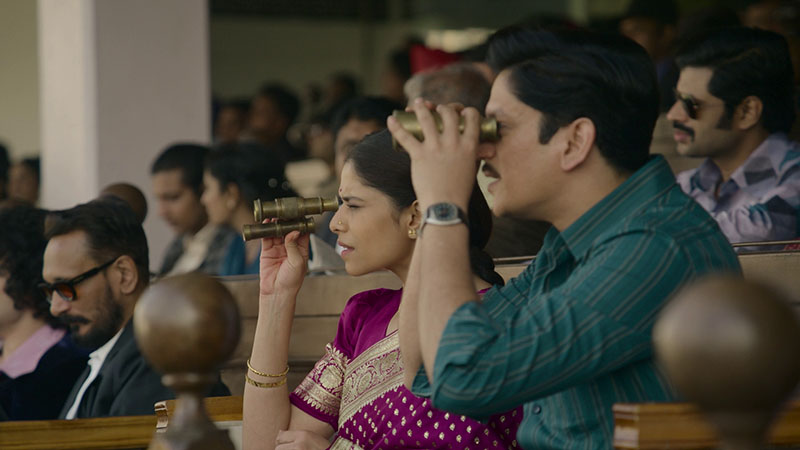
At the VIP enclosure of Mahalaxmi Racecourse
In Bombay gambling is in the air and on the ground – at a street corner, inside a cotton mill, in the race course, at a party of the elites of town, in the central courtyard of a chawl, in the watering holes and even in the police van. In the opening scene of the film two policemen lay a bet on a third man’s life. Then comes the title sequence. The race course appears prominently in the title sequence to remind the viewer that here is a fully legal form of gambling imported into our land by the colonizer. A lone journalist named T.P D’Souza, working for The Progress Post, files a story “Deep Dive into the Race Course”. The editor summarily rejects the story and asks him to follow Sharmila and Pataudi instead of following race horses. Inside the “New Bombay Wholesalers Cotton Merchants”, Lalji Bhai is the kingpin of gambling. Brij Bhatti is his henchman who rigs the game everyday. But the apple cart will soon upset. Brij Bhatti is the game changer.
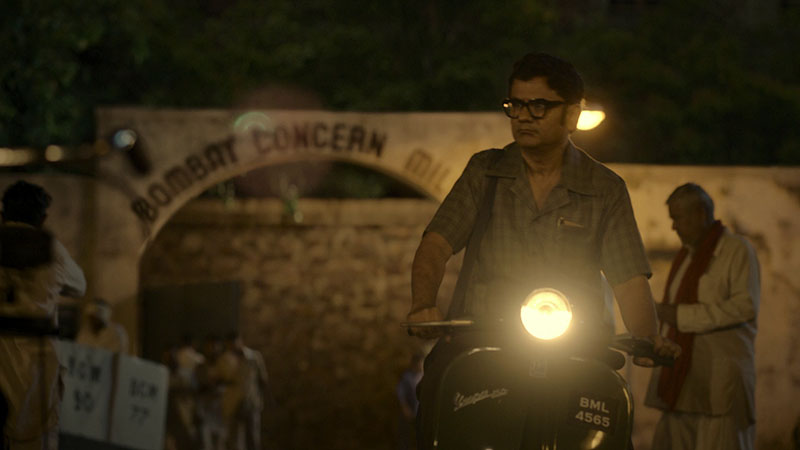
TP D’Souza comes looking for the matka story
Brij Bhatti and Gulrukh the Parsee widow cross paths for the first time at the entrance of the Mahalaxmi Race Course. Brij passes on a betting tip to Gulrukh and lends her his luck before leaving the race course in a fit of anger. Gulrukh takes the stranger’s parting advice seriously, lays her bet on a ‘lame’ horse and wins. This is the beginning of a relationship of shared luck that will blossom into something fantastic.
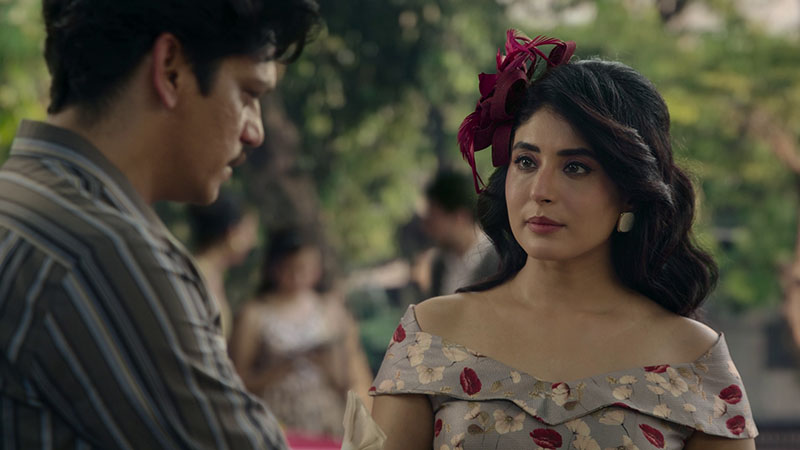
Brij’s first encounter with Gulrukh
In a later episode Brij Bhatti comes back to the race course, this time with his wife. He takes his position in the VIP gallery from where he had been thrown out ignominiously in the first episode and tells his wife “Look around you. They are all people who run the country – industrialists, media barons, top bureaucrats. Gambling is a pastime for all of them.” Soon Brij Bhatti would also be one of them – running the nation through his urn and his mind game.
Matka King is about the gambling game that Brij Bhatti invents for the poorly paid cotton mill workers. It is a common man’s betting game. Kings and queens are weeded out from the deck of cards used in the game. The betting can be done with as small an amount as 10 paise and any one of the players can draw the card. Through this humble game, the common man’s hopes are kept alive – hopes for a better tomorrow in the midst of existential grind. These hopes form the raw material of Brij Bhatti’s enterprise. He knows that he cannot let these hopes wilt or turn stale. The common man’s hopes should be fresh every morning when he comes to lay his fresh bet. This is one value that remains unchanged through the eleven years and eight episodes of the series. The common man’s trust in Brij Bhatti remained unshaken.
For Brij Bhatti, what began as a desperate attempt to put together ten thousand rupees in a week, fanned out to a nationwide game played out in the lanes and bylanes of cities and towns – all connected via telephone lines to the central gaming hub at Anmol Bazar, Bombay. Brij Bhatti earned ten thousand rupees many, many times over, which he used for oiling the palms of the law to keep the machinery of his game lubricated. The title sequence begins with a palm clutching onto a wad of banknotes. In Bombay money speaks. If you have the money, you wield the power. Brij Bhatti rapidly earned that power.
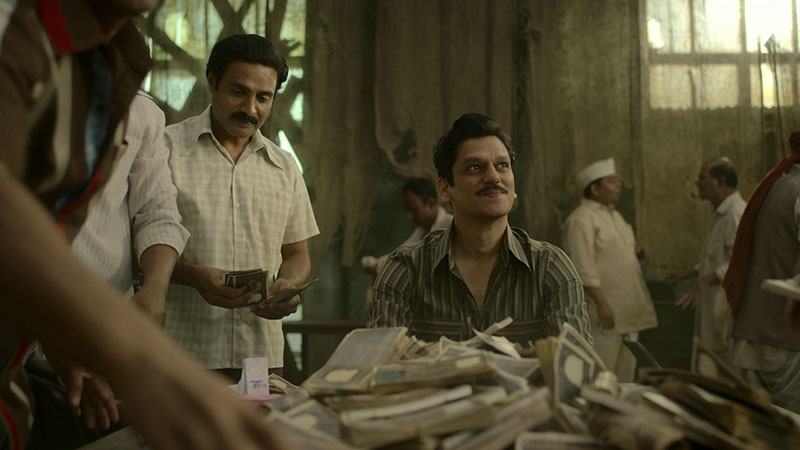
The mountain of cash grows bigger and bigger
He is alert, he is observant, perceptive to his environment and he does not let an opportunity slip through his fingers. Significantly, he does not resort to violence to solve his problems. He solves them through mind games. Brij is not an evil man. But is he a good guy? Even his wife Barkha cannot figure out. In spite of the shifting shades of gray, black and white become the defining colours of his life.
First, he acquires a black Ambassador car by paying for it cash down and after a few years he switches to his signature white dress. Underneath the white is a man not necessarily of high morals, but of steadfast vision and a steely resolve. He never loses his mind, never laughs out loud and never raises his voice. Yet, he is in control. Once he sets his mind on something, he finds a way to have it. He manipulates the weather office to shift a cricket match to Bangalore so that he can have his brother’s wedding at the Brabourne Stadium in Bombay. Brij is a man of few words. Perhaps that is why we need the voice of his right hand man Dagdu telling us what is going on in Brij Bhatti’s mind.
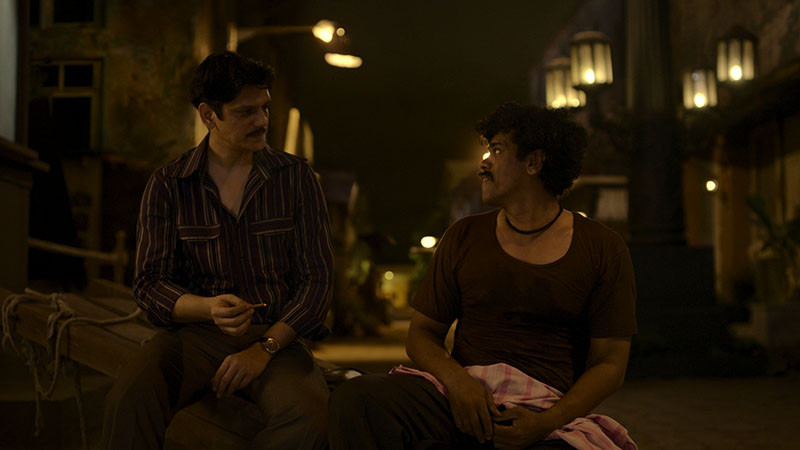
Brij and Dagdu
To Vijay Varma’s credit, he has got under the skin of Brij Bhatti. He has internalized his character’s thought process. That is why he can express so much with so little. Just a shrug of the shoulders, a sideways glance, a puff at his bidi are enough to express his thoughts. Sudhakar Reddy’s camera and lighting scheme do justice to the restrained acting style of Vijay Varma. We rarely see him alone in the film, we rarely see him in close up. But the camera does not miss his heartbeats whether he is with ‘matka queen’ Gulrukh or his homemaker wife Barkha, whether he is in conversation with the minister or doing a tricky negotiation with a criminal gang.
By episode 3 or 4 the spectator may begin to take note of the documentary footage in the title sequence. This is a story rooted in a specific era in history. A time span of 11 years covered in eight episodes, starts just after Pandit Nehru’s death in 1964 and ends with his daughter Indira Gandhi declaring Emergency in 1975. In these 11 years as the nation grapples with mounting socio economic problems and epochal events like the Naxalite Movement and Bangladesh Liberation War, Brij Bhatti’s matka game flourishes.
However, in positing the story of the matka king against a historical backdrop, Nagraj Manjule and his scriptwriter slip at places. Badan pe sitare lapete huye is a song that became a hit in 1969. In episode 3, when this song suddenly bursts forth on the sound track, the year is 1966 or 67. There was no India-Pakistan cricket match held in the early 70s. So shifting the cricket match from Bombay to Bangalore rings false. In the 70s Bombay was not called Mumbai – as announced by the airlines that was bringing Brij back from Delhi to Bombay. However, these are minor slips.
The research team has got it right where it really matters. The Maharashtra State Lottery was announced and officially launched on April 12, 1969. “It was launched to combat the growing, illegal “Matka” gambling schemes and to provide a trustworthy avenue for people to win prizes, while generating revenue for state developmental works,” informs AI overview of Google Search. The first draw was held at Rang Bhavan near Metro Cinema.
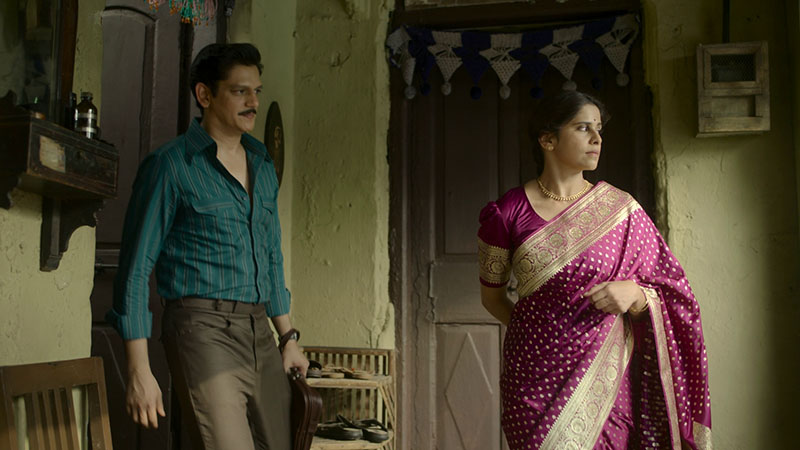
Badan pe sitare lapete huye
Brij Bhatti had suggested to the State Minister to legalise the matka game and earn revenue through taxes. The Minister instead launched the Maharashtra State Lottery. Brij saw this challenge as an opportunity to cleanse his ‘illegal’ cash in the Government laundry. His team approached the winners and bought off the cheques by paying them cash.
Does Brij Bhatti have an idea about the money he has earned in these 11 years? Probably he does. That is why he tells the minister on two occasions, “Make my matka business legal and I will solve the financial crunch of the nation”.
The character that plays out against Brij Bhatti through all the eleven episodes of the series, is not his adversary Lalji Bhai, not the two women in Brij’s life, not his brother Lachhman, but the lowly labourer Dagdu in New Bombay Wholesalers Cotton Merchants. Even before he becomes Brij’s trusted lieutenant, he takes on the role of the narrator whose voice takes us through critical junctures of the story. Dagdu is the only character whose back story becomes an important strand in the narrative. At times, Dagdu too is puzzled by the actions or lack of action of his Seth. He cannot understand why his Seth is hell-bent on holding his brother’s wedding reception in a cricket stadium, just as he cannot understand why his Seth is not getting Dagdu’s love interest released on bail.
Unquestioned loyalty gradually begins to turn sour. Dagdu realises that blood runs thicker than water. Brij would never do for Dagdu what he would do for his brother Lachman. Dagdu takes his destiny in his own hands and when he is face to face with his Seth, he looks into his eyes from his position on the ground and asks some difficult questions. At the end of eleven episodes, Dagdu’s story remains unfinished, unresolved. Will he be the lead character in Season 2? One has to wait and see.
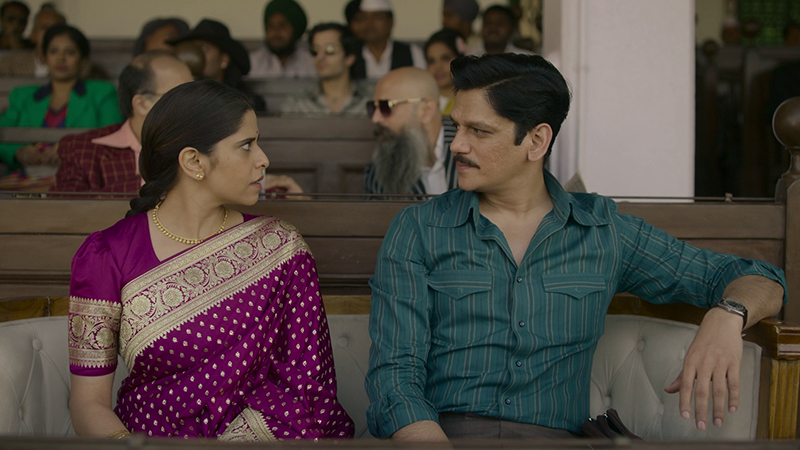
Brij and Barkha in the company of those who run the nation
Brij Bhatti is a singularity in a flawed system. Such a spiked singularity is bound to be short lived. The system has its own way of renormalizing itself. When Season 1 heads towards a climactic end, Brij Bhatti is a lonely, hunted man. His last straw snaps when his eleven years old son rejects him. He comes home, calls the police and surrenders, thinking that he will be safer in police custody than outside. But Nagraj Manjule has other plans.
One begins to wonder who would inherit the huge wealth earned by keeping hopes of millions of people high; why this wealth is not pumped back among the people for their own good. But then, an act like that would have exonerated Brij Bhatti. Nagraj Manjule did not want to make a hero out of him.
The series Matka King provides fodder for scholars of economic history of a country – to analyse how it is possible for an individual to amass so much wealth in such a short span of time. The common man will wonder what would have happened to this wealth if the Govt had announced demonetization – and wait for Season 2 to take its toll.
IFFD 2026: A Celebration of Cinema, Culture, and Contrasts
Baring Kabir Suman’s Soul – A Review of Bare Voice
All That Breathes Review: Finding Exquisite Beauty in Urban ‘Low Life’
Abhimaan (1973) — Where Music Leads the Way

Whether you are new or veteran, you are important. Please contribute with your articles on cinema, we are looking forward for an association. Send your writings to amitava@silhouette-magazine.com

Silhouette Magazine publishes articles, reviews, critiques and interviews and other cinema-related works, artworks, photographs and other publishable material contributed by writers and critics as a friendly gesture. The opinions shared by the writers and critics are their personal opinion and does not reflect the opinion of Silhouette Magazine. Images on Silhouette Magazine are posted for the sole purpose of academic interest and to illuminate the text. The images and screen shots are the copyright of their original owners. Silhouette Magazine strives to provide attribution wherever possible. Images used in the posts have been procured from the contributors themselves, public forums, social networking sites, publicity releases, YouTube, Pixabay and Creative Commons. Please inform us if any of the images used here are copyrighted, we will pull those images down.