Stay tuned to our new posts and updates! Click to join us on WhatsApp  & Telegram
  Channel
& Telegram Channel & Telegram Channel 




With every new book, author and music historian Manek Premchand deepens our understanding of Hindi cinema’s Golden Era. His latest work, Soulfully Yours Ravi, is perhaps his most intimate and emotionally resonant yet, a rediscovery of the unassuming, soft-spoken singer-lyricist-composer Ravi, whose melodies continue to enchant millions even as his name recedes from popular recall. Through this book, Premchand reclaims Ravi’s rightful place in Hindi cinema’s musical heritage, bringing readers closer to a man who lived simply, composed beautifully, and left behind a legacy far richer than the fame he himself ever sought.
In this conversation, we explore the inspiration behind this work, the challenges of researching an understated genius, and the fascinating anecdotes that shaped this heartfelt tribute.

Manek Premchand
A distinguished music critic, Hindi film connoisseur, and celebrated author, Manek Premchand has long been fascinated by the music of Hindi cinema’s Golden Era. His deep passion for this world has inspired an impressive body of work, including Yesterday’s Melodies, Today’s Memories, Musical Moments From Hindi Films, Romancing The Song, Shiv Kumar Sharma: The Man and His Music (co-authored), Talat Mahmood — The Velvet Voice, Hitting The Right Notes, The Hindi Music Jukebox, The Unforgettable Music of Hemant Kumar, Majrooh Sultanpuri — The Poet For All Reasons, Windows to the Soul and And the Music Lives On. Taking a deep dive into cinema, beyond film music, his DIRECTOR’S CHAIR — Hindi Cinema’s Golden Age, offers an engaging study of Hindi cinema’s key directors from the silent era up to 1980. In addition to these acclaimed books, he has written hundreds of articles on music for leading newspapers and platforms.
Armed with his passion for Hindi cinema’s music and supported by decades of industry knowledge, he brings a rare depth, nuance, and authenticity to his work.
Soulfully Yours Ravi by Manek Premchand is more than a chronicle of a composer’s life; it is a heartfelt attempt to restore visibility to an artist – a singer-lyricist-composer whose melodies continue to echo across time.
In this wide-ranging conversation, Premchand discusses the paradox of Ravi’s fame, the joys and challenges of researching his music, and the deeply human stories behind a composer who preferred to let his tunes speak for him. Drawing from his personal interactions with Ravi as well as painstaking archival work, Premchand opens a doorway into a legacy built not on glamour but on quiet brilliance.
Read on as we uncover the journey behind this remarkable work.
________________________________________________

Soulfully Yours, Ravi by Manek Premchand
Jyoti Babel: What inspired you to write an entire book on Ravi, an artist who is adored for his music, yet often overlooked in lists of “top composers”? Was there a particular incident, song, or memory that made you feel Ravi deserved a full-length exploration at this stage of your writing career?
Manek Premchand: I had always enjoyed Ravi’s music, especially some songs like Mili khaak mein muhabbat (Chaudhvin Ka Chand), and Kaun aaya ke nigaahon mein chamak jaag utthi (Waqt), but it was only after meeting him a few times that I realised what a genuinely kind man he was. Over the years, I would hear people say he was underrated or that he never quite got his due. I, too, wondered why fame had passed him by. Was it because he was gentle, non-aggressive, and unwilling to flex his musical muscles? That old saying—“Nice guys finish last”—kept coming back to me. Somewhere along the way, I felt that perhaps my shoulders were ready to carry his legacy, in a manner of speaking. And that’s how this book finally took shape.
Jyoti Babel: In the book, you talk about the paradox of Ravi’s melodies being ubiquitous while the man himself remains relatively anonymous. How do you explain this disconnect between popularity and recognition? Why do you think tribute concerts, retrospectives, or academic work on Ravi have been relatively rare, despite his staggering musical output?
Manek Premchand: Mainly because he kept a very low profile. He avoided the social circuits—no wining and dining, no PR machinery, no self-promotion. Even in the Golden Era, people were networking with journalists, hosting parties, and reminding the world of their achievements. Ravi stayed far from all that. Today, someone with his temperament would feel like an anachronism—almost invisible despite immense talent. In his struggling years he even lived in a tin shed; in today’s world you might imagine him running a small shop selling mobile covers! That was Ravi: private, grounded, and utterly devoted to his work.

Ravi with Usha and Lata Mangeshkar and Sahir Ludhianvi
Jyoti Babel: Given that comparatively less material is available on Ravi than on other Golden Era composers, how challenging was the research process for this book?
Manek Premchand: There are a few interviews online, and I had my own detailed conversation with him. In 2011, he also spoke to a small group of us friends. But the real challenge was classifying and making sense of the staggering volume of his work—his ghazals, mujras, qawwalis. Yet, when you love what you’re doing, Providence lights your way. The process became joyful rather than difficult.
Jyoti Babel: How challenging was it to curate and critically examine Ravi’s “Top 100” songs? What criteria guided your choices? Did your perspective on any of these songs change during your research, either musically or emotionally?
Manek Premchand: The real challenge was only the selection—Ravi created far more than a hundred masterpieces. I sent the full list of his songs to many friends and asked them to pick their top hundred. About ninety of the final list came from this process; the remaining ten were my own choices because they had extraordinary merit. Popularity was the key measure, but originality and musical expression were never ignored. And the writing? Not difficult at all. Throughout this journey, I felt like a ten-year-old boy who had just been gifted a giant Lego set.
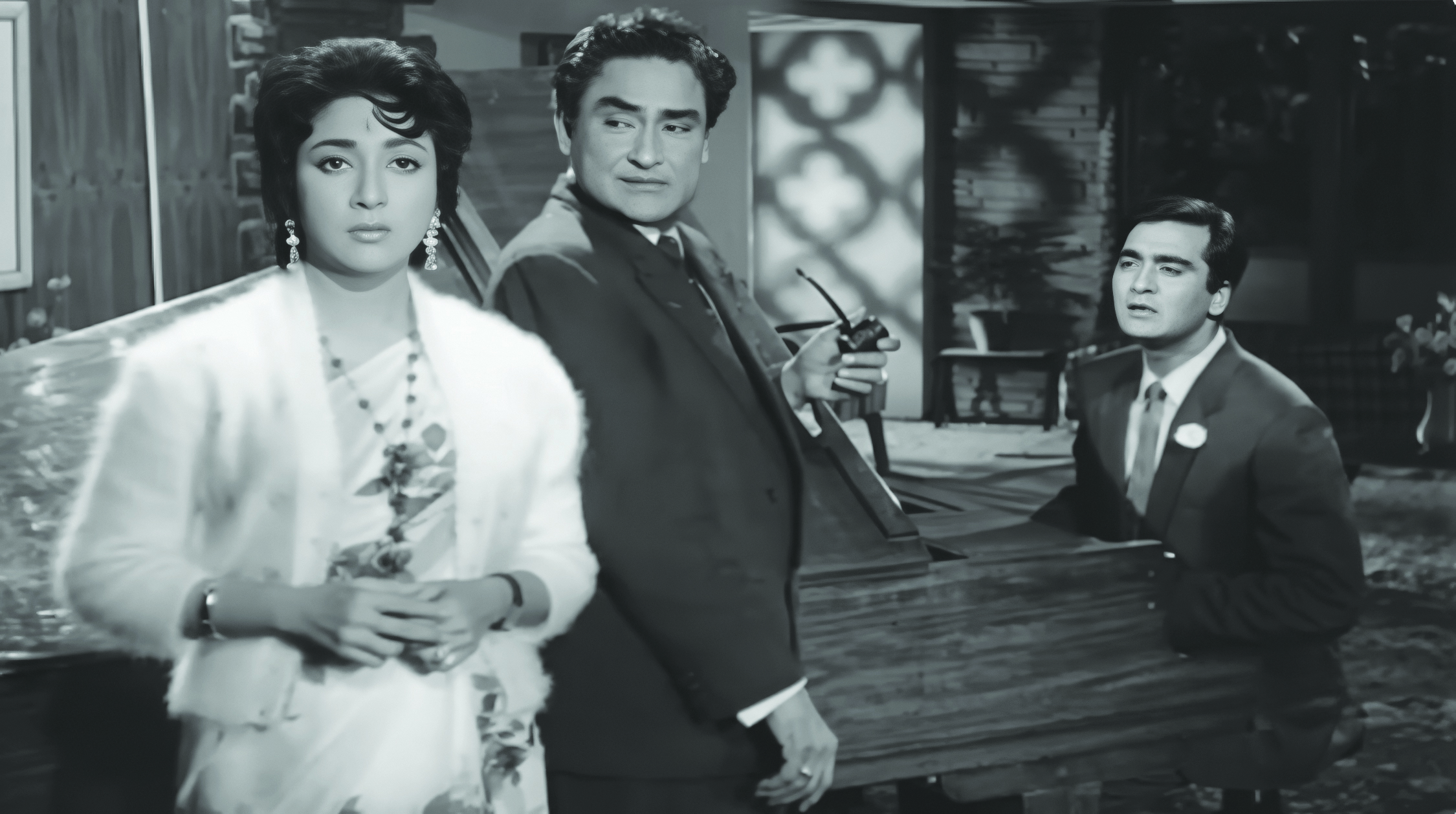
Mala Sinha, Ashok Kumar and Sunil Dutt in Chalo ik baar phir se ajnabi ban jaayein hum dono (Gumrah, 1963) Ravi / Sahir / Mahendra Kapoor
Jyoti Babel: The book includes statistical chapters, his collaborations with singers and lyricists, his filmography, and his list of songs. What patterns surprised you during this deep dive?
Manek Premchand: Several! He worked with an astonishing 35 lyricists—possibly a record. He composed over 800 songs, not counting his prolific work in the South, where he was “Bombay Ravi.” And to my amazement, he may have composed more ghazals than any other film composer. Truly stunning discoveries.
Jyoti Babel: You met Ravi multiple times between 1992 and 2011. Can you describe a moment from these meetings that most revealed the man behind the music?
Manek Premchand: His softness. He spoke so gently that you had to lean in to hear him. He weighed every word—something he shared with Khayyam, and I suspect with Naushad as well. Many composers weren’t overly concerned with lyrics, but Ravi respected them deeply. That sensitivity is perhaps why he created such magic with Shakeel, Sahir, and Rajinder Krishan.
Jyoti Babel: Ravi was known for using fewer than a dozen instruments and for avoiding elaborate orchestration. How did this minimalism shape his musical identity? Which song, in your opinion, best represents his “less is more” philosophy?
Manek Premchand: He often saved his producers money simply by relying on pure melody instead of elaborate orchestration. And that minimalism became part of his signature. Many songs illustrate this—Laage na more jiya (Ghunghat), Kaise kahoon main baat jiya ki (Gehra Daag), and Sada khush rahe tu (Pyaar Ka Saagar), to name a few. Simple, elegant, unforgettable.
Laage na mora jiya (Ghunghat, 1960) Ravi / Shakeel Badayuni / Lata Mangeshkar
Jyoti Babel: In your view, what distinguishes Ravi’s musical style from that of his contemporaries?
The absence of a fixed watermark. He is difficult to slot, somewhat like a chameleon—in the best sense. But if you study him long enough, you start seeing the true picture: a hardworking composer who consistently delivered simple, refined, well-crafted tunes with immense heart.
Jyoti Babel: Ravi was truly a “three-in-one” artist; he wrote, sang, and composed. Why do you think he gravitated more toward composing than writing or singing?
Manek Premchand: Probably the marketplace. He came to Bombay to become a singer and did sing a few songs after becoming an independent composer. But he soon realised that his true domain was composing, so he happily opened the door for Rafi, Talat, Kishore, Manna, and of course, Mahendra Kapoor—whom he handled with exceptional finesse. He wrote many lyrics too, but again stepped aside for the greats. When they were gone, he returned to it, but by then the golden musical era had faded.
Jyoti Babel: Your chapters on Ravi’s ghazals and qawwalis are particularly rich. What made him excel in these forms?
Manek Premchand: His deep literary sensibility. I sensed it when I met him, but while researching his body of work, I was astonished. The sheer volume of his ghazals—possibly more than anyone else—took my breath away. I wish I could have asked him where that spark came from.
Jyoti Babel: From the book’s exploration, which lullaby or mujra stands out as quintessential Ravi, and why?
Manek Premchand: Tough call, but gun to head? The Shakeel-written, Asha-rendered ghazal, Insaan muhabbat mein kuchh kaam to kar jaaye from Nartaki. Uff the harmonium, wow the dramatic pauses, and the lyrics, divine! Lullaby? Again, gun to head, it’s Asha once more in Pawan more angna mein dheere dheere aana from Shehnai.
Jyoti Babel: Among Ravi’s many lyricist collaborations, who do you think brought out the best in him? Any underrated pairing readers should know about?
Manek Premchand: Best pairing? Tough call. But I’d say it’s a toss-up between Sahir and Shakeel. Absolute dead heat!
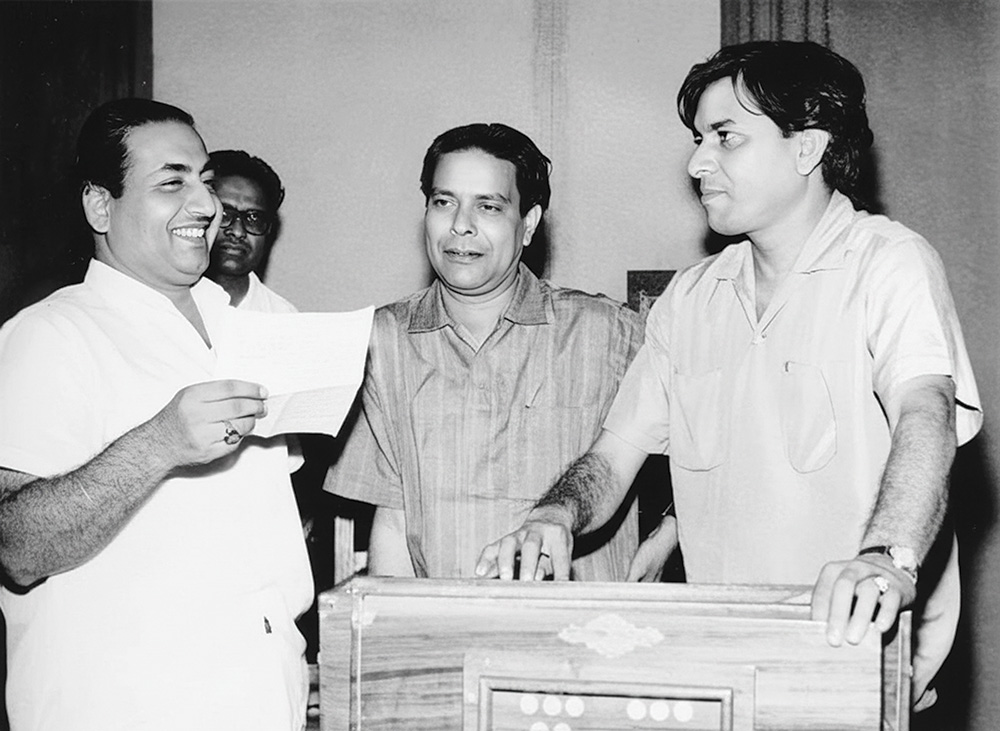
Mohd Rafi, Shakeel Badayuni and Ravi rehearsing a song
Jyoti Babel: We have heard a lot about the fruitful association of Ravi with B.R. Chopra. Their songs are still so popular. Which directors brought out the very best in him?
Manek Premchand: Certainly B.R. Chopra, as you mentioned. Also Devendra Goel and the Nadiadwalas. Ravi was loved for his easy manner—no gossip, no criticism, no scolding latecomers. He was so infused with music that everything else felt small. And so he kept delivering excellence, film after film.
Jyoti Babel: You’ve mentioned Ravi began writing his autobiography, but could not complete it. How did that knowledge influence your responsibility as a biographer?
Manek Premchand: I only discovered this late, Jyoti—just two months before finishing my manuscript—while watching his interviews. Earlier, I had avoided all external material because I didn’t want anything to colour my perspective. It reminded me of something Khayyam once told me: he deliberately avoided watching Pakistan’s Umrao Jaan Ada while composing Umrao Jaan, so his music would remain uninfluenced. Interestingly, Ravi himself composed for Mehndi, the first feature on Umrao Jaan, and he too was navigating uncharted territory.
Chaudhvin ka chand (Chaudhvin Ka Chand, 1960) Ravi / Shakeel Badayuni / Mohd Rafi
Jyoti Babel: Compared with your earlier books, Hemant Kumar, Talat Mahmood, Majrooh Sultanpuri, Director’s Chair, how does this book differ in approach and structure?
Manek Premchand: Each book—on Hemant Kumar, Talat Mahmood, Majrooh Sultanpuri, and Director’s Chair—has its own beauty. The Ravi book is different because he is perceived as “underrated,” unlike the other three. And unlike them, almost no substantial literature existed on him. So I hope this book fills a much-felt gap.
Jyoti Babel: If you had to explain Ravi’s legacy to a young music student today, what are the three enduring lessons his body of work offers? Can you recommend five essential Ravi songs to understand his genius?
Manek Premchand: His simplicity, his enthusiasm, and his unwavering focus on melody. Ravi was something else… truly marvellous. Listen to what he achieved with Rafi and Asha. And—if I may—I urge young musicians to read this book, especially the Overview, Interview, and the 100 Best Songs. It will tell you details about many of Ravi’s musical masterpieces, including these five: Jaan-e-bahaar husn tera bemisaal hai (Pyaar Kiya To Darna Kya), Itni haseen itni jawaan raat, kya karen (Aaj Aur Kal), Ye raaten ye mausam nadi ka kinaara (Dilli Ka Thug), Jab chali thandi hawa (Do Badan), and Aap aaye to khayaal-e-dil-e-naashaad aaya (Gumrah).
Ye raaten ye mausam nadi ka kinaara (Dilli Ka Thug, 1958) Ravi / Shailendra / Asha Bhosle, Kishore Kumar
Jyoti Babel: Finally, could you share what you’re working on next? Any upcoming projects your readers can look forward to?
Manek Premchand: My mind is a blank just now. Hopefully someday soon, I’ll get a spark. Maybe He will advise and say, “Do it. I’m watching over you!”
Jyoti Babel: So be it! Thank you for this enriching conversation, and wishing you the very best for your future works.
Manek Premchand can be reached at manekpremchand@gmail.com and 9820362010
Soulfully Yours Ravi by Manek Premchand
Genre: Non-Fiction/Cinema
Binding: Paperback (6.14″ x 9.25″)
Pages: 455 pages
Published by: Blue Pencil, 2025
You can order the book on Blue Pencil Online, Amazon and Flipkart, UN Dhur and other bookstores.
More Must-Read in Silhouette Interviews
Director’s Chair – Hindi Cinema’s Golden Age: In Conversation with Manek Premchand
Yeh Un Dinoñ Ki Baat Hai – In Conversation with Yasir Abbasi
‘Films Must be Restored Like a Work of Art’: In Conversation with Shivendra Singh Dungarpur

Whether you are new or veteran, you are important. Please contribute with your articles on cinema, we are looking forward for an association. Send your writings to amitava@silhouette-magazine.com

Silhouette Magazine publishes articles, reviews, critiques and interviews and other cinema-related works, artworks, photographs and other publishable material contributed by writers and critics as a friendly gesture. The opinions shared by the writers and critics are their personal opinion and does not reflect the opinion of Silhouette Magazine. Images on Silhouette Magazine are posted for the sole purpose of academic interest and to illuminate the text. The images and screen shots are the copyright of their original owners. Silhouette Magazine strives to provide attribution wherever possible. Images used in the posts have been procured from the contributors themselves, public forums, social networking sites, publicity releases, YouTube, Pixabay and Creative Commons. Please inform us if any of the images used here are copyrighted, we will pull those images down.

















































































This is so fantastic. Genuinity comes at a price. A genuine thinker and writer like Manek Premchand will only spend time for a genuine composer like Ravi. The questions by Miss Babel were so were articulated. So were the answers clear and crisp. We have been now got habituated to reading Manek thoughts on some of the greatest film personalities that we have been following for decades now.Whether it is Talat Mahmood Hemant Kumar Majrooh Sultanpuri. Or even the whole suite of film directors. We shrug off artistes as lesser known and not so famous. Read his work and you will realise there is nothing like lesser known. We need to go down to the bottom of the person work and we will realise some of the people we never knew have done such great work.
Thank you so much for your kind words. You’re absolutely right – Manek Sir has immense expertise in this field, and his work has always highlighted the richness of Hindi film music in all its dimensions. What makes this book even more special is that, for the first time, he has focused on an artist whose music everyone knows, but whose name has not received the recognition it truly deserves. It was a pleasure putting these questions together, and I’m glad the conversation resonated with you.
Soulfully Yours, Ravi by Manek Premchand is an invaluable and deeply insightful contribution to Hindi film music literature. It is a book every serious lover of Hindi film music must read—not merely to remember music director Ravi, but to truly understand him.
The title of the book finds a perfect echo in Ustad Amir Khan’s profound words:
“Naghma wohi hai jo rooh sune aur rooh sunaye.”
This philosophy beautifully defines both the subject of the book—Ravi, a composer of rare soulful depth—and the author, who has examined Ravi’s music with equal sensitivity and sincerity.
What sets this book apart is its clear and deliberate focus. Manek Premchand wisely keeps Ravi’s personal life and struggles brief, choosing instead to concentrate on what truly defines Ravi’s legacy—his music. The author’s detailed analysis of melodies, orchestration, lyrical structure, and emotional intent reflects a level of musical understanding that only a seasoned connoisseur can possess.
Analysing 100 songs of Ravi is, by any measure, a monumental task, and Premchand accomplishes it with remarkable clarity and dedication. The separate chapters on qawwali and mujra compositions further highlight Ravi’s versatility and command over diverse musical forms. The inclusion of Ravi’s complete filmography with songs adds immense reference value, making the book both scholarly and reader-friendly.
One of the greatest achievements of this book is that it enables the reader to listen afresh. After reading it, Ravi’s songs reveal new layers of beauty, craftsmanship, and emotional depth. A composer who gave us timeless classics like “Chaudhvin Ka Chand Ho” had, sadly, faded from popular memory—this book restores him to his rightful place with dignity and authority.
Soulfully Yours, Ravi is not just a tribute; it is an act of cultural preservation. Manek Premchand deserves heartfelt appreciation for his painstaking research, musical sensitivity, and unwavering commitment to celebrating Ravi’s art. Through this book, Ravi’s soul-stirring melodies continue to live, breathe, and resonate—just as true naghmas always do. ajaykanagat2003@yahoo.com