Stay tuned to our new posts and updates!
Click to join us on WhatsApp


From diyas to solar panels, India’s lighting journey reflects the country’s remarkable clean energy transformation. This blog explores the evolution of electrification, the rapid growth of solar energy, key government initiatives, industry challenges, and the roadmap driving India’s transition towards a more sustainable and resilient energy future.
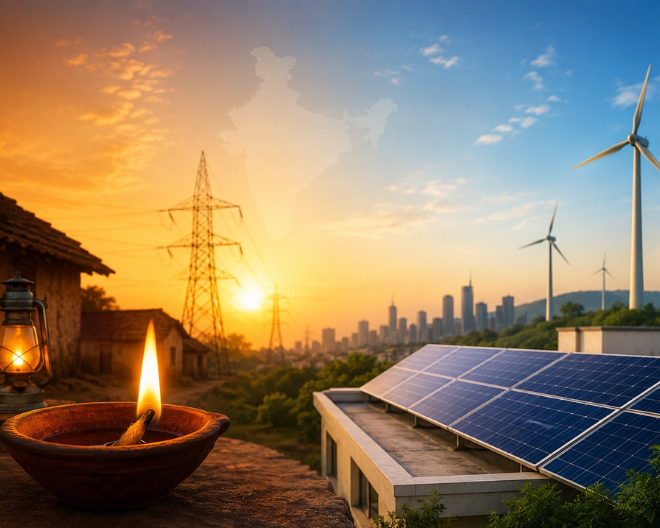
India’s transition from diyas to solar panels reflects its growing commitment to clean energy and sustainable development. (AI Representation)
India’s relationship with light stretches back millennia, and the story of how that light is produced says a great deal about the country’s economic and social transformation. For generations, homes across India were lit by little more than a flame in a clay diya: a small, flickering source of light that was as much a ritual as a necessity. Today, an increasing number of Indian rooftops carry a photovoltaic solar panel, quietly converting sunlight into electricity that powers fans, refrigerators and televisions long after the sun has set. This shift, from oil lamps to grid electricity to rooftop solar, has unfolded over roughly a century and a half, but its most dramatic chapter has been written in just the last decade. The journey from diyas to solar panels reflects India’s remarkable transition towards cleaner, more sustainable sources of energy.
This article traces that journey in two parts. It first decodes the milestones that took India from diyas and kerosene lanterns to a national electricity grid, and finally to a solar-powered future. It then examines, using data from the Ministry of New and Renewable Energy (MNRE) and the Ministry of Power (MoP), the key aspects of India’s solar energy programme and the scale of the opportunity that remains, as the country works toward its Panchamrit climate commitments, before turning to the challenges and the road ahead.
India’s lighting story did not move in a straight line from tradition to technology. It moved through distinct eras, each shaped by the fuels and infrastructure available at the time.
For most of India’s history, the diya, a small clay lamp fuelled by ghee or mustard oil, was the primary source of light after sunset. It was cheap to make but expensive to sustain through a whole night, which meant households used it sparingly and compressed most of their work and daily life into daylight hours. Its glow also carried deep cultural meaning, most visibly during Diwali, where light continues to symbolise the triumph of good over darkness.
By the late 19th and early 20th centuries, kerosene lanterns began replacing oil lamps in many parts of India, offering brighter and longer-lasting light. Kerosene remained the dominant lighting fuel for rural households for much of the 20th century, but it came with real costs: indoor air pollution, fire risk, and continued dependence on a fuel that had to be transported to even the most remote villages.
Electricity reached Indian cities as early as the 1890s, but for decades it remained largely an urban phenomenon. Rural electrification accelerated through successive Five-Year Plans, yet the last mile, connecting the poorest and most remote households, remained the hardest stretch. The Pradhan Mantri Sahaj Bijli Har Ghar Yojana (PM-Saubhagya), launched in 2017, was designed specifically to close this gap, and within roughly eighteen months the government reported that virtually all inhabited villages and the vast majority of households had been connected to the grid, one of the fastest household electrification drives undertaken anywhere in the world.
Grid connectivity solved the problem of access, but exposed a new one: reliability and the heavy reliance on coal-fired generation to meet a rapidly growing demand for electricity. India’s answer has been the Jawaharlal Nehru National Solar Mission, launched in January 2010, which set out to make solar technology diffusion policy-friendly and cost-competitive across the country. In the years since, and especially since 2014, solar has moved from a marginal, subsidy-dependent technology into a central pillar of the country’s energy strategy, the subject of the next section.
India’s solar sector has moved from single-digit gigawatt capacity a decade ago to becoming the backbone of the country’s renewable energy mix. The following data, drawn from MNRE and Ministry of Power publications, illustrates both the scale already achieved and the scale of the opportunity ahead.
According to MNRE, India’s cumulative solar power installed capacity had reached around 70.10 GW as on 30 June 2023, a roughly 27-fold increase from the 2.63 GW installed in 2014. Renewable energy capacity more broadly (excluding large hydro) stood at about 179 GW as on 31 May 2023, of which solar accounted for roughly 67 GW and wind for around 43 GW, with the remainder made up of small hydro, biomass and other sources. MNRE’s Year End Review 2023 notes that the country was on track to add about 13.5 GW of renewable energy capacity across the calendar year, representing an investment of close to ₹74,000 crore.
Taken together with nuclear power, India’s total non-fossil fuel electricity capacity stood at around 186 GW by October 2023, according to Central Electricity Authority data, up from roughly 158 GW just two years earlier. The Ministry of Power has separately reported that the share of non-fossil sources in India’s total electricity generation stood at 25.44% in FY 2022-23, and at 22.45% for the year up to May 2023. As per IRENA’s Renewable Capacity Statistics 2023, these gains placed India 4th globally in overall renewable energy installed capacity, 4th in wind power capacity, and 5th in solar power capacity.
Utility-scale solar farms have driven the bulk of India’s capacity growth so far, but the government has been steadily expanding incentives for households and institutions to install rooftop systems under the Rooftop Solar Programme (Phase II), which offers central financial assistance to residential consumers. MNRE’s Year-End Review 2023 reports that about 741 MW of capacity was installed under the grid-connected rooftop solar programme between January and November 2023 alone, with a further approximately 2.77 GW installed across all sectors with or without central assistance, during the same period. Complementing this, the PM-KUSUM scheme continues to support farmers in installing standalone solar pumps and solarising existing grid-connected agricultural pumps, while also allowing them to become solar power producers on barren or fallow land.
Ground-mounted, utility-scale projects remain the largest single contributor to India’s solar capacity. In calendar year 2023, Rajasthan led all states in new utility-scale solar additions with about 2,193 MW, followed by Gujarat at 1,317 MW and Maharashtra at 979 MW. India is home to some of the world’s largest solar installations, including the 2,245 MW Bhadla Solar Park in Rajasthan and the Pavagada Solar Park in Karnataka, developed under the government’s Solar Park Scheme, which aims to establish about 50 solar parks of 500 MW capacity or more, targeting a cumulative capacity of roughly 38 GW. The National Institute of Solar Energy (NISE) has assessed the country’s overall solar potential at approximately 748 GW, assuming just 3% of India’s wasteland area is used for solar PV modules.
Absorbing this scale of variable renewable generation requires both grid upgrades and a stronger domestic supply chain. MNRE has directed renewable energy implementing agencies to issue bids for 50 GW of renewable power capacity annually from FY 2023-24 through FY 2027-28. On 18 October 2023, the Cabinet Committee on Economic Affairs approved Phase II of the Green Energy Corridor, an inter-state transmission system to evacuate 13 GW of renewable energy projects from Ladakh, alongside 12,000 MWh of battery energy storage. On the manufacturing side, letters of award were issued in April 2023 under Tranche-II of the Production Linked Incentive (PLI) Scheme, worth ₹19,500 crore, to set up 39,600 MW of high-efficiency solar PV module manufacturing capacity, part of a broader push to reduce India’s reliance on imported solar cells and PV modules.
India’s solar growth story is far from friction-free, and two sets of challenges stand out as the sector scales further.
Solar power, by nature, is generated only during daylight hours and varies with weather and season. As Solar’s share of the electricity mix grows, this intermittency places increasing strain on grid balancing and requires substantial investment in energy storage, including Battery Energy Storage Systems (BESS) and Pumped Hydro Storage (PHP) to ensure power remains available around the clock rather than only when the sun is shining.
Utility-scale solar projects require large tracts of contiguous land, which can be difficult to acquire without displacing communities or affecting agricultural livelihoods. Financing remains another constraint: while costs have fallen sharply over the past decade, mobilising affordable, long-term capital for large solar and storage projects continues to be harder in India than in many developed markets. India has also been working to build up domestic manufacturing of solar cells and modules, through the Approved List of Models and Manufacturers (ALMM) and the Production Linked Incentive scheme for high-efficiency solar PV modules to reduce dependence on imports, though achieving full self-sufficiency in the solar supply chain remains very much a work in progress as manufacturing capacity under these schemes is still being built out.
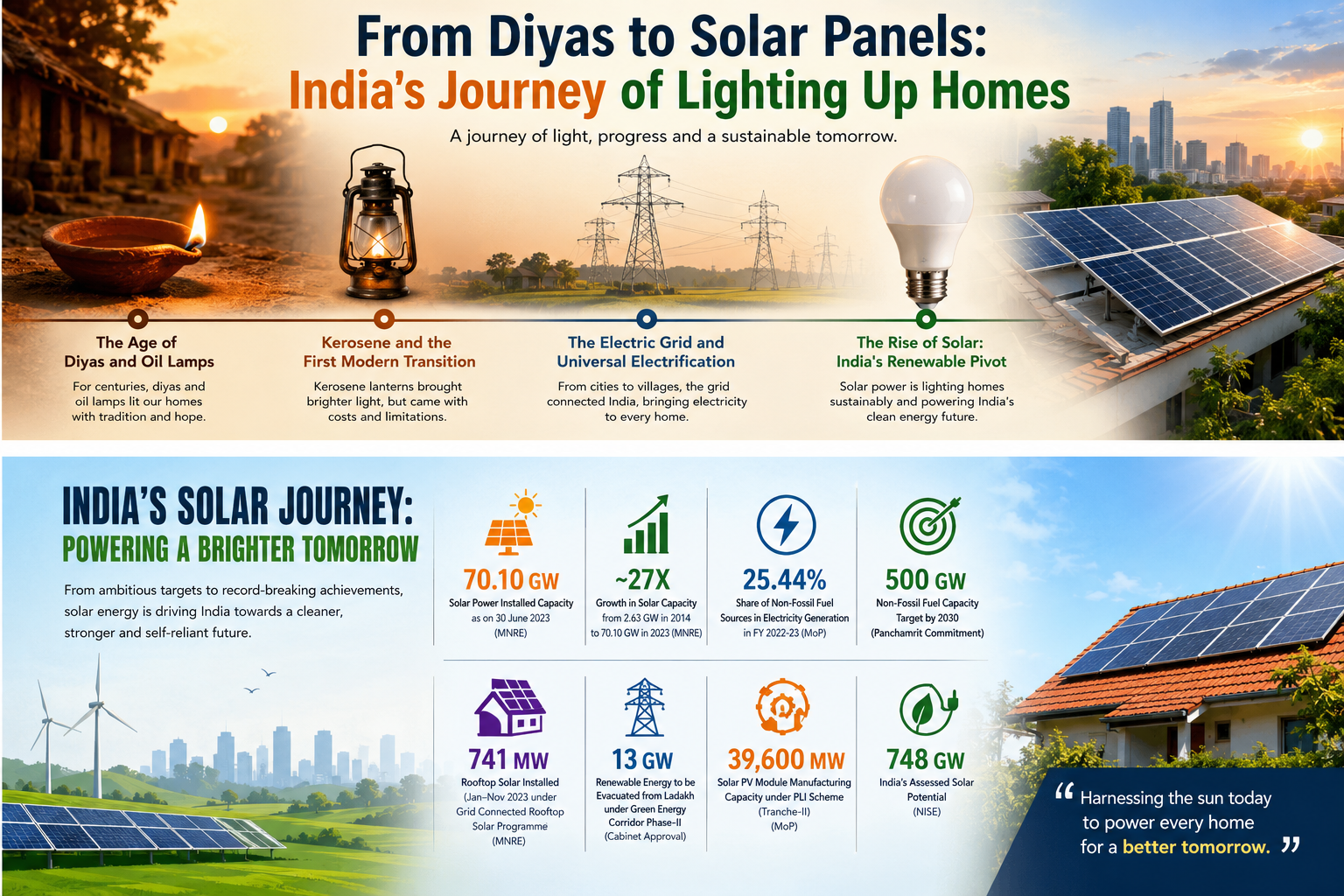
An infographic highlighting the evolution of India’s lighting systems, key electrification milestones, and the rapid growth of solar energy. (AI Representation)
India’s clean energy transition remains deeply anchored in the “Panchamrit” commitments announced by our Hon’ble Prime Minister Shri Narendra Modi at COP26 in Glasgow in 2021: reaching 500 GW of non-fossil fuel capacity by 2030, meeting 50% of the country’s energy requirements from renewable sources by 2030, cutting projected carbon emissions by one billion tonnes by 2030, reducing the carbon intensity of the economy by 45% from 2005 levels, and achieving net-zero emissions by 2070. The government has indicated that India’s earlier Nationally Determined Contribution target of 40% of installed electricity capacity from non-fossil sources was already met well ahead of its original 2030 deadline, underscoring the pace of the transition so far.
With solar accounting for the largest share of new renewable capacity added each year, continued investment in the Rooftop Solar Programme, expansion of utility-scale parks, the ramp-up of domestic module manufacturing under the PLI scheme, and parallel upgrades to transmission infrastructure such as the Green Energy Corridor will together determine how quickly India can convert its solar potential into dependable, everyday electricity for every home, completing the remarkable journey from diyas to solar panels.
References
1) Ministry of New and Renewable Energy, Govt. of India. Solar Overview. mnre.gov.in
2) Ministry of New and Renewable Energy, Govt. of India (2023). Year End Review 2023, Press Information Bureau.
3) Ministry of Power, Govt. of India (2023). 500 GW Non-Fossil Fuel Target. powermin.gov.in
4) Central Electricity Authority, Govt. of India (2023). Renewable Energy Installed Capacity Data.
5) International Renewable Energy Agency (IRENA), Renewable Capacity Statistics 2023.
6) Press Information Bureau (PIB), Govt. of India (2023). Cabinet approves Green Energy Corridor Phase-II for Ladakh.
More Must Read on LnC
Greening the Grid: How is India’s Power Sector Embracing Sustainability?


Got a poem, story, musing or painting you would like to share with the world? Send your creative writings and expressions to editor@learningandcreativity.com
Learning and Creativity publishes articles, stories, poems, reviews, and other literary works, artworks, photographs and other publishable material contributed by writers, artists and photographers as a friendly gesture. The opinions shared by the writers, artists and photographers are their personal opinion and does not reflect the opinion of Learning and Creativity- emagazine. Images used in the posts (not including those from Learning and Creativity's own photo archives) have been procured from the contributors themselves, public forums, social networking sites, publicity releases, free photo sites such as Pixabay, Pexels, Morguefile, etc and Wikimedia Creative Commons. Please inform us if any of the images used here are copyrighted, we will pull those images down.