Stay tuned to our new posts and updates! Click to join us on WhatsApp  & Telegram
  Channel
& Telegram Channel & Telegram Channel 




Bare Voice will introduce to the music lovers of the world, the phenomenon called Suman. A Silhouette review by Subha Das Mollick.
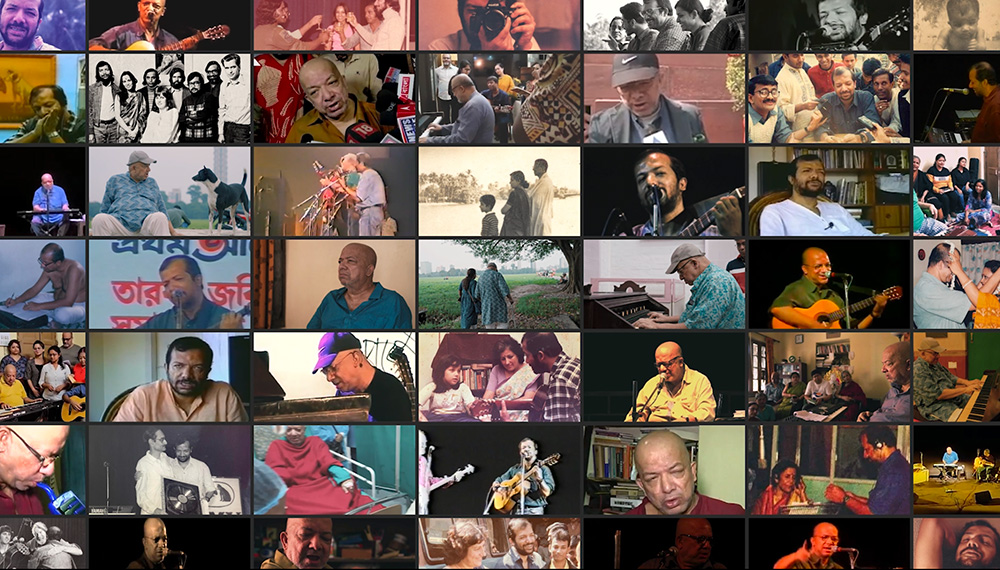
A mosaic of Suman’s life
In Jaideep Varma’s documentary film Bare Voice, not only does the ageing singer, composer, lyricist Kabir Suman sing in his bare voice, but he also bares his soul to Jaideep and his camera and by proxy to his viewers and to posterity. Suman is candid about the fact that the first song he penned was a fake Rabindra Sangeet, he is candid about his first meeting with Maya Angelou in USA, his first live show in Calcutta and the women who came into his life. He records for posterity how he was pushed into the Naxalite version of Communism by the cold metallic nozzle of a pistol and how he fell out of Communist ideals by the sight of the endless rows of ‘Unbckannt’ (meaning Unknown) graves on the other side of the crumbled Berlin Wall. He shares anecdotes of his days as Lok Sabha M.P, he tells us why he abandoned his ‘পৈতে’ (Brahminical holy thread) and embraced Islam and he laments his return to his roots from the ‘new world’ holding promise for his creativity to blossom.
As Suman speaks, he relives those moments in his life. He is overpowered by emotions that he had felt decades back and the emotions pour out through his expressions, his voice, his entire body.
Suman does not play to the camera as he speaks. He simply relives his long, chequered, colourful life through his reminiscences. The camera is the catalyst that provokes him to look back and perhaps re- examine.
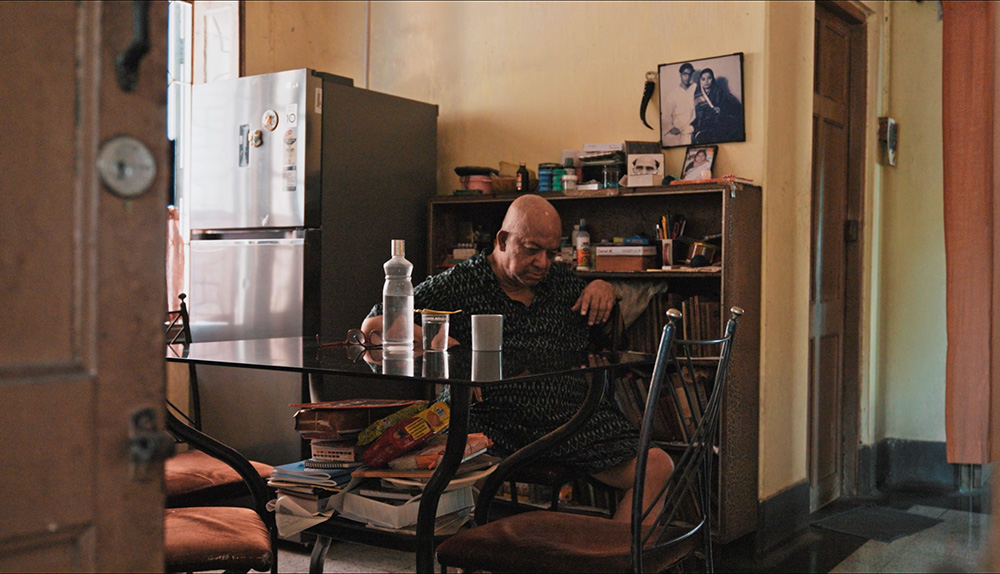
Suman down his memory lane
Jaideep Varma, on his part, has heightened the dramatic moments through the relentless camera gaze slowly fading into the black. He has used archival footage as a counterpoint to Suman’s dramatic retelling. In telling the story of Suman’s life and the stories behind his songs, Varma has stuck to a linear chronology, starting from baby Suman absorbing Bismillah Khan’s shehnai through the thick towel he was wrapped in, to his falling out of an elite English medium school and taking admission in a Bengali medium school where he learnt all the good things of life, to his first audition at AIR, his first visit to France where he encounters Bob Dylan like brandy in an empty stomach, his stay in USA and subsequent return to his city- right up to the present times where he is experimenting with Bangla kheyal. The story is put together with Suman’s own reminiscences, interspersed with comments from co-musicians, music critics and cultural commentators. Shantanu Moitra says, “here is one man who can enter the Hall of Fame as a lyricist, as a composer and as a singer. But why have we forgotten him today? Where did we go wrong or where did he go wrong?”
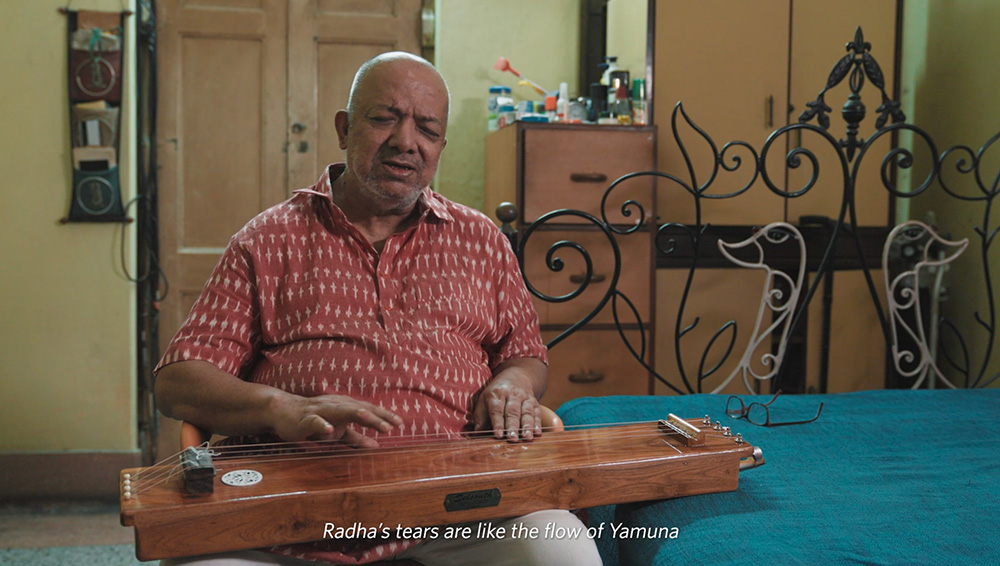
Suman singing Bangla Khayal
With that question we enter the story of Suman’s life and his music. Suman is born in a land where ideas of nationalism have taken roots; where stalwarts of Bengal Renaissance have rediscovered our roots. He speaks in a language that has given the nation its national anthem and national song. This is a place where not just the Pancha Kavi, but all the stalwarts of the Bengal Renaissance have composed songs – be it Raja Ram Mohan Roy or Chittaranjan Das. Early in the film Suman hums a Rabindra Sangeet “এ কি সত্য সকলই সত্য, হে আমার চিরভক্ত” (Is it all true, O my ever admirer) and says that one can spend a lifetime singing only Rabindra Sangeet. A little later he says that we are cursed to have a Rabindranath among us. We cannot get out of his shadow. As the nation is burning and a war is waging and refugees are pouring from across the border, All India Radio is continuing to broadcast songs of love and longing – songs that have no relevance to the times we are living in.
Suman picks up his pen and writes about common people in straightforward and almost colloquial words. His songs are not rousing revolutionary songs like those of Salil Chowdhury. His songs are not sloppy with cliched metaphors. The metaphors are fresh and relatable.
গান তুমি হও গরমকালের সন্ধ্যেবেলার হাওয়া
অনেক পুড়ে যাওয়ার পরে খানিক বেঁচে যাওয়া
(Song, you are an evening breeze after a hot summer day
A fresh breath of life after the burn out of the day)
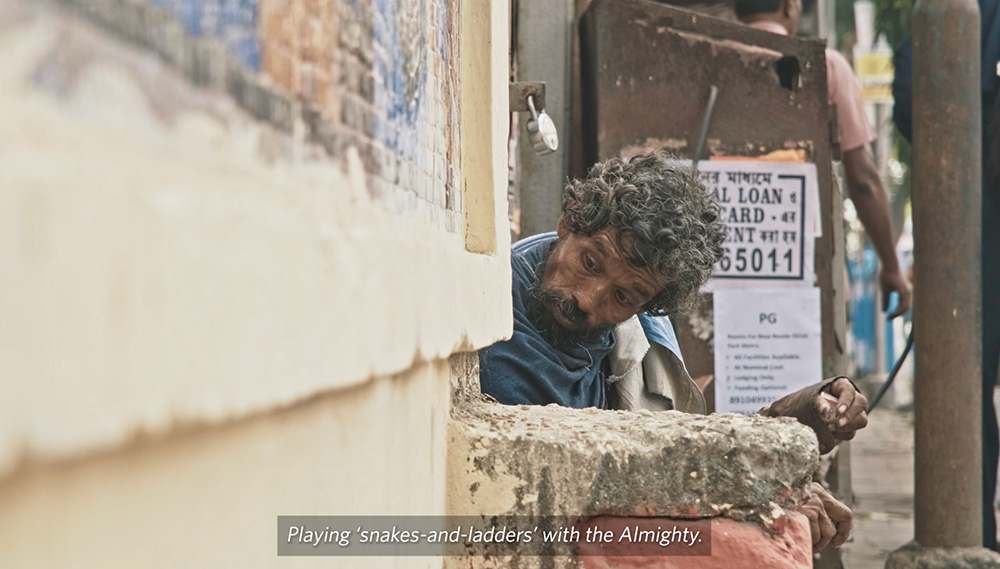
The mad man round the street corner in the song Pagol
Suman’s songs are not about the exotic. They are about the commonplace – the teenaged rickshaw puller, the mad man at the street corner, the unknown flute seller who walks along the lane on a rainy day and his songs are about his bustling city Calcutta. Calcutta is the city he grew up in and returned to again and again from his visits to the West.
এই শহর জানে আমার প্রথম সব কিছু
পালতে চাই যত সে আসে আমার পিছু পিছু
(This city knows all my first acts
The more I run away the more it follows my tracks)
As we watch these songs playing out in Bare Voice, we thank his mother Uma for putting him in a Bengali school. Suman would probably never have had such a robust command over his language if he studied in an elite English medium school.
Sudipto Chatterjee says in the prelude of Bare Voice “If a great artist shows up on a cultural horizon, there are two things that he definitely does. One, he produces a volume and two, he exhausts a language.”
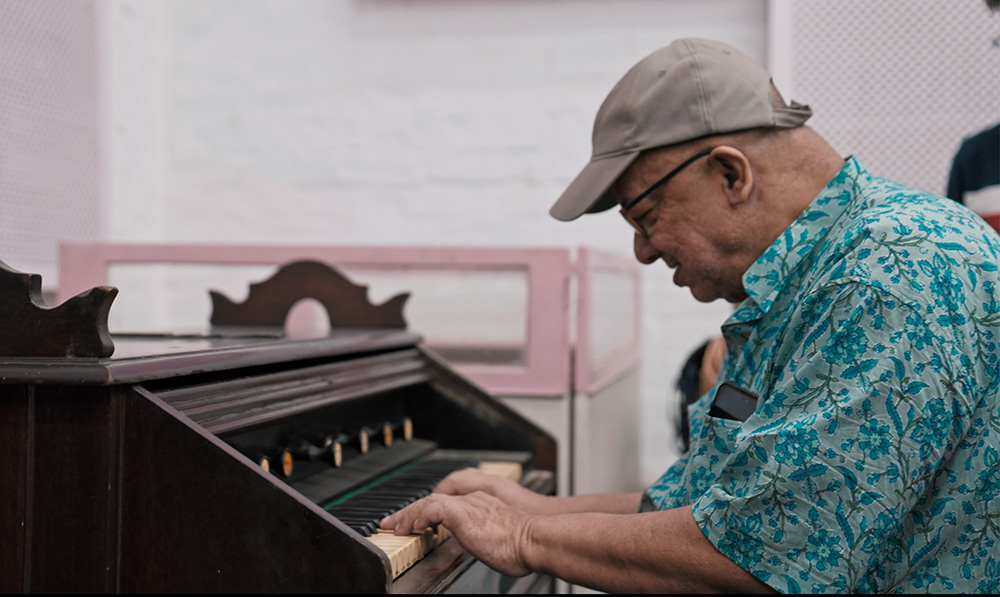
Suman trying out the table organ at HMV studio
Suman is not a messiah who has come down to save the world. He is not a pied piper who takes his followers wherever he goes. He stands alone and firm. He is a chronicler of his times – an observer sometimes bemused, sometimes angry, always alert. One whole generation has grown up listening to ‘আমাদেরই জন্য’ (It is all for us), ‘তোমাকে চাই’(All I need is you), ‘পেটকাটি চাঁদিয়াল’ (The moon shaped kite) or ‘ও গানওয়ালা’ (Peddler of songs).
Jaideep Varma has visualized these songs with his loving yet scathing, well framed yet unromantic lens. His camera is observant, unhurried and not eager to please the ‘reels generation’. In the song ‘পেটকাটি চাঁদিয়াল’ he has kept his camera just behind the paddle of the cycle rickshaw. For the entire duration of the song, we see a pair of cracked feet wearing worn out ‘hawai chappals’ pushing the paddles. Jaideep’s view of Calcutta is not a tourist’s superficial view. It is a familiar view of an insider. Jaideep does not wear his technical proficiency on his arm. It is quietly integrated in the body of the film. His attention to details and the depth of his research shows in the animated graphics, in the in-between texts to bridge the sequences, in the mosaic of various facets of Suman’s life.
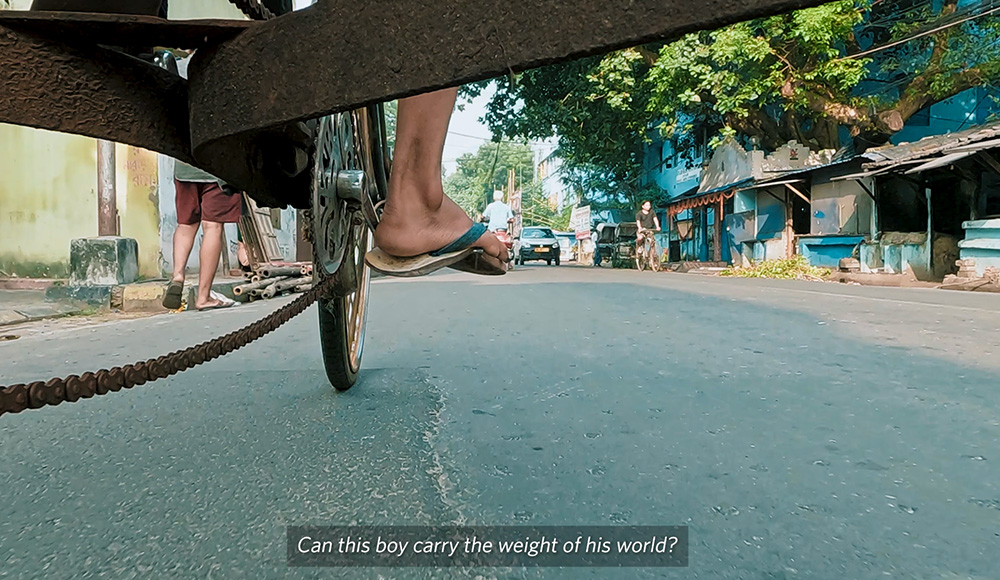
PVisualization of the song Petkati Chabial
The much-awaited line ‘গড়িয়াহাটার মোড় মিনি মিনি বাস বাস’ (The Gariahat crossing/ Mini buses racing) comes at 56 min 29 sec. A song released in 1992 springs back to life with redoubled energy with visuals captured almost 25 years after the original release of the song. The song takes up 6 minutes of screen time, with comments by Sudipto Chatterjee, Shantanu Moitra and Suman himself, skilfully interspersed in between the lyrics. It leaves one breathless and hungry for more.
Close at heels follows Suman’s signature song ‘তোমাকে চাই’. As a prelude to the song Suman recounts how the lyrics came to him as longing for a woman and suddenly spinned off to a new level, leaving the woman behind. Suman says, “And now the girl was no more there. Just Kolkata.” Jaideep’s camera follows a girl in slow motion, then cranes up to give us a bird’s eye view of Kolkata. Suman’s bare voice singing merges with the original sound track released in 1992 – and then back to his bare voice singing, which merges with the 30th anniversary concert in celebration of the song. A plaintive solo song of longing suddenly becomes a chorus.
‘তিনি বৃদ্ধ হলেন’ (He grows old) is a song dedicated to his father, who, in spite of showing many faces of cruelty, had exposed Suman to the wide spectrum of music via a borrowed gramophone player. With the lines ‘দম ফুরানো কলের গানে’ (On the slowing down gramophone), which are a part of the song, Suman pays homage to all the composers and singers who have shaped his musical sensibility. He ends by paying homage to his father who brought these songs to him, who has been his lifelong friend, but now has grown old, leaving him behind.
The day his father died Suman went for a show that had been sold out and could not be cancelled. At the end of the show he said, “I have been singing for three hours. None of you told me ‘You have fulfilled your professional commitment. Now go home and perform the last rites of your father.’”
Death is a recurring motif in Bare Voice. The film begins with Suman’s near encounter with death, followed by his song ‘জাতিস্মর’ where he sings
অমরত্বের প্রত্যাশা নেই নেই কোনো দাবি দাওয়া
এই নশ্বর জীবনের মানে শুধু তোমাকেই চাওয়া
……
আগেও মরেছি আবার মরবো প্রেমের দিব্যি দিয়ে
(I do not hope for immortality; I have no tall claims
In my mortal life my only claim is You
……
I have died many deaths; I will die again for You)
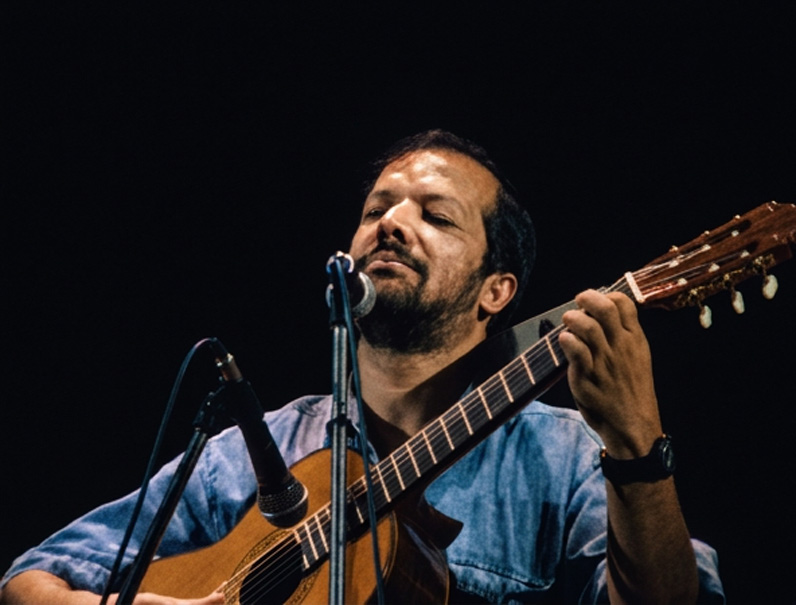
Suman at the prime of his career
At the end of 2 hours and 15 minutes it is time for Suman to sing ‘ঘুমাও বাউণ্ডুলে ঘুমাও এবার’ (Time for you to sleep, O vagabond). The screen goes black. We hear Suman’s voice recalling how when he was at death’s door, he had a vision of Vivekananda standing erect. Sudipto Chatterjee had said earlier in the film “A genius does not die”.
Jaideep Varma first met Suman on 17 January 2024. What was supposed to be an hour-long meeting, lasted six hours. “Do what you plan to do fast. Am not there for long” were his parting words. Suman borrowed three weeks’ time to recover. Shooting began on 20 April 2024. The core shooting was wrapped up in two weeks. The rest of the effort went in procuring archival footage, photographs, and songs. Sa Re Ga Ma (HMV) came forward and offered the original tracks of Suman’s songs to Varma against the credit of Sa Re Ga Ma as co-producer of the film. Sudipto Chatterjee offered the rushes of his film Free to Sing made in 1996. Jaideep painstakingly digitized the footage from analogue tapes that had visuals of Suman’s stage performances and Pete Seger’s 1996 visit to Calcutta.
Editing a documentary film is at times trickier than editing a pre-scripted fiction film. A documentary editor had to spend endless hours groping for the juxtapositions that would complete the story or throw new light to the story. He has to churn the amorphous mass of the rushes to look for the strands that would complete the narrative tapestry. At last, a radiant bird comes to life, it spreads its wings and takes a flight. The wings of the bird should be light for it to fly high as the dead weight of avoidable footage should be taken off its wings.
Suman has been a phenomenon in his lifetime. He is instrumental in initiating a whole new genre called ‘জীবনমুখী গান’ or ‘Songs of Life’. Bare Voice captures this expanse. When the credits begin to roll, Suman emerges as a vulnerable yet contended man whose mind is still ticking with new ideas. He is a sum total of all his songs and more.
Bare Voice is a film that would draw in fans of Suman, followers of contemporary Bengali music, cultural historians and scholars of modern Bengali language. Bare Voice will introduce to the music lovers of the world, the phenomenon called Suman. It is a film worth watching again and again and discovering something new in every viewing.
(Pictures used are courtesy Subha Das Mollick)
More Must Read in Silhouette
Raghu Rai – An Unframed Portrait
Buddhadeb Dasgupta’s Uttara – Poetry on Celluloid
All That Breathes Review: Finding Exquisite Beauty in Urban ‘Low Life’
Sound the Trumpets: The Elephant Whisperers
Dwelling in Travelling: Chronicle of the Baghdadi Jews of Calcutta

Whether you are new or veteran, you are important. Please contribute with your articles on cinema, we are looking forward for an association. Send your writings to amitava@silhouette-magazine.com

Silhouette Magazine publishes articles, reviews, critiques and interviews and other cinema-related works, artworks, photographs and other publishable material contributed by writers and critics as a friendly gesture. The opinions shared by the writers and critics are their personal opinion and does not reflect the opinion of Silhouette Magazine. Images on Silhouette Magazine are posted for the sole purpose of academic interest and to illuminate the text. The images and screen shots are the copyright of their original owners. Silhouette Magazine strives to provide attribution wherever possible. Images used in the posts have been procured from the contributors themselves, public forums, social networking sites, publicity releases, YouTube, Pixabay and Creative Commons. Please inform us if any of the images used here are copyrighted, we will pull those images down.

































































There is one grave mistake, there is nothing or has never been any genre called ‘জীবনমুখী গান’ or ‘Songs of Life’. It was a term mentioned once in one of the albums of Nachiketa Chakraborty and the media took that term and clubbed Anjan Dutt, Nachiketa and Kabir Suman under its umbrella(which is a blunder). Kabir Suman and always considered his music to be ” modern bengali songs” or bangla adhunik gaan” and has spoken against terming his songs as jibonmukhi and had even chided ” If my songs are jibonmukhi, then are the other songs moronmukhi?”
Ideally one should abstain from providing legitimacy to the term “jibonmukhi” in context of Kabir Suman’s music.
Mr. Aryan Khanwalkar, your point is well taken. However, the songs of Kabir Suman, Nachiketa, Anjn Dutt cannot be termed as adhunik bangla gaan. These songs are a genre distinctly different from what we understand as adhunik bangla gaan. They may be called atyadhunic bangla gaan or post modern Bengali songs as opposed to modern Bengali songs.