Stay tuned to our new posts and updates! Click to join us on WhatsApp  & Telegram
  Channel
& Telegram Channel & Telegram Channel 




Gaurav Sahay revisits the songs of Asha Bhosle across eras to encounter not merely a singer, but a phenomenon, one who refused confinement, who adapted and evolved, yet retained a signature distinctly her own.
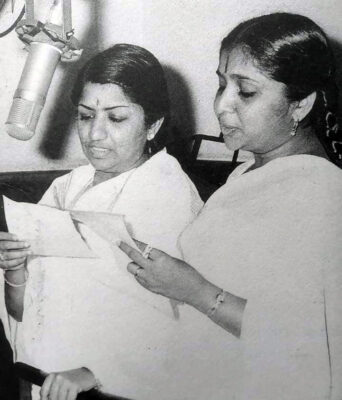
Lata Mangeshkar and Asha Bhosle
Asha-Lata: Beyond comparison, beyond time
I often find myself reflecting upon a curious question: has there ever existed a more gifted and enduring sibling duo, in India or perhaps anywhere in the world, across any sphere of art or sport?
In our school days, pie charts would illustrate that nearly 71 per cent of the Earth is water and about 29 per cent is land. When I contemplate the vast landscape of Hindi playback singing, I am inclined to imagine a similar proportion, where an overwhelming share would seem to belong to Lata Mangeshkar and Asha Bhosle. Factually, this may not be precise, yet emotionally and artistically, it feels irrefutable. Their collective oeuvre, spanning generations, reigned for nearly six decades, leaving an indelible imprint on millions, perhaps even billions, across the world.
With Lata Mangeshkar’s passing in 2022, and now Asha Bhosle’s departure on 12th April 2026, both at the same age, it feels as though an era has gently receded into memory.
If Lata was the embodiment of purity, discipline, and an almost classical sanctity, never once descending from the exalted pedestal she created, Asha represented movement, exploration, and reinvention. True to her name, she became ‘Asha’, a symbol of renewal and possibility for listeners seeking something distinct.
While Lata remained steadfast in her classical brilliance, Asha charted her course through the interstices of change, responding to shifting musical sensibilities with remarkable adaptability. In many ways, her trajectory evokes that of Kishore Kumar, who, despite the towering presence of Mohammed Rafi, forged a resonance uniquely his own.
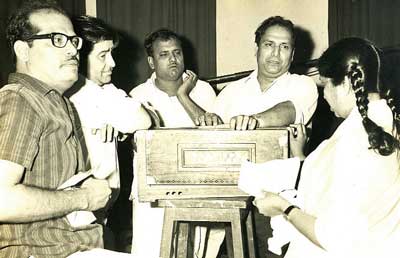
Manna Dey, Raj Kapoor, Unknown, Shankar and Asha Bhosle (Pic courtesy: ShankarJaikishan.Wordpress)
Asha may not always have been the conventional first choice, yet she evolved into something far more enduring, a universe unto herself. She did not compete with Lata; rather, she complemented and expanded the musical cosmos. Over time, she grew into a banyan of her own, deeply rooted, far-reaching, and sheltering an entirely different spectrum of listeners.
Her versatility remains unparalleled. From classical intricacies to cabaret, from mujra to pop, from playful cadence to evocative poetry, she traversed genres with effortless command. Each decade revealed a new facet of her artistry, and yet she remained unmistakably herself.
To revisit her songs across eras is to encounter not merely a singer, but a phenomenon, one who refused confinement, who adapted and evolved, yet retained a signature distinctly her own. Perhaps that is her greatest legacy, not just the songs she rendered, but the possibilities she opened for generations to come.
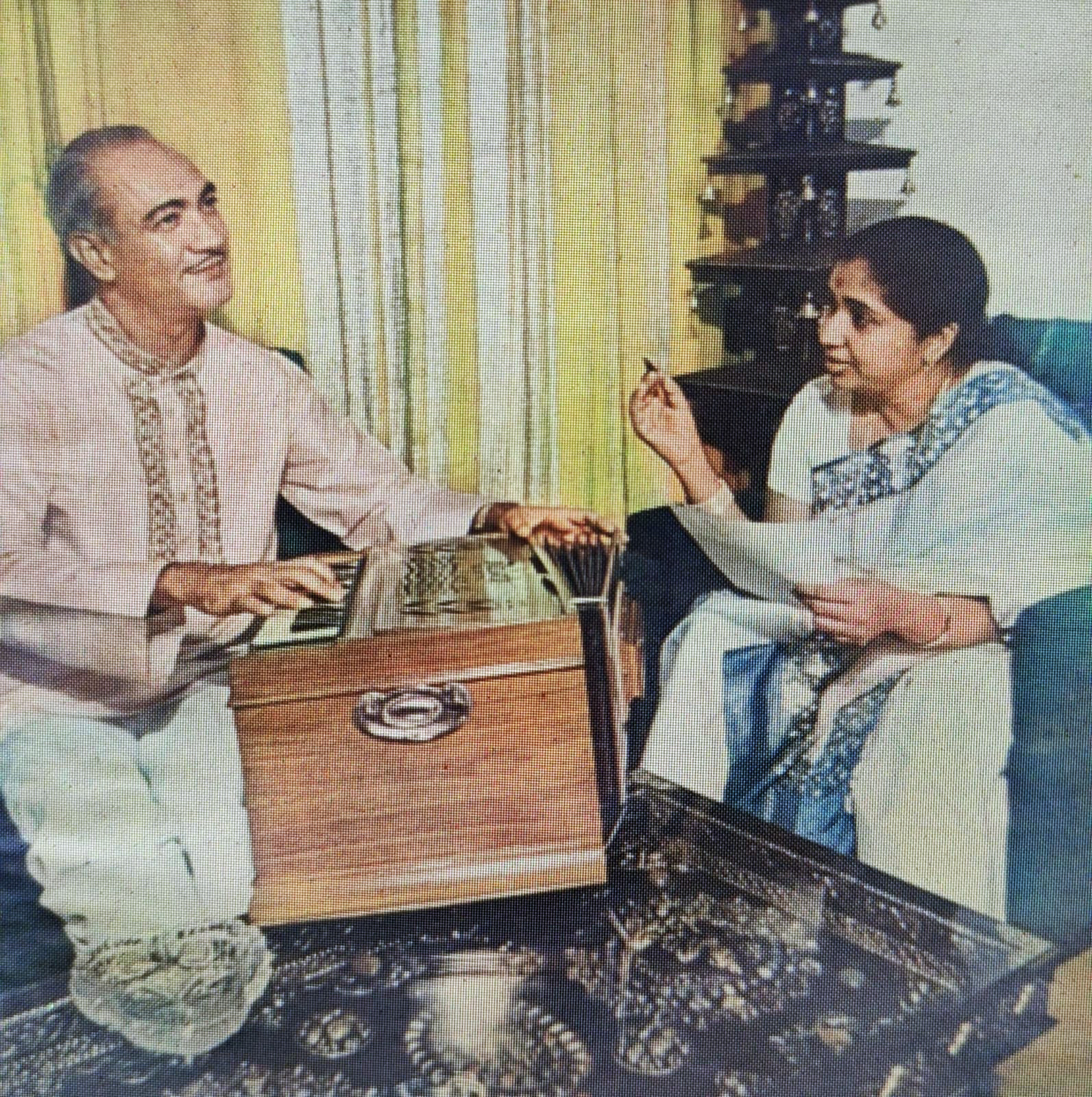
OP Nayyar and Asha Bhosle (Pic courtesy: SMM Ausaja Archives)
O P Nayyar and the defining ascent
To begin with, Asha Bhosle found herself in the midst of formidable contemporaries—her own sister Lata Mangeshkar, along with Shamshad Begum and Geeta Dutt, who dominated the musical firmament of the 1950s. She was rarely perceived as the natural playback voice for leading actresses and required a decisive impetus to carve an identity of her own.
That impetus came in the form of O P Nayyar. His creative divergence from Lata ji inadvertently became the catalyst for Asha’s emergence. Naya Daur marked a turning point, a genuine new dawn. The Nayyar–Sahir–Asha triad struck a powerful chord, and Maang ke saath tumhara emerged as a defining moment, consolidating a partnership that would go on to yield some of Hindi cinema’s most enduring melodies.
In Deewana hua badal, if Nayyar transported listeners to the tranquil expanse of the Kashmir Valley, it was Asha’s voice that flowed like the Jhelum—tinke ki tarah main beh nikli—fluid, evocative, and life-affirming, lending depth and continuity to the composition. More significantly, Nayyar instilled in her a quiet self-assurance, reinforcing that she was no less gifted than her illustrious sister, and need not emulate a style that belonged to an altogether different orbit.
Aaiye meherbaan is often recalled for Madhubala’s ethereal allure, yet it is the sensuous timbre of Asha’s voice that completes the experience.
Kiska jala aashiyan bijli ko hai kya khabar…
If Nayyar’s prelude mesmerises and Madhubala captivates in an instant, it is Asha’s voice that revives, elevates, and sustains the moment. Such is the charisma of the song that one feels her voice brings the listener back to life, again and again.
Aaiye meherbaan (Howrah Bridge, 1958) OP Nayyar / Qamar Jalalabadi / Asha Bhosle
Earning the confidence of musical maestros
I have always admired Asha Bhosle for the quiet strength with which she stood alongside her sister Lata in Bandini. S D Burman entrusted two songs each to both singers—Lata lending her voice to Nutan, while Asha rendered O panchi pyare and Ab ke baras bhej bhaiya ko babul.
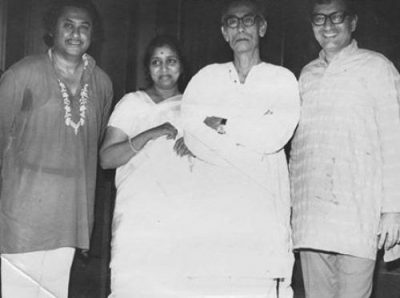
Kishore Kumar with Asha Bhonsle, SD Burman and Vijay Anand (Pic courtesy: Hamara Photos)
To my mind, Asha’s songs carried a deeper emotional resonance, bringing out the pathos with a certain lived-in authenticity. It is said that Dada Burman was initially uncertain and, in a moment of candour, even asked Asha whether she had a brother—perhaps questioning her ability to internalise the emotion. What followed, however, was nothing short of sublime.
Nostalgia is a great release if the present is an unmitigated mope with all doors closed. But what Shailendra has done is to project and extend the nostalgia, the memory of the good times, into a wishfulness for the future. And remarkably, the burden of the moment present is transcended. The convict used her nostalgia to weave a world of fantasies, of hope. Asha, in turn, demonstrated a rare ability to feel the cinematic context from within. One could sense the melancholia, but also the undercurrent of yearning. Her voice did not just carry the lyrics; it deepened them, enhancing the lyrical beauty of Shailendra’s words against the gentle lilt of Dada Burman’s composition. Under the direction of Bimal Roy, the song was placed in the voice of a convict, a woman confined, yet emotionally expansive. It was, arguably, one of Asha’s finest renderings.
A voice that transforms pain into melody
Ga mere man ga…
In this SD Burman composition, Asha is nothing short of supreme. The song is layered with meaning and philosophy, yet remains beautifully anchored to the word “ga”—its ascensions, its elongations, its quiet insistence. Toward the end, there is a brief yet charged surge where the word seems to gather an almost kinetic force—rising, as if attaining an escape velocity along a parabolic curve, before dissolving into stillness. Majrooh was extraordinary in articulating the many strains of human emotion with consummate ease and elegance.
There is an unmistakable sadness coursing through its soul, even as it appears celebratory on the surface—phir bhi tu jhoomein jaa! Asha’s voice, in that moment, feels deeply personal, as though she is drawing upon a reservoir of her own unspoken pain.
In its essence, the song seems to echo Shelley’s immortal line: “Our sweetest songs are those that tell of saddest thought.”
khaa thes aur muskaa… gaa mere man gaa—endure, smile, and continue to sing, even when it hurts.
Gaa mere mann gaa (Lajwanti, 1958) SD Burman / Majrooh Sultanpuri / Asha Bhosle
The other shade of emotion
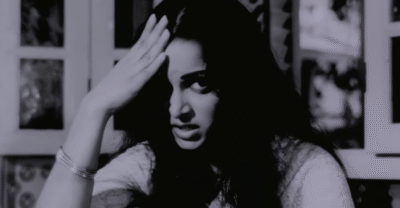
Waheeda Rehman in Bhanwara bada naadan hai (Sahib Bibi aur Ghulam)
Even in Sahib Bibi Aur Ghulam, Asha Bhosle was not the principal playback voice for the leading actress. Yet, Hemant Kumar employed her with remarkable effect in Bhanwra bada nadaan hai, kaliyan ki muskaan hai. The song carries impishness—a lightness and playfulness that feels almost carefree. In contrast, Geeta Dutt’s Na jaao saiyan is steeped in longing, its melancholic pull drawing the listener inward. What makes the composition truly compelling is this delicate balance of moods. The emotional weight of Geeta Dutt’s pathos finds a natural counterpoint in Asha’s buoyant rendition.
When a song takes flight.
Tu chuppi hai kahaan, main tadapta yahaan
Aa jab talak tera mera na hoga milan
Main zameen aasman ko hilaati rahungi
An extraordinary duet, no matter which lens one chooses to view it through. Penned by Bharat Vyas, the Hindi purist, the song carries a poetic richness that feels both classical and expansive. C Ramchandra sets it to a composition that is uniquely fluid, its lilt allowing a remarkable freedom of expression. At one moment, it rests, almost placid, gently unhurried and then, without warning, it soars.
There is something cinematic even in its musical movement. It reminds me of a Republic Day flypast, one formation of jets thundering past, followed by a sudden lull, a suspended silence, before another formation cuts through the sky with renewed force.
And when Asha Bhosle reaches the apogee of her singing, it feels as though she is summoning every fibre of her being, every breath, every sinew, to achieve that perfect trajectory. It is almost akin to a discus thrower, swirling with controlled intensity, gathering strength before releasing the discus into space with precision and grace.
Alongside her, Manna Dey matches that scale and spirit. Together, they do not merely render the song, they launch it, placing it into an orbit of their own.
Tu chhupi hai kahaan (Navrang, 1959) C Ramchandra / Bharat Vyas / Asha Bhosle & Manna Dey
Living in the Moment
Ravi’s Aagey bhi jaane na tu, peeche bhi jaane na tu transcends the boundaries of a conventional song; it emerges as a meditation on life itself. It does not merely allude to the fleeting nature of existence, it articulates it with a quiet, assured clarity. The composition gently persuades us to disengage from the weight of the past and the anxieties of the future.
What lends the song its enduring charm, however, is the way Asha Bhosle inhabits this philosophy. Her voice does not render it austere or contemplative in a distant sense; instead, she imbues it with a certain romance of living, an invitation to embrace the present with grace and spontaneity.
Ravi’s composition unfolds with a grand, almost ballroom-like elegance, while Asha’s soaring vocals move effortlessly across its expanse, drawing the listener into a space where reflection and indulgence coexist. One senses a gentle persuasion within the song, an urging to relinquish restraint, to pause, perhaps with a quiet drink in hand, and experience the moment with a bindaas abandon, unburdened and vividly alive.
Aagey bhi jaane na tu (Waqt, 1965) Ravi / Sahir Ludhianvi / Asha Bhosle
The tender intimacy of Chalo chalein Maa
The association of Hemant Kumar with Asha Bhosle also yielded some memorable gems. Among them, Chalo chalein Maa, stands apart—not for romance, nor for the lament of a forsaken lover, but for something far more intimate and human. The song is not about a love-related elation, nor a wail, nor a pine of a lover jilted or forsaken. It is about a woman and her son, reveling in togetherness away from the pricks and woes of their present world. I love this song more for the sadness inherent in it – almost a progressive sadness that turns me sad, vulnerable, a bit raw. And I do not resent such occasional empathetic sensitivity, perhaps indispensable to one’s evolution.
Asha’s rendition remains in complete integrity with the sentiment of the composition. She does not overstate; she inhabits. And in doing so, she elevates the song into something quietly deep.
Chalo chalein maa (Jagriti, 1954) Hemant Kumar / Pradeep / Asha Bhosle
The Rebel, The Uninhibited
The arrival of R D Burman, alongside Kishore Kumar and the phenomenon of Rajesh Khanna, altered the very complexion of Bollywood music. The soundscape became more contemporary, more rhythmic, and Kishore Kumar ascended to dominance. Within this shifting milieu, the ever-versatile Asha Bhosle found her rhythm with remarkable ease, aligning herself effortlessly with the pulse of a new musical era.
She became the defining voice of Zeenat Aman in Dum maro dum. The song was nothing short of a cultural phenomenon. The smoky, almost surreal ambience, R D Burman’s assured elan heralding a new decade, and Asha’s voice, free, uninhibited, and quietly defiant, converged to create something iconic:
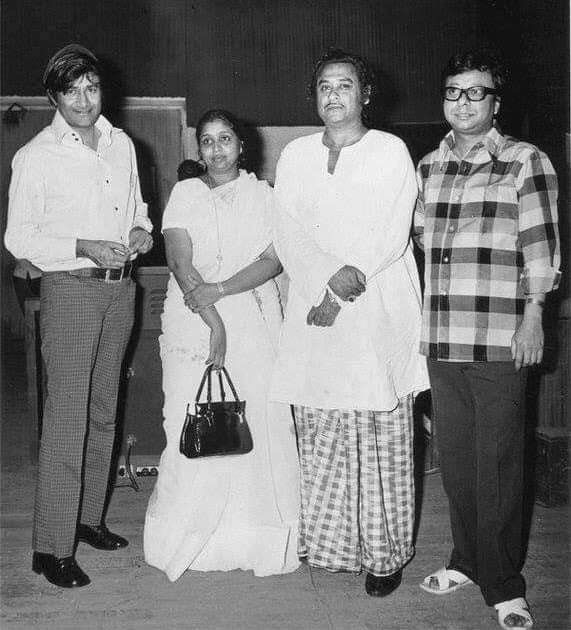
Dev Anand, Asha Bhosle, Kishore Kumar and RD Burman
Duniya ne humko diya kya
Duniya se hamne liya kya
Hum sab ki parwa kare kyon
Sabne hamaara kiya kya
It felt less like a song and more like a statement, a subdued yet resolute rebellion, an assertion of living life on one’s own terms.
Perhaps its resonance was so deep because it seemed to mirror Asha’s own journey. Her personal life bore the marks of turbulence, an early marriage to Ganpat Bhosle that did not endure, emotional upheavals, and the difficult resolve to step away despite responsibilities. Even within her own family, including Lata Mangeshkar, there was initial disapproval. Professionally too, despite her evolving stature, she had to contend for recognition that did not come as readily as it did to her sister.
Seen in this light, Dum maro dum acquires an almost cathartic dimension, a release of a wounded yet resilient spirit finding articulation through music. It went on to become not merely a cult classic, but the foundation of a sound that would define retro culture, evoked even today to capture a sense of abandon, detachment, and liberation.
In it, Asha Bhosle once again transformed lived experience into enduring expression, turning personal upheaval into a voice that continues to resonate across time.
Dum maaro dum (Hare Rama Hare Krishna, 1971) RD Burman / Anand Bakshi / Asha Bhosle
The classical ascendancy
Despite her brilliance across genres, there was a phase when Asha Bhosle was not immediately associated with classical depth. Her repertoire was expansive and versatile, yet the definitive imprint of a classical vocalist seemed, for a time, just beyond reach. That perception underwent a decisive transformation with Khayyam’s Umrao Jaan.
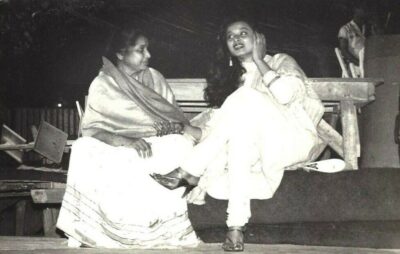
Asha Bhosle with Rekha
With Dil cheez kya hai, In aankhon ki masti, and Yeh kya jagah hai doston, Asha did not merely evolve, she ascended into the highest echelon, standing alongside Lata Mangeshkar as an artist of complete range. It is often noted that Khayyam guided her to render these compositions in a lower scale than her natural pitch, a nuanced yet transformative adjustment that lent a rare gravitas to her voice. The outcome was sublime, earning her the National Award and, more significantly, conferring upon her a renewed artistic identity.
If Umrao Jaan established her classical finesse, Ijaazat revealed her extraordinary ability to animate abstraction. Under the music direction of her husband R D Burman and the evocative lyricism of Gulzar, Mera kuch samaan emerged as a composition of rare distinction, a piece of free verse, largely unbound by conventional rhyme or structure, yet deeply suffused with pathos.
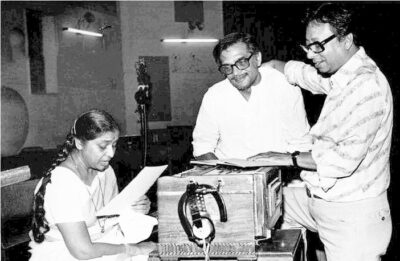
Asha Bhosle, Gulzar and RD Burman
Woh raat lauta do… mera woh samaan lauta do…
In Asha’s voice, this seemingly unstructured poetry acquired rhythm, emotion, and resonance. In collaboration with R D Burman, she transformed prose into a deeply felt musical experience, one that remains among her most celebrated renderings.
At the other end of the spectrum lay a space she claimed entirely as her own. While Lata remained discerning, particularly with cabaret-style compositions and suggestive lyrics, Asha embraced them with confidence and finesse. The result was a repertoire of enduring appeal – Piya tu ab to aaja, Yeh hai reshmi zulfon ka andhera, Yeh mera dil pyar ka deewana, Duniya mein logon ko, Hungama ho gaya, Aao na gale lagao na, to name a few.
Consider Aao na gale lagao na, picturised on Helen opposite Rajesh Khanna. Even in the absence of visuals, Asha’s voice conjures the entire scene, the allure, the seduction, the emotional undercurrent. Such was her command that she could evoke imagery purely through sound.
Perhaps this was her greatest strength, an ability to traverse extremes with equal authority, to inhabit every shade of emotion, and to render each genre distinctly her own.
Aao na gale lagao na (Mere Jeevan Saathi, 1972) RD Burman / Majrooh Sultanpuri / Asha Bhosle
Asha and Lata: Meeting on the same creative plane
While individual preferences may differ, it is perhaps fair to suggest that the sheer volume of outstanding songs rendered by Lata Mangeshkar may well surpass those of Asha Bhosle. Yet whenever both were given equal creative space within the same cinematic canvas, Asha stood firmly alongside her, often matching and, at times, subtly reinterpreting the emotional contour of a composition.
One is reminded of Samay o dheere chalo from Rudaali, composed by Bhupen Hazarika and rendered in distinct interpretations by Hazarika himself, Lata, and Asha. Listening to all three versions reveals a fascinating divergence in emotional treatment.
Bhupen Hazarika’s rendition carries a quiet, philosophical restraint, grounded and contemplative in its expression. Lata ji’s version, on the other hand, is steeped in pathos, her voice suffused with a deep, aching melancholy that draws the listener inward.
Asha, however, chooses an altogether different trajectory. She does not linger in sorrow; she moves through the moment with fluidity. Her expression is not weighed down by grief but shaped by a keen sensitivity to the situation, a kind of emotional immediacy that feels instinctive.
Yeh hawa sab le gayi,
karwan ke nishaan bhi uda le gayi
Udti hawaaon waale milenge kahaan,
koi bata do mere piya ka nishaan
There is no overt lament here, no surrender to despair. Instead, one senses a searching curiosity, an almost innocent inquiry into the workings of fate. She does not anticipate loss; she seeks to comprehend it.
It is this nuanced shift, this ability to inhabit the emotional moment with such clarity, that elevates Asha’s rendition into something truly exceptional, reaffirming her place alongside the finest interpreters of song.
Samay o dheere chalo (Rudaali, 1993) Bhupen Hazarika / Gulzar / Asha Bhosle
The young voice at 62
Who could have imagined that Asha Bhosle would one day lend her voice to the sensuous screen presence of Urmila Matondkar in Tanha Tanh? When A R Rahman emerged as a defining musical force of the era, he made a bold and instinctive choice in his very first Hindi film, Rangeela—he chose Asha.
At 62, when many would have settled into a defined legacy, Asha reinvented herself with astonishing ease. Her voice did not carry the weight of age; it carried the pulse of desire, the restlessness of youth. Such was her intuitive grasp of emotion that she seemed to absorb the character’s yearning as her own, her singing responding seamlessly to the visual narrative.
Her album Janam samjha karo went on to become a smashing hit. During our school days, it captured the imagination of every impressionable mind, effortlessly bridging generations.
Even later, Yash Raj Films turned to her voice for Le gayi le gayi in Dil To Pagal Hai. The song carried her signature playfulness, an impish, teasing energy that rose instantly and lingered.
Similarly, in Subhash Ghai’s Taal, her rendition of Kahin aag lage lag jaave, picturized on Aishwarya Rai, once again demonstrated her mastery over cinematic context. Even within a fast-paced composition, she brought out a deep undercurrent of pain.
Is toote dil ki peed sahi na jaaye
In that moment, it is as if Asha’s voice takes over the emotional burden, enabling the actor to express anguish with greater ease. Her singing does not merely accompany the scene; it completes it.
Le gayi le gayi (Dil To Pagal Hai, 1997) Uttam Singh / Anand Bakshi / Asha Bhosle
From 92 years to eternity.
The passing of Asha Bhosle at the age of 92 is not merely the end of a life; it is a moment of national mourning. Her contribution, spanning over eight decades, is so vast and layered that no words can fully encompass the magnitude of her work or the richness of her journey. And yet, in remembering her, one instinctively returns to the very song she gave us, Tum jiyo hazaaro saal, saal ke din ho pachaas hazaar, penned by Majrooh Sultanpuri. A song that, across generations, has become the voice of our blessings, our celebrations, and our quiet prayers for those we hold dear.
There is a rare joy in her rendition, an effervescence that makes the blessing feel immediate, almost as if it is being offered in that very moment. It carries the very essence of her name, Asha, a hope articulated with warmth and conviction, a heartfelt wish that those we cherish live long and well.
And perhaps, therein resides the deeper truth. While she may have lived 92 years in time, her voice has moved far beyond the boundaries of time itself. The sentiment of pachaas hazaar saal no longer remains a poetic exaggeration; through her songs, it assumes the character of a lived and lasting reality.
Tum jiyo hazaaro saal (Sujata, 1959 ) SD Burman / Majrooh Sultanpuri / Asha Bhosle
The song that never fell silent
She had once expressed a wish to leave this world while singing. And in a way, she did. Even at 92, the music within her had not dimmed; it remained vibrant, alive, and inseparable from her being.
Asha Bhosle’s life is best celebrated through her songs. Whenever one pauses, weighed down by thoughts or touched by a moment of quiet melancholy, I instinctively return to her voice:
Mud mud ke na dekh
Mud mud ke
Zindgani ke safar mein
Tu akela hi nahi hai
Hum bhi tere humsafar hain
Aye gaye manzilon ke nishaan
Lehraake jhuma jhuka asmaan
Lekin rukega na ye kaarawaan
There is something deeply reassuring in these lines, a gentle yet compelling reminder that life, despite its interludes and adversities, must continue its onward movement.
Asha’s own journey was marked by numerous personal and professional milestones, some triumphant, others exacting. Yet, through it all, her spirit retained a celebratory cadence.
Lehra ke jhuma jhuka asmaan… that image appears almost emblematic of her own journey.
Asha ji, the world pauses today, not in silence but in gratitude, to salute you for enriching countless lives with songs that will continue to resonate.
Mud mud ke na dekh (Shree 420, 1955 ) Shankar-Jaikishan / Shailendra / Asha Bhosle
(All images are sourced from publicly available internet sources unless otherwise credited)
More Must Read in Silhouette
Asha Bhosle: The Many Moods of a Matchless Voice
Kanan Devi: ‘The First Singing Star’

Whether you are new or veteran, you are important. Please contribute with your articles on cinema, we are looking forward for an association. Send your writings to amitava@silhouette-magazine.com

 Asha Bhosle: The Many Moods of a Matchless Voice
 Musical Rhythms of the Running Train
 Pioneering Experiments Which Became Trends: S D Burman and His Music (Part-I)
 ‘Deewana Mastana Hua Dil’ – Mesmerizing Music of SD Burman-Majrooh (Oct 1 Anniversary Special)
 The Composer and the Man of His Own Terms: OP Nayyar
 Salil Chowdhury: Creating Music ‘Outside the Rules’
Silhouette Magazine publishes articles, reviews, critiques and interviews and other cinema-related works, artworks, photographs and other publishable material contributed by writers and critics as a friendly gesture. The opinions shared by the writers and critics are their personal opinion and does not reflect the opinion of Silhouette Magazine. Images on Silhouette Magazine are posted for the sole purpose of academic interest and to illuminate the text. The images and screen shots are the copyright of their original owners. Silhouette Magazine strives to provide attribution wherever possible. Images used in the posts have been procured from the contributors themselves, public forums, social networking sites, publicity releases, YouTube, Pixabay and Creative Commons. Please inform us if any of the images used here are copyrighted, we will pull those images down.










































































A very comprehensive, very thoughtfully conceived and written, very beautiful essay on Asha
that leaves little to be said although it will take Volumes to say it all.
I love the song selections. Thank you.
Thanks Sir. I am feeling encouraged. I am happy to note that the article was able to engage you.
That was an absolutely flawless piece. You’ve captured her life with such grace and depth—especially the way you portrayed her remarkable journey into Bollywood, by sheer talent and her own style. A true legend, brought to life so beautifully through your words.
And the selection of songs…it’s just wonderful.
Thanks Sharmistha. Your appreciation is a shuge encouragement. In today’s time of instagram people do not have much time to read such long pieces. Thanks again.
Very comprehensively brings out Asha’s musical journey, its defining moments, its ascensions. The article engages and keeps one interested a little more as it internalises, inalienably, her connectedness and interface with her fellow artistes, her great sister, her emotional highs .
The song selection ditto es my favourites, and have been deconstructed with a literary flourish. Imageries are fabulous.
This write up can double as a short reference document on Asha.
Wow …I am gonna cherish your comment. In fact I am thankful for guiding me and giving the input for constructing the write up. I am feeling rewarded.
Your article beautifully captures the timeless brilliance of Asha Bhosle and Lata Mangeshkar. The way you highlighted their individual styles while also celebrating their shared legacy in Indian music was especially compelling. You brought out not just their achievements, but the emotion and cultural depth behind their voices, making the piece feel both informative and heartfelt.
The descriptions of their iconic songs and influence were vivid without being overwhelming, and your tone carried a genuine admiration that made the article engaging to read. It’s clear you put thought into portraying them not just as legends, but as artists who shaped generations of listeners.
Overall, it’s a thoughtful and well-crafted tribute that does justice to two extraordinary musical icons.
Ambika thanks for such an elaborate and wonderful comment. I am delighted that the write up was able to engage you. Your observations are spot on. Drawing comparison with Lata was important as they both were contemporaries and legendary sisters ofcourse.
What a tribute to Asha ji 👍
(Pls correct her date of passing)
Sir thanks . Glad you liked the write up. Thanks for pointing it out. Stand corrected.