Stay tuned to our new posts and updates!
Click to join us on WhatsApp


(Excerpted with permission from Pt 3 Ch 2, ‘Bharat Bhaag Hai Jaaga’ of Kadam Kadam: The Long March, a novel in Bengali by legendary author and screenplay writer Nabendu Ghosh, translated into English by Ratnottama Sengupta)
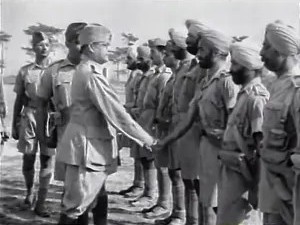
Netaji with the soldiers of the Azad Hind Fauj
Only two days had passed when we were summoned — by Netaji himself! We — Siraj, Abdul Ghani, Sansari Ram, Sibtey, Inder, Hari Ram, Mohd Yusuf who played the banjo with a single string; folk singer Yunus, and I — were ecstatic to hear this. We followed Captain Bhandari who had brought us the news, to reach Netaji’s bungalow at 11 am.
We found more people waiting to meet him. Barely ten minutes had elapsed when Netaji came and stood before us. We saluted him in the usual military manner. He acknowledged it with a return salute.
“I have come to know about your talents,” he said directly. “Who amongst you is Ram Singh?”
“Hujour, Netaji!” A Gurkha soldier stepped forward.
“Oh, it’s you!” Netaji smiled at him.
We had not seen Ram Singh Thakuri until this moment.
“You sing very well, Ram Singh,” Netaji said. “I used to listen to your programme in Berlin since you people used to sing national songs. I was very fond of them.”
Ram Singh saluted to express his joy.
Netaji continued to speak, “Vande Mataram is emotionally bewitching when sung. But it is not easy to render for one and all. So Hafiz, a poet-soldier amongst us, has composed a nationalist song on an easier score.”
A young man in his mid-30s stepped out of the waiting lot and saluted Netaji. He nodded in acknowledgement and asked, “Will you sing it for us now, Hafiz?”
“Ji, Netaji!” Hafiz cleared his throat to start singing. And we all stood in the posture we adopt when the patriotic Vande Mataram is played.
The song went thus:
Kadam Kadam badhaye jaa,
Khushi ke geet gaaye jaa,
Yeh zindagi hai qaum ki –
Tu qaum pe lutaye jaa…
March, march, ahead you go,
Singing a cheerful song,
This life is for your country, men!
Lay it down for countrymen…
Tu Sher-e-Hind aage badh
Marne se bhee tu na darr
Aasman tak uthakey sar,
Josh-e-watan badhaye jaa.
You’re Lion of India, go forward –
Scared of death, you never are!
Raise your head to touch the sky –
Inspire you will your countrymen.
Himmat teri badhti rahe,
Khuda teri sunti rahe,
Jo saamne tere padey
Tu khaak me milaye jaa.
Your courage’ll grow manifold
God will always be by you –
Every hindrance on your way,
Raze it to the ground, you will!
‘Chalo Dilli!’ pukarke,
Qaumi nisha sambhalke
Lal Qiley par gaarhke
Lehraye jaa, lehraye jaa…
With ‘Chalo Dilli!” – on your lips
Holding aloft the flag of your land,
On Red Fort you’ll unfurl it
To watch it fly ever so high!
Enchanted by the regimental song, we joined the fervour by raising the INA slogan, ‘Chalo Dilli!”
Kadam kadam badaye jaa (Bose: The Forgotten Hero, 2004)
***
Netaji would smoke a lot when he was engrossed in work. Not a single one at other times. He was ever ready for a cup of tea.
He was, at this time, extremely busy. Four or five meetings he would hold daily, with military personnel and civilians too. He was setting up cabinets in different locations. And wherever he went, we would be his guard. Consequently, we had no time of our own.
It was 1 in the night when we sat down, as instructed by Captain B Narayan, to discuss the score for Jana Gana Mana with Major Abid Hasan — who later added ‘Safrani’ to his name to indicate his ‘saffron’ heritage. This gentleman from Hyderabad had gone to Berlin as a student. There he had joined Netaji as his personal secretary. He accompanied Netaji in the submarine he travelled in from Kiel in Germany to Sumatra and then Japan. This very Abid Hasan was discussing Jana Gana Mana with us as we sat in a circle around him.
He was of a short stature, and wore a French-cut beard that imparted a distinguished look. He was sharp of intellect and had a humour-filled personality. He didn’t quite like the music we had scored to sing in Hindi the poem penned as Bharat Bhagya Vidhata. “It’s just not happening,” he was forthright. “It has no punch. You boys are soldiers. This song is to arouse you, it should fill you with zeal. Your blood should double the speed at which it courses in your veins.”
We refreshed our singing and tried again. This time, we gained his approval. “Yes, it works!”
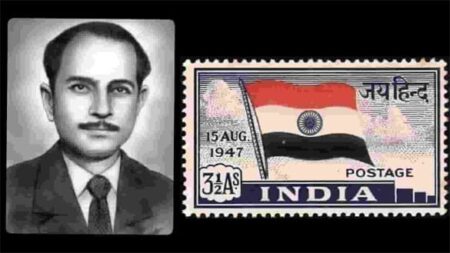
Syed Abid Hasan Safrani
We now circled him with a request. “Please tell us about Netaji’s journey from Germany to Japan! Please…”
“Don’t try to know everything right now,” Abid Hasan shook his head. “I’ll only tell you this: every minute of the three-month journey was full of danger. We could travel only at night — during the day we had to remain submerged in the Atlantic Ocean. Once by chance we surfaced, the riders in the enemy zone came full speed to ram us.
“But on that journey, I realised that, along with his motherland, Netaji has a great love for songs and music. There was hardly any space inside the submarine to spread out or relax. So he would be irked, exasperated. That’s when he would want even a hoarse voice like mine to break into a song. I had no option but to croak like a frog.”
He broke into a guffaw at his own joke. We joined in the laughter.
Then, under his guidance, Siraj and I voiced Jana Gana Mana in Hindi:
Shubh sukh chaen ki barkha barse,
Bharat bhaag hai jaaga!
Punjab Sindh Gujarat Maratha
Dravid Utkal Banga,
Chanchal sagar Vindhya Himalay
Neela Jamuna Ganga –
Tere nitt gun gaaye,
Tujhse jeevan paaye,
Har tan paaye aasha!
Suraj ban kar jag par chamke,
Bharat naam subhaga…
Jai Ho! Jai Ho! Jai Ho!
Jai Jai Jai Jai Ho!
Sab ke dil mein preet basaye teri meethi bani
Har subah ke rahne wale, har mazhab ke praani
Bhed aur farq mita ke, sab gode mein teri aake,
Guthey prem ki mala…
Suraj ban kar jag par chamke,
Bharat naam subhaga…
Jai Ho! Jai Ho! Jai Ho!
Jai Jai Jai Jai Ho!
Shubh saverey pankh pakheru Tere hi gun gaaye,
Sugandh bharii bharpur hawayein jeevan mein rut laaye.
Sab milkar ke pukarey Jai Hind ke naarey
Pyara desh hamara!
Suraj ban kar jag par chamke,
Bharat naam subhaga…
Jai Ho! Jai Ho! Jai Ho!
Jai Jai Jai Jai Ho!
We set it to music and rehearsed it along with those who would sing in the chorus. We were preparing it as the inaugural song for the day the Azad Hind Government would be formed.
Meanwhile, in the month of September a selection was made of the First Division soldiers to form the ‘Subhas Regiment’. At its head was Captain Shah Nawaz, a soldier from 1/14 Punjab Regiment. He was one of the foremost leaders of INA and he was devoted to Netaji.
***
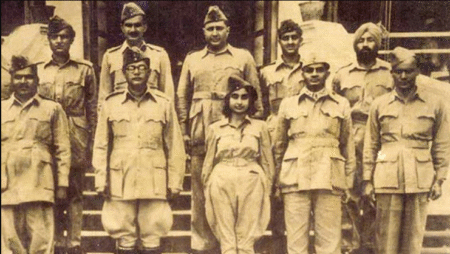
Capt Lakshmi Swaminathan, leader of the all-women Rani Jhansi Regiment with Netaji. Rani Jhansi Regiment was the only female combat regiment in WW2, on any side.
There were other developments. The struggle for freedom was not confined to men, women were equally keen and able to be in the fight. Only if they become part of it would the fight be complete. So an all-women regiment was established in July 1943. This only female combat regiment in WW2, on any side, it was named Rani Jhansi Regiment, after the warrior queen of 1857 rebellion against the British. Most of the cadets were young descendants of the Indian expatriates in South East Asia, majorly Malays of Indian origin. They were given the rank of non-commissioned officers. And they were led by Captain Lakshmi Swaminathan.
Like the training we had undergone, the ladies also had to undergo military and combat training. They had drills and marches. They trained to handle rifles, hand grenades and bayonets. A number of them were chosen for training in jungle warfare in Burma. Some were also chosen for nurses’ training.
***
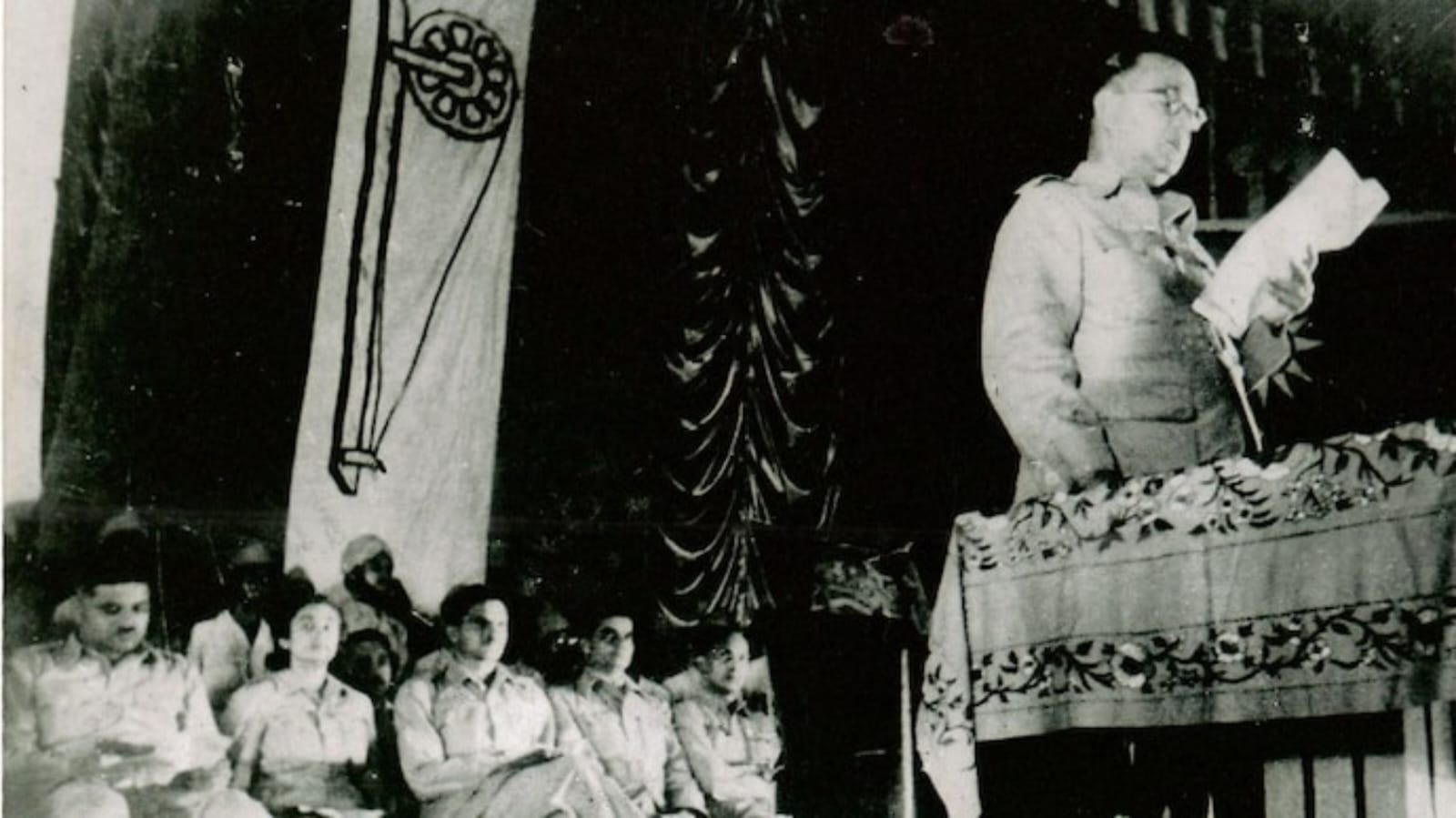
Netaji Subhas Chandra Bose proclaiming the establishment of the Provisional Government of Free India (Azad Hind Government), in Singapore on October 21, 1943.
On October 21, 1943, we again assembled in the Cathay Theatre of Singapore. Here, Subhas Chandra Bose announced that Azad Hind Sarkar, the Government in Exile he was establishing, would be a Provisional Government. It would give way to a permanent government elected by the Indian people once independence was achieved. He was confident of achieving this goal because he had the support of not only every Indian but also of a major section of the British Indian Army. This would not have been possible without the active support of Japan — so, as a token of its gratitude, INA would gift Japan ten fighter aircraft.
This announcement was greeted by resounding applause and cheering. “Long live Indo-Japan friendship!” they shouted.
Netaji further announced, “Henceforth every Indian of every religion, in every district on the soil of India, is a free citizen. This provisional government is the First Government of Independent India. This government will change when the people of India want to change it.”
Then he proceeded to name the members of the Cabinet. One by one, every member of the cabinet had to take an oath.
The oath-taking commenced with Netaji. “I, Subhas Chandra Bose, vow in the name of God that, for the unconditional freedom of India and 40 crore of my countrymen, I will carry on the struggle for freedom till the very last day of my life. I will dedicate every moment of my life to the service of the nation, and the well-being of my 40 crore brethren will be my foremost duty. Even after Independence, I will sacrifice the last drop of blood in my body to safeguard its sovereignty.”
While taking this oath, every now and then his voice was choking with emotion. He was even breaking into tears. And on witnessing this, Siraj, Inder and I also got misty-eyed.
Netaji was followed by Major General Jagannath Rao Bhonsle, Shah Nawaz, Meer Jamal, Mohammed Zaman Kiani, Col Rashid Ali, and Dr Lakshmi Swaminathan among others.
Shah Nawaz said, “We have various expressions for greeting in India – Namaste, Salam, Selam alaikum, Ram Ram, Good Morning… Instead of them, this day onward we will have only one greeting – Jai Hind!”
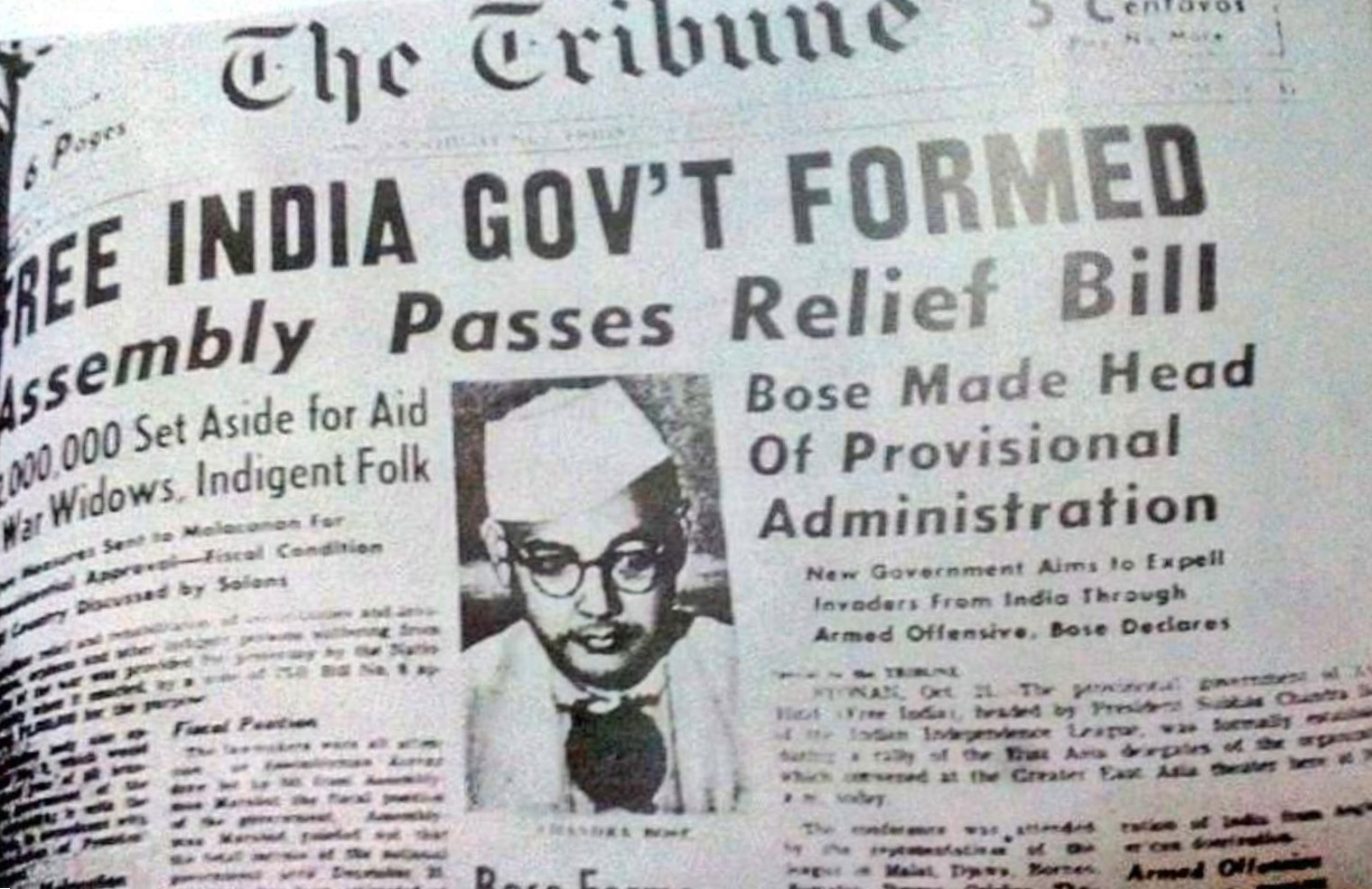
Front page news in The Tribune, October 22, 1943
At the end of the meeting everyone rose to their feet – and we sang the anthem of the nation.
O Ruler of the people’s mind,
Victory be to You, Bharat!
You’re the dispenser of our destiny.
Punjab Sindh Gujarat Maratha
Dravida-land,
Orissa, Bengal…
Vindhya mountains,Himalayan range,
Yamuna, Ganga, the frothing waves
Of the Seas and the Ocean —
They rise to the sound of your name
They seek your benign blessings
They sing the song of your glory.
You who impart well-being to people
May victory be forever yours, India!
You’re the dispenser of our destiny –
Victory! Victory! Victory!
Eternal Victory to You!
***
That night, we were sitting outside our barracks. Inder broke the silence with this observation, “How fortunate that we became slaves of the British rulers and came to fight their war! How else would we have got this golden opportunity to drive away the rulers!”
“Yes, we will return to an independent India,” Siraj added.
“When?!” Sibtey could not contain his excitement. “When will we see that day?”
“The dawn of that day is at our threshold,” I said, “if I may echo Rabindra Nath.”
“Who Rabindra?” Abdul Ghani had no idea.
“You don’t know Rabindra Nath?!” I was stunned. “Tagore got the Nobel Prize for his poems in Geetanjali!”
“Oh, Ta-Gore Saab!” Abdul Ghani laughed out. “Yes, I’ve heard of him!” Then he looked at me, “Pardon me Shankarji, I interrupted you.”
“Bharat aabar jagat sabhay, Shreshtha aasan labey!” I recited the lines to say, “India will again rise to claim its seat at the high table of nations!”
“Waah! Doubtless!” Abdul Ghani clapped his hands.
“And, no nation can claim shresthattva, greatness unless it is Independent,” Siraj commented.
“Beshaque!” Sibtey too clapped in agreement. “Without a spec of doubt!”
“And all this is happening thanks to one person: Netaji!” Siraj was clear in his mind.
“In the garb of a human, Netaji is Kumar Kartik, the commander of the gods in warfare,” I voiced what has been in my thoughts so far.
“Well said, Shankar!” – Inder nodded in appreciation.
Sibtey stood upright and saluted, military style. “Long live Netaji!” he cried out.
“Netaji Zindabad!” we echoed, standing upright. And then we started to sing –
Kadam kadam badhaye jaa…
March, March ahead,
With a song on your lips…
This life is for the country, men
Lay it down for your countrymen…
We concluded unanimously with the slogan — Chalo Dilli! Onwards to the Red Fort!
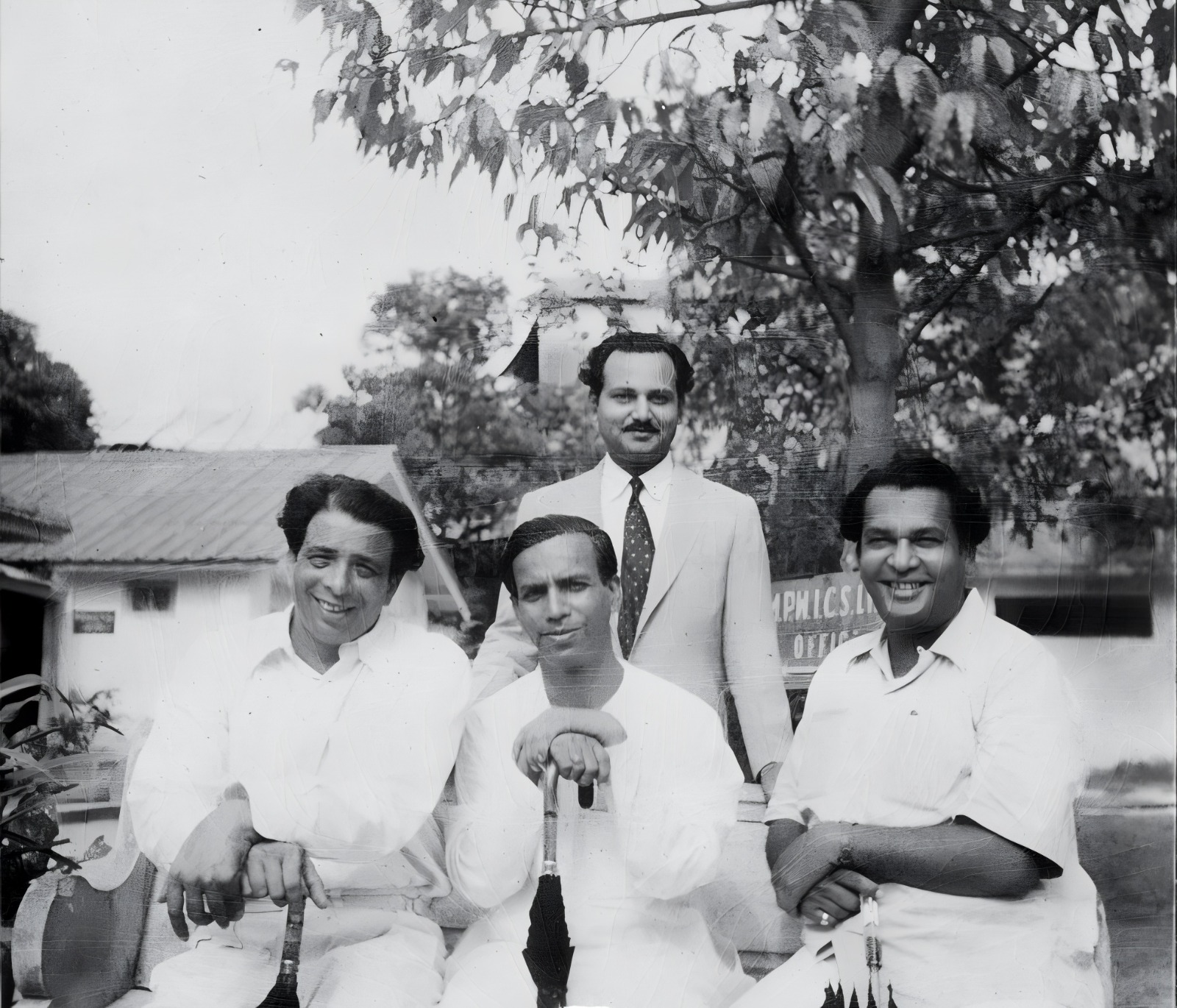
Actor Nazir Hussain (a Prisoner of War who joined the INA under Netaji), Nabendu Ghosh and actor-comedian Asit Sen (Pic: Rare photo from family collections of Ratnottama Sengupta)
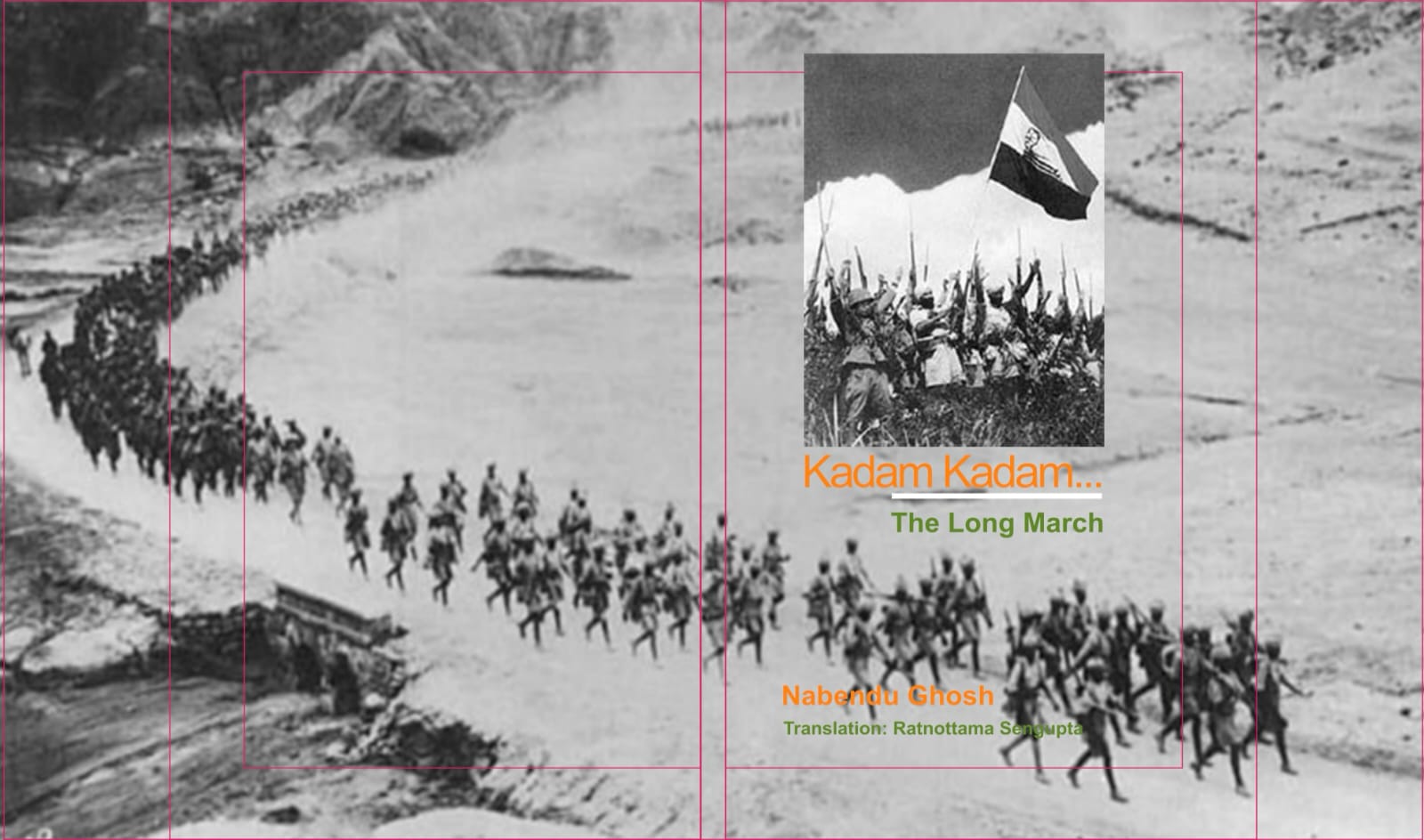
Kadam Kadam: The Long March – a novel by Nabendu Ghosh on the INA
Kadam Kadam: The Long March
Nabendu Ghosh
Translated by: Ratnottama Sengupta
Book Cover Designer: Ronnie Gupta
Publisher: Tagore Society, Singapore
Editor: Himani Swami
Launched in Singapore on January 28, 2026
More Must Read in LnC-Silhouette
Nazir Hussain, the INA and the Long March of Kadam Kadam
Ba: The Forgotten Mother of the Nation