Stay tuned to our new posts and updates!
Click to join us on WhatsApp


A few poems to offer a glimpse into the emotional and thematic range of the poem collection For You the Call of Thousand Birds by Shiladitya Sarkar.
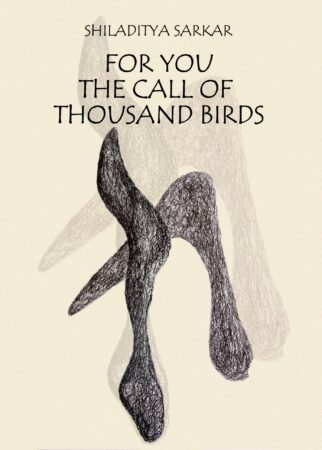
For You the Call of Thousand Birds by Shiladitya Sarkar
For You The Call of Thousand Birds is a deeply reflective poetry collection that moves between the intimate and the collective, tracing emotional landscapes shaped by memory, longing, and quiet introspection. The poems do not follow a single narrative; instead, they unfold as fragments of lived experience, where personal symbols intersect with shared human emotions.
There is a certain stillness in these pages. Everyday moments, often overlooked, are rendered with striking sensitivity, allowing the reader to pause, observe, and engage with the subtleties of inner life. The collection invites you to sit with discomfort, beauty, and contradiction, all at once, making it as contemplative as it is evocative.
From the quiet mundanity of Day’s end task to the piercing introspection of Her inquiry, from the visceral intensity of Eclipse & love to the expansive, almost surreal reflections in The city I am calling from, each piece reflects a distinct yet interconnected voice.
Together, they embody the essence of the collection, where the personal becomes universal, and where silence often speaks as loudly as words.
Last night, the city landed on my palms.
Sitting on a staircase, I skimmed its contours like a love-smitten Radha. I journeyed into its evil lair like a trained jockey. Like Satyabati, I carried its whiff to the gates of doom. I wanted to crush it like a tube of toothpaste.
Under the night sky of July, the giant city slept beside me. Snuggling up to the blemishes on its walls, I watched the stars, neon lights, and heard a cat yowling on my neighbour’s roof.
Alone, like asteroids, like a prowling tiger, like dew drenching a blade of grass, like us, images framed themselves. Pictures traded places. The naked, profound city lay in my cupped palms, too exposed for me to make it my home.
I looked for people. I wondered if a wayward screech would have helped to spotlight the wounds festering in sanatoriums and sanctuaries.
Then, I saw the enrolled faces on my palms.
Slowly, some reclaimed what they had given me before: myths, blackouts, impressions, and cold tongues. Some overturned the ritual pot and made new designs. Some hummed a fitting tune for the bright July night. But many stayed within their Lakshman-rekha—the primordial circle of fear no one should breach.
I urged them to step out and run wildly together.
They repeated: “Fables warned us to stay put.”
They said, “We fear the bite of faceless dreams.”
Beside hollow houses, near street corners, shadows embrace. Within our irises, another spring slips into coma. Before a final hurrah, the metropolis seethes, burning my angels, my books, and my little city within me.
Nothing much.
Only soaked tissues in
used coffee mugs.
After Avira departed,
leaving behind a whiff of
perfume,
the destitute poet bent over
his broom stick
to spruce up the clutter
in the company of a
cockroach.
Do you feel guilty
for having abandoned a basket of berries at the
feet of forbidden wants?
Her inquiry splits me open.
The berries remain untouched
for the sun to make them rotten.
A gift for scroungers.
On the day of the solar eclipse, my body erupted. Behind shuttered windows, I lacerated while the moon, sun and earth played out their magic in the open. The whole neighbourhood was glued to the celestial splendour. People stood transfixed on different terraces, looking at the sky through dark glasses or handmade eye protection gear, as the moon casts an evening shade all about the neighbourhood at eleven in the afternoon.
My room by then had become saturated with colours more blinding than sunlight. My body moved, first with the slowness of a clock whose battery had slackened, and then with the speed of a car freed from a bottleneck. The inferno inside me swelled like a bad tumour, and loud voices skittered through my veins. Outside, the moon split away from the path of the sun, and neighbours bade a thunderous goodbye while hooded figures arrived at my door. I fled past them with the swiftness of meerkats, rushing into a burrow before I could be cornered by them to confess the curves of embrace in times of an eclipse.

Day’s end task – a poem from For You The Call of Thousand Birds
For You the Call of Thousand Birds explores a multitude of presences and voices that influence the course of a personal journey, fostering a symbiotic relationship between the individual and the collective, as well as between personal symbols and shared expressions of emotion. Consequently, the homage is not aimed at a singular individual or a mere expression of fondness. One embodies many, and many collectively embody one.
The essence of the book lies in its subtlety rather than in any overt artifice. It weaves together elements of mythology, unexpected shifts in imagery, and the incorporation of contemporary experiences, often accentuated by a playful tone or profound introspection.
This work serves as a narrative of love, rupture, disorientation, and the transformation of both self and community. The author, also a visual artist, merges artistic insight with narrative voices throughout the book, creating a distinctive aspect of its overall design. The visuals are not intended to guide the reader but rather to suggest what may be felt beyond the written word.
For You the Call of Thousand Birds
Author: Shiladitya Sarkar
Genre: Poetry
Binding: Hardcover (5″ x 8″)
Pages: 162 pages
Published: Virasat Trade, 30 July 2024
ISBN: 978-93-92281-96-9
Insignificant: Poetic Reflections on the Vast Cosmos and Self
Rabindranath Tagore and India’s First Electrical Recording


Got a poem, story, musing or painting you would like to share with the world? Send your creative writings and expressions to editor@learningandcreativity.com
Learning and Creativity publishes articles, stories, poems, reviews, and other literary works, artworks, photographs and other publishable material contributed by writers, artists and photographers as a friendly gesture. The opinions shared by the writers, artists and photographers are their personal opinion and does not reflect the opinion of Learning and Creativity- emagazine. Images used in the posts (not including those from Learning and Creativity's own photo archives) have been procured from the contributors themselves, public forums, social networking sites, publicity releases, free photo sites such as Pixabay, Pexels, Morguefile, etc and Wikimedia Creative Commons. Please inform us if any of the images used here are copyrighted, we will pull those images down.