Stay tuned to our new posts and updates! Click to join us on WhatsApp  & Telegram
  Channel
& Telegram  Channel & Telegram Channel




A lyrical portrait of Salil Chowdhury, this article journeys through his revolutionary beginnings, his seamless fusion of Western and Indian music, immortal film songs, deep artistic friendships, and a legacy that transcends language, era, and genre in Indian cinema.

Salil Chowdhury with Manna Dey (Pic: Facebook)
“Since my childhood, I grew up listening to Western classical music. My father was very fond of Western classical music, and he had a very big collection of symphonies. My father was also a good musician despite being a physician. We used to love Indian classical also… we had collections of Fayaz Khan, semi-classicals like KC Dey… I have been hearing them since I was just 4 years old. So this has gone into my blood, that is why these symphonies are there, I don’t consider them as foreign because I grew up with them,” Salil Chowdhury had recalled in an interview to Mrutyunjay Kumar Jha, a prominent broadcast journalist1.
Spending his childhood at a tea estate in Assam, where his father was a doctor, Salil listened to and absorbed the fantastic selection of Western classical music his father had. His father used to stage plays and musical events with the workers in the estate, and Salil imbibed the beautiful music of the North East, as well as Rabindra Sangeet.
Salil was exposed to India’s Freedom Struggle, the tragic Bengal famine, and the Peasant Movement very early, when he was still young and impressionable. He was thus deeply influenced by Communist ideology. This was during the British regime, and a warrant was issued for his arrest. He went underground among the paddy fields of the Sundarbans with the help of local peasants but used this period productively to develop his writing for plays and songs, while soaking in the music of the land.
For eight years, until 1953, when he moved to Bombay, he worked in several Bengali films as a composer. His script for a Bengali film about a peasant dispossessed of his land, forced to migrate to Calcutta and suffer hardship there, attracted the attention of ace director Bimal Roy. Roy then sought to make a film in the style of Vittorio De Sica’s Bicycle Thieves, presenting parallel cinema as a healthy alternative to the glitzy, garish commercial cinema. This movement was gaining ground in West Bengal and was later elevated into a cult art form by Satyajit Ray in his Bengali films of the mid-1950s.
Bimal Roy invited Salil to join him in Bombay to adapt his Bengali script into a Hindi film, Do Bigha Zamin. While the story’s basic skeletal idea is attributed to Rabindranath Tagore, it was substantially transformed and expanded for the screen by Salil Chowdhury. After a few twists and turns, Salil found himself in Bombay, not only as a story writer but also making his dream debut as a music composer in Hindi films with Do Bigha Zamin. The film’s songs and music won several awards and were widely acclaimed, firmly establishing Salil as a successful music director in Bombay.

The Indian Delegation in Moscow, 1959 (Third from L to R) Nargis, Bimal Roy, Nirupa Roy, Salil Chowdhury, Hrishikesh Mukherjee and Radhu Karmakar (in front)
In the Hindi film music milieu of the early 1950s, when Salil arrived in 1953 to make his mark, composers such as Anil Biswas, Naushad, Vasant Desai, C. Ramchandra, S D Burman, Shankar Jaikishan, Madan Mohan, and Roshan were already firmly established, each known for a distinctive musical style and for films that succeeded largely on the strength of their music alone.
Into this competitive world stepped Salil with memorable scores for films such as Do Bigha Zamin (Dharti kahe pukaar ke), Biraj Bahu (Mere mann bhula bhula), Naukri (Chota sa ghar hoga), Parivar (Jhir jhir jhir jhir badarwa barse and Jaa tose nahin boloon Kanhaiya), Taangewali (Halke halke chalo sanware), Jagte Raho (Zindagi khwab hai and Jago Mohan pyare), and Ek Gaon Ki Kahani (Talat Mahmood’s delectable Raat ne kya kya khwab dikhaye and Jhoome re neela ambar jhoome, dharti ko chume re).
Jaa tose nahin bolu Kanhaiya (Parivar, 1956) Salil Chowdhury / Shailendra / Lata Mangeshkar, Manna Dey (based on Raaga Hamsadhwani)
Salil followed these with a succession of musical gems such as Madhumati, Parakh, Usne Kaha Tha, Char Diwari, Chaaya, Kabuliwala, Maya, and several other films. There was no stopping him thereafter.
The songs that he created, besides being excellent, catchy, and hummable tunes that appealed to filmgoers, successfully incorporated his learning, imbued from the vast range of Western classical music he had absorbed in his youth. His creations may have sounded somewhat complex to the average listener’s ear, but they possessed a sweet charm of their own. One could clearly notice that, while the vocal passages of his songs were deeply appealing, he boldly experimented by introducing a wide range of Western musical forms and instruments into the preludes and interludes, seamlessly blending them with the folk music of India and the West. He was, in effect, a master of fusion music long before the term itself entered the vocabulary of Hindi cinema.
It is this Western influence that comes through in songs such as Itna na mujhse tu pyaar badha (Talat Mahmood and Lata Mangeshkar), Aha rimjhim ke yeh pyare pyare geet liye (Talat Mahmood and Lata Mangeshkar), Mere khwabon mein khayalon mein (Mukesh and Lata Mangeshkar), Aankhon mein masti sharab ki (Talat Mahmood), and many, many others. (Salil was accused by some of having copied Mozart’s Symphony No. 40 in G Minor for Itna na mujhse tu pyaar badha. However, if one listens closely, the resemblance is limited to the introductory notes. It is clearly an inspiration rather than a note-by-note imitation, and the melody soon veers into a distinctly Salil idiom. The slower, sad solo version sung by Talat is equally beautiful.) Or the songs of Maya (1961) – Tasveer teri dil mein, jis din se utari hai (Lata and Rafi), Ja re ja re ud ja re panchi (Lata) and Ae dil kahan teri manzil (Dwijen Mukherjee, sounding remarkably like Hemant Kumar and a superb use of the chorus as part of the rhythm).
Aha rimjhim ke yeh pyare pyare geet liye (Usne Kaha Tha, 1960) Salil Chowdhury / Shailendra / Lata Mangeshkar, Talat Mahmood
And yet, when the occasion demanded, he was equally capable of creating music of great sensitivity and restraint. Listen to Mere khwabon mein khayalon mein chupe, man ke meet mere (as well as the other songs mentioned above) and note the sudden take-off into Western, chorus-driven interludes. Then listen to Kahin door jab din dhal jaaye, Maine tere liye hi saat rang ke sapne chune, and Na jiya laage na from Anand. Or consider Jaane mann jaane mann and Na jaane kyon hota hai yeh zindagi ke saath from Chhoti Si Baat. Or his songs from Mere Apne, Rajnigandha, Kaala Patthar, and many others.
Na jiya laage na (Anand, 1971) Salil Chowdhury / Yogesh / Lata Mangeshkar
Equally remarkable is Guzar jaayen din din din, ke har pal gin gin gin from Annadata (1972), a song for which Salil insisted that Kishore Kumar alone should sing. The composition was so complex that even Kishore had to record eighteen takes before the final version was approved. Similarly, Koi hota jisko apna, hum apna keh lete yaaron from Mere Apne (1971, lyrics by Gulzar) was rendered by Kishore with extraordinary pathos and depth. It is hard to believe that the composer of all these diverse and distinctive songs was one and the same Salil Chowdhury.
Koi hota jisko apna (Mere Apne, 1971) Salil Chowdhury / Gulzar / Kishore Kumar
Salil’s immensely valuable contribution to Madhumati, which won two Filmfare Awards for Best Music and Best Female Playback Singer for Lata Mangeshkar, cannot easily be measured. However, it was the song picturised on Johnny Walker, who won the Filmfare Award for Best Supporting Actor, that made Jangal mein mor nacha kisne na dekha an inseparable and memorable part of Madhumati, a film already enriched with superb music, mystery, brilliant performances, and evocative locations. When one recalls Madhumati, one inevitably also remembers Johnny Walker and Jangal mein mor nacha, along with the award-winning Aaja re pardesi. I consider this performance, much like Sar jo tera chakraye from Pyaasa, to be among Johnny Walker’s finest.
Jangal mein mor naacha (Madhumati, 1958) Salil Chowdhury / Shailendra / Mohd Rafi
Salil held Lata Mangeshkar in the highest regard and was deeply committed to her voice for rendering his compositions. Among male singers, he strongly favoured Mukesh, who sang most of his songs, and to a slightly lesser extent, Talat Mahmood. He used Mohammed Rafi, Manna Dey, and Kishore Kumar sparingly. Nevertheless, whenever he did turn to these three singers, he created outstanding compositions that made astute use of their individual strengths, resulting in songs of exceptional quality.
In the same interview with Mrutyunjay Kumar Jha, cited earlier, Salil spoke about singers and recalled his creation of a song specifically for Dilip Kumar. Here is his revealing observation about the song and Dilip Kumar’s experience of singing it: “You know, Dilip Kumar’s only Hindi film song was my composition for the film Musafir (1957). It was a duet with Lata. He was extremely nervous and moved to tears. The song was Lagi nahi choote rama, chahe jiya jaye. It was a thumri. After that, Dilip never sang again. In fact, Dilip sang the song quite well, despite his awe at singing a duet alongside Lata.”
Laagi naahi chhoote Rama, chaahe jiya jaaye (Musafir, 1957) Salil Chowdhury / Shailendra / Dilip Kumar, Lata Mangeshkar
Salil also shared an interesting insight about Aaja re pardesi. He explained that the tune was first used as background music in Jagte Raho, in a scene where Raj Kapoor repeatedly tries to drink water but is thwarted each time. To convey his helplessness and unquenched thirst, Salil used this tune in the background. Later, Shailendra suggested developing the tune into a full song for Madhumati. It was then that Shailendra wrote the opening line of Aaja re pardesi.
Salil was held in very high regard by his peers. Jaikishan, of the Shankar Jaikishan duo, used to refer to him as “The Genius”. Raj Kapoor once remarked, “He can play almost any instrument he lays his hands on, from the tabla to the sarod, from the piano to the piccolo.” Salil was exceptionally perceptive in recognising musical talent in others, and once said of Ilaiyaraaja, who was then a guitarist in Salil’s musical troupe, “I think he is going to be the best composer in India.” This was long before Ilaiyaraaja had begun composing independently. A R Rahman, too, has acknowledged that his musical understanding was greatly influenced by the musical sessions conducted by Salil Chowdhury. On learning of Salil’s passing in September 1995, Naushad observed, “He was the composer of composers; with his death, one of the seven notes of music has been lost.”
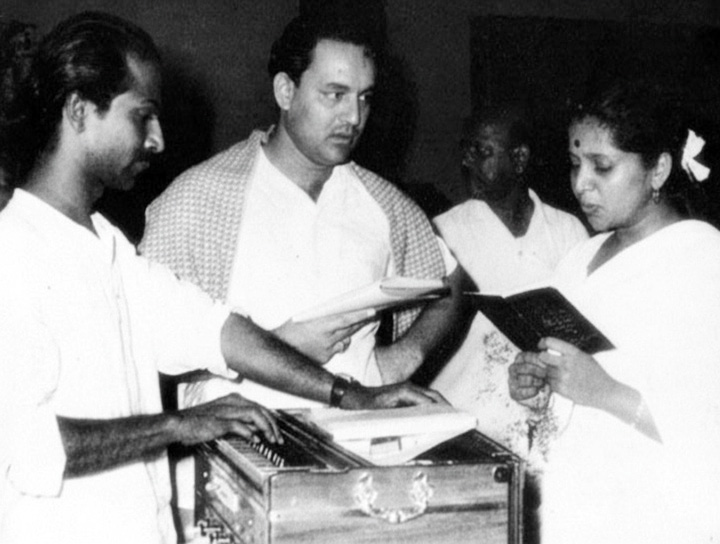
Salil Chowdhury with Mukesh and Asha Bhosle
Lata Mangeshkar, who sang some of Salil’s most complex compositions with apparent ease, said in an interview, “Over the course of my life, I have worked with over a hundred music directors. Of these, perhaps only ten truly understood both music and cinema. And among those ten, Salilda was the foremost.” This naturally and unmistakably places Salil Chowdhury at the very top.
Salil had deep affection and regard for R D Burman. In turn, R D Burman considered Salil Chowdhury his guru and would often approach him for guidance on musical arrangement. Chowdhury, who was fourteen years older, regarded Pancham as a younger brother. When Pancham passed away at the age of fifty-four on January 4, 1994, a heartbroken Salil found it impossible to accept the news of his untimely demise. That night, after returning home from the crematorium, he wrote an elegy for Pancham that was never revealed to anyone. This account is drawn from Tribute to Salil Chowdhury with His Elegy on Pancham by Priyanka Das Gupta, quoting singer Antara Chowdhury, Salil’s daughter, published in The Times of India on September 4, 20222.
True to being a salt-of-the-earth figure, Salil once drew a parallel with Bengal’s passion for football to describe himself. He said, “Take the game of football. All the rules are there, yet there is a player like Pele who produces something outside the rules, even while remaining within them. I am that Pele in music.”
Spanning 75 Hindi films, 41 Bengali films, and 27 Malayalam films, besides several films in other languages Salil Chowdhury’s music transcends language and era, marking him as one of Indian cinema’s most extraordinary composers.
References:
1. Tribute to a Legend: In Conversation With Salil Chowdhury in ’91
2. Tribute to Salil Chowdhury with his elegy on Pancham
(All pictures are courtesy Google Image Search)


Whether you are new or veteran, you are important. Please contribute with your articles on cinema, we are looking forward for an association. Send your writings to amitava@silhouette-magazine.com

 Salil Chowdhury: The Unpredictable Genius
 Salil Chowdhury – A Continuum of Art
 ‘She is Capable of Delivering Anything a Music Maker Can Think Of’ – Salil Chowdhury Speaks About Lata Mangeshkar
 Apni Kahaani Chhod Ja: Leave a Story That Will Be Retold
 Rahe Na Rahe Hum: ‘Mahanayika’ Suchitra Sen’s Aura Lingers On…
 Madhumati: Salil Chowdhury’s Magnum Opus in Hindi Cinema
Silhouette Magazine publishes articles, reviews, critiques and interviews and other cinema-related works, artworks, photographs and other publishable material contributed by writers and critics as a friendly gesture. The opinions shared by the writers and critics are their personal opinion and does not reflect the opinion of Silhouette Magazine. Images on Silhouette Magazine are posted for the sole purpose of academic interest and to illuminate the text. The images and screen shots are the copyright of their original owners. Silhouette Magazine strives to provide attribution wherever possible. Images used in the posts have been procured from the contributors themselves, public forums, social networking sites, publicity releases, YouTube, Pixabay and Creative Commons. Please inform us if any of the images used here are copyrighted, we will pull those images down.






















































What a scholarly write up. Numero Uno Sir
Thank you, Sunilji. Glad you liked it.
Pingback: Carnival of Blogs on Golden Era of Hindi Film Music – Volume XIV – January 2026 Edition – The world is too small? or Is it?