Stay tuned to our new posts and updates!
Click to join us on WhatsApp


Intentional parenting isn’t always about preparing children for a distant future. Sometimes it’s about protecting the small, quiet habits that shape who they become. Sitting beside a child with a book, turning pages together, feels like one such habit.
And just like that, January is over, and we are already into the second month of 2026. I didn’t make any big promises to myself when the new year began. No resolutions written down, no lists pinned to the fridge. I only knew that I didn’t want to rush. I wanted to move slowly, to do one thing at a time, and to be present for it.
The world around us doesn’t really allow for slowness anymore. Everything moves fast: news, opinions, trends, even childhood. Some days it feels like we are all running just to keep up, trying not to fall behind.
I started a few new books, and most of them still sit in what I call my ‘am reading’ category. I pick them up when I find a few spare minutes, sometimes early in the morning, sometimes late at night. I read depending on my mood, my energy, and how the day has unfolded.
Some of my thinking around reading has also been shaped by watching my child grow. Parenting has a way of quietly rearranging your priorities. Things you once did only for yourself begin to matter for different reasons.
You start asking small but persistent questions. What habits will stay with them? What will they carry forward without realising it? In a world filled with screens, speed, AI, and constant stimulation, I’ve been wondering what it means to offer something slower, something that asks for patience.
That question is what led us to books.
We started with one book I felt my 10-year-old might enjoy: Notebook and Other Stories by K. Shivalingappa Handihal. I made a conscious effort to read it with him, not just hand it over and hope for the best.
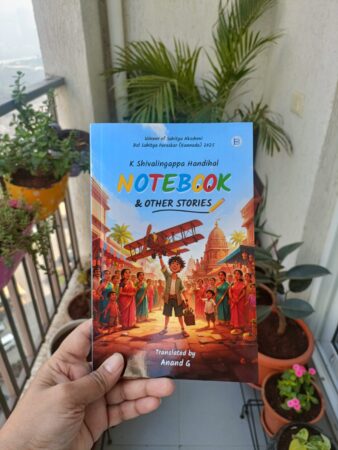 Some days, he read a few stories on his own. On other days, usually at bedtime, we lay down together and I read aloud. After each story, we paused for a bit. We talked about what he felt, what he liked, and sometimes what confused him. There was no need to arrive at the “right” interpretation. The conversation itself felt like the point.
The book helped in small but meaningful ways. The pages are colourful. The cover is inviting. The stories are short, warm, and gently curious. And that mattered. It kept him interested enough to come back, to pick it up again.
These are stories set in rural India. Stories of ordinary children navigating everyday life with courage, humour, and quiet resilience. The characters live in worlds my son hasn’t experienced and may never directly experience. And yet, through these stories, he could step into their lives, even if only briefly.
One story, The Dream That Came True, made him pause. It follows Thimmaraju, a village boy who longs to go to school but cannot. He has no parents and his care-taker uncle wants him to work in the fields instead. So the boy does what he can. He stands in the queue for school uniforms. He peeks into classrooms and listens to lessons from outside the window.
There’s a teacher, Shivanna Sir, who appears across many stories. In this one, he notices. He intervenes. He pays the fees and brings the child into school. When we finished reading, my son didn’t move on right away. He sat with it for a while. Then he told me that Shivanna Sir did a very good thing by letting Thimmaraju into the school. He spoke about fairness, about how education can open doors for a child. What struck me was how clearly he saw it, how one adult’s decision had changed the entire course of a child’s life.

The Day the Cloud Came Down
Another day, I found him laughing out loud while reading. I asked him what it was about. He told me about a story titled The Day a Cloud Came Down. The protagonist, Arun, panics when he looks at the clock in the morning and realises he might be late. My son laughed and said it felt like the story was written about him. It was one of those small moments where a book stops being something you read and becomes something you recognise yourself in.
Another story introduced him to Khushi, a young girl who stays home to care for her younger sibling while her brother goes to school. Again, a reality unfamiliar to him. Again, a quiet conversation followed.
This is the quiet power of reading.
Books allow children to encounter complexity without being overwhelmed by it. They build empathy without demanding lived hardship. They expand a child’s understanding of the world gently, one story at a time.
I’ve also learnt something about reading itself during these weeks. While my son can read independently, he doesn’t always want to, not yet. Sometimes he needs me beside him. Sometimes progress happens not through ability but through companionship.
In an age of micro-content and shrinking attention spans, reading together needs to be more intentional than ever. It asks children to slow down, to sit with a story, to follow a thought from beginning to end.
And perhaps more importantly, it teaches them that focus is something worth cultivating.
Intentional parenting, I believe, isn’t always about preparing children for the future. Sometimes it’s about protecting the small, quiet habits that shape who they become; habits that cultivate patience, attention, curiosity, and empathy.
Author: K Shivalingappa Handihal
Publisher: Blue Pencil 2026
Price: ₹349
Available on: Amazon | Blue Pencil
More Must Read in LnC
Book Review: Almond – A Novel by Won Pyung Sohn
The Currency of Trust in Effective Parenting
Insignificant: Poetic Reflections on the Vast Cosmos and Self