Stay tuned to our new posts and updates! Click to join us on WhatsApp  & Telegram Channel
 & Telegram
  Channel & Telegram Channel




Nabendu Ghosh’s adaptation of Phaniswar Nath Renu’s ‘Maila Anchal’ promised to be a remarkable film. It starred Dharmendra and Jaya Bhaduri in the lead roles. And 75 percent of the shooting had been completed. Yet Dagdar Baboo remained unfinished…
Ratnottama Sengupta translates pages from Nabendu’s autobiography Eka Naukar Jatri (Journey of a Lonesome Boat) revealing the little-known saga of the film that never reached the screen, illustrated with exclusive, unseen photographs from her collection. A special Silhouette tribute on Dharmendra’s birth anniversary.
In the early 1960s an anthology of Hindi stories, Aath Lambi Kahaniyan came into my hands. I read all the eight stories. The best, to me, was one by a new name: Teesri Kasam Urf Maare Gaye Gulfam. Seldom had I come by any writing with so much fidelity to lived life.

Nabendu Ghosh
I learnt that the writer had already won recognition for writing a novel that voiced the reality of contemporary rural India. It radically changed the narrative styles that prevailed in earlier Hindi novels. This would later secure him the national honour of Padma Shri, and he would be credited for bringing the regional experiences of Bihar into mainstream Hindi literature. But all these are later developments. That novel was Maila Anchal.
That very evening I made a trip to Dadar to procure a copy of Maila Anchal. It was an amazing piece of literature. Breath-taking in its sweep and breathing in its personas. It was a gallery of full bodied characters sketching a chiaroscuro of emotions – love, hatred, envy, violence, greed, prejudices, and politics. Congress, Communist, Socialist, Hindu Mahasabha: an unmapped village in a small pocket of Purnea district was mirroring all of Bihar – indeed, all of India. I was captivated. And I resolved to bring the novel on screen – as a director.
But that proved a challenging task. I had to upset many an applecart.
One day Phani Majumdar called me. “If you transfer the rights to me, I have a producer willing to invest in the film.”

‘Maila Anchal’ by Phanishwar Nath Renu (Pic: Amazon)
“Not possible Phani Da,” I politely refused to do that. “Munshiji will not agree,” I added. (Phani Da directed Bhaiya in 1961 and later Kanyadaan, in 1965. I had scripted both which were the first films respectively in Magadhi and Maithili languages. After Kanyadan Phani Da directed Toofan Mein Pyar Kahan for the same producer S H Munshi who had crafted a string of successes with Kafila directed by Arvind Sen and Baap Beti directed by Bimalda – both based on my stories. And, Renu had penned the dialogues for Kanyadan.)
Another day Bimalda said to me, “Paul Mahendra mentioned that this novel by Phaniswar Nath Renu is terrific. Will you give me the rights to film it?”
“Excuse me Bimalda,” I shook my head. “I have decided to direct it.”
A colleague of ours, and Bimalda’s assistant Raghunath Jhalani had turned director and gained eminence (with Aaye Din Bahar Ke, 1965). He sent an emissary to Renu saying, “I will make a success of Maila Anchal if you sell the rights to me.”
Self-serving comes in many shades.
******
Meanwhile two developments overtook my life. Scouting for stories that would be worthy of Bimalda I tumbled upon Tamasi, a riveting novel by Jarasandha. The name is highly regarded in Bengali literature for Louha Kapat. The writer had been a jailor and seen at close quarters the life behind iron bars.

Jarasandha’s ‘Tamasi’ was adapted on screen as Bandini, starring Nutan, Ashok Kumar and Dharmendra
This novel Tamasi was about a woman who was convicted for poisoning a patient in the hospital where she was working as an ayah. The minute I finished reading it, I handed it to Bimalda.
He too was enthralled by Tamasi. “Please go to Calcutta and acquire the rights to film it,” Bimalda directed me. “Once you agree on a figure I will send the amount.”
Jarasandha was a pen name used by Charu Chandra Chakraborty. A perfect gentleman, courteous and erudite, he happily gave the filming rights to Bimal Roy Productions.
I had to work real hard to visualise for screen the multi layered love story. Set against the backdrop of the Nationalist movement of the 1930s, the film was titled Bandini, Prisoner. Cast in the title role was Nutan, who had charmed the world as Sujata in Bimalda’s earlier production.
“Dada Namaskar!” Nutan sweetly greeted me with her winning smile.

Talent contest photo of Dharmendra
Tarun Bose, who was Nutan’s foster father in Sujata, would play the jailor now. And Dharmendra, a young aspirant who had aced the Filmfare All India Talent Contest in 1958, was cast as the Doctor of the jail who comes to love the polite, soft spoken, ever-benign murderess. However, the real hero of the script was Ashok Kumar, the Nationalist for whose sake Kalyani had poisoned the hysteria patient.
Nutan was incomparable as the convict. She had internalised the trauma of the protagonist Kalyani, the product of a Vaishnav family whose love for the man who promised marriage; her sense of honour; her grief at having to leave her home and village; shock at her father’s sudden death; and insufferable humiliation by the woman her betrothed had married – all culminated in her taking the unnerving step.
Nutan once again, after Sujata, won the Filmfare award. Bandini was adjudged the Second Best Film at Karlovy Vary Film Festival 1964. Bimalda came home victorious, only to take to bed with cancer. An irrepressible smoker who would think nothing of smoking away 50-60 Chesterfields in a day, he stayed up nights too puffing at a cigarette if he was preoccupied with the picturisation of a certain scene he was to shoot the next day. Boudi, the worthy other half of the dedicated director, had shared this with me one day when she woke up to see “a disembodied red glow pacing from one end of the room to the other…”
The culmination of this ceaseless consumption was the chest cancer that took away the giant of cinema at age 56. Hardly an age to go – but January 8, 1966 brought to end two years of endurance test for the legend who was still dreaming of filming Amrit Kumbher Sandhaney.
I lost my film guru, the arching banyan who had given me a chance to leave behind the darkness that befell Bengali literature at Partition, by asking me to join him on his voyage to Bombay.

Nabendu Ghosh speaking about Bimal Roy and his films in And They Made Classics…
******
The other development concerned Shailendra, who was lyricist for Bimalda since Do Bigha Zamin, and Basu Bhattacharya who had married Bimalda’s daughter Rinki.
The two had struck a friendship since Bimalda was directing Parakh. Shailendra often visited the tiny place Basu had rented near Mohan Studios.
One day I heard people in the Studio discussing these two names in hushed tones. Shailendra, they said, was turning producer for his friend Basu who was raring to sit in the director’s chair.
When I next met Basu he confirmed the grapevine. “Yes, Shailendra wants to produce a film but where is the story? Tell me if you have one Nabendu Da!”
“Yes!” I said, pulling out the Aath Lambi Kahaniyan. “Read the story Teesri Kasam, and then let’s discuss.”
Basu took home the collection. Five or six days later I heard that Shailendra had also read the story and resolved to film it.
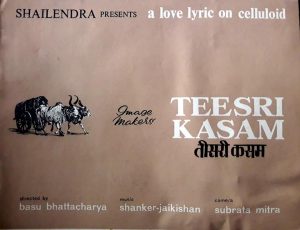
The Teesri Kasam booklet (Pic: Ratnottama Sengupta)
Shailendra was a star lyricist. Most of the hit songs in Hindi films of 1950s were penned by him. And, in particular, he was favoured by Raj Kapoor: he always relied on Shailendra’s lyrics, Shankar-Jaikishan’s music and Mukesh’s playback. Given this association, it was taken for granted that the blue-eyed actor would play the central role of a bullock cart driver.
Raj Kapoor said, “I am not saying ‘Yes’ without hearing the story. Ask your friend to come with Nabendu Ghosh Da for a sitting. Let me discuss it with them.”
A date was decided upon. We went to Raj Kapoor’s office at 9 pm. Why so late? Because Raj Kapoor used to have lunch at 4 pm, then rest for a while. It would be 7 pm by the time he came out of his siesta and prepared for social interaction. So it was close to 10 pm by the time we settled down in his R K Studios office at Chembur.
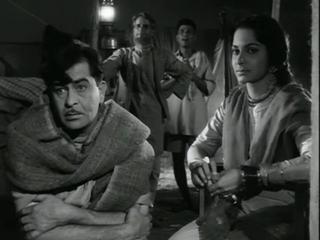
Hiraman, the bullock cart driver has to ferry the nautch girl Hirabai
I narrated the story of Teesri Kasam. It is again a unique love story set in the Purnea district of Bihar. Hiraman, the bullock cart driver gets a customer: he has to ferry the nautch girl Hirabai, to the big mela where the Nautanki company has set up tent. On the way the innocent gariwan strikes a conversation with the dancer. He would break the monotony of the journey by singing folklores and ballads of the region. Hirabai finds his innocence, his guileless affection quite fetching, and strikes a friendship with him.
This causes envy amongst his friends and equals. And raises the hackles of the Nautanki manager, and the ire of the zamindar whose advances the dancer rejects. At the end of the mela she turns down the offers from other Nautanki companies and returns to her native village, determined to live up only to Hiraman’s trust.
Seeing her off at the railway station Hiraman sings, “What was in your heart, Oh Creator of This World, when you planted love in men and women? Why did you bring them together if you wanted to part them again?”
A bewitching story peopled by characters throbbing with life. The simplicity of village life, the complexities of a dancing woman’s life, the rustic humour, the dreams, the pain of loss… Every emotion was made palpable by the performances. Yes, it remains one of Raj Kapoor’s best. But here again, it was Waheeda Rehman who lifted the film to a new height with both, her acting prowess and her enticing dances.

Nabendu Ghosh in a cameo as a drunkard spectator in Teesri Kasam
The cameos of the friends and leeches of the gariwan too remain etched in memory. I played one of them – a drunkard – at the behest of Shailendra, with whom I had struck a camaraderie since he wrote the songs for most of the films I scripted for Bimalda: Naukri, Biraj Bahu, Madhumati, Yahudi, Bandini.
Teesri Kasam went on to win the President’s Award, a crowning glory for the poet-lyricist. It remains the launching pad for three directors who emerged in a big way on the Indian screen – Basu Bhattacharya, Basu Chatterjee, B R Ishara. And it firmed up Shailendra’s and my connections with our roots in Bihar.
******
In Bombay my links with Bihar had always been strengthened by S H Munshi. This man from Gaya had struck big in Bombay when he produced Kafila with Ashok Kumar in the lead and the southern star Ranjan in a supporting role. Then he produced Baap Beti with Ranjan and Baby Tabassum in the lead roles. This was around the time Maa was getting delayed because Bombay Talkies had run into financial trouble.
Bimalda had come to Bombay with an entire team. It included screenplay writer, editor, cameraman, art director, dialogue writer, assistant director. So that we would not be idle, we were constantly narrating stories to other major producers. After one such narration S Mukherjee had said, “It is a nice story, but I am a businessman, so I will not make it.”
Munshiji had heard the story, and he said, “I like it very much. I would like to produce it if Bimal Roy directs it.” That film was Baap Beti.

Bimal Roy with Ranjan, Tabassum, the actors of Baap Beti and Rinki Roy
Being from Gaya, Munshiji had an affinity for Renu’s Maithili. Renu himself spoke fluent Bengali, just like one born into the language. In fact he once said to me that his ancestors were originally from Rahanpur in Malda district of West Bengal (now in Nawabganj district of Bangladesh). He had married thrice. The first time was to Rekha, as a boy in his village, Aurahi Hingna (near Forbesganj on Nepal border). Then he spent some years in Nepal where he tied the knot with Padma, a lady of Nepali origin. After he became a reputed writer and started living in Patna, he set up family with Bengali speaking Latika. By his own admission,
By his own admission, (R/o) Renu’s writing was influenced by Satinath Bhaduri, who authored the seminal Bengali novels Jagori and Dhorai Charit Manas, but I was captivated by Maila Anchal. And Munshiji, being an ardent admirer of Renu, at once procured the rights to the novel that I would direct.
******
Preparations were now afoot to can Maila Anchal.
The protagonist on whom the novel hinges is a village doctor.
Ever since he debuted in Bandini, Dharmendra used to respect me a lot. He had unreserved affection, indeed love for me. He trusted me with the screenplay of a number of films featuring him. So, the moment I proposed for him to play the role, he was on board.
Now for the leading lady: who should I approach? Since I was known as a writer, who would be drawn to a project that I would direct?
For a while before this I had been going to Pune at regular intervals, to give the students at the Film Institute of India an insight into the discipline of screenplay writing. For some years they had been sending me telegrams to own up this responsibility, but I had been shying away from it. Why? I was scared I would have to study a lot in order to teach the graduate students who were applying from across the land. I had served on the selection committee for some admissions, so I knew that most of the applicants were educated, intelligent and determined to grow in cinema. I couldn’t possibly face such bright minds without constantly updating and equipping myself cinematically. So I would routinely disregard the telegrams – until 1967.
Vice Principal Mushir Ahmed had doubled the number of telegrams and Principal Jagat Murari was a gentleman whenever we met. So I had to give in. I would go once a month. A car would wait to pick me up at the station. I would stay in a room of the Guest House for 3-4 days and return to my livelihood in Bombay.
The environs of the Institute was charged with creative energy. On my first visit students of all the departments had gathered in the classroom. A stimulating conversation ensued – and lasted for two hours. The next day Mushir Ahmed said to me, “The students are charmed by the interaction with you. You must continue this association with the Direction students.”
And it continued for 25 years…
******
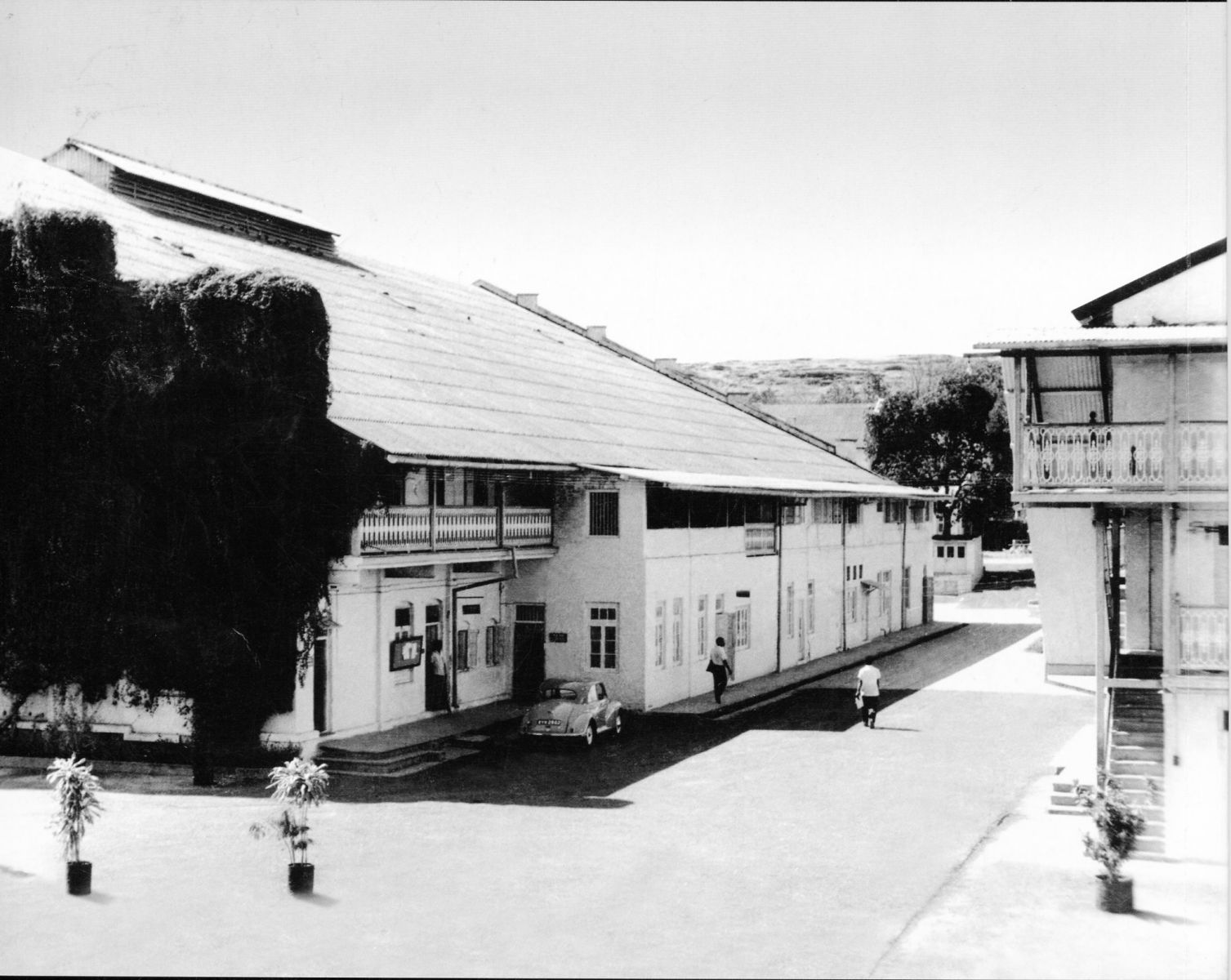
The Film and Television Institute of India (FTII) was set up by the Government of India in 1960, in the premises of the erstwhile Prabhat Studios in Pune (Pic: FTII)
Four students from Direction, but seven students were regular for Screenplay Writing. If my first visit had conquered their interest, from the second visit onward they would come to my guest room. Soon students from the other departments also started trooping in with the Direction students. I would be surrounded by them as long as my stay lasted. I came to treasure their love and respect.
From the first floor verandah, while waiting for the tea-biscuit from the canteen below, I would notice the movement of students and their interaction with their teacher. The Acting students were always the most chirpy. And, among them, there was this one girl – short, sharp features, very dignified though only about twenty years old. She seemed to be a natural ringleader. One day when chatting with the Direction students I asked about her.
“She is Jaya, daughter of writer Taroon Bhaduri,” they said.
“Taroon Bhaduri… You mean the author of Abhishapta Chambal?”
“Yes Sir. The writer serves in a high post in the Tourism Department of Madhya Pradesh government.”
“Waah. So she is the daughter of a famous father.”
******
On my next journey Basu Chatterjee was my co-passenger. He was the chief Assistant Director for Basu Bhattacharya during the making of Teesri Kasam. Now he had taken a loan from Film Finance Corporation to make a film. He was heading to the Institute to scout for a favourable newcomer for the central role.
Two days later Basu Chatterjee returned to Bombay. That same evening when I was relaxing on the verandah, the daughter of writer Taroon Coomar Bhaduri came to see me along with some of my students.
“Sir, Jaya wants to speak with you…”
“What about?” – I asked after arranging seats for them.
“To seek your advice,” my student explained noticing that my curiosity was turning into concern.
“I am in a quandary,” Jaya spoke. “You know Basu Chatterji was here to select an actor. And he wants me to play the female lead in his film, Sara Akash.”
“That is good news,” I said. “Basu will surely make a sensitive film.”
“But that is the problem,” Jaya shook her head. “The admission rules had laid down that during the two years in the Institute no student can act in any film. But this is a good offer. So what should I do Sir?”
I thought about it. “It will be a good debut for you. You can go ahead.”
“Even if I have to go away from the Institute and give up the thought of getting a degree?” – Jaya persisted. That forced me to rethink.

Jaya Bhaduri in Guddi
“You value your education – and a year from now you will graduate in Acting,” I proceeded to clarify her thoughts. “You are the most promising student in your batch. Everyone praises your ability. A Gold Medal for the topper is likely to bring you more – and perhaps better – offers. So go ahead and respect the goal that has drawn you to this Institute. That way you will satisfy your inner self, your soul. And I am certain your histrionic ability will be duly recognised.”
Jaya was convinced by what I said. “You have cleared my doubts,” she said. “Thank you, Sir.”
That day onwards Jaya Bhaduri too became one of my disciples. And her respect deepened a year later when, right after she graduated, Hrishikesh Mukherjee offered her the eponymous role of Guddi in the film he was set to launch.
That flagged off the victory trail of Jaya Bhaduri. And I got the leading lady for my planned film, Maila Anchal.

Dharmendra and Jaya Bhaduri in Dagdar Baboo
******
Those days, if you planned to make any film, you had to start by registering the title with the Indian Motion Picture Producers Association (IMPPA). No one else but you could then use that title.
I had to stumble when I entered the IMPPA office to register the title of Maila Anchal. Someone else had registered it some years ago! What misfortune was this? I had to let go of such a poetic and apt title.
I put on my thinking cap. But no other title was half as befitting. And then this thought occurred to me: In the central role Dharmendra was playing a Doctor. And he connects all the other characters in the film who represented the different segments of Mother India. And everyone he meets, greets him as ‘Dagdar Baboo’ – in rural Bihar that’s how a Doctor was addressed. So why not have that as the title for the film?

(L) Dagdar Baboo was modelled on a real life village doctor (Dharmendra in and as Dagdar Baboo) (R) Jaya dressed as Swami Vivekananda
Munshiji happily concurred with this title. So we lost no time in cracking the auspicious coconut to mark the Shubh Mahurat inside the Mohan Studios that had been home to Bimal Roy Productions. Hrishikesh Mukherjee, my friend through highs and lows in cinema, sounded the clapper board while Dharmendra faced the camera on February 27, 1975.

Dharmendra, Producer S H Munshi, Manobina Roy (Bimal Roy’s wife), Jaya Bhaduri and Mr Wadia of Bombay Laboratories at the Shubh Mahurat of Dagdar Baboo

Hrishikesh Mukherjee with the clapstick for the mahurat shot featuring Dharmendra – date 27th February 1975

Dulal Guha, Dharmendra, Hrishikesh Mukherjee, Jaya, and Nabendu Ghosh after the Dagdar Baboo Mahurat shot
That set off the shooting which proceeded unhindered. The script was peopled by so many characters. One chapter of the film unspooled around the Mahant of an Akhara in the village. This ascetic president of a Kabir Panthi monastic order was blind. To essay this, my longtime friend and associate Asit Sen agreed to go against his stereotyped image of a comedian.

Nabendu Ghosh directing Asit Sen in the role of the blind Mahant of a Kabir panthi Akhara
Utpal Dutt, the legend of Bengali theatre who made a remarkable changeover and turned comedian in Hindi films, was playing the heroine Jaya Bhaduri’s father.

Nabendu Ghosh discussing a scene with Utpal Dutt, Dharmendra and Jaya Bhaduri
The villain of the story was being played by Ajitesh Bandopadhyay, so admired in Tapan Sinha’s Haatey Baajarey. Kali Banerjee, another remarkable actor from Bengal seen in Bawarchi was to play Baldev. And the lilting music was scored by Rahul Dev Burman – Pancham to us, being the son of our adorable Sachin Karta.

Nandita Thakur, Kali Banerjee in Dagdar Baboo
With Dharmendra and a host of others we shot on location in Purnea zilla of north Bihar. In Forbesganj, to be precise. People emptied their homes and were hanging from trees to watch the shooting – perhaps because Phaniswar Nath Renu came from here. He belonged to the underprivileged Mandal community but enjoyed the benefits of land, education and social status.
I visited his family in the neighbourhood, he lived there with his wife – quiet natured, soft spoken – and his sons. We also shot some scenes in the paddy fields outside of Kolkata. Excellent performance by every single member of the cast.

Shekhar Chatterjee on an outdoor location in Dagdar Baboo
I started dreaming big so far as the film was concerned. But I also sensed that many people were unhappy with the progress of the film. Why? What was my fault? Ambition?
Our producer trusted a Calcutta based financier, Mr Daga. He was true to his words, always. So Munshiji borrowed money at high interest for shooting, always by signing promissory notes to return the amount. I kept shooting but he could not arrange to edit the rushes. It was a sad state of affairs.

Dharmendra does a mock blood pressure check up of the Director Nabendu Ghosh

Dagdar Baboo advertisement in a Hindi magazine
Maila Anchal is a literary work. It views the trials and tribulations of life in the caste-ridden interiors of the land during the Quit India movement – through the lens of a young doctor who cared for the people across the social structure. Reflecting the dialect, lifestyle, even the beliefs and superstitions that lead to catastrophe, it did not have any scope for lascivious dance or heady songs.
So, by watching the unedited rushes no distributor could get a hang of where the film was heading. And so, even when 75% of the film had been canned, no distributor was coming forth.
After 1977 no work was done on the film. But whatever was seen had made a deep impression on Dharmendra and – especially – on Jaya. They were very hopeful that this film will be a landmark in their careers.
But ill-starred Nabendu Ghosh could do little to salvage the situation. And Munshiji suffered far more. Dogged by money lenders, and unable to cope with the worries, he succumbed to ill health. After he passed away, his unworthy sons proved simply unequal to the task of carrying forward his legacy. Consequently the negatives of all that we had shot of Dagdar Baboo gathered dust in the cupboards of Bombay Laboratories.

Chinmoy Roy and the drill by a Nationalist group of young men in Dagdar Baboo
From Nabendu Ghosh’s autobiography Eka Naukar Jatri/ Journey of a Lonesome Boat
Translation from Bengali: Ratnottama Sengupta
More Must Read on Silhouette
Phani Majumdar: A Journey Through Life…
Nazir Hussain, the INA and the Long March of Kadam Kadam
Of Incomplete Tales: My Friendship with Guru Dutt (Parts 1 & 2)
Teesri Kasam – A Story of Love That Meandered to its Dead End

Whether you are new or veteran, you are important. Please contribute with your articles on cinema, we are looking forward for an association. Send your writings to amitava@silhouette-magazine.com

 Hrishikesh Mukherjee: Master of the Middle Path
 ‘My heart swells with pride when I see their work’: Nabendu Ghosh in conversation with Ameen Sayani
 The Making of Do Bigha Zamin
 Shailendra’s Teesri Kasam: Sapne Jagaa Ke Tune Kaahe Ko De Di Judaai
 Gender, Politics, Power and the World of Hrishikesh Mukherjee: Part III
 Gender, Politics, Power and the World Of Hrishikesh Mukherjee: Part I
Silhouette Magazine publishes articles, reviews, critiques and interviews and other cinema-related works, artworks, photographs and other publishable material contributed by writers and critics as a friendly gesture. The opinions shared by the writers and critics are their personal opinion and does not reflect the opinion of Silhouette Magazine. Images on Silhouette Magazine are posted for the sole purpose of academic interest and to illuminate the text. The images and screen shots are the copyright of their original owners. Silhouette Magazine strives to provide attribution wherever possible. Images used in the posts have been procured from the contributors themselves, public forums, social networking sites, publicity releases, YouTube, Pixabay and Creative Commons. Please inform us if any of the images used here are copyrighted, we will pull those images down.



























































Pingback: Carnival of Blogs on Golden Era of Hindi Film Music – Volume XIII – Deceember 2025 Edition – The world is too small? or Is it?