Stay tuned to our new posts and updates! Click to join us on WhatsApp  & Telegram
  Channel
& Telegram  Channel & Telegram Channel




In a cinematic extravaganza that is replete with memorable music, Khuda nigehban ho tumhara remains underrated. Shirish Waghmode revisits this gem from Mughal-e-Azam.

The palace guards draw their swords and lead Anarkali away
The Mughal-e-Azam has just decreed that his renegade son, heir to the throne-be sent to his death for rebellion against the throne. Raja Mansingh steps in and offers a masterful diplomatic move. Eliminate the cause of the rebellion, and the insurrection will fizzle out by itself. Remove Anarkali and the prince will have nothing to fight for!
Anarkali (Madhubala) is manipulated into the scheme by being offered a fatal deal. “We’ll spare the prince if you agree to sacrifice your life.” Unaware of the shenanigans of the royalty, the naïve Anarkali yields. She is given the onerous task of tricking the prince into inhaling a drug-coated flower, inducing unconsciousness. That done, the soldiers arrive to whisk him away and to take Anarkali to her preordained doom.
As she watches the love of her life being taken away from her, never to be seen again, she realises that her dreams lie irrevocably shattered, and the end is near. She hears the chimes of the final hour, there rises from her motionless lips – a silent scream…
Woh aayi subah ke parade se maut ki aawaz
kisi ne tod diya jaise zindagi ka saaz
Prophetical words that signal the last rites of passage.
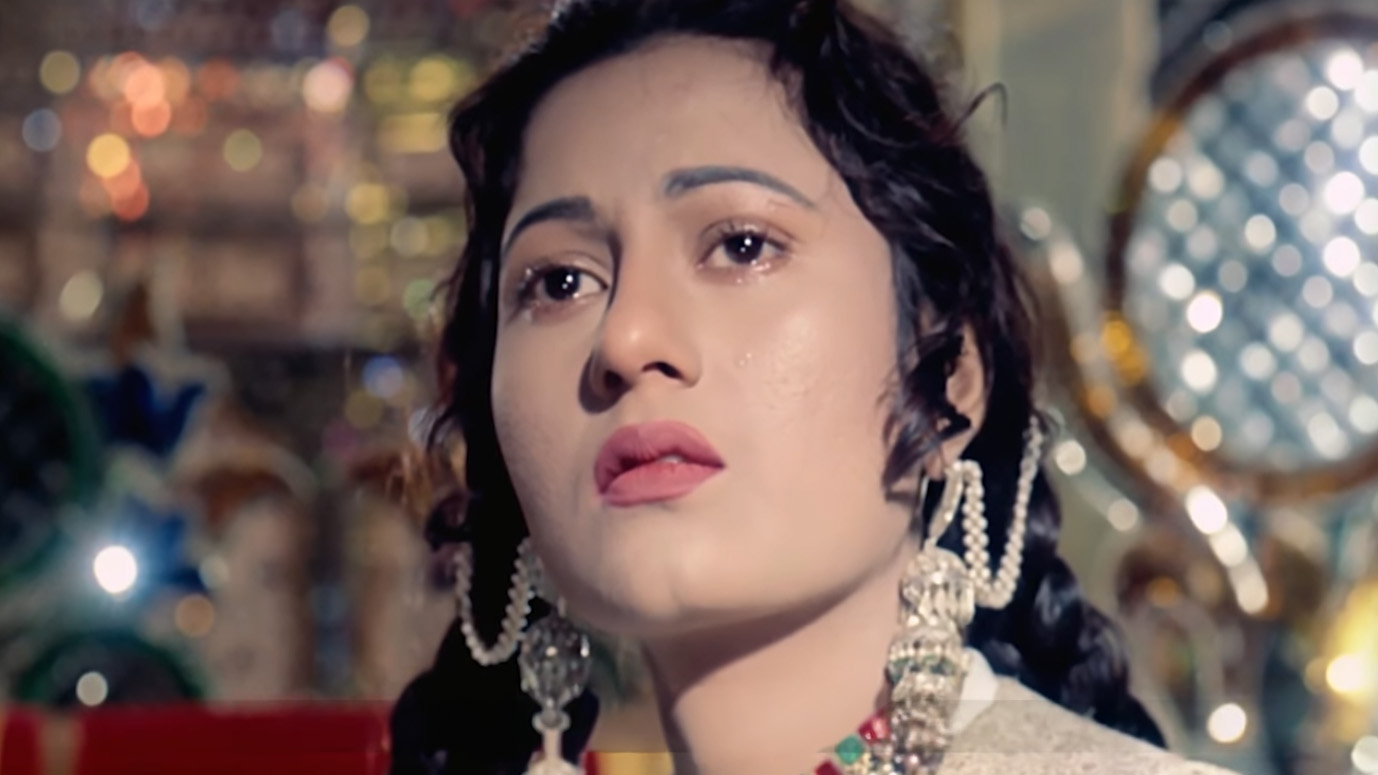
A disconsolate Anarkali wishes her prince a tearful farewell
The Lyrics
Softly parting the curtains of the morning clouds, the sun sounds the deathly gong. It is an ominous stillness that fills the air. But the foreboding chill does not prevent a disconsolate Anarkali from wishing her prince a tearful farewell.
Khuda nigehban ho tumhara
dhadakte dil ka payaam le lo
“May Allah (The Lord) watch over you as you embark on a path which leads you away from me”, she seems to say. “My heart beats for you in farewell. I am leaving your world, your life, never to return. Rise, at least acknowledge my salutations one last time. Rise, my Prince, for one last adieu, I implore you!”
Hai waqt-e-rukhsat, gale laga lo
Khataayein bhi aaj bakhsh daalo
Bichhadne waale ka dil na todo
Zaraa Mohabbat se kaam le lo
The moment of truth has arrived, with a note of finality. Embrace me, hold me tight, my Prince, and forgive me my trespasses. Indulge me in my simple desires, my Prince, do not deny one who is leaving you forever. Gently, not harshly, with love, not rage, bid me a sweet goodbye. Like all else, let this farewell be also remembered forever!
Uthe janazaa jo kal hamara
kasam hai tumko, na dena kandha
When you awaken, you might find me gone. But when the heathens arrive to carry my bier away, do not join the pallbearers, do not be party to that heinous act. Do not be part of those who are glad to cart away my mortal remains. Do not join the procession of the wicked!
Na ho mohabbat hamari ruswa
ye aansuon kaa payaam le lo
Such an act will sully the image of our Love. Reduce it from divinity to ordinariness and from immortality to mortality. I beseech you with tearful eyes, lest it cast a shadow on the sanctity of our Love!
Tumhari duniya se jaa rahe hain
utho hamara salam le lo
Actually the best way to appreciate the song is to watch it in isolation. In the movie, it is just a cog in the wheel of events that happen at a furious pace. Sandwiched between a song before and the dramatic sequences which follow is this song, starting with –
Woh aayi subah ke parde se maut ki aawaz
Kisi ne tod diya jaise zindagi ka saaz
Ominous words that signal the final rites of passage.
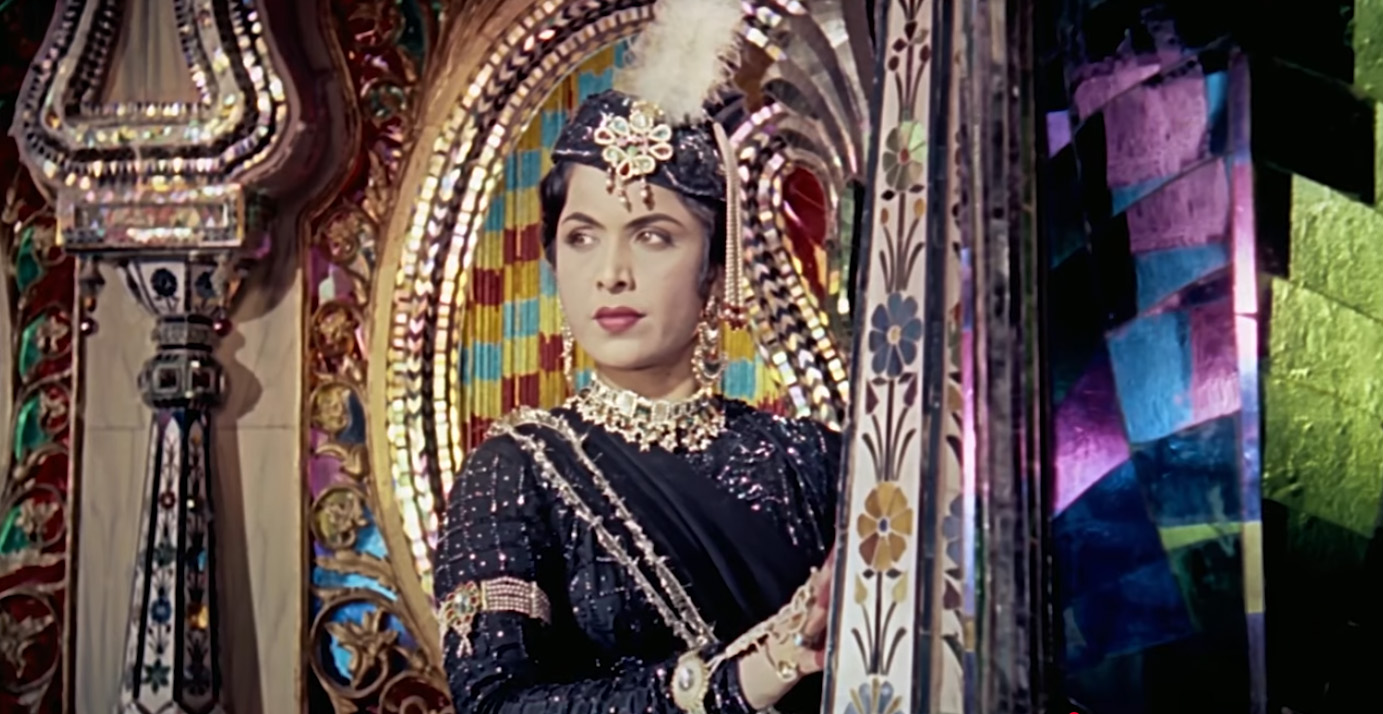
Bahar (Nigar Sultana) watches as Anarkali is being led away
In a cinematic extravaganza that is replete with memorable music, this song remains underrated. Mughal-e-Azam’s musical mosaic that boasts the defiance – the prince declares
Pyar ki aandhi ruk na sakegi
nafrat ki deewaaron se
Khun-e-mohabbat ho na sakega
khanjar se talwaaron se
(Zindabad zindabad ai mohabbat zindabad)
to the magical sequence of Anarkali’s firm assertion –
Parda nahin jab koi Khuda se
Bandon se parda karna kya
jab pyar kiya to darna kya
It has a Qawwali that is a treat to watch and hear –
Teri mehfil mein qismat aazmaakar hum bhi dekhenge
and the tragic plaint –
Mohabbat ki jhoothi kahaani pe roye
But it is in this song that Madhubala reaches her emotive zenith. Every expression is intense, every word is enunciated with grief, and every gesture reeks of defeat. She brings tears to your eyes. Through the tears, we still clearly see that shorn of her beauteous presence, her hypnotising dances, and her costumed persona, Madhubala has left herself behind – and become for the last and final time – Anarkali!
One more flame is extinguished to brighten the pages of history!
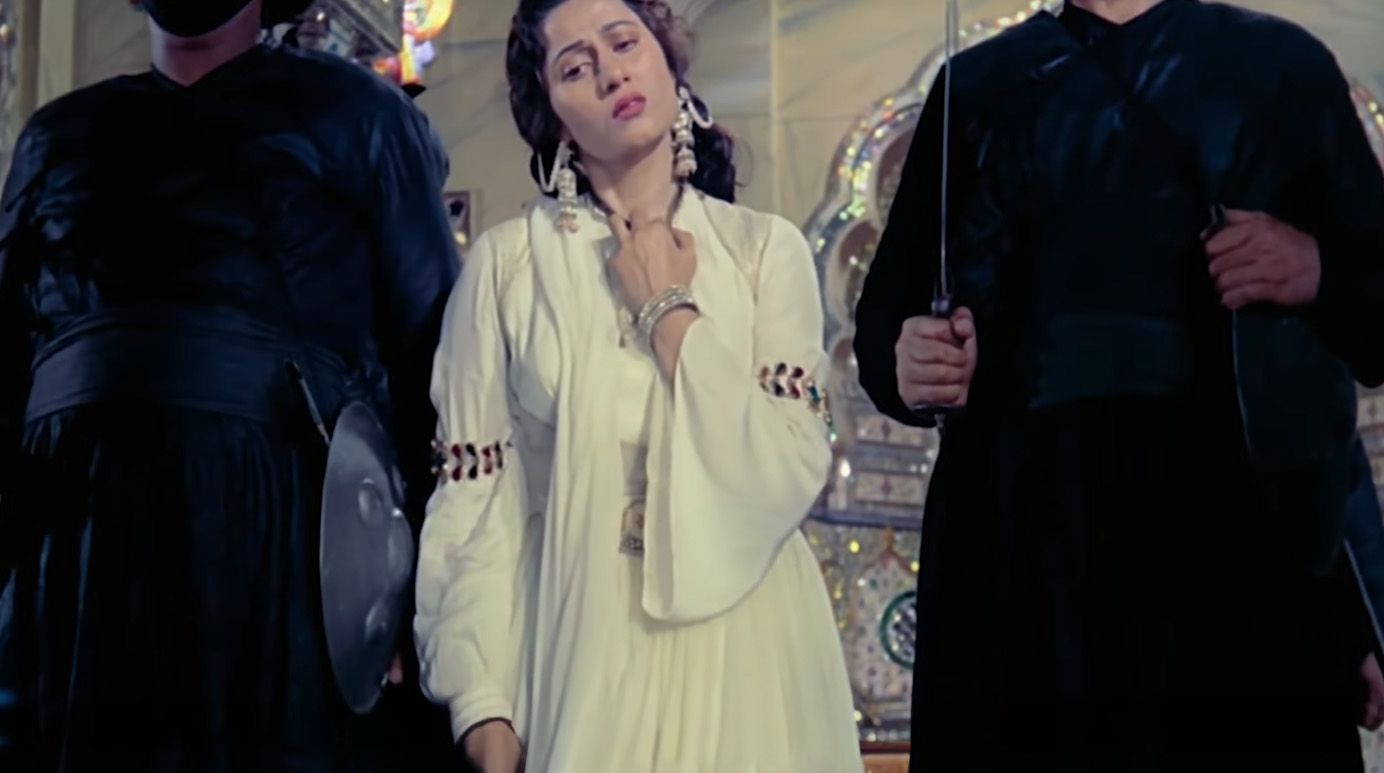
Anarkali walks towards her doom, tearing off her jewellery
The Picturisation
Used as a background motif, Khuda nigehban ho tumhara, a final plea to the Almighty, intensifies the poignancy of Anarkali’s final journey towards eternal rest. Aware of its emotional power, K. Asif filmed the sequence in Technicolor, one of the rare colour moments in an otherwise black-and-white film. As the palace guards draw their swords and lead her away, close-ups of Madhubala’s porcelain face, tears streaming down her cheeks, hold the viewer spellbound.
Clad in resplendent white, stark against the black-uniformed guards flanking her, Anarkali drags herself forward, tearing off her necklace and pulling out her earrings, fully aware that she is walking towards her doom.
The gates open. Anarkali walks on, trailed by columns of guards with unsheathed swords, leaving behind the unconscious Salim (Dilip Kumar) sprawled on the floor. The magnificent Sheesh Mahal stands as a mute testimony to the tragic denouement of this love.
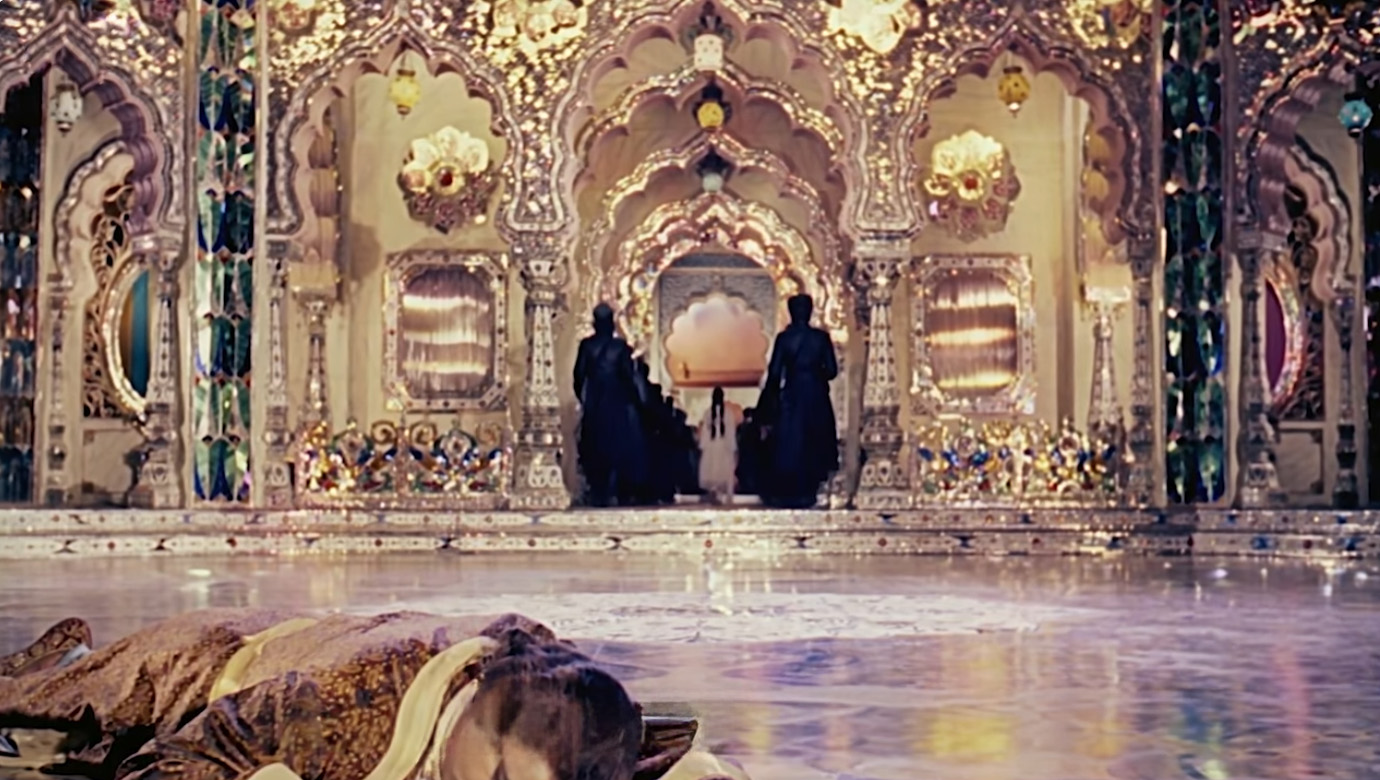
Anarkali is taken away, leaving behind the unconscious Salim
The Music
The song is based on Raag Yaman Kalyan. Naushad’s compositions are fundamentally melody-driven, where harmony is never overly prominent and never distracts from or overwhelms the melodic core.
In this song, if one listens closely, the accompaniment is remarkably sparse. Behind the melody, a vibraphone gently mirrors the melodic line. The tabla is played softly, complemented by the subtle use of wooden claves. In the interludes, a small group of violins creates a muted, rounded texture rather than a high-pitched sweep. Later, the sitar emerges, beautifully blended with the sarangi, adding depth without disturbing the song’s delicate balance.
Not only through the songs, Naushad saab also delivers a superlative background score that elevates every scene and adds to the film’s grandeur. The impending calamity casts its shadow through tremulous strains that signal an approaching tragedy. Almost single-handedly, he shapes this historical masterpiece into a truly memorable musical.
Khuda nigehban ho tumhara (Mughal-e-Azam, 1960) Naushad / Shakeel Badayuni / Lata Mangeshkar
More Must Read in Silhouette
Koi Chupke Se Aake: The Unspoken Melody of the Past
Jaane Kya Dhoondti Rehti Hai: Of a World Where Love Is Incinerated
When Cinema Matched Music Beat by Beat: Nadiya Kinare in Abhimaan

Whether you are new or veteran, you are important. Please contribute with your articles on cinema, we are looking forward for an association. Send your writings to amitava@silhouette-magazine.com

Silhouette Magazine publishes articles, reviews, critiques and interviews and other cinema-related works, artworks, photographs and other publishable material contributed by writers and critics as a friendly gesture. The opinions shared by the writers and critics are their personal opinion and does not reflect the opinion of Silhouette Magazine. Images on Silhouette Magazine are posted for the sole purpose of academic interest and to illuminate the text. The images and screen shots are the copyright of their original owners. Silhouette Magazine strives to provide attribution wherever possible. Images used in the posts have been procured from the contributors themselves, public forums, social networking sites, publicity releases, YouTube, Pixabay and Creative Commons. Please inform us if any of the images used here are copyrighted, we will pull those images down.





































































A brilliant discourse on a few songs from ‘Mughal e Azam’, that spotlights some aspects about these songs that deserved attention. Apart from the lyrics of Shakeel Badayuni flowing in a euphonious stream that makes them memorable, your highlighting “Khuda nigehbaan ho” strikes a chord in my heart.
I have always felt that, quite unjustifiably, “Pyar kiya toh darna kya” has taken a stranglehold in the minds of filmgoers as the ‘Best song ever’ and so on, who believe that songs are an essential ingredient of our films. In my view, “Khuda nigehbaan” deserves that place; Naushad himself had regarded this song (and ‘Bekas pe karam’) as being among his best creations. In fact, I would go further and place ‘Bekas pe karam’ and ‘Yeh dil ki lagi kum kya hogi’ too as superior to ‘Pyar kiya toh’. There will be many ready to lynch me for this view but it is my considered opinion that the glam and glitter of that ‘Thousand Mirrored ceiling’, and Madhubala’s impish, daring and defiant looks and words hurled at Prithviraj, reduced to a helpless ‘Grin and Bear it’ state, swayed filmgoers to be bowled over completely in favour of this song as being the’Best’ etc. To me it simply seemed a kind of Hypnosis. The REAL songs of Mughal e Azam, and those that rank among the best of the Naushad/ Shakeel duo, are elsewhere.
Thank you for this lovely writeup that perfectly echoes some of my own feelings. I do not wish to add a word more to your excellnt analysis.
I am overwhelmed by your musical Pat -on -the back!I have always admired your understanding and analysis of Music and am only trying to follow in your footsteps Thanks for knowingly or unknowingly becoming my Guiding Light !
It is my sincere belief that ‘Lovers’ of Music generally, and Hindi film songs in particular, are
slightly mad. We are not satisfied merely by the song per se but allow it to enter our soul and take possession of our wits. Thus, repeated listening to these songs (and anlalysing them) is a sacred act that provides fulfilment and pleasure. This becomes even more pronounced as we age and turns into a crutch that helps living just that bit bettter.
Thank you.
Pingback: Carnival of Blogs on Golden Era of Hindi Film Music – Volume XIV – January 2026 Edition – The world is too small? or Is it?