Stay tuned to our new posts and updates! Click to join us on WhatsApp  & Telegram
  Channel
& Telegram Channel & Telegram Channel 




In this lyrical exploration, Madhulika Liddle examines Salil Chowdhury’s Madhumati score, revealing how music, narrative, landscape, and emotion fuse into a cinematic masterpiece.
Many years ago, I remember watching a Bimal Roy retrospective on television. Several of his most famous films—Do Bigha Zameen, Sujata, Bandini, Madhumati—were screened, and there were brief interviews with the director’s wife, Manobina Roy. I recall seeing her talk about Madhumati: that it held a record when it came to film music. Salil Chowdhury’s songs for the film, she said, were at one time all on the popular hit parade Binaca Geetmala.
Perhaps I misunderstood what Mrs Roy meant; perhaps her memory (this would have been in the 1990s) was fading. While Suhaana safar aur yeh mausam haseen and Aaja re pardesi featured in Geetmala’s top songs of 1958, Dil tadap-tadapke keh raha hai, Ghadi-ghadi mora dil dhadke, Toote hue khwaabon ne and Chadh gayo paapi bichhua were popular but didn’t make it to the top. But what about Zulmi sang aankh ladi, or the hilarious Jangal mein mor naacha?
In my opinion, there is no real need to discuss this. Salil Chowdhury won the Filmfare Award for Best Music Director for his score for Madhumati (and Lata Mangeshkar won the Best Female Playback Singer Award for Aaja re pardesi). The proof of the pudding is in the eating, after all.
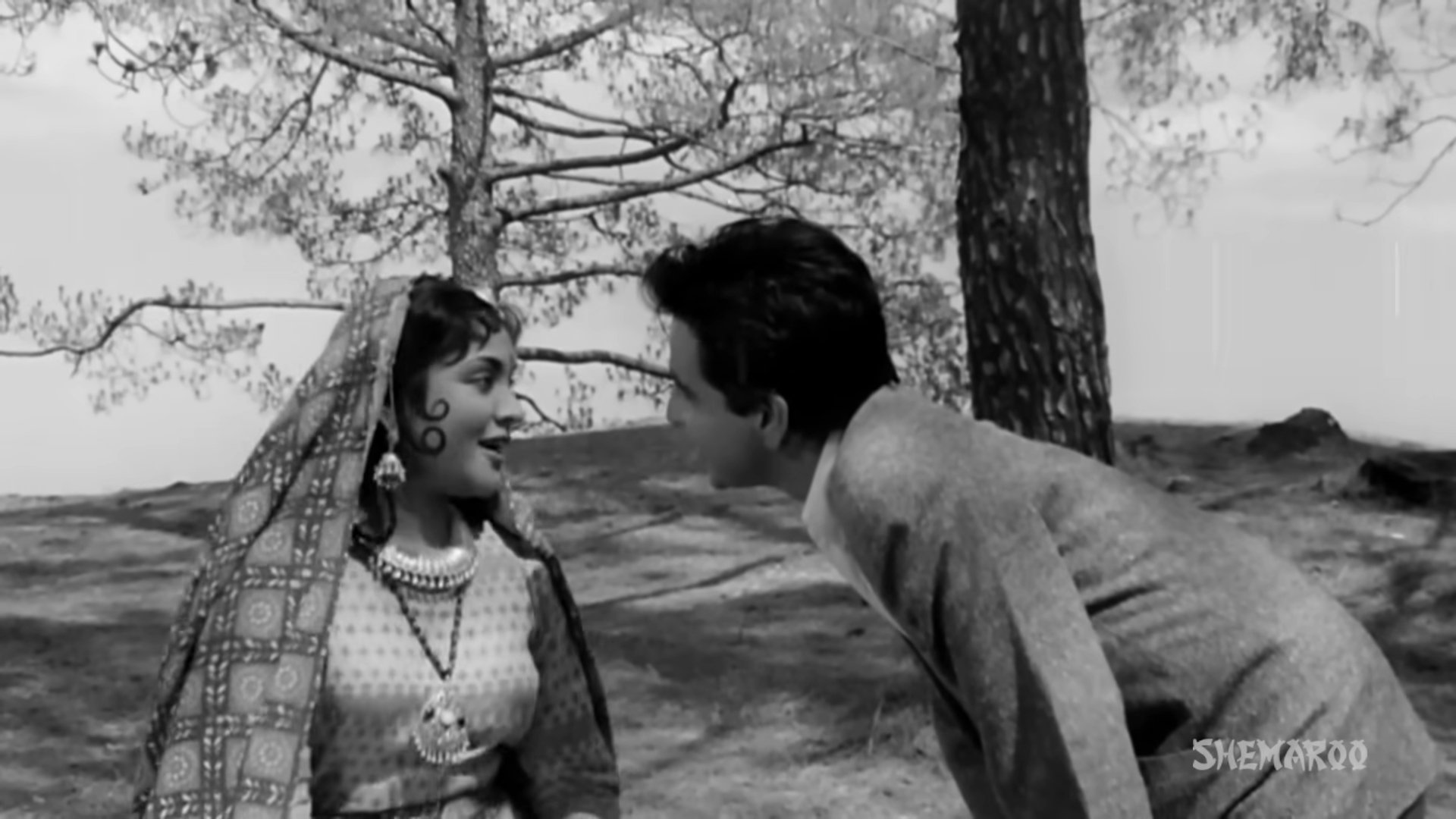
I also think that, to appreciate Salil’s music for Madhumati more fully, it pays to watch the film. This is not one of those many films where the songs have been inserted any old how, just to mirror onscreen emotions and situations. A close viewing, and you realize just how much effort, how much attention to detail has gone into this. Salil is a genius; but Bimal Roy must also be lauded for the careful composition of the film, which allows the music to shine through in a way that makes the film that much more memorable.
The first song of Madhumati comes just about fifteen minutes into the film. Anand, arriving to take on the job of manager in a zamindar’s timber estate, finds himself enchanted by the beauty all around him. Suhaana safar aur yeh mausam haseen does not come out of the blue: it is inspired by the surroundings. Anand hears the singing of a group of women, and then the call of a man herding goats—and from these sounds, he too is spurred on to sing. The music trills and ripples like the frothing waters of the river and waterfall; it swirls and whistles like the wind. And when, in a moment of playfulness, Anand calls out to the mountains, there is an echo. This is where a subtle detail is worked in: echoes across such a vast space often blur. While Mukesh’s voice, singing for Anand, is clear, the echo is a humming by a chorus.
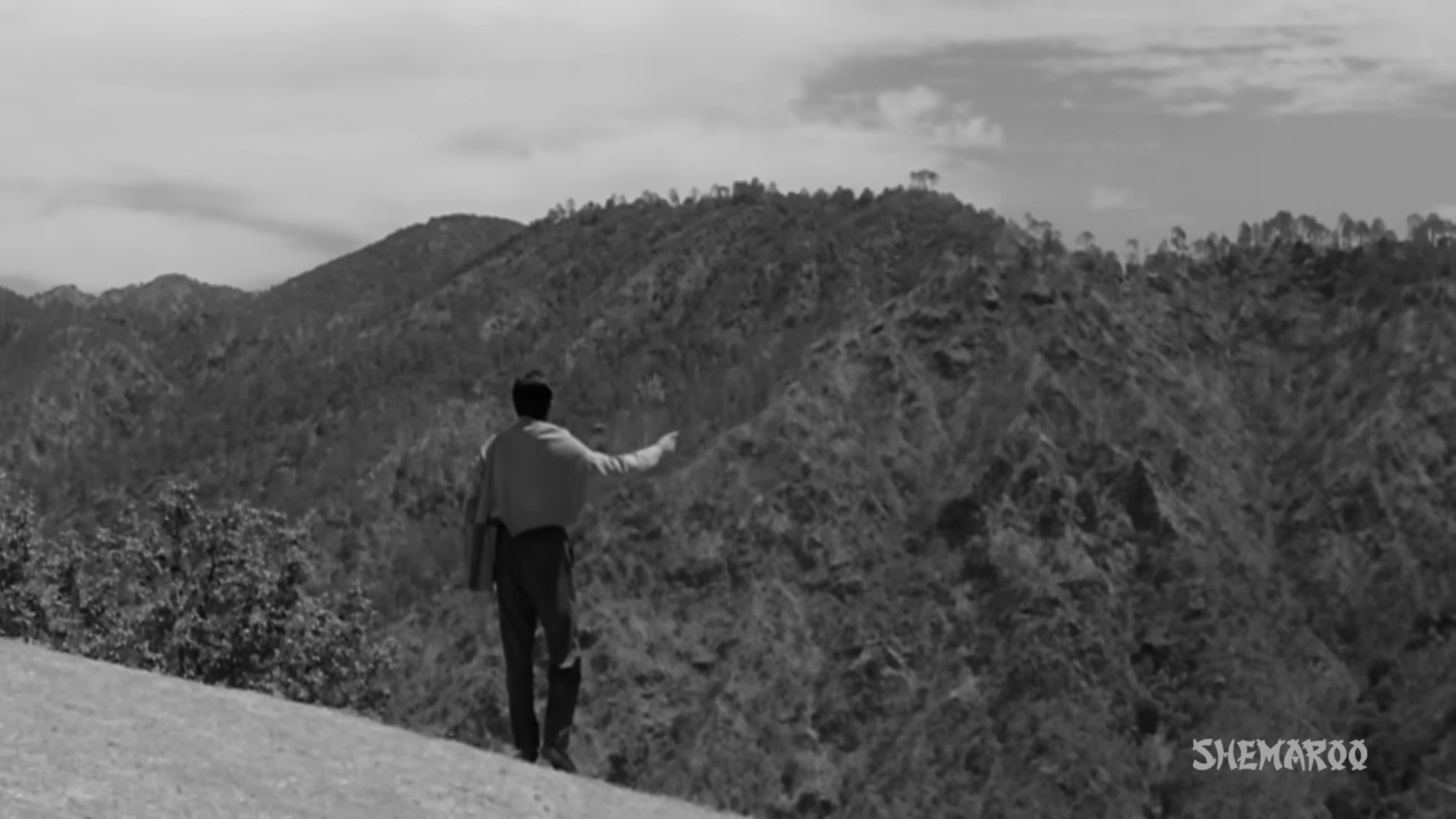
Suhana safar aur yeh mausam haseen
Another detail that reveals just how closely Salil’s and Shailendra’s songs were woven in with the screenplay is in the previews, so to say, of some songs. Just after Suhaana safar aur yeh mausam haseen ends, Anand nearly walks off the cliff, and is saved by a shout of warning from a woman on a nearby mountain. Anand only sees her silhouette, before she moves away and is hidden by the mist; but he hears her sing three words: Aaja re pardesi.
Anand settles in to his job and gets acquainted with the others on the estate. At night, with the mist settling over the mountains, he hears those same words again, sung in the same voice—and then again, one day when he’s out walking. This time, it is not just that brief line, that vague sense of longing: now we see the woman (the eponymous Madhumati, ‘Madhu’) and now we hear her song in its entirety. Aaja re pardesi is a complex song, its tempo and tune as playful, as nimble and constantly-moving as the woman who goes skipping between the trees, seeming to play hide-and-seek with the mist. Embedded within this lilting song is a glimpse of a tune yet to appear: Ghadi-ghadi mora dil dhadke comes later on in the film, but the interludes in Aaja re pardesi offer a brief instrumental version of the song.
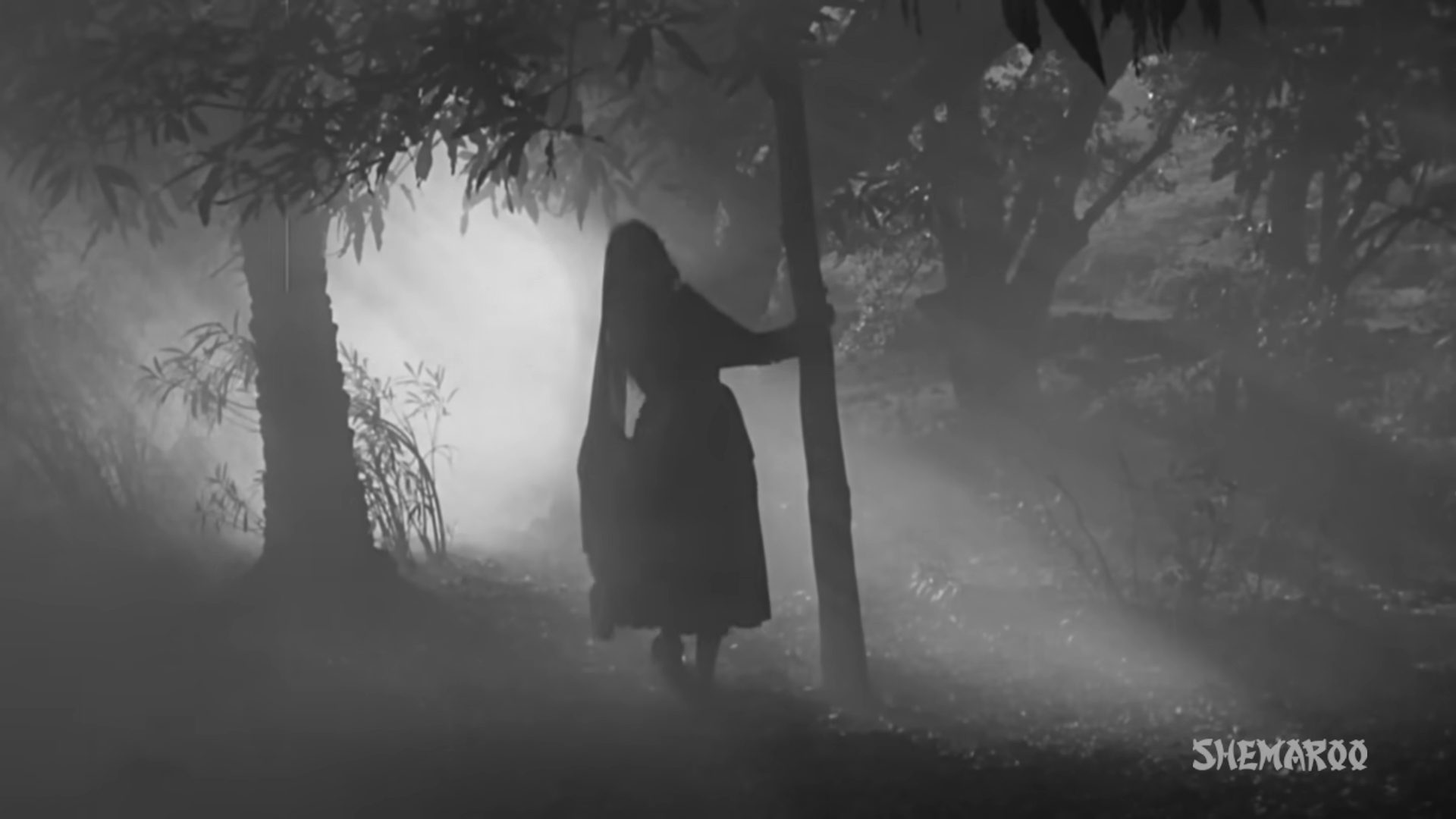
Aaja re pardesi
Shortly after Aaja re pardesi, Anand and Madhu finally come face to face. From here onwards, their love blossoms swiftly. Even while he grapples with the exigencies of work (including having to deal with a shady munim and an unscrupulous, belligerent foreman) Anand takes time out to woo Madhu. The very first overture, though, is hers: at a village fair, she sings Zulmi sang aankh ladi. A light, upbeat tune based on a Kumaoni folk song, the rhythm here is markedly Pahadi, the contribution of the chorus an important element (as it is in several of the songs in Madhumati).
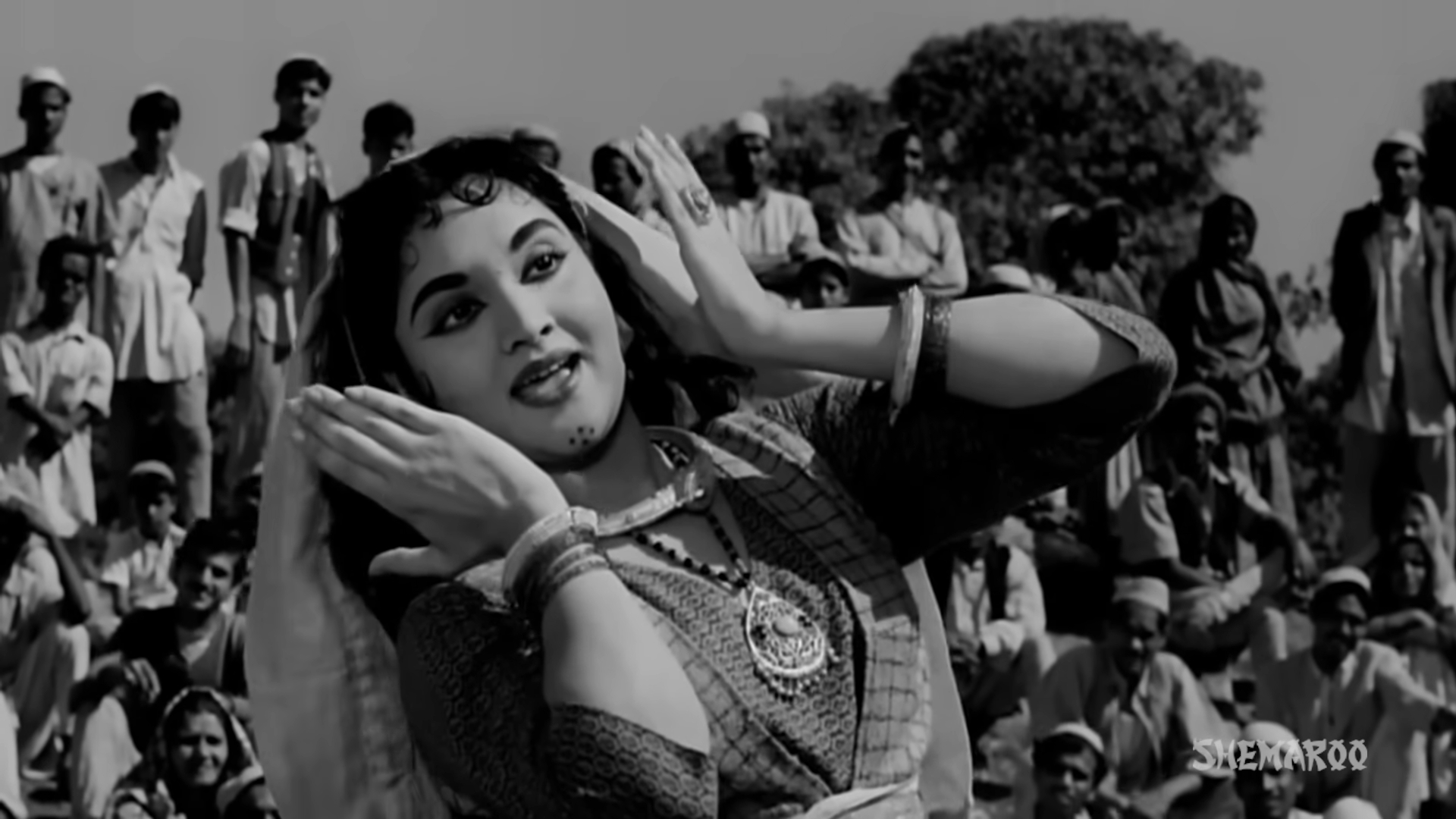
Zulmi sang aankh ladi
Even though there is a brief, very disturbing interlude (Madhu is intercepted by the evil Raja Ugra Narayan, a ruthless lecher who is also Anand’s boss), the romance continues to play out with conversation and song against a backdrop of the mountains. Madhu, waiting for Anand to come, sings the beautiful Ghadi-ghadi mora dil dhadke. Composed in Raag Bageshri, this song—like all of Lata’s other solos in the film—has a stunningly melodious, vibrant quality to it that is the very essence of what SD Burman had called good music: a tune so recognizable, so relatable, that even the man on the street would be able to appreciate it.
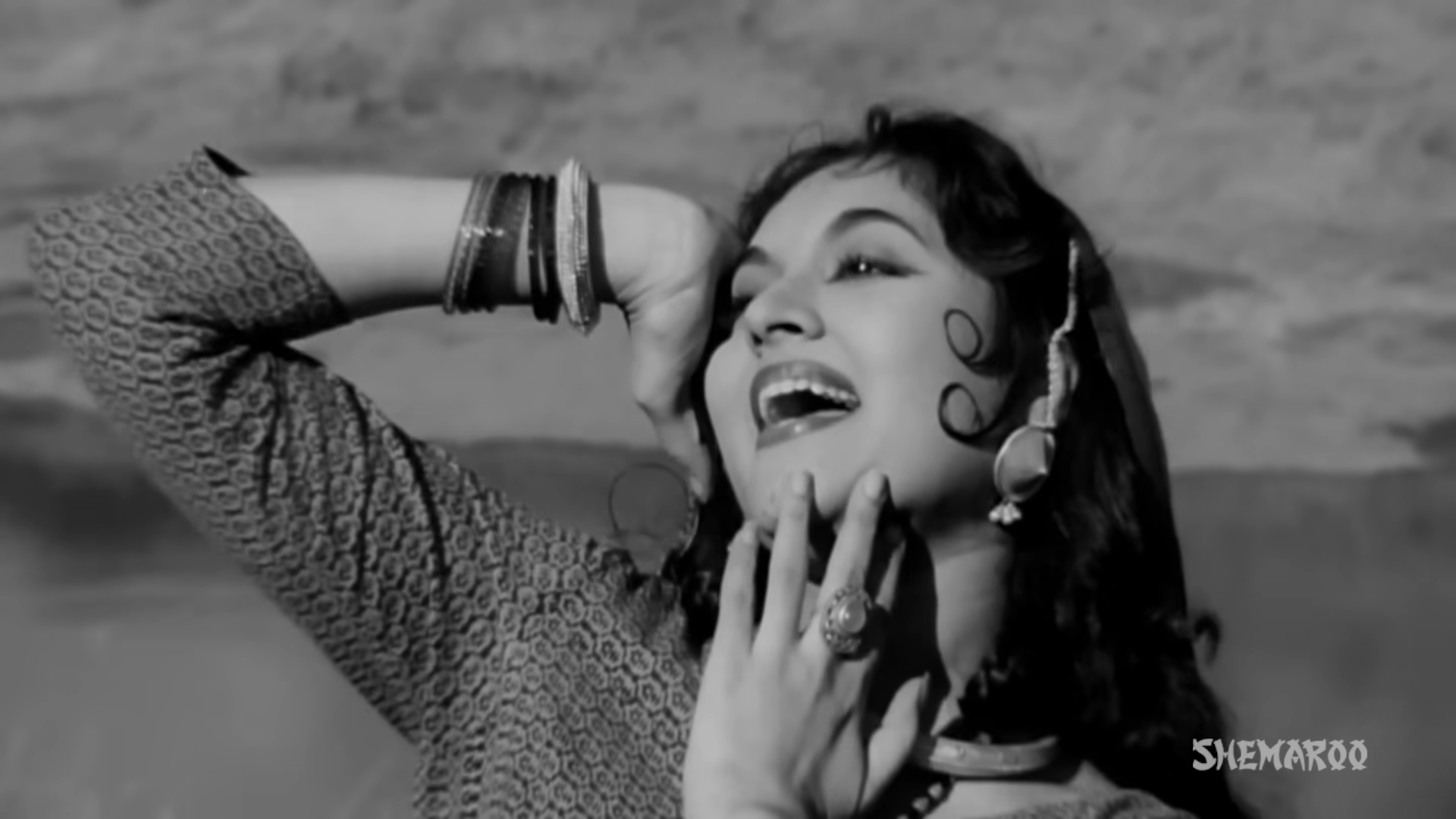
Ghadi-ghadi mora dil dhadke
The next song comes almost on the heels of Ghadi-ghadi mora dil dhadke, and though the setting is the same, among the pine trees on the mountain, this song is very different from the previous one. Dil tadap-tadap ke keh raha hai aa bhi jaa, sung by Mukesh and Lata, is the only duet picturized on Anand and Madhu. Also, unlike the folk- or raag-based songs that have so far marked this love story, this one was inspired by a Polish folk song. Szla dzieweczka do laseczka (‘A girl went to the forest’) is a traditional Polish tune, probably from the 19th century; it talks of the love between a girl and a hunter, but any romance in the lyrics is, I suspect, only coincidental. What is truly impressive is the way Salil takes a Western tune and turns it into something very different: a song that doesn’t sound at all out of place in this setting, this culture. The resemblance is there, but Salil’s own riff on the tune, the intricacies he’s introduced, makes Dil tadap-tadap ke keh raha hai so much more interesting than the original.
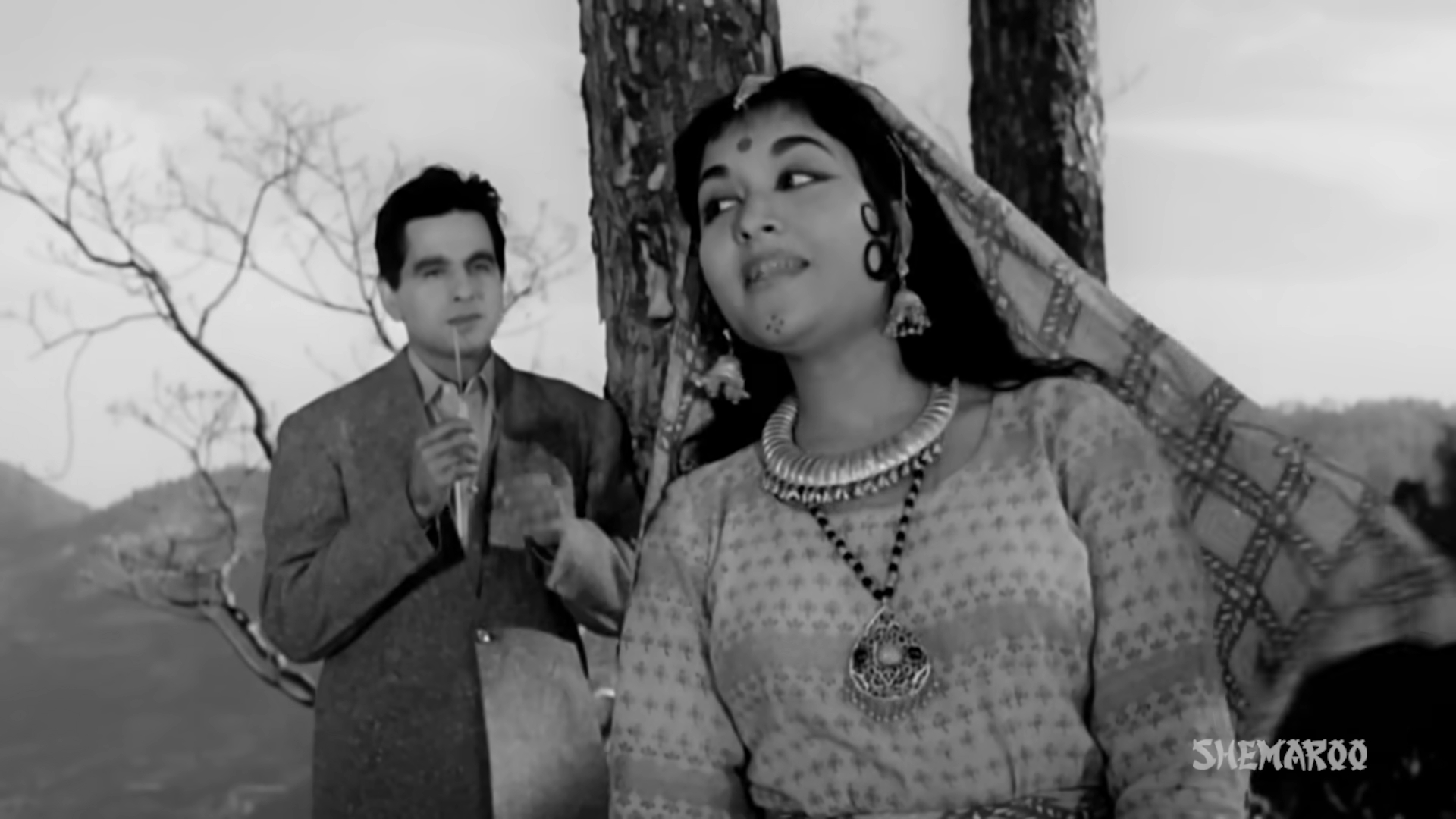
Dil tadap-tadap ke keh raha hai
One last song rounds out the romance of Anand and Madhu: at a village gathering, she dances and sings Chadh gayo paapi bichhua. Like the earlier Zulmi sang aankh ladi, this one too is a ‘social’ type of love song: the expression of love takes place in full view of the public, even though the lyrics do not specifically name the object of the singer’s attentions. Sung by Lata and Manna Dey (the latter singing playback for an extra, not for Dilip Kumar), along with a chorus, Chadh gayo paapi bichhua draws inspiration from Assamese folk music (Salil’s father had been a doctor on a tea estate in Assam, and Salil’s childhood had been spent there, among the tea gardens). Note the way the music—and, at one point, the chorus’s singing—turns ominous just before the bad news of the scorpion’s depredations is announced. The upbeat rhythm of the rest of the song contrasts superbly with these intervals of sinister foreboding.
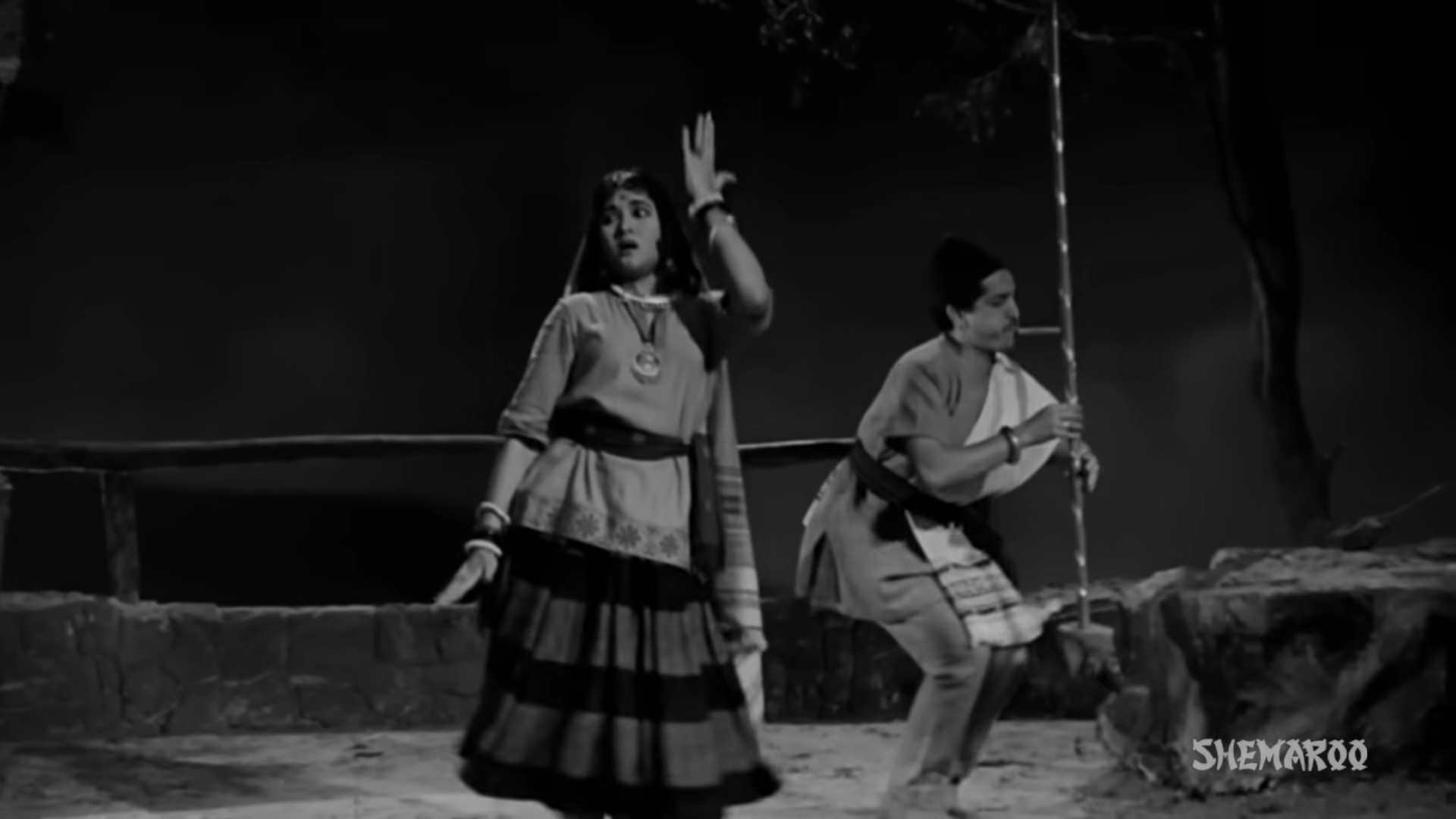
Chadh gayo paapi bichhua
Chadh gayo paapi bichhua is the last romantic song in Madhumati. Shortly afterwards, Ugra Narayan manages to ensnare Madhu. Part of the plot involves getting Anand’s servant Charan Das drunk. Of course, with Johnny Walker playing Charan Das, this is an opportunity that few film-makers would pass up: a chance for a funny song. Thoroughly tipsy, Charan Das stumbles around, climbing up trees and swinging from them, all the while complaining of how people begrudge him his drink. Jangal mein mor naacha kisi ne na dekha is one of those very rare examples of a funny song where the humour lies not just in the lyrics or the rendition (Rafi is perfect as Charan Das’s inebriated voice), but in the music itself. Just as Charan Das stumbles and trips, so too does the music: the lightness, the playfulness of it (those blasts of the trumpet, especially), is a brilliant mirroring of the character’s intoxication.
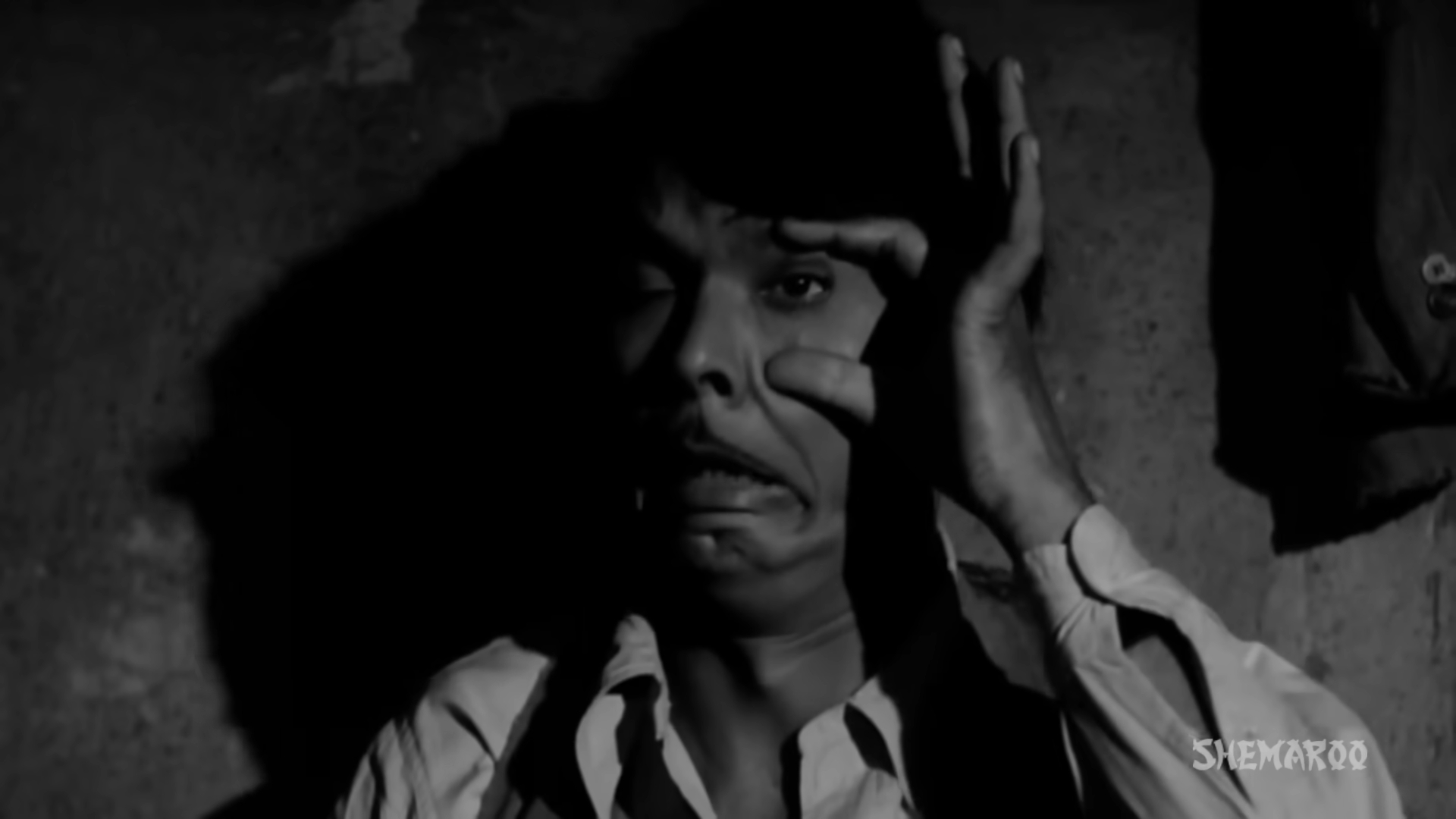
Jangal mein mor naacha
The very last song of the film is the absolute opposite of Jangal mein mor naacha. The first song in Madhumati is a solo sung by Anand among the mountains; so is the last one, Toote hue khwaabon ne. Anand returns after a two-day long trip on which Ugra Narayan had sent him, only to discover that Madhu has gone missing, obviously fallen prey to Ugra Narayan’s lasciviousness. Despite much searching, Anand can find no trace of his beloved. Eventually, broken-hearted and despairing, he returns to the hillside shrine where Madhu had taken him, and there he sings of his love for her.
In a score that features so many ebullient songs, Toote hue khwaabon ne stands out as the one song that is gloomy: yet Salil does not make it weepy. There is, instead, a mounting desperation in the music and in Rafi’s voice, an increasing anguish: how will he live without Madhu?
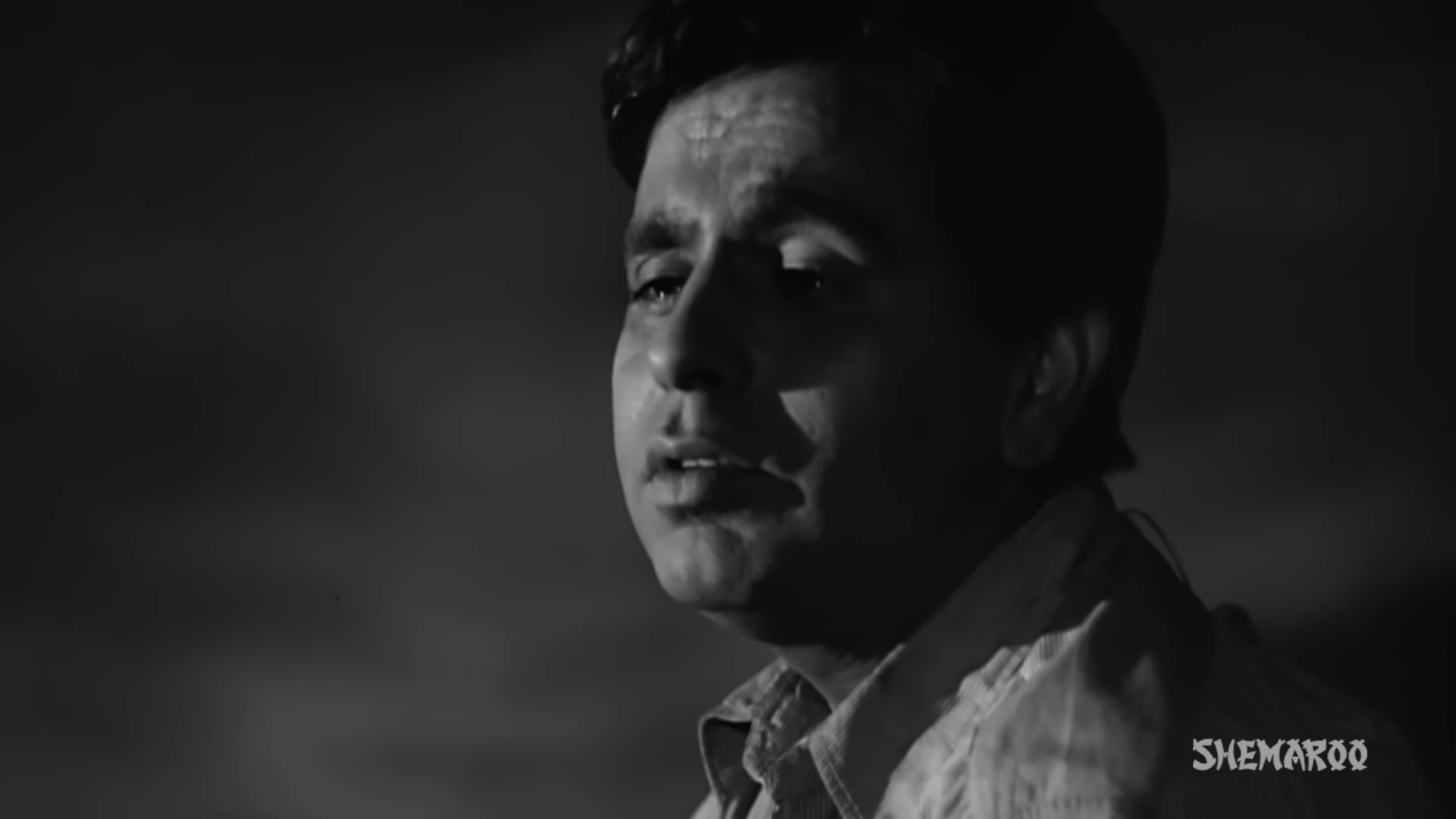
Toote hue khwaabon ne
The full-length songs end at this point, but it’s not as if there is no music, no singing beyond this. Instead, with Madhu gone, Anand once again begins to hear her haunting Aaja re pardesi echoing eerily across the mountains. The words, however, differ from those in her original song. This time, her distant voice sings Ghir aayi raat andhera chhaaya, a nod to the darkness that has swallowed up Anand’s joy. Another song comes to Anand out of the past: attending a dance performance, he is reminded of Chadh gayo paapi bichhua—but he gets up and hurries out of the theatre before the song can go any further.
Another song is abruptly cut short, this time by Anand suddenly coming into a room where Ugra Narayan (in a common method used to show a villain’s debauchery) is watching a tawaif perform. Mubarak Begum sings Hum haal-e-dil sunaayenge suniye ke na suniye, but the film contains only about a minute of the song: Anand’s explosive entry onto the scene cuts the tawaif off.
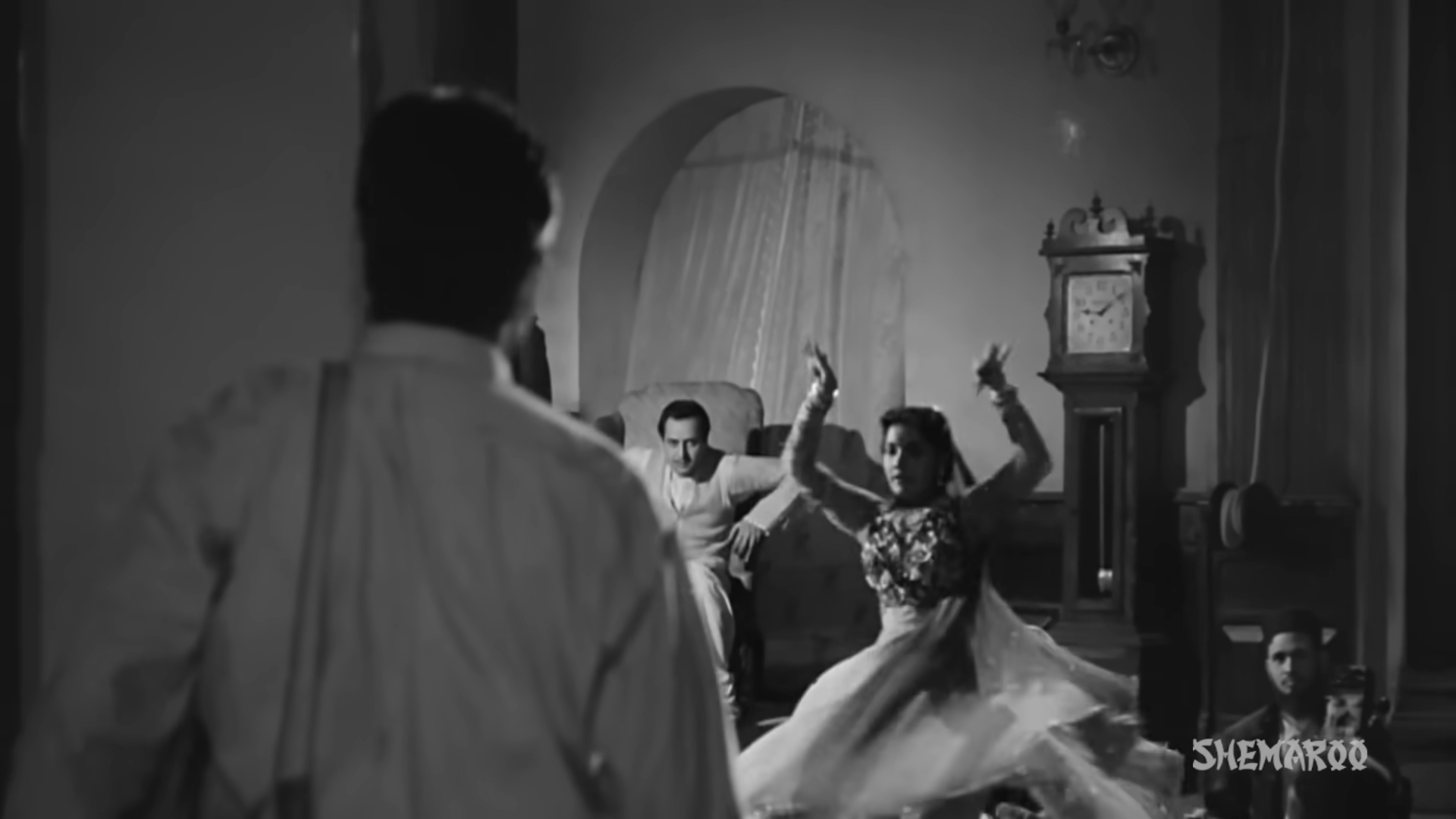
Hum haal-e-dil sunaayenge suniye ke na suniye
Two more songs were originally part of the score of Madhumati. The first one, sung by Dwijen Mukherjee along with a chorus and beginning with Bhudo Advani’s voice, is Tan jale mann jalta rahe. Inspired by an American country song called Sixteen Tons, this one was probably picturized on the ojha (played by Bhudo Advani) whom Charan Das summons to help Anand by exorcising the ghost of Madhu. Bhudo Advani’s is the voice that begins this song before it is taken over by Dwijen Mukherjee and the chorus. The contrast between the clear voice of Mukherjee, the high female voices of the chorus, and the deep, almost rasping voice—so ominous—of the male chorus, evokes a sense of dread.
Also originally part of the film was Kancha le kanchi layi laayo, inspired from a Kumaoni folk song (or Nepali, or both: there seems to be little consensus on its genesis). Like Tan jale, this one too has a very pronounced contribution by the chorus, along with solo sections by Asha Bhonsle, Sabita Chowdhury, and Ghulam Mohammad. The first line of the song is retained in the film, sung by a group of women as they walk along a mountain path on their way to the fair; the rest, however, was removed from the final print of Madhumati.
Perhaps because it is so briefly heard in the film, Hum haal-e-dil sunaayenge tends to get overlooked. Tan jale mann jalta rahe and Kancha le kanchi layi laayo, while both have their merits, are perhaps not quite as mesmerizing as the better-known songs of Madhumati (or does it seem like that to me because I have not heard them as often as the others, and so am not used to them?)
But the rest of the songs, all eight of them, are hard to choose between. Each of them is a gem, each resounding proof of Salil’s genius. No matter which emotion the song is supposed to capture—anticipation, intoxication, despair, passion, playfulness—Salil’s music achieves that as powerfully as do Shailendra’s lyrics or the voices of the playback singers.
Madhumati won for Bimal Roy the Best Director Award at the sixth Filmfare Awards, in 1959; the film also won the National Award for Best Feature Film in Hindi. At the Filmfare Awards, the film got a total of 12 nominations, of which it won 9—a record which it maintained for 37 years, before it was overtaken by Dilwaale Dulhaniya Le Jaayenge in 1996. It also ended up being Bimal Roy’s biggest commercial success, and one of the top-grossing Hindi films of its time.
Madhumati’s success was hardly surprising. The cast was good, with Dilip Kumar, Vyjyanthimala, Pran and Johnny Walker among the most dependable (and popular) actors in their ‘categories’ of that era. The setting, in present-day Uttarakhand, was picturesque, and Dilip Gupta’s cinematography (which won him a Filmfare Award) was stunning: those pine trees rising out of the swirling mists, the sun’s rays playing hide-and-seek with the spray from the waterfall, Madhu appearing out of the mist… this is a film that is aesthetically very pleasing.
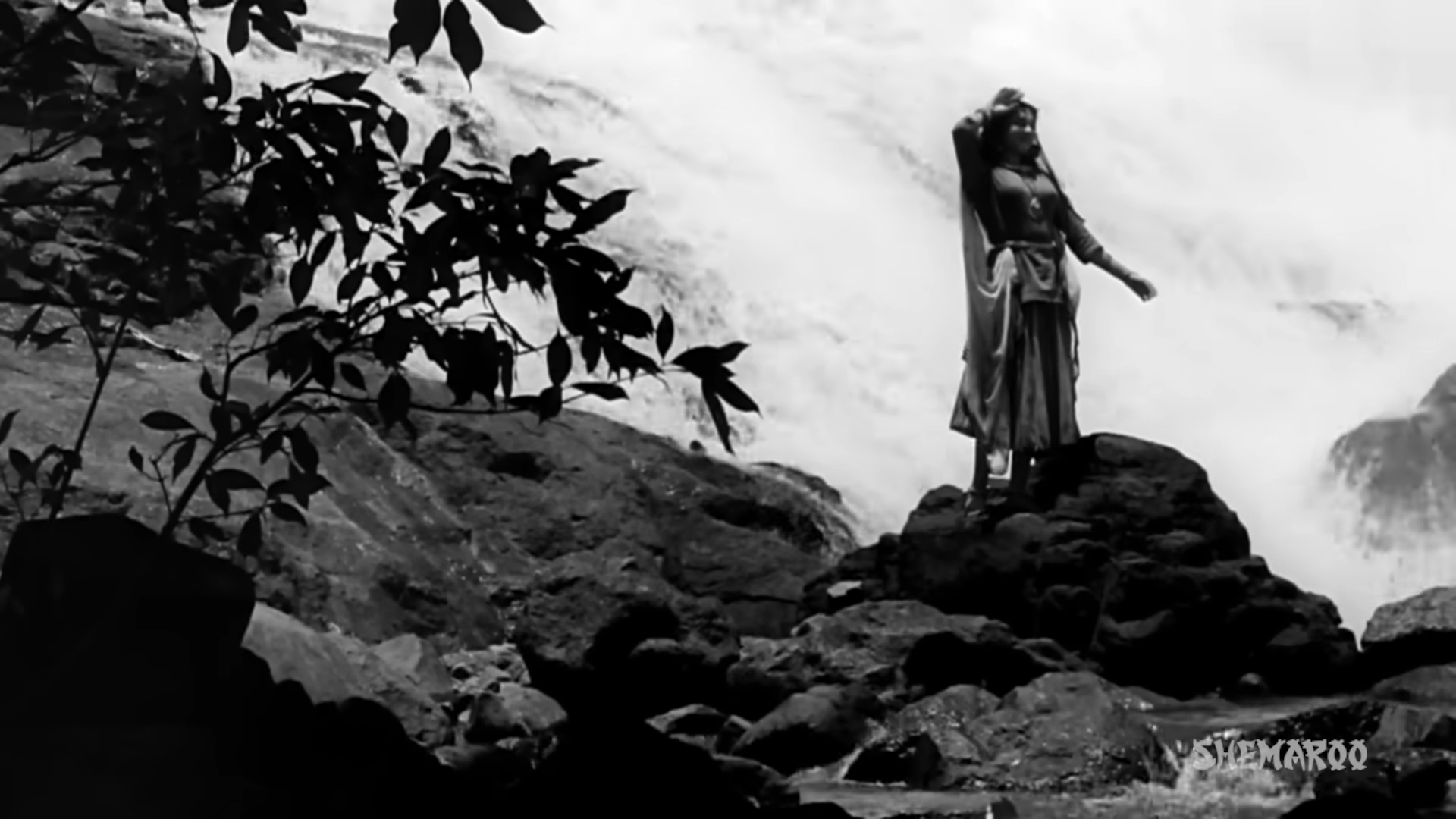
Madhu appearing out of the mist
Then, there is the story, originally by Ritwik Ghatak: a classic romance of a city man and a village girl, and with a third wheel in the form of the villainous Ugra Narayan. It is a fairly standard story up to a point; the twist in the tale comes only after the unjust death of Madhu. From there onwards, the surprises are unexpected enough to keep the momentum of the film going even though there are no more songs.
But it is the songs, really, that are the pivot of this film. Take them away, and the romance of Anand and Madhu falls through. Take away Charan Das’s inebriated rant and he is much less memorable a comic character. Take away Madhu’s sweet—and later restless, yearning—song of anticipation, and the sense of mystery dissipates. The songs of Madhumati, whether inspired from halfway across the world, or from within India itself, carry the film.


Whether you are new or veteran, you are important. Please contribute with your articles on cinema, we are looking forward for an association. Send your writings to amitava@silhouette-magazine.com

 Apni Kahaani Chhod Ja: Leave a Story That Will Be Retold
 Teesri Kasam – A Story of Love That Meandered to its Dead End
 Salil Chowdhury: Creating Music ‘Outside the Rules’
 Shailendra’s Teesri Kasam: Sapne Jagaa Ke Tune Kaahe Ko De Di Judaai
 ‘She is Capable of Delivering Anything a Music Maker Can Think Of’ – Salil Chowdhury Speaks About Lata Mangeshkar
 Salil Sangeet: How Salil Chowdhury’s Bengali Songs Reimagined Genre, Social Awareness and Humanism
Silhouette Magazine publishes articles, reviews, critiques and interviews and other cinema-related works, artworks, photographs and other publishable material contributed by writers and critics as a friendly gesture. The opinions shared by the writers and critics are their personal opinion and does not reflect the opinion of Silhouette Magazine. Images on Silhouette Magazine are posted for the sole purpose of academic interest and to illuminate the text. The images and screen shots are the copyright of their original owners. Silhouette Magazine strives to provide attribution wherever possible. Images used in the posts have been procured from the contributors themselves, public forums, social networking sites, publicity releases, YouTube, Pixabay and Creative Commons. Please inform us if any of the images used here are copyrighted, we will pull those images down.



































































Thanks Madhu. Love the songs in Madhumati. I was a child when I attended the Filmfare awards in Shanmukhnanda Hall – My uncle was one of the recipients for best dialogue. A full orchestra played some of the songs. I remember being overawed by the spectacle!
Hi Madhu. Thanks for this post – absolutely love the songs. I was a child when I attended the Filmfare awards in Shanmukhnanda hall. My uncle was one of the recipients – for best dialogue. Everything was larger than life for me, a full orchestra played some of the songs – Lata sang. I was overawed and since then the songs of Madhumati have had a special place in my heart.
Yes, indeed, Nishi – I had noticed that Rajinder Singh Bedi had won the award for the dialogues. That must have been quite an experience, to attend the function! Thank you for sharing that memory.
Thank you so much. I had reviewed Madhumati a long time back, but for Salil’s centenary, it seemed appropriate to revisit the film, from the perspective of his songs – and I discovered that, at a re-viewing, the songs are really so much more than wonderful pieces of music: they are in reality a critical part of the film.
Pingback: Carnival of Blogs on Golden Era of Hindi Film Music – Volume XIII – December 2025 Edition – The world is too small? or Is it?
Der aaye durust aaye, Madhu. Such a fitting tribute to Salil Choudhury, so what if it’s not on his birthdate?
I loved the analysis of the songs within the context of the film. It’s always a pleasure when the songs fit the narrative instead of being shoehorned in, and it’s doubly joyful when the songs are of such stellar quality. Your review of this film’s music was a wonderful start to my morning. (Even if I took more than a week to comment on it!)
I am so happy you liked this post, Anu! I was hoping you would get to read it, and was – I will admit – a little nervous. But approbation from you is all the approval I need. 🙂 Thank you.
And yes, I completely agree re: the idea of songs actually adding to the narrative rather than just being there. No matter how good the songs, they’re that much better when they contribute to the film as a whole, when you can see that the film wouldn’t be that complete without the songs.