Stay tuned to our new posts and updates! Click to join us on WhatsApp  & Telegram
  Channel
& Telegram Channel & Telegram Channel 




Despite the shadows of Partition repeatedly appearing as a motif in his Partition Trilogy (Meghe Dhaka Tara, Subarnarekha and Komal Gandhar), Ritwik Ghatak’s cinema transcended that to themes of dislocation and the rupture of human existence. Partha Pratim Ghosh finds out.
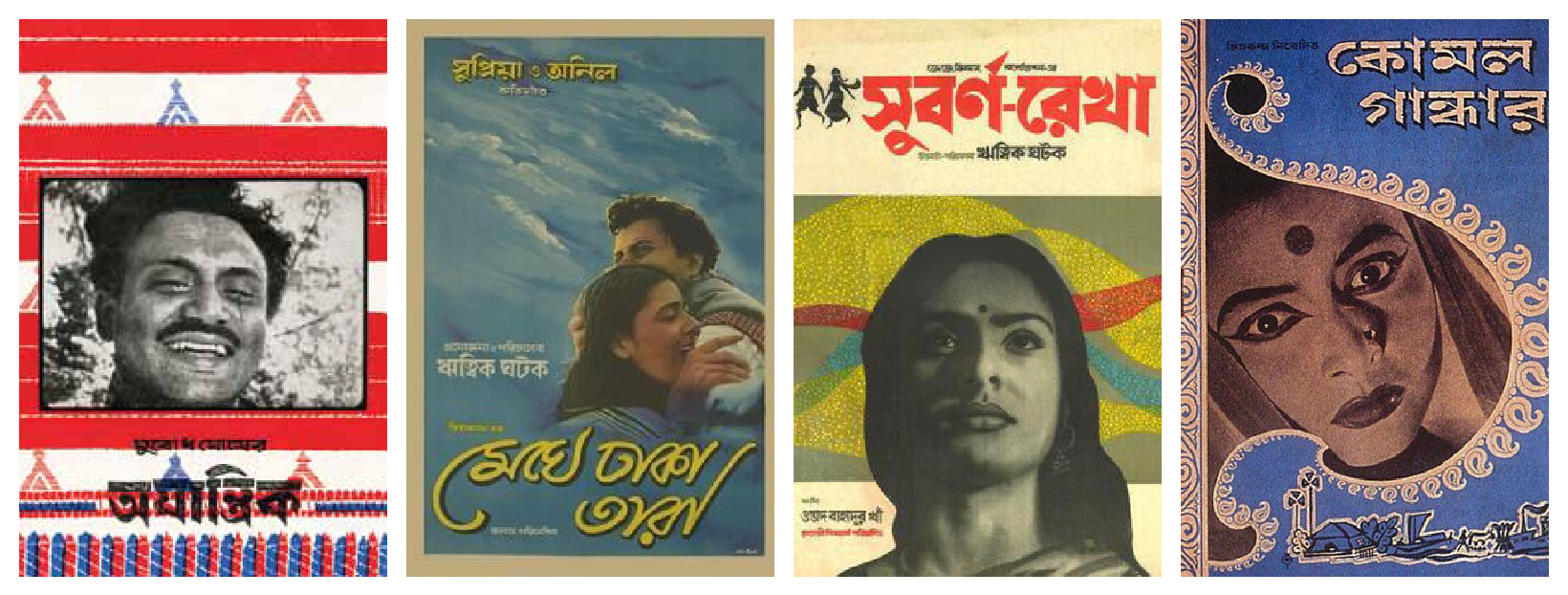 Ritwik Ghatak’s iconic status was majorly built as the chronicler of a bleeding Bengal, wounded in the Partition in 1947 – a seer whose art of Cinema combined personal exile, collective trauma, and cultural memory. Born in Dhaka and cast adrift by the catastrophe of Partition, Ghatak turned his lens toward the ruptures of Bengal.
However, despite the shadows of Partition repeatedly appearing as a motif in Meghe Dhaka Tara, Subarna Rekha and Komal Gandhar, his cinema was not limited only to that. His cinema transcends the partition of Bengal to themes of dislocation and the rupture of human existence. While doing so, what distinguishes Ghatak from his contemporaries, including his stylistic opposite, Satyajit Ray, is his refusal to accept traditional cinematographic composition and soundscapes.
The focus on this rupture also makes Ghatak’s films a cinema of confrontation: loud, erratic, harsh and barbed; his camera does not flatter, it trembles and shocks. Most tellingly, the mise-en-scène often places his human characters at the edges of a wide landscape, instead of making them the central focus of the shot. His soundscapes are not merely incidental, which ‘realistic’ cinema adheres to; very often, he uses amplified sound, not always environmental, which interrupts, disturbs and is also symbolic, instead of rendering sublime harmony to a sequence.
His aesthetic was born not from avant-garde experimentation, but from his profound roots in Bengal’s tradition, its mythology and archetypes. Ghatak’s inimitable cinematic form can be traced to even his early short stories, many of them impressionistic, surreal, and grief-stricken. His short stories preage his cinematic language. In these stories, we encounter fathers who vanish into rivers, machines that speak, trees that mourn, and women whose gazes burn with forgotten myth. The same motifs reappear in his films, magnified and, at times, distorted.

Cinema and I
Ghatak’s own essays explain his vision. In Cinema and I, he insists: “Our responsibility is not to manufacture illusions. It is to show how truth trembles. That trembling—call it myth, music, montage—is where real cinema begins.”
His short stories, all of which predate his films, often contain certain skeletal gestures of scenes he would later introduce in his films.
Unlike traditional cinema that privileged frontal frames, Ghatak bursts them into apparently irrelevant visual shocks along with a shocking soundscape. In a broader sense, Ghatak’s compositions encode in themselves the metaphysics of displacement and fracture. The misaligned angles, the inconsistent eyelines, the violation of screen direction, sometimes emotive and dramatic acting styles – all function as his emotional whole.
In Ajantrik, the use of wide-angle lenses distorts spatial relationships, placing Bimal and his dilapidated car named ‘Jagaddal’ in unnaturally expansive or cramped environments. In a remarkable sequence filmed in a long lateral tracking shot, Bimal drives through a craggy landscape where the horizon line is pushed toward the top of the frame, making Jagaddal appear like a ship lost at sea. The sound design in this sequence adds another layer – the rhythmic groans of Jagaddal merge with a tribal chant sung by passing Adivasis. The camera does not move through them but with them.
In the film, Ghatak showcases two perceptions of technology: the Adivasis integrate machine into ritual (singing beside it), while in the later scenes, the urban middle-class derides Jagaddal as junk. This contrast is profound.
Ghatak suggests that modernity has become alien to itself – that those closest to the land (and myth) often accept the machine not as an intrusion but as an extension of life itself. In their world, the machine is not opposed to nature but folded into it, named, adorned, and even ritualised. By contrast, the urban bourgeoisie, removed from land and myth, tend to view machines as alien instruments – cold, external, and at times predatory. Bimal’s affection for his decrepit car, Jagaddal, reveals this older intimacy – he does not see the car as a lifeless contraption but as a companion, a being with moods and memory.
One cannot ignore the symbolic shot of the bell in Ajantrik: two passengers arrive, and a large iron bell dominates the frame, hanging like a temple relic. The bell is never rung. Its stillness resonates as absence, a suggestion that time has stopped for Bimal, that ritual has lost its meaning. In his story ‘Ecstasy’, a similar image appears: “She stood in front of the shrine, but no bells rang. It was all there – the flowers, the lamp – but the god had left.” The overlap between story and the film is clear.
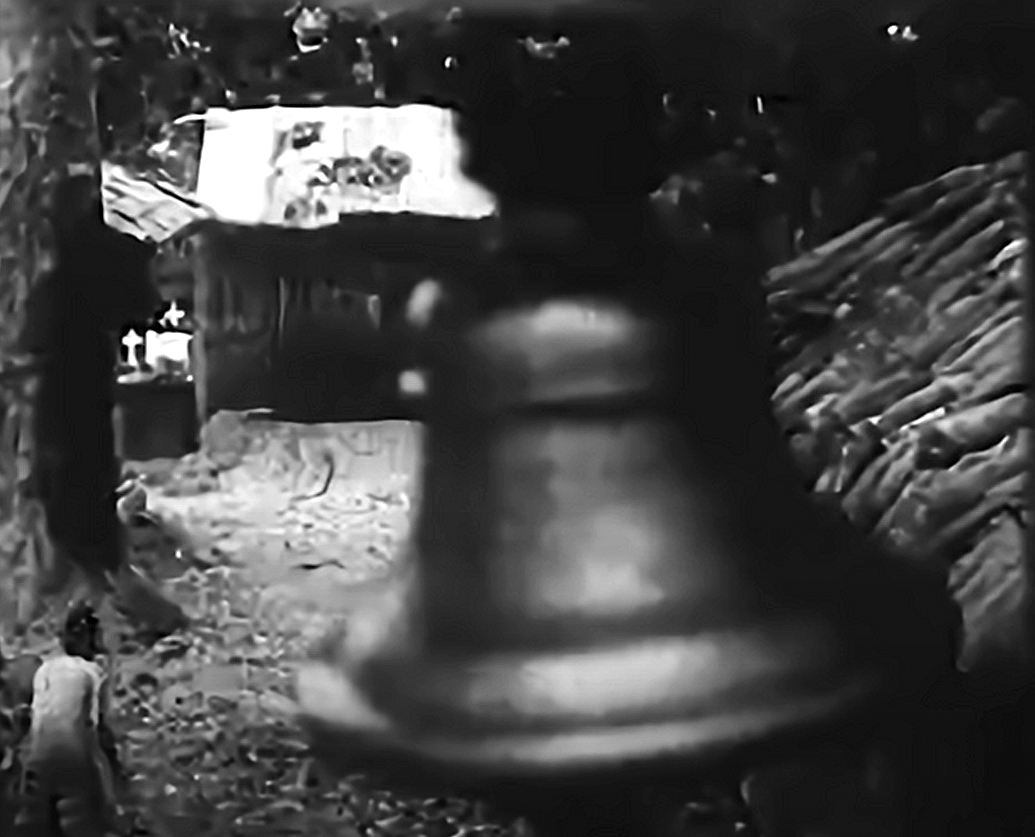
The bell in Ajantrik
Later in the film, a poignant parallel emerges between Bimal’s attachment to Jagaddal and a beggar’s heartbreak over losing his old tumbler. In that scene, Ghatak lingers on the beggar’s face – a study in quiet loss, which echoes Bimal’s own attachment to his old car. The montage of Jagaddal being dismantled is intercut with images of desolate hills, silence, and rusting tools. A child is seen sitting and honking the horn of the dismantled car. It’s not just a car being scrapped; the scene immediately transcends to the cycle of life.
Ghatak’s characters are frequently pushed to the periphery of the frame, often obscured, silhouetted, or dwarfed by their surroundings. In this refusal to centre the subject, he critiques a world where marginality has become the default condition of existence.
Ghatak’s deployment of the frame in Meghe Dhaka Tara is repetitive. He constantly displaces Nita and her elder brother Shankar, cutting them off from full spatial agency in a number of sequences. In a recurring visual motif, Nita is seen behind grillwork or framed through half-closed doors – even in moments of intimacy, such as her brief exchanges with her lover Sanat, the framing disrupts cohesion.
Doors, windows, even shadows cast like prison bars. This is where Ghatak’s mastery lies: the geometry of the image becomes psychological terrain.
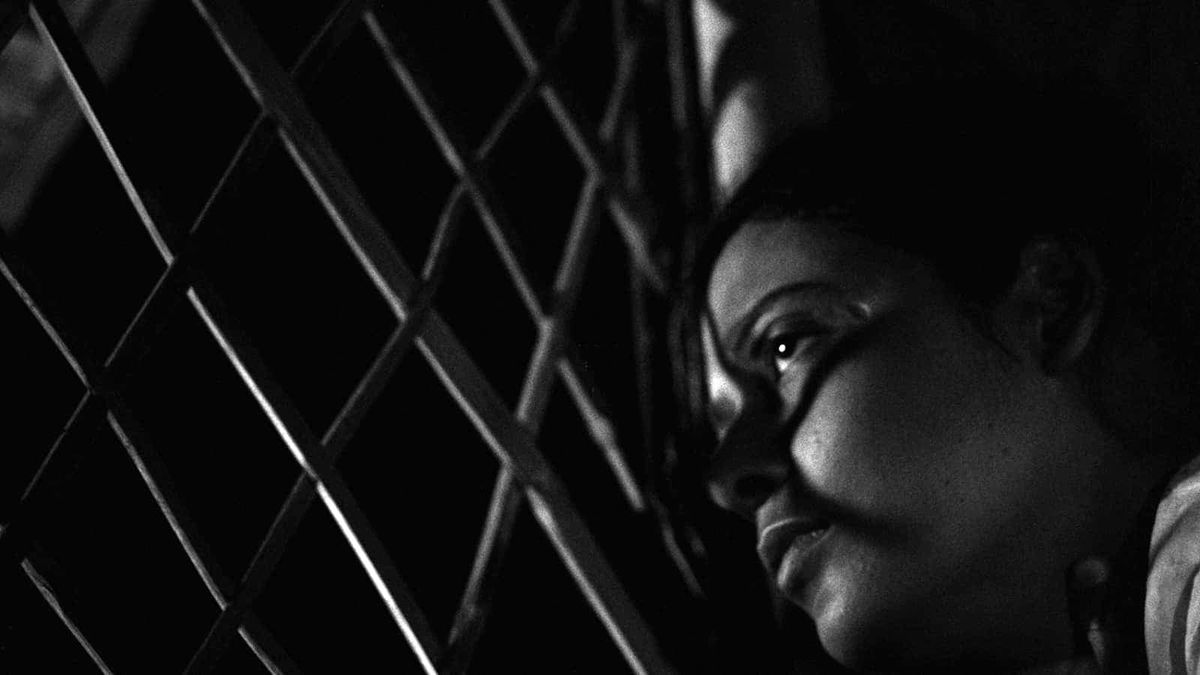
Nita, under the shadows of the window bars, her face offset in the frame
One iconic moment occurs when Nita discovers her sister’s presence in Sanat’s new home. Ghatak shoots Nita and her pain from a Dutch angle, placing her at the right of the frame, with a thin shadow of the window bar slicing across her face, as if she is dislocated from her space. The soundscape captures a sharp whipping, its pace gradually increasing. This compositional decision turns Nita’s heartbreak into a metaphor – she is not just betrayed and isolated but dislocated cinematographically.
A tormented Nita, placed marginally at the right side of the frame, the soundscape shocks with a sharp whipping.
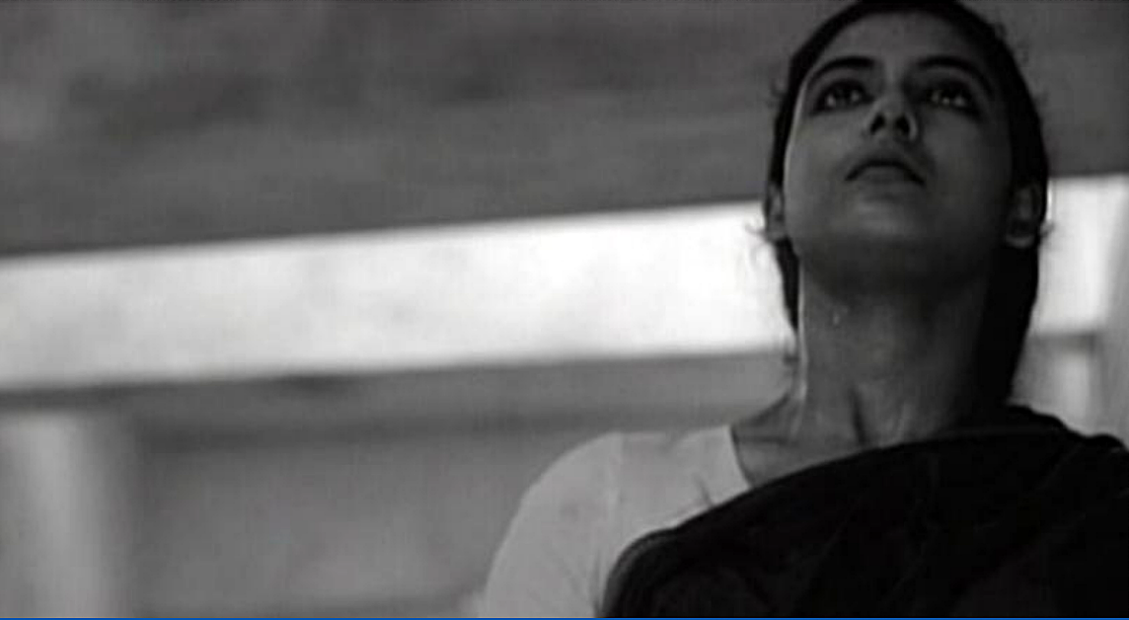
A tormented Nita, placed marginally at the right side of the frame, the soundscape shocks with a sharp whipping.
In Cinema and I, he writes, “Whatever is pretentiously dull or breathtakingly spectacular is not necessarily art… Art consists of bursts of fancy. Whatever may be the genre, art brings with it the feeling of being in the presence of living truth.” Ghatak’s ‘truth’ resists clarity. It is oblique, jagged, and fractured.
The film’s most iconic moment, when Nita breaks down and says, “Dada, aami banchte cheyechilam” (Brother, I wanted to live), is unparalleled in Indian cinema. Ghatak stages it against a backdrop of mountains, amidst wind and echo. Rather than centring Nita, the camera doesn’t focus on her at all; the vast expanse of the horizon fills the screen. Just before this emotive eruption, a small child is seen walking through the foreground, indifferent to her pain. This compositional choice is devastating. The child, faceless and moving toward the unknown, contrasts with Nita, static and shattered. Life, indifferent, continues.
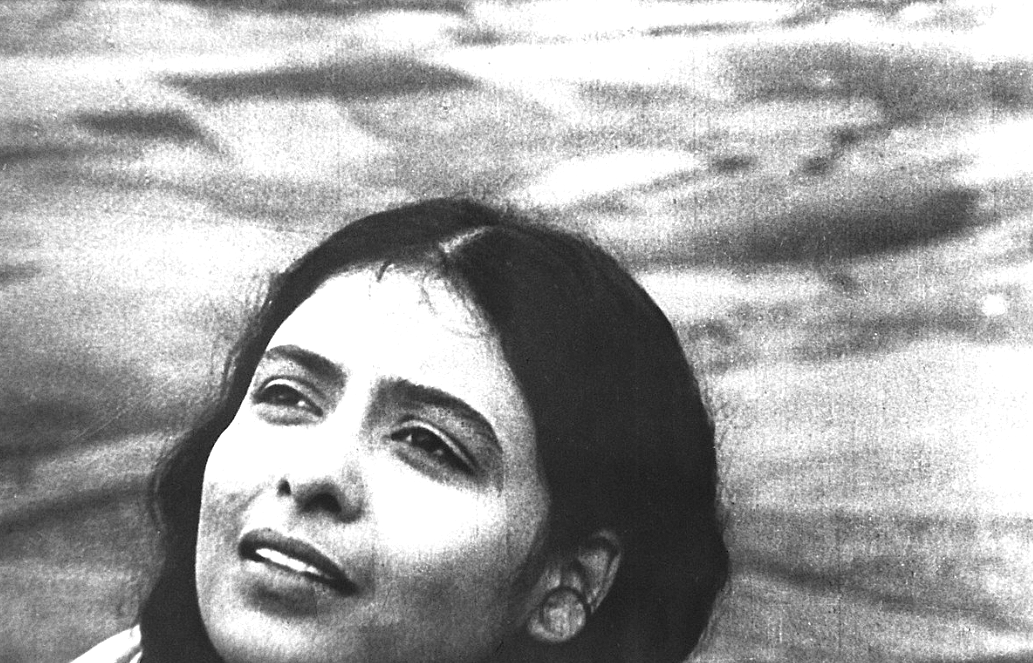
“Dada aami banchte cheyechilam” – Nita’s face at the bottom left of the frame
In his essay, ‘Music in Indian Cinema and the Epic Approach’, Ghatak said: “We must realize the epic is not grand because of its scale – but because it transforms personal grief into collective truth.” Nita’s suffering is not merely personal; it is cosmic, civilisational.
His short story ‘Eyes’ offers an early blueprint of his vision. The narrator describes a woman “whose eyes held a monsoon sky – not weeping, not dry – but waiting for a storm to begin.” Nita’s character is built on similar tension: she holds the sky, yet no one looks up. She remains unacknowledged.
Thus, Meghe Dhaka Tara is not just a story of a woman’s sacrifice. It is an invocation of the archetypal feminine force, eroded by patriarchy, capitalism, and displacement.
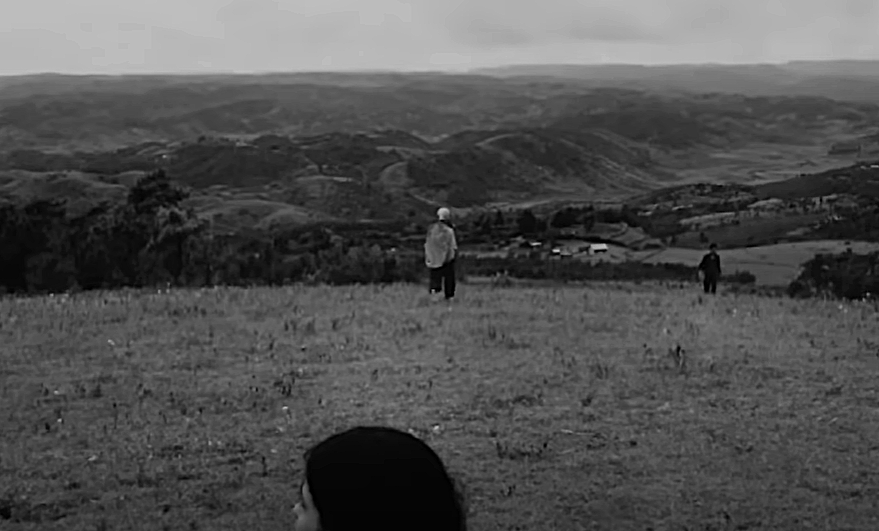
In the sanatorium, Nita’s head is placed at the bottom left of a wide landscape. A boy walks to the horizon
In Subarnarekha (1965), Ghatak reaches perhaps his most heartbreaking articulation of post-Partition rupture. The story of Sita and Abhiram – raised as siblings in the refugee colony and later, star-crossed lovers – is not merely tragic. It is an anti-epic, a reversal of the Ramayana. While the divine Sita was dislocated by Rama and she returned to earth after proving her chastity, Ghatak’s Sita is dislocated by the very system that once called her sacred. As a precursor to the dislocation, in one of the film’s most startling scenes, a young Sita is confronted by a Bahu Rupi – a traditional folk performer dressed as Mother Kali. The encounter is brief, but his sudden appearance is a shock. The Bahu Rupi’s mask looms large in the frame, his monstrous form exaggerated by a low-angle lens and the sudden cut to Sita’s frozen face. The sequence carries clear allegorical weight: it suggests an impending demonic fate.
This moment resonates with a passage from Ghatak’s story ‘The River’s Edge’, in which a child runs from a masquerade and mutters: “I know that face. It used to be the god who danced during festivals. Now he only comes when someone dies.” The evolution of the sacred into the sinister is central to Subarnarekha‘s basic theme.
What’s especially striking in Subarnarekha is Ghatak’s insistence that mythological symbols emerge not from temples or texts, but from the ordinary lives of people. In one powerful scene, when Abhiram discovers his biological mother, Kaushalya, dying near a railway station, the moment is not captured in traditional linearity. It is fractured and split with apparently incoherent shots. Beginning with Abhiram’s face and his mother’s face, intermittently captured in haze, kept out of focus from the perspective of their respective gazes, the shot leaves them and the camera captures a train entering the station, moves to a child in a cradle, and ends with a fisherman throwing a net into the river. The soundscape captures somebody lamenting, “Bagdi Bou mara jaachchhe” (“The lower-caste woman is dying”).
Through this inconsistent and fractured mise-en-scène, Ghatak shocks his audience and reveals many things. Abhiram first discovers he is not the son of a brahmin, but of an outcast. The story of separation between mother and son in the original mythology of Ramayana is retold and recast as the story of a mother’s and son’s dislocation in a landscape of outcasts. There is an element of revolt. The rest of the fractured montage leaves the interpretation open to the audience and elevates the sequence to the level of poetry.
One such interpretation may be a cosmic view of the world at large, with two opposing themes: one, the loudly whistling train, representing a machine-driven, mechanical society; the other, the fisherman, representing old rural tradition embedded in nature. Both worlds remain indifferent to Abhiram’s shock and personal mourning as he and his dying mother, Kaushalya, stand at the verge of a final separation.
Ghatak’s essay ‘Experimentation: My Only Religion’ captures this tension: “I do not want to copy our gods. I want to show what happens when our gods forget us. That is the modern epic.” Subarnarekha thus becomes a modern myth of the forsaken.
In the short story, ‘The Earthly Paradise’, a woman asks, “Where do rivers take our names when they forget us?” Ghatak answers through this film: Rivers don’t forget; they just keep flowing. In Subarnarekha, the streak of gold is memory itself – ever-receding, ungraspable, already lost before it is found.
Komal Gandhar revolves around Anusuya, a strong-willed and idealistic woman, and Bhrigu, a passionate theatre director. They belong to rival theatre groups, which had once been a united leftist cultural front, but are now split due to ideological differences and personal ego clashes.
Through the medium of theatre, Ghatak critiques the fragmentation and fracture of both the political left and Indian society, drawing a parallel between the broken theatre group and divided Bengal.
The mythological underpinning of Komal Gandhar emerges most clearly in the character of Anusuya, whose emotional trajectory echoes Shakuntala from Kalidasa’s play.
Ghatak doesn’t mirror the Shakuntala myth; he transforms it. In his framing, Shakuntala is not the lost beloved, but the memory-bearer. She is not reclaimed; she chooses whether or not to bond with her homeland, her fractured space. This shift draws upon Rabindranath Tagore’s seminal essay on Shakuntala, in which he distinguishes her from Shakespeare’s Miranda (The Tempest). Miranda, Tagore argues, is innocent because she knows nothing of the world. Shakuntala, by contrast, is emotional because she remembers too much. Ghatak’s Anasuya resembles Shakuntala.
The personal-political-ideological fracture becomes the central dissonance of the film. Bhrigu’s commitment to a different theatre group mirrors the fragmentation of the left – each faction clinging to its truth, forgetting the shared emotion that once united them.
In a poignant moment, Bhrigu and Anusuya stand by a disused railway track, a powerful visual metaphor for separation. As Bhrigu reflects on the past, he laments the division of their homeland, saying, “That was our land, our home.” Anusuya, sharing in this sorrow, responds, “Our Bangladesh, what has become of it?” This exchange underscores their shared trauma and the emotional distance that has emerged between them.
A standout sequence on the same railway track features a tracking shot accompanied by the haunting refrain of ‘Dohai Ali.’ This scene symbolises the division and longing that permeate the characters’ lives. The music’s crescendo mirrors the escalating emotional intensity, culminating in a visual representation of separation and yearning.
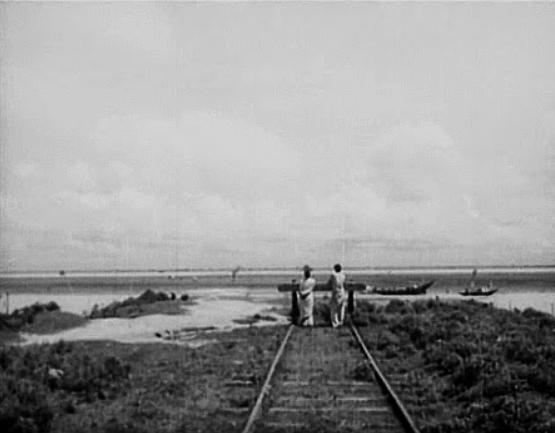
Anasuya and Bhrigu, physically distanced, standing on a railway track. Partitioned Bengal on the other side of the river
Ghatak’s earlier short story, ‘On the Trail of the Milky Way’, contains a striking precursor: “They told stories in rooms that echoed, but no one clapped. The stars listened. And sometimes, that was enough.” In Komal Gandhar, Ghatak seems to extend this idea. The characters rehearse plays, sing in empty halls, wander through fractured spaces, not for applause, but to hold on to meaning. Theatre is not performance; it is preservation.
In his essay ‘What Ails Indian Filmmaking?’, Ghatak writes: “Our stage, like our society, is full of false props. But behind the curtain, something real is always humming—a song, a sob, a memory. That’s where cinema should go.” Komal Gandhar goes precisely there. It stages the myth of waiting, not as sentiment, but as strategy.
The aesthetic of Ghatak’s films is frequently haunted by mother archetypes. In Meghe Dhaka Tara, Nita’s mother is pragmatic, cruel in love. Nita, in contrast, represents a mother who sacrifices. In Subarnarekha, the mother is replaced by Sita, who takes care of Ishwar, her elder brother. The mother is also demonic, a symbol of destruction in the form of Mother Kali. In Komal Gandhar, mothers are memories of lost spaces.
And then, there is the music. Komal Gandhar – ‘the soft note.’ A note between notes. The aesthetics of Ghatak’s cinema resides there – in the interval, in the fracture.

Whether you are new or veteran, you are important. Please contribute with your articles on cinema, we are looking forward for an association. Send your writings to amitava@silhouette-magazine.com

 Landscape of Exile: Individual and Cultural Alienation in Ritwik Ghatak’s Films
 Ritwik Ghatak: A Crusader Of The Rootless
 Something Like an Autobiography: A Critical Reading of Komal Gandhar
 Riverine Stories: Titas and Ritwik Ghatak’s Cinematic Departure
 Reason Ramblings and Redemption
 No Cloud-capped Star, Ritwik
Silhouette Magazine publishes articles, reviews, critiques and interviews and other cinema-related works, artworks, photographs and other publishable material contributed by writers and critics as a friendly gesture. The opinions shared by the writers and critics are their personal opinion and does not reflect the opinion of Silhouette Magazine. Images on Silhouette Magazine are posted for the sole purpose of academic interest and to illuminate the text. The images and screen shots are the copyright of their original owners. Silhouette Magazine strives to provide attribution wherever possible. Images used in the posts have been procured from the contributors themselves, public forums, social networking sites, publicity releases, YouTube, Pixabay and Creative Commons. Please inform us if any of the images used here are copyrighted, we will pull those images down.




































































Very significant essay on Ritwil Ghatak’s aesthetics and he core ideas recurring in his body of work. For the first time somebody has referred to Ghatak’s literary output to explain fountainhead of his aesthetics.