Stay tuned to our new posts and updates! Click to join us on WhatsApp  & Telegram
  Channel
& Telegram Channel & Telegram Channel 




The people like Cathy and Reg from Cathy Come Home, or the jobless protagonists like Yosser from Blackstuff are all casualties of the Welfare state.
 After the violent and cataclysmic events that shook the European continent during the first half of the twentieth century, Europe was naturally reluctant to go back to its old aristocratic ways. Most of the continent in ruins, Western European governments embarked on an effort to put their nations’ long suffering populace on a firmer foothold. Partly to improve the quality of life and also partly to dilute the appeal of radical ideas like communism and fascism, they adopted a broadly left leaning socialist system within a liberal democratic framework of government – giving birth to the welfare state system.
The ‘Welfare state’ is run by the people’s representatives to provide for the welfare of the people. Access to affordable but quality Education, Health, Housing and other benefits that a citizen has rights to enjoy are guaranteed by the government. Most of the Western European countries adopted this model of governance, to a varying degree of success. As the war refugees settled down and the post war economic boom followed, the displacement of people in Europe, in its most literal term, became a thing of the past. Or did it?
Ironically, it is the welfare state system whose actions inadvertently displace large sections of people who are forced to live almost like refugees in their own country or city. It is rather hard to imagine that any displaced people exist at all in the economically developed, civilized world of modern day Europe. And I am not, repeat not, pointing my fingers to the flotsams of the society, nor the lunatic or criminal fringes who prefer to remain displaced by their own accord or are on the run by acts of law enforcing agencies. I am referring to perfectly middle class, law-abiding citizens, who, aided by a mixture of sheer bad luck, insensitive government agencies and unhelpful fellow citizens, become displaced – displaced from their workplace, from their home, from their family support systems, and from their dreams for a better future.
 The seed to displacement is again within the welfare state system itself. Unfortunately the welfare state, while striving to take care of its people, creates a bloated and indifferent officialdom, which cares more about its own welfare rather than the people whose welfare they are supposed to look after. Not that the officials become corrupt or dishonest, but their obsession with processes, methods, files and forms in triplicate that clouds their view of the real world and real people. The classic BBC TV comedy series of the 80s, Yes Minister is one of the finest examples of the grip that bureaucracy has over government and implementation of its policies. In a particularly ironic episode, we learn about a newly constructed Hospital staffed with 300 people, but without a single patient, allegedly because the government has no resources left to treat the patients!!! The entire episode leaves us breathless at the callous indifference the bureaucracy has towards the masses.
The above example can also be seen as the “displacement” of the idea of the welfare state from its stated aims. Whilst a welfare state need not degenerate into a dictatorship or a tyranny, best depicted in Animal Farm, the common man nevertheless faces an indifferent bureaucracy in most of the countries. The renowned TV series Boys from the Blackstuff, by Alan Bleasdale made against the bleak backdrop of industrial depression during the Thatcher years of early 80s springs to mind as an example of how the working class gets stripped off its dignity by unemployment and insensitive bureaucracy. In a number of episodes, the role of the government employment agency is itself questionable. Instead of helping the jobless to stand on their feet, the agency is seen to be more active in tracking down the unemployed people (like Yosser, a father with 3 kids) who try to make ends meet doing a bit of moonlighting while staying on dole. Here we see another example of welfare system getting displaced from its aim of providing jobs to the jobless, diverting its energies towards tackling benefit fraud.
Another outstanding example of a study in multiple layered displacement is the TV film Cathy Come Home, which we will discuss at length. Without resorting to melodrama, it strives to show how a family is affected by physical and mental displacement within a welfare state, as well as the already mentioned displacement of the welfare state system itself from its lofty ideals. In this film, the indifference and insensitivity of minor government officials at every level of the British welfare state system towards Cathy’s hapless family relentlessly builds up to the tragic end of the movie. Maybe the officials are not directly to blame, but their system of processes and attitude towards their fellow citizens is instrumental in leading up to the displacement of a young family from everything they held dear.

Made in 1966 for BBC Television as a part of the Wednesday Play series, Cathy Come Home is a scathing drama about a young family’s slide into homelessness and poverty in 1960s Britain. Starring Carol White as Cathy and Ray Brooks as her husband Reg, the film was written by Jeremy Sandford and directed by Kenneth Loach. To this day, it remains a defining moment of Television drama, paving the way for ‘docu-dramas’ and firmly established the reputation of TV as a powerful media that can influence the public opinion and political agenda of the day by focusing on topical and often controversial subject matter.
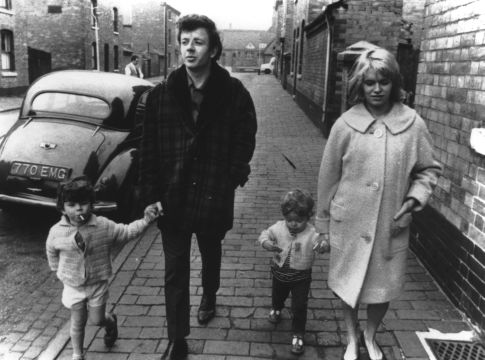
The drama follows young lovers Cathy and Reg from their initial happier days in London, Cathy as a modern young bride and Reg a cheery, optimistic fellow with a decent job, as they look forward to a settled comfortable life in a home of their own. They rent a costly apartment, “it even smells different”, and were even contemplating buying a property of their own. When, however, Reg meets with an accident and loses his job, their cosy life slowly starts to unravel. Their financial standing as a family in tatters, their downward spiral starts and continues hard and brutal till the very end. Firstly, it made itself manifest in its most physical form. Unable to afford the rent of their new home, the young family moves in with Reg’s mother in her small tenement flat. This was just the start of their displacement. They next move into a slum housing, then onto a caravan park, and ultimately to different hostels, before the repeated displacements have their final disastrous consequence on this once happy family. The film follows a traditional linear narrative style, and we find the family struggling endlessly and ultimately losing out, displaced from being a hopeful and relatively affluent young family to destitution, poverty and homelessness.
Close to the heels of their physical displacements, what starkly stands out is the displacement of their common dream. At the start of the film, we were given a glimpse of how Cathy and Reg planned their future, the mood being positive and light-hearted, with peppy music playing in the background. They plan the interior decorations of their new home, which came with double glazing at the windows, parquet flooring and other goodies of a modern apartment. However, their dream undergoes a major shift in its character as they are forced to move again and again. Reg, recovered from the accident, dreams of getting a decent job, which will pay enough for him to be able to afford a shelter for his young family. They no longer dream of “the flat with the bottle openers on the walls”, but more of a basic accommodation where they can seek shelter. Cathy simply dreams of keeping the family together as it is threatened and torn apart by continuous disruptions. This can be portrayed as the displacement of lofty dreams and their replacement by more pragmatic and realistic ambitions.
The recurring theme of physical displacement of the characters from their home and hearth forms the core of the narrative, and also the crux of the problem. When the family first moves into Reg’s mother’s little flat, usual sparks start flying between Cathy and her mother-in-law and it was clear that the modern young couple will have to move out soon. This universally familiar displacement scenario (if we can at all call it as displacement, in all seriousness of the term – moving out after disagreements with in-laws), at first seems clichéd, but it ominously indicates that more family breakdowns and separations are looming ahead, and this time, it will be Cathy’s family who will be on the block.
The family moves into a run-down, slum housing in a back street. But their luck runs out when the kind landlady dies and her relatives want back the possession of the rooms and the rent in arrears. The family, threatened with an eviction order, desperately searches for a home, only to get rejected by the landlords. Here they have their first brush with a government official, who symbolised the insensitive pattern that the official processes tend to be. He explains that the housing needs are accessed by a ”points” system, and they do not qualify for priority allocation to flats in the new housing developments. So the first forcible eviction follows. As their household articles are strewn over the gutters, Cathy can only cry helplessly. The official mutters “I am only doing my job”, as if to wash away the guilt from his hands.
This pattern follows, as the family, now with three children, moves into a caravan park. Life is difficult and dirty, but they survive somehow. But the local people who wants the area cleaned up for development, resort to strong arm tactics to evict these homeless people, and it climaxes with a fire in one of the caravans, which kills a baby. Ken Loach used his cameras to great effect, as we see the camera shift from one desperate face to another, trying to control the raging fire with buckets of water. Another displacement, and this time into a derelict house, and then a last ditch attempt to stay in a tent in an open field, which obviously fails as they realise the futility of their struggle.
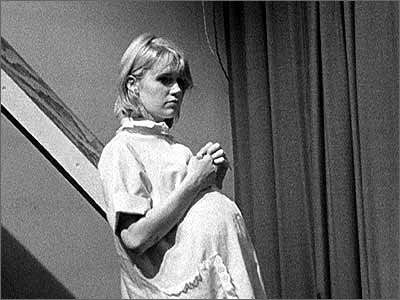 All the while, the family’s repeated homelessness provides us with another displacement scenario that the family has to undergo. It is the displacement of individuals in the family from their normal family life. Despite the best efforts made by Cathy and Reg, they had to concede that their family of five, the couple and three toddlers, cannot survive the relentless pressure of repeated displacements. The first casualty of this was the husband, Reg. When Cathy and her children had to move into a hostel for the homeless, Reg had to stay behind, as the facility was only for the mothers and children. His frustration was apparent when he threw tantrums at the nurse manning the gates of the facility. Reg had to get into the hostel surreptitiously through the back door during the night just to be united with Cathy, his wife. In a touching scene, Cathy weeps in Reg’s arms in the darkened hostel room, as she feels her normal family life slipping away inexorably. The second displacement from the family is that of their eldest son, whom Cathy had to keep with her mother-in-law till they find some accommodation. It’s another moving scene when Cathy waves goodbye to her child through a glass window. Merely a toddler, the child has taken repeated homelessness rather poorly, and can be seen as a victim, displaced from his parents and immediate family. As time goes by, Cathy realises that Reg too is drifting away from family life. This is inevitable in the breakdown of the family support structure from which both of them are physically and mentally displaced, and it is no longer possible even to keep up the pretence of a family. Somewhere in their journey, they have become hostage to the welfare state. It appears that the couple has lost their position in the queue for allotment of a flat in the new housing estates being developed by the government due to their frequent movement resulting from repeated displacement, and ironically now it is the turn of the government to blame them for their misery.
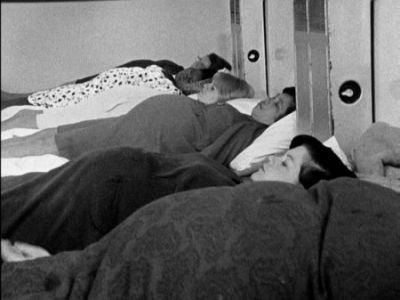
The welfare state, which does precious little till the crisis boils over, now steps in with missionary zeal to “save” the children from such delinquent parents. When Cathy is moved next to a dormitory with her two remaining children, it’s merely a question of time when even these children will be taken away from her. In the words of an official to Cathy, “We are not interested in you any more, it’s the children we are worried about. If you cannot find a place for them, we have to do so.” In the final climactic sequence, Cathy flees to a railway station with her children, one still in a pram, in a last desperate attempt to keep the family (or whatever is left of it) from falling apart, where the welfare officials seize the children to remove them to government shelters.
The disintegration of Cathy’s family, which starts with the in-laws, then moves to her beloved husband, and finally claims her children one by one, is now complete. The pressure of displacement has destroyed her family, at the end not even sparing her most intimate familial bonds – that between a mother and her children – leaving her alone and aimless at the side of the highway.
That the welfare state is itself displaced from the lofty ideals which it is supposed to adhere to is obvious enough. Somewhere the whole concept has gone horribly wrong. When the camera accompanies the homeless couple in the offices of various government departments, and where they face the faceless bureaucrats lording over the hapless citizens, the officials seem detached from reality, displaced in the ivory towers of their make belief surroundings, where men and women are mere statistics. Time and again Cathy finds herself at a loss at the lack of understanding from the bureaucrats, the white collar administrators who are merely “doing their job”. They try to help – keeping within their well laid down processes of course – but their effort seems so absurdly outlandish or banal that we start to loathe them. But that was what director’s point was. Ken Loach used real life council officials to play some of the parts, not just as a gimmick, but also because they play these parts day in and day out as their job, their career. In the final scene, when Cathy’s children are forcibly taken away from her in the Railway station by the government officials, we tend to think of them as positively cruel and inhuman. Do we not notice a displacement of the idea of a welfare state? How it should be run and how it has degenerated into a bureaucratic monolith?
The people like Cathy and Reg from Cathy Come Home, or the jobless protagonists like Yosser from Blackstuff are all casualties of the Welfare state. They are pushed around like so much human litter and nobody is willing to help them. And its’ all happening in contemporary Britain, which proclaims itself as a model of welfare state, where “Cradle to Grave” social security system is in place. Although nearly two decades divide these two, the displacement of the welfare state from the utopia it aims to create remains as distant as ever. These films serve as a bitter reminder that these people could be anyone like us, respectable citizens much as the same as anyone else, whose lives and dreams have been torn apart and displaced by the so called “welfare state system” of developed countries.
(All pictures used in this article are courtesy the Internet)

Whether you are new or veteran, you are important. Please contribute with your articles on cinema, we are looking forward for an association. Send your writings to amitava@silhouette-magazine.com

Silhouette Magazine publishes articles, reviews, critiques and interviews and other cinema-related works, artworks, photographs and other publishable material contributed by writers and critics as a friendly gesture. The opinions shared by the writers and critics are their personal opinion and does not reflect the opinion of Silhouette Magazine. Images on Silhouette Magazine are posted for the sole purpose of academic interest and to illuminate the text. The images and screen shots are the copyright of their original owners. Silhouette Magazine strives to provide attribution wherever possible. Images used in the posts have been procured from the contributors themselves, public forums, social networking sites, publicity releases, YouTube, Pixabay and Creative Commons. Please inform us if any of the images used here are copyrighted, we will pull those images down.