Stay tuned to our new posts and updates! Click to join us on WhatsApp  & Telegram
  Channel
& Telegram Channel & Telegram Channel 




That’s how Nabendu Ghosh remembered Ghatak

Nabendu Ghosh
January of 1947 was winding up. The Partition of India was yet to happen. A literary meet in Rajshahi (now in Bangladesh) invited Manoj Basu and Narayan Gangopadhyay. And I had the good fortune to be the third writer in the team.
We reached Rajshahi a day before the meet was to begin.
The organisers had arranged our stay in an enormous mansion occupied by a miniscule-part owner of the mammoth property. The building was surrounded by trees and trees.
Hoping to get my speech out of the way, I retired to the room allotted to me. But as soon as I settled down with pen and paper, Manoj Da and Narayan Babu showed up. We chitchatted for some time about this and that – and at the fag end of the adda, ghosts entered the discussion.
Narayan Babu took the floor. His manner of speaking heightened the mystery and the drama. When we wound up our stories, Manoj Da and Narayan Babu returned to the adjacent room. And I spruced up the fool’scap papers to complete the speech I’d started drafting. No longer had I settled down when the personas of Narayan Babu’s tales started casting their long shadows on my imagination. In the quiet of the midnight chequered only by the cricket’s song, my spine started to tingle with fear. I can’t fully recall the story Narayan Babu had narrated but the the graphic details of one of the paras got etched in my mind.
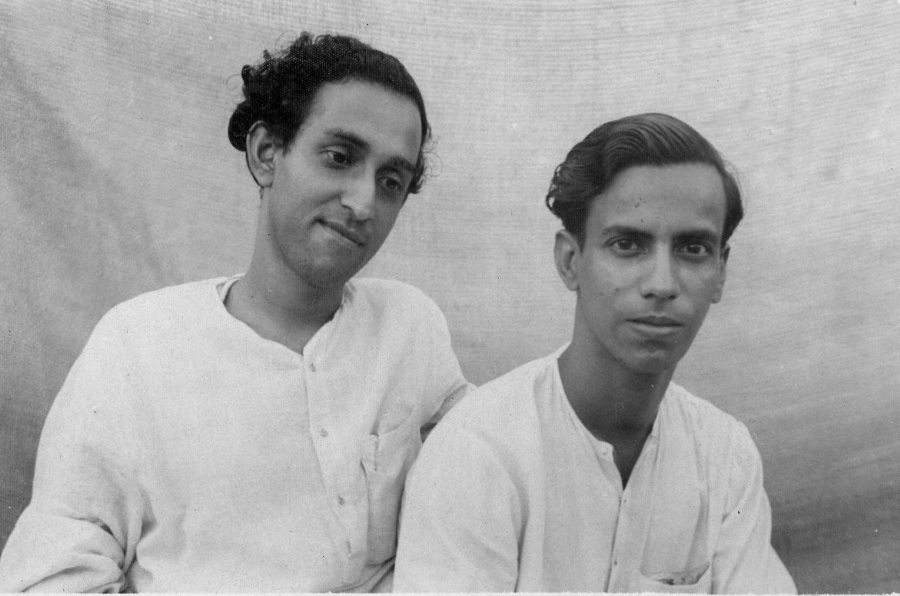
Nabendu Ghosh (right) with Narayan Gangopadhyay (Pic: Ratnottama Sengupta)
The protagonist of his story was immersed in reading a novel when suddenly he heard a sound. Startled, he looked up to see a long tongue stick out of the wall and lick up the semi-fluid kheer resting on the table. He could not ignore the slurp-slurp sound of the act.
That night, while jotting down my thoughts, I could not stop myself from glancing every now and then at the walls around me. Once I finished writing and put the cap back on the pen, I went to sleep but I did not switch off the light.
—xxx—
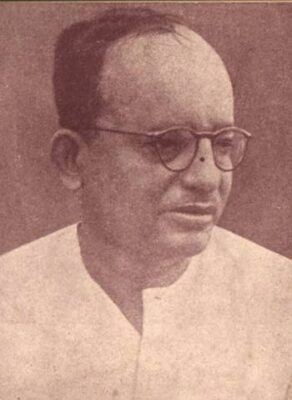
Manoj Basu (Pic: banglaclassicbooks.blogspot.com)
The next morning, we completed the ritual of morning tea in the giant drawing room of that mansion. I proceeded to finish the chore of shaving while Manoj Da and Narayan Babu got busy with the other morning routine – of devouring the newspaper: Manoj Da with the English daily Amrit Bazar Patrika and Narayan Babu with the Bengali Ananda Bazar Patrika.
At this juncture, someone came to visit them. I could gauge this from the sharp and forceful voice that seemed to be asserting itself in the drawing room.
By the time I finished shaving, it seemed the stranger in the drawing room was having a heated exchange with Narayan Babu. Both voices were speaking at a high pitch. Hastily, I splashed after-shave and made my way to that room.
The visitor was a young man, perhaps 22 or 23 years of age, fair-complexioned, lean and tall. He was arguing with Narayan Babu. Unnoticed, I stood at the door listening to them. I could make out what they were arguing over. I remembered that, just days ago, an essay by a member of the Communist Party of India was circulating amongst the members and supporters. Everywhere it was being avidly discussed in animated whispers. The topic? ‘Is Rabindranath a Reactionary?’ This was indeed the thrust of the essay.
The excitable young man was saying, “You’re an esteemed and popular literary figure of Bengal. That’s not all. You are one of the most distinguished professors of Bengali literature. In spite of boasting such learned members, this unknown person — Barin Roy — has the audacity to dub the supreme name in Bengali literature as ‘reactionary’!”
Narayan Babu laughed in reply. “This individual has written a thesis — but we don’t agree with him.”
The young man also made an attempt to laugh. But the voice did not lose its edge. “If most of the Party members did not agree with him, how did his thesis get published and distributed?”
Manoj Da agreeably intervened, “Is there any need to prolong this discussion, dear? Narayan Babu does not concur with Barin Roy’s statement — but the Party is not paying any heed to him either. So console yourself with the thought that Narayan Babu is supporting your protest.”
At this, the young man’s body language changed. As did the pitch of his voice. There was a softness, a respect shimmering in his eyes now.
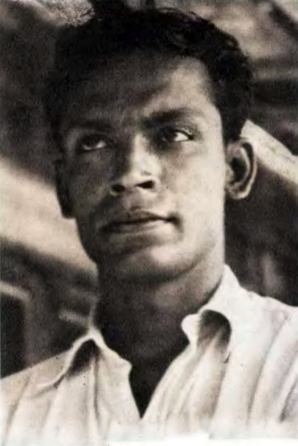
A young Ritwik Ghatak
Manoj Da turned towards me and introduced us: “This is Ritwik, the youngest brother of a renowned poet.”
“Poet Manish Ghatak’s brother,” Narayan Babu added. Then he addressed the young man, “This is the eminent writer Nabendu Ghosh.”
The young man named Ritwik stood up, folded his hands in a Namaskar and said, “I have read some of your stories. I am truly fond of your writing.”
“Dhanyawad,” I thanked him.
Tea for me arrived at the scene. In the course of the conversation, I learnt that the Ghataks are a highly respected family of Rajshahi. Further, each and every member of the Ghatak family has a talent in one or the other art.
After a while the younger brother of Manish Ghatak took leave, duly seeking forgiveness for his heated outburst.
Manoj Da commented, “Manish Babu is a highly placed official — a magistrate. In the government circles, he holds a lot of clout. In the realm of Bengali poetry too, he strides with great assurance. His youngest brother also has great sway!”
We laughed out loud in amusement.
***
The literary meet commenced that very evening. Casting my eyes this way and that I spotted the young man from the Ghatak family. Attentively, he was listening to Manoj Da. And while the loaded speech was in progress, I recalled these lines from a romantic poem of Manish Ghatak.
The temple bells chimed to ring in
The hours of evening prayers…
The reverberations came to a lull
At the crest of Nandan hills.
The lights that leapt to life in a trice
Kept shimmering
In the secret chambers
Of two throbbing hearts
In the loft.
So this Ritwik Ghatak is the youngest brother of that poet, Manish Ghatak.
**
1949.
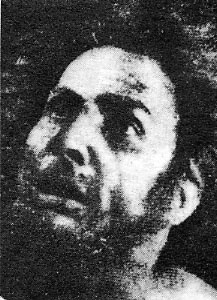
Bijon Bhattacharya
In the meantime, the West Bengal government banned Gananatya Sangha – the People’s Theatre Movement, the radical theatre group which attempted to bring social and political awareness in rural Bengal during the colonial rule. So Bijon Bhattacharya, the reputed director of Nabanna, along with Sudhi Pradhan, author of Marxist Cultural Movement in India: Chronicles & Documents, formed another group, Natya Chakra. They decided to stage a series of plays, among which was Dinabandhu Mitra’s Nil Darpan. The 1860 classic exposed the brutal exploitation of Indian farmers by British indigo planters.
I got a call to be part of the cast.
The indigo planters used to lock up many farmers in cramped rooms. I was one of the three-four farmers — and another youth dressed up as a farmer was Ritwik Ghatak.
The directors team of Bijon Bhattacharya and Sudhi Pradhan included another name – Mrinal Sen. And the cast of Nil Darpan included Geeta Som, first cousin of actor Anup Kumar. In the days to come she would tie the knot with Mrinal Sen.
The first night of Nil Darpan caused a stir among the theatre lovers of Kolkata. We, the members of Natya Chakra were exhilarated.
From Eka Naukar Jatri/ Journey of a Lonesome Boat by Nabendu Ghosh
Translation: Ratnottama Sengupta

Whether you are new or veteran, you are important. Please contribute with your articles on cinema, we are looking forward for an association. Send your writings to amitava@silhouette-magazine.com

 No Cloud-capped Star, Ritwik
 Bimal Roy: Why He’s Evergreen
 ‘My heart swells with pride when I see their work’: Nabendu Ghosh in conversation with Ameen Sayani
 The Dagdar Baboo of ‘Maila Anchal’
 Something Like an Autobiography: A Critical Reading of Komal Gandhar
 Landscape of Exile: Individual and Cultural Alienation in Ritwik Ghatak’s Films
Silhouette Magazine publishes articles, reviews, critiques and interviews and other cinema-related works, artworks, photographs and other publishable material contributed by writers and critics as a friendly gesture. The opinions shared by the writers and critics are their personal opinion and does not reflect the opinion of Silhouette Magazine. Images on Silhouette Magazine are posted for the sole purpose of academic interest and to illuminate the text. The images and screen shots are the copyright of their original owners. Silhouette Magazine strives to provide attribution wherever possible. Images used in the posts have been procured from the contributors themselves, public forums, social networking sites, publicity releases, YouTube, Pixabay and Creative Commons. Please inform us if any of the images used here are copyrighted, we will pull those images down.