Stay tuned to our new posts and updates! Click to join us on WhatsApp  & Telegram
  Channel
& Telegram  Channel & Telegram Channel




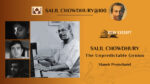
When we explore the works of Salil da and attempt to understand why he was unparalleled among his contemporaries, layers of his unique and insightful musical dimensions begin to unfold. Kunal Desai looks at some of them through his songs.

Lata Mangeshkar and Salil Chowdhury
(Pic: lataonline.com)
Little did Dr. Maloni know what legacy he was leaving behind when he left Hathikuli Tea Estate in Assam. His fondness for Western classical music resulted in a collection of many shellac records and a gramophone, which he didn’t take with him when he moved out of Hathikuli; his successor, Dr. Gyanendra Chowdhury, inherited that pile of records. The great composers, such as Bach, Beethoven, and Tchaikovsky, among others, whose work was pressed on those records, shaped the mind and musical insights of the young son of Dr. Gyanendra Chowdhury. His name was Salil Chaowdhury.
Apart from the numerous art forms that Salil Chowdhury explored, his work as a music composer in multiple languages, primarily Bengali, Hindi, and Malayalam, has kept music lovers and musicologists fascinated. A very interesting fact about Salil Chowdhury is that he began his artistic pursuits as a musician and songwriter and explored story, screenplay writing, and poetry in his lifetime. That’s why he can be called ‘Continuum of Art’. A continuum is a series or chain in which each link is a little different from the others, and at the end, the last one is completely different from the first one. Similarly, Salil Chowdhury, fondly known as Salil da, from a very small age began practicing music and in the epilogue of his life, he was a multi-faceted artist.

Salil Chowdhury and Mohd Rafi (Pic courtesy: Hamaraphotos)
When Salil da joined his brother Nikhil Chowdhury’s orchestra group called ‘Milan Parishad’, he was already playing flute. Here, he learnt to play the esraj, piano, and violin. Milan Parishad used to play music during dramas backstage, and young Salil da used to play the piano. This became the foundation and training ground for him to become an acclaimed background music composer. Later, he joined the Indian People’s Theatre Association (IPTA).
Artists from various fields joined IPTA to collaborate and create social awareness through the expression of art. During IPTA days, Salil da wrote songs, composed them, and took them to various nooks of Bengal. These were the compositions that stimulated social justice. He called them ‘Songs of Awakening’. These songs transformed the musician Salil da into a composer.
Raj Kapoor worked with Salil da in Jagte Raho (1955), and he used to call him ‘Master of Many Instruments’. Thus was the natural inclination of music in him that he could play any instrument that he laid his hands on. However, the flute stayed with him for a long time, and he used the flute very beautifully in his songs.
When Salil da began composing for films, especially in Hindi films, the trend was that musicians would assist established composers and eventually try to become independent music directors. In the case of Salil da, this never happened. He was a self-taught composer who established himself as a top league composer in films.
When we explore the works of Salil da and attempt to understand why he was unparalleled among his contemporaries, layers of his unique and insightful musical dimensions begin to unfold.
Let’s look at some of them through his songs.

Kishore Kumar recording a song with Salil Chowdhury as Shailendra and Cawas Lord look on. (Pic: Facebook)
Salil da had very early influences of Western Classical Music, which employed various techniques of collective singing, known as a chorus. Later, he also founded Calcutta Youth Choir and Bombay Youth Choir. Before we have a glimpse of his use of chorus and choir, it is very important to understand the difference between the two. Let’s also have a look at the use of each of the techniques during the songs.
A form of singing where a group of singers sing the same lines together collectively.
Jaago Mohan pyare (Jagte Raho, 1956) Shailendra / Lata Mangeshkar
A perfect example of the use of choir singing is in this song. The song begins with the high cry of men and women singing “jaago……”. Men in a low pitch and women in a high pitch singing the same words. This is a remarkable use of choir because not only does the layered singing sound better than an entire chorus singing in the same pitch, but also it is more impactful due to the listener’s mind registering the better-sounding chorus.
A form where various groups of singers sing the same lines in different voice pitches, which are called baritone, tenor, alto, and soprano in ascending order. This creates layers of voices in different pitches and sounds different.
Woh ek nigah kya mili (Half Ticket, 1962) Shailendra / Kishore Kumar and Lata Mangeshkar
An underrated gem of three legendary artists, Kishore Kumar, Lata Mangeshkar, and Salil da. This song is a unique blend of jazz, Indian, and western classical wherein the composition is set on swing rhythm in the sthayi and on Keherwa Taal in the antara with wonderful use of soprano pitch crooning by Lata ji. When Kishore da sings the scat words ‘aa ha ha aa ha……….’ Asha ji sings the vocal harmony on even a higher pitch. For a better understanding of the application of these techniques, let’s just enjoy this song.
On the other hand, choral harmony is a brilliant way of using vocals in place of instruments. Imagine a song wherein the singer is singing his or her lines, and in the background, a violin is playing a melody. In music theory, this is called harmony or obbligato. In simple words, what the violin is playing is a tune that harmonises with the vocals. Now, how would it be if the violin tune is replaced by another singer’s vocal singing the same tune? Well, that’s what is called Vocal Harmony, and when a chorus is singing such harmony, it becomes choral harmony.
Chalte hi jana (Usne Kaha Tha, 1960) Shailendra / Mohd Rafi
Choral harmony has always been a very effective expression when there is a situation of a picnic or group singing. Here, in this song, Salil da cleverly tapped the potential of choral singing, where a group of friends are on a trip in horse-drawn carts. Immediately as the song begins and Mohd Rafi sings the lines Chalte hi jana, ho chalte hi jana, jahan tak aaj ye raah chale, the chorus follows the same lines and, in the background, another small group of chorus singers croons the harmony. This is called choral harmony, where a group of chorus singers sing harmony for another vocalist’s vocals being sung in the foreground.
While we have seen how Salil da utilised his formative experiences of IPTA days in composing the film songs so effectively, let’s explore how the composer Salil da employed the technique of Vocal Harmony.
Vocal harmony is similar to choral harmony, with only the difference that in place of the chorus, only one singer sings the harmony while another singer sings the main lines of the song. The Bengali composers have used this technique very well. Let’s take a look at a few songs wherein Salil da has used it.
Dil tadap tadap ke (Usne Kaha Tha, 1960) Shailendra / Mukesh and Lata Mangeshkar
As the first antara of the song Tu nahi to ye bahar kya bahar hai comes to an end, and Mukesh ji sings the sign line Dil tadap tadap ke keh raha hai, Lata ji softly enters the song with her crooning of harmony that complements the singing of Mukesh ji and culminates at the same note in the end. Now, in place of Lata ji’s vocals, any instrument such as a violin or a flute could also have been used. However, Salil da chose to get Lata ji sing it to suit the situation of the song.
———-
Jaaneman jaaneman tere do nayan (Chhoti Si Baat, 1960) Yogesh / Asha Bhosle and Yesudas
Another lovely example of vocal harmonies sung by both duet singers alternatively for each other. At the end of the song, when Yesudas sings the line Janeman janeman tere do nayan, Asha ji sings the harmony in scat words la la la, and when Asha ji sings Mere do nayan chor nahi sajan, Yesudas ji sings a similar scat words harmony. This beautiful twist gives a nice conclusion to the song.
The typical structure of our film songs is a derivative of Dhrupad singing, where the song is typically divided into sthayi – antara – sanchari – antara with interlude music in between. The tune of a sanchari is different than the tune of the antara. It is really a skilled job to compose a Sanchari because the tune is completely different than the antara, it must fit into the lyrical and harmonic structure and in the Chhand or Meter of the song. Generally, the film music composers in the Hindi cinema have not ventured to compose Sanchari in their songs. However, Salil da did compose two beautiful songs with Sanchari. They are –
O sajana barkha bahar aayi (Parakh, 1960) Shailendra / Lata Mangeshkar
In this song, the verse Aisi rimjhim mein o sajan, pyase pyase mere nayan, tere hi khwab mein kho gaye that we listen to after the first antara is sanchari.
———-
Naa jiya lage naa (Anand, 1971) Yogesh / Lata Mangeshkar
In this song, the verse Naa jiya lage na, Piya teri bawari se raha jaye na that comes after the first antara is sanchari.
Composers in films have discovered very early that short phrases in simple Chhand or Meter makes the composition easily appealing to audiences because of the simplicity of the composition. If the sthayi or mukhda of the song features short phrases with some musical pieces, it becomes hummable and quickly accepted by the audience. Many popular and very successful songs in our films are composed on this formula.
Here, Salil da takes a non-conformist approach. He has composed songs with longer phrases that fit into his complex tunes. Why complex? Because his tunes used to have many jumping notes, such as Sa to Ma, without any bridge notes in between, to help the singer reach very high notes directly from the low note.
As a result, the singers had to work hard to understand and deliver the composition as envisioned by Salil da. He has gone on record saying that his tunes were not very easy to sing. He has always created music that he enjoyed composing, and as a result of this process, some brilliant songs were born. Let’s look at them :
Sawan ki raaton mein (Prem Patra, 1962) Gulzar / Lata Mangeshkar and Talat Mahmood
A song with a poetry recital and a lovely monsoon romance feel.
———-
Madbhari ye hawayein (Anokha Daan, 1972) Gulzar / Lata Mangeshkar
A song with long phrases in sthayi and antara with lovely hummable tune.
———-
Guzar jaye din (Annadata, 1972) Yogesh / Kishore Kumar
A song that has long sthayi and the tune with jumping notes.

Lata Mangeshkar, Salil Chowdhury and Manna Dey
———-
Kanha bole na (Sangat, 1976) Jan Nisar Akhtar / Lata Mangeshkar and Manna De
A song from an unreleased film. The melodic flow and its subtle tone make it even more enchanting. Had this movie been released, this song alone would have become the identity of the film.
Every composer has their own preferred sound design or settings for their songs through which they can create their best compositions. Sound design consists of choice of instruments and style of arrangement. In the compositions of Salil da, we can observe some of the peculiarities that indicate his style of composing.
Salil da learnt to play flute from his early childhood, and the flute stayed with him for a very long time. He has always found a place for flute pieces in his compositions. Also, he has used the flute and saxophone to play harmonies in the background of vocals in his songs. One beautiful example is O sajana’ barkha bahar aayi, wherein we can listen to Saxophone harmony or obligato in the background of the vocals of Lata ji.
In Hindi films, we have two sets of composers who were highly inspired by Western music. The first set of composers was those whose style focused on melody and symphonies, typical features of Western classical music. Another set of composers were those whose style was influenced by modern jazz of the post-60s and music of counterculture, such as rock n’ roll and pop. Salil da was from the first set of composers whose style seems to be symphonic and melody-centric.

Talat Mahmood and Salil Chowdhury (Pic: Image search on Google)
In Western classical music, the use of bass is very limited, up to adding the required punch to the tune. However, in rock and jazz music, the bass is as important as rhythm. Salil da happened to be inspired by western classical music and hence we find very controlled use of bass in his songs.
While we have attempted to explore the works and unconventional approach of Salil da towards music, this is just a glimpse into his intricate work as a composer.
Salil da is rightly called the composer of the composers because his music repertoire is truly insightful for not only other composers but also for practicing musicians. His songs slowly grow over the minds of the listeners like old wine and grip them for a long time.
He once said in his interview that “I do not know what to opt for: Poetry, Story writing, Orchestration or Composing for films. I just try to be creative with what fits the moment and my temperament”.
This one statement sums up his intellect and calibre as an artist.
As Albert Einstein said, “Creativity is intelligence having fun.” Salil da truly had fun as an artist all through his life.


Whether you are new or veteran, you are important. Please contribute with your articles on cinema, we are looking forward for an association. Send your writings to amitava@silhouette-magazine.com

Silhouette Magazine publishes articles, reviews, critiques and interviews and other cinema-related works, artworks, photographs and other publishable material contributed by writers and critics as a friendly gesture. The opinions shared by the writers and critics are their personal opinion and does not reflect the opinion of Silhouette Magazine. Images on Silhouette Magazine are posted for the sole purpose of academic interest and to illuminate the text. The images and screen shots are the copyright of their original owners. Silhouette Magazine strives to provide attribution wherever possible. Images used in the posts have been procured from the contributors themselves, public forums, social networking sites, publicity releases, YouTube, Pixabay and Creative Commons. Please inform us if any of the images used here are copyrighted, we will pull those images down.


























































An absorbing and well researched article on the immortal Salilda and his music. Many aspects of his songs have been brought out here that even avid lovers of his music may not have been aware of. The writer deserves all the praise that the followers of Salilda’s music are bound to shower on this article.
Thank you so much for your kind words and appreciating this write up.
A very insightful essay on the multitalented Salilda demonstrating his experimental approach to music in details.Loved the chorus,choir and vocal harmony portions that Salilda had inherited during his IPTA days that shaped him up as a brilliant composer
No wonder,Naushad ji had said after Salilda’s demise that music has lost one of its seven notes !
Pingback: Carnival of Blogs on Golden Era of Hindi Film Music – Volume XIII – November 2025 Edition – The world is too small? or Is it?