Stay tuned to our new posts and updates! Click to join us on WhatsApp  & Telegram
  Channel
& Telegram  Channel & Telegram Channel




Komal Gandhar, Ritwik Ghatak’s sublime cinematic attempt is also considered to be one of his “most intellectual” films. This is probably because, Komal Gandhar emanates a different tune, for it is the only film in the trilogy that opens up a utopian avenue of union, while the other two exude the bleakness of separation. Soumalya Chatterjee offers a critical reading of the film and observes how Ghatak searches for his own self in the characters of Bhrigu and Anasuya.
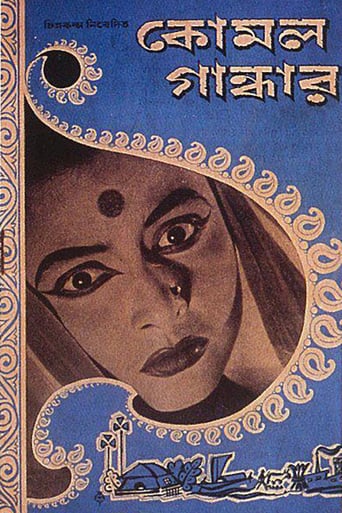
Komal Gandhar poster
Not many of the postcolonial auteurs were subjected to the booby trap, set by the bourgeoisie, of being named incomprehensible. Very few artistes, who radically cast spells of their dissent on the sanctimonious establishment fell prey to that petty conspiracy. To our disappointment, Ritwik Ghatak was ostracized by this conspiracy to such an extent that his entire oeuvre has been sentenced to collective oblivion for decades. Sedimentation of amnesia on the forlorn tins of film reels subjugated Ghatak’s radical voice to the unfathomable bog water. This has certainly been a success for the ‘bhadralok’ Bengali who, in his very nature, is deceitful toward any revolutionary spark he beholds in his socio-political milieu.
It’d be a sin to read the silence that looms over the nation on Ghatak’s birth centenary as apolitical. The so-called abstruse mysticality of Ghatak’s cinema that is said to alienate the regular audience from his works is not the case in reality; rather, it is a politically predetermined shallow aporia, placed at the conjunction of his works and the audience, that really isolates his cinema. Ritwik’s urgency to express his pangs and agonies for the people of Bengal compelled him to embrace cinema; for such a mind committed to the people, the last thing would be to create incomprehensible cinema that oozes esotericism. For Ghatak was not a subscriber to the idea of “Art for art’s sake”; rather, he wanted to have a reciprocity from the audience. We find him writing in one of his essays, “In the case of cinema, when an audience starts seeing a film, they also create … a filmmaker throws up certain ideas; it is the audience who fulfils them. Then only it becomes a total whole”.[1] This desired interdependence was affected when the ‘bhadraloks’, in search of linear narratives and simpler forms, alienated Ghatak from the centre of our culture industry and constantly pushed him to the edge.

Ritwik Ghatak
Ritwik’s engagement with cinema began in the early 50s of the last century. The chief exponent of his works is a two-pronged experimentation: one with image and sound and the other with the philosophy. His philosophy was deeply entrenched in his intellectual understandings of Indian civilization, which was inculcated in a materialistic fashion in his construction of images. This Marxist approach may have had its roots in the dictums given by Mao-Tse-Tung to his party members. For Mao, gaining an intellectual insight into one’s own civilization was a mandatory task to understand the essential contemporary political scenario for a Marxist-Leninist. Hence, he critiqued his comrades and wanted to have a change in the party’s style of work: “Many party members are completely in the dark about Chinese history either of the last hundred years or of ancient times … to their own ancestors, they have clean forgotten them. There is no lively atmosphere of studying seriously either the present or the past.[2] Ghatak, being a communist and a partisan artiste, seems to have adopted Mao’s imperative when he writes, “Also, we are an epic people. We like to sprawl, we are not much involved in story-intrigues, we like to be re-told the same myths and legends again and again.”[3] This path, followed by Ritwik, explains the de facto behind his incessant usage of archetypes by shedding off the idealistic notions from the body of popular myths and using them in a materialistic discourse.
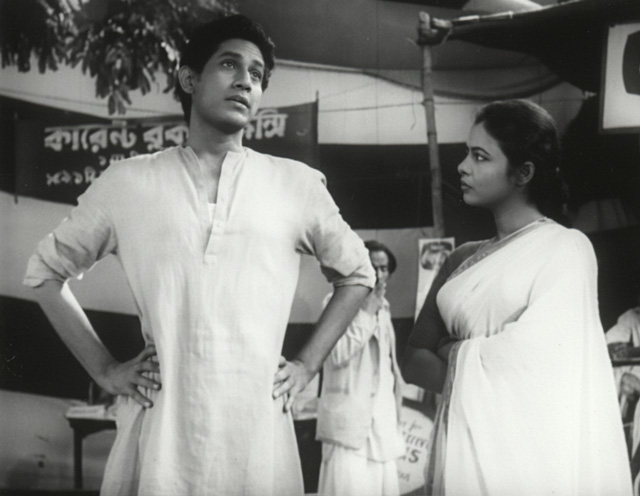
Ritwik’s psyche, when he came into filmmaking, was already engulfed by trenchant scars left by the partition. His heart was shattered at the sight of warring brothers, which turned the waters of the Ganges and Padma crimson, during the time of independence. This led him to overtly criticise the Congress and Muslim League, whom he regarded as responsible for chopping the country into pieces. The harrowing visions of partition, that haunted Ghatak throughout his life, found a redemption in his three films (Meghe Dhaka Tara, Komal Gandhar, and Subarnarekha), a.k.a, Partition Trilogy. In the middle of his filmmaking career, Ghatak invested himself completely by undertaking the task of restitution of the most catastrophic event postcolonial Bengal had ever experienced. He didn’t want to come up with a sort of exploration, either technically or psychologically, of the crisis; rather, a dialectical reiteration of partition through the present material conditions of human beings affected by the crisis was his desired target, for partition was, for him, a disaster that endangered the Bengali identity. He found it “urgent to present to the public eye the crumbling appearance of a divided Bengal to awaken the Bengalis to an awareness of their state and concern for their past and the future.”[4]
Komal Gandhar, of the three films Ghatak made on partition, is regarded as the artiste’s sublime cinematic attempt by none other than the artiste himself. In his own words, Komal Gandhar is his “most intellectual film.” Why so? It is not easy to arrive at a simplified answer containing simple logics to justify the auteur’s claim. Among the triptych, Komal Gandhar emanates a different tune, for it is the only film in the trilogy that opens up a utopian avenue of union, while the other two exude the bleakness of separation. A critical reading of Komal Gandhar demands a twofold understanding from the viewer: one, where s/he needs to engage with Ghatak’s selection of the subjects and his following incorporations of myth and music to prepare the utopian avenue, and the other method is to enlighten her/himself about Ghatak’s earlier engagement with the cultural wing of the undivided CPI (Communist Party of India), named IPTA (Indian People’s Theatre Association). His dreams and despair as a young cultural activist were embedded as a meta-text into the film’s main narrative.
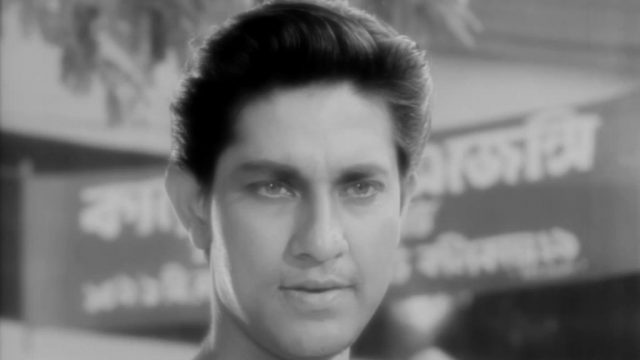
Komal Gandhar opens with the sequence of a play. Bhrigu, in a big close-up, vociferously asks, as if charging us, why he should leave his beautiful country and become a refugee in a land where even the sky is covered with so much smoke? Slowly, we come to know about the rifts and contentions between two theatre groups called ‘Niriksha’ (Experimentation) and ‘Dakshina Path’ (The Southern Way). Soon, Anasuya comes with the proposal of organizing a joint production of Kalidasa’s Abhijnana Shakuntalam, and the two groups unite for a brief period of time. Their union reflects an allegorical representation of the unification of two severed Bengal provinces and Ghatak’s attempt to forge an imaginative space (perhaps an attempt to overcome his trauma as well) which is free from the postcolonial quotidian struggles.
Bhrigu (the protagonist of Ghatak’s Komal Gandhar), as can be traced from ‘Mahabharata’, is a sage born from the flames of Brahma’s offering whose wife cannot be snatched from him. In the film also, Anasuya’s union with Bhrigu transpired on the condition of Anasuya’s rejection of her fiancée Samar, settled in the West.
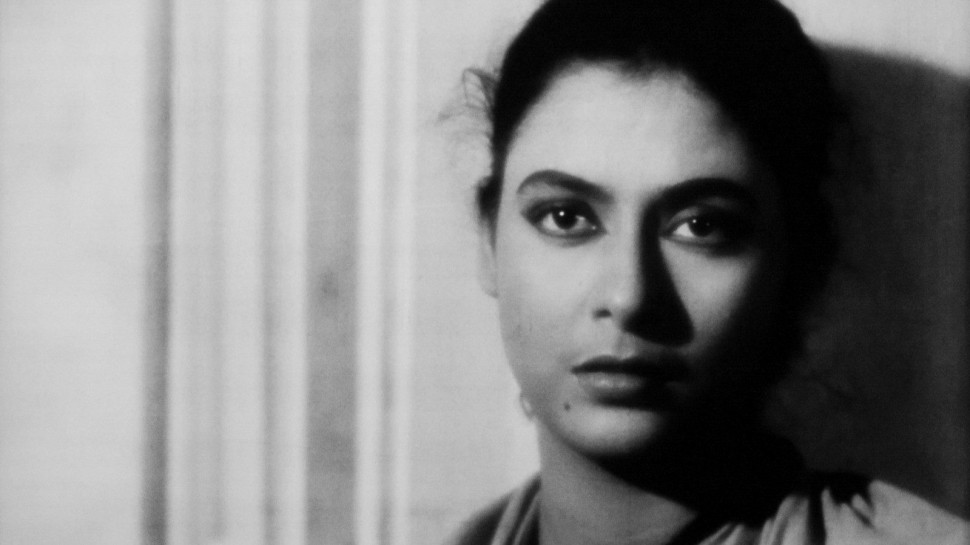
The case of Anasuya is a more complex one. Her name literally means “One without envy,” and according to the mythological annals, Anasuya, along with Priyamvada, was a companion of Shakuntala. She, in the film, embodies the lush and tranquil serenity of Bengal. In the midst of petty politicking and jealousy, Anasuya manifests the character of an ideal theatre artist, whose “uncontaminated idealism are repeatedly accentuated through close-ups and soft focus”[5]. A few sequences before the denouement, she laments unambiguously that if she leaves her country for marrying Samar, she will be escaping her commitments and responsibilities towards theatre. Hence, it can be debated that Anasuya partly portrays Ghatak’s earlier self (a committed theatre activist), but perhaps, mostly, she enacts a space of Ghatak’s desired reification. Bangladesh in Komal Gandhar has been referred to as a “sweet smiling little girl.” This innocence of a little girl is what Ghatak tried to inculcate in Anasuya’s character.
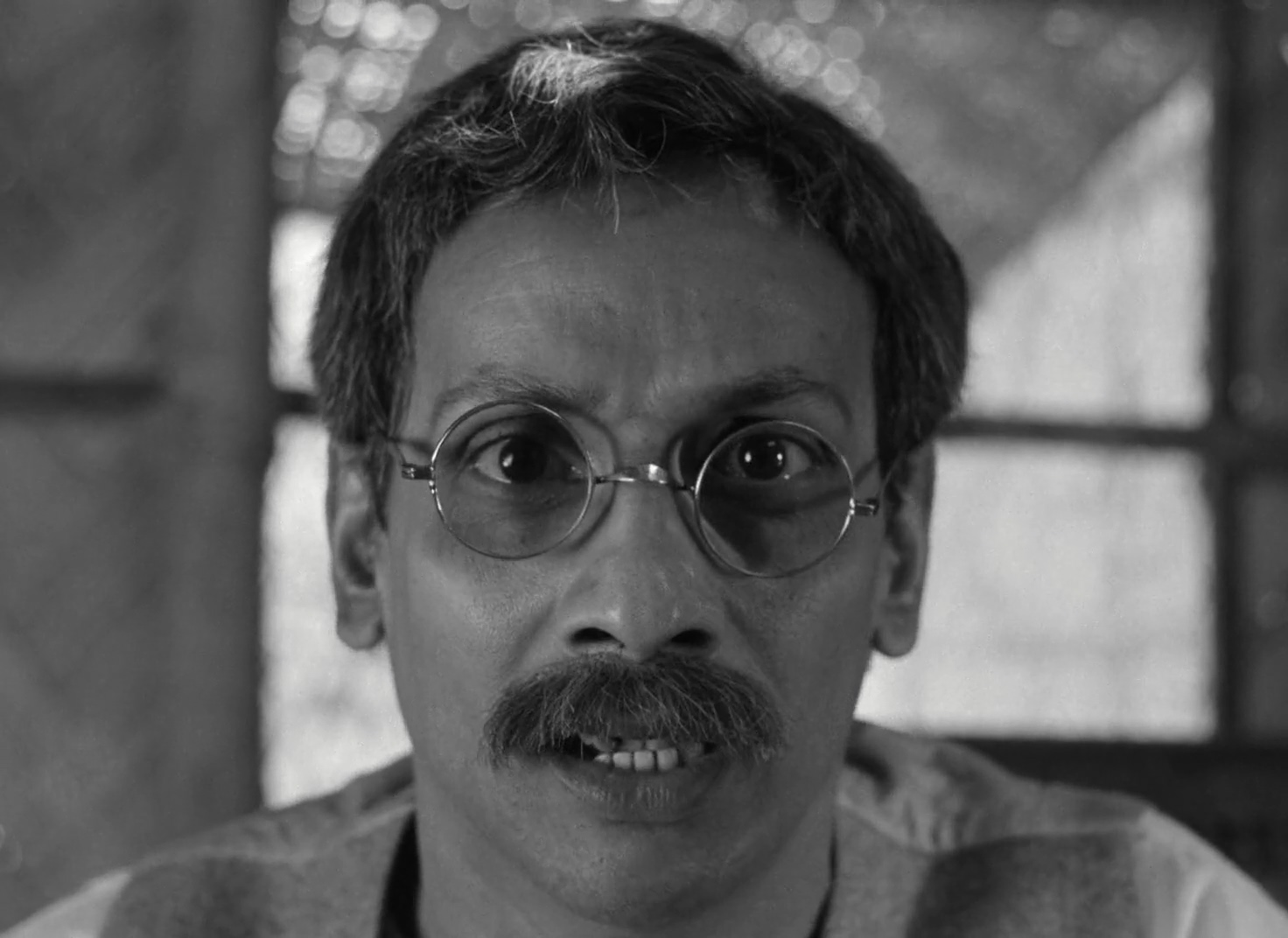
The flattened third note on the musical scale is referred to as ‘Komal Gandhar.’ Veteran film scholar Moinak Biswas translates it as the ‘Gandhar sublime.’ The term was popularized by Rabindranath Tagore when he composed a poem having the same name — where the poet, enchanted by a girl, names her ‘Komal Gandhar’ secretly — and later by the modernist poet Bishnu Dey, who expressed the idea of Bengal as an undivided entity. Both the poems worked as an undercurrent to the film’s main narrative. On the one hand, the abstract woman figure of Tagore’s poem is given a bodily presence in Anasuya, and on the other, when Bhrigu recites the Tagore poem for the first time to Anasuya, she immediately compares the poet’s imagination with Bangladesh, therefore shifting the imagination from an individual to a particular region. This transition can be regarded as a conscious attempt by Ghatak to elevate the narrative’s focus to a larger canvas and lift Anasuya from the matrix of regular characters and place her in an imaginary space where he longs to reiterate past damages and their aftermaths.
Ghatak also employs the Shakuntala-Dushyanta myth as a dominant meta-narrative in the film. The union of the two theatre groups encouraged Bhrigu to stage ‘Abhijnana Shakuntalam’, which he wished to produce for a long time but hadn’t attempted because the production needed a large coterie of skilled actors and a lump sum, which was impossible for a single theatre group to manage. However, Bhrigu and Anasuya’s joint efforts were sabotaged, and the production ended up as a mise en abyme, separating the two groups again. Arguably, the sequence is a reflection of the early tragedy of ‘Abhijnana Shakuntalam’, which, we know, is a necessary literary trope placed in a particular situation of the play by Kalidasa to lead us towards the ultimate union. The failure of producing Shakuntala enacted a shift in the film. Anasuya, who earlier compared herself with Miranda (a character in William Shakespeare’s ‘The Tempest’), slowly embodied the features of Shakuntala. Her endurance—both personal and professional—as shown by Ghatak, started to reveal a typical Indian feminine flavour, which in no way can be compared with a Western character. In this manner, Ghatak shook off the Western traits from her and implanted Anasuya strongly in the Indian tradition. In a scene during the climax, a political activist compared Anasuya with his dead sister (possibly a victim of the violence that partition unfolded), and in another scene, where Anasuya mourns imagining the pangs she will experience if she had to marry Samar—which would ultimately uproot her from her own soil—Ghatak softly tilted the camera to focus on Maa Durga’s (a Hindu goddess who is believed to leave her home on the occasion of the last day of Durga Puja) face for a brief moment in a big close-up.
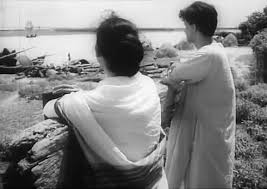
Bhrigu and Anasuya
The earlier tragedy that Bhrigu and Anasuya faced, during the staging of the play, in the final repose, metamorphosed into an act of union (the obvious denouement in Kalidasa’s play). In ‘Art Cinema and India’s Forgotten Futures’ Rochona Majumdar’s comment on the final scene is pertinent here to mention. She says, “The camera focuses on Anasuya’s and Bhrigu’s joined hands – evoking the ‘Gandharva’-style marital union of Shakuntala and Dushyanta – as centuries old wedding songs, a constant feature of Komal Gandhar‘s soundtrack, play in the background. It then pans from the two individuals to shots of the great riverine plains of Bengal, Himalayan mountains, the Calcutta cityscape… The movement of shots from the couples to nature and the city is complemented by the transition from the wedding folk songs to a Rabindrasangeet… The couple – Bhrigu and Anasuya – represented a projection of Ghatak’s desire for unity between different cultural organizations as well as between the eastern and the western parts of Bengal.”
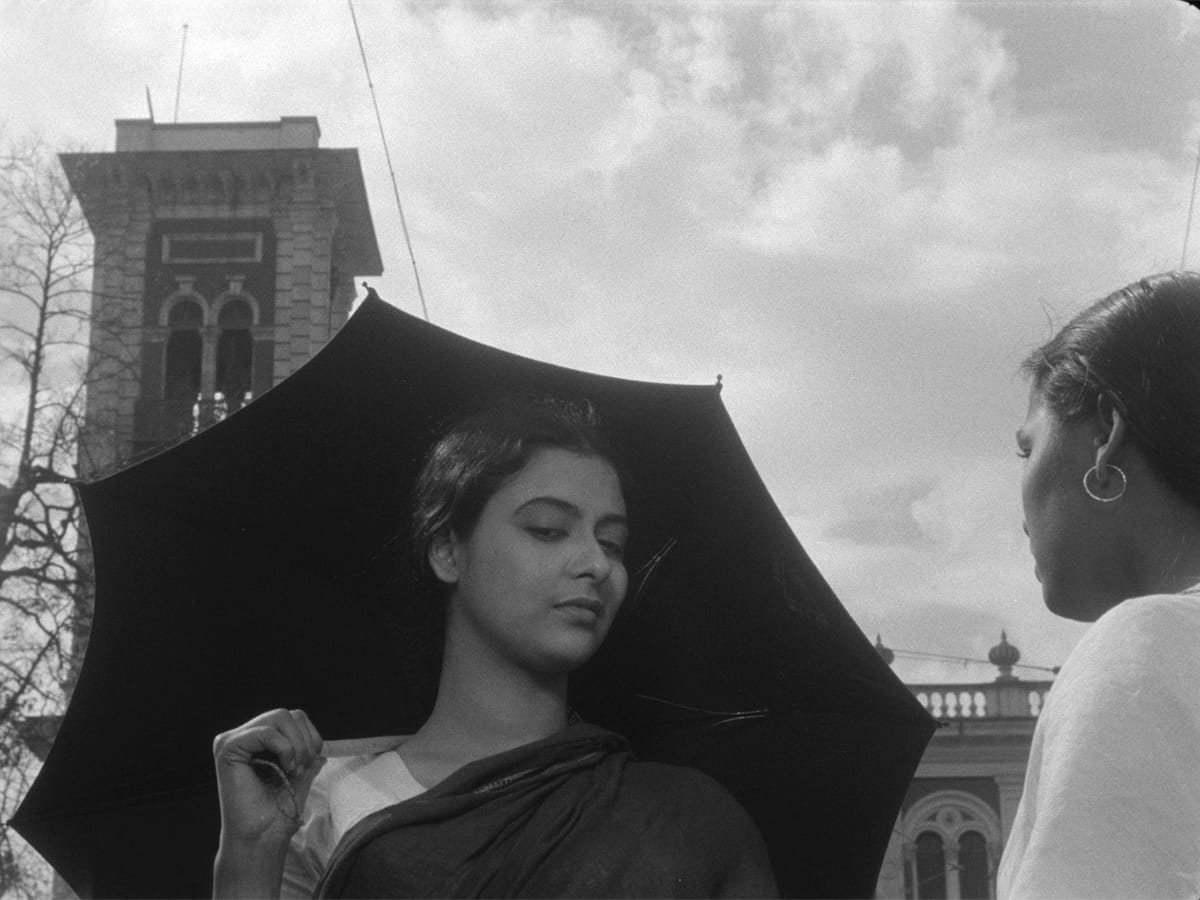
Another aspect that makes Komal Gandhar a distinguishable film in Ritwik’s oeuvre is its soundtrack. The profuse usage of various kinds of music, of which marriage songs are the dominant ones, easily catches our attention. Since the film manifests Ritwik’s imagination of the unification of two severed lands, it is “replete with songs of union”[6]. In addition to that, Ghatak predetermined the employment of the songs to use them as a leitmotif. For instance, he used the age-old traditional marriage song Aamer Tolay Jhamur Jhumur once in the beginning of the film and again in the final act of reunion. He designed his entire soundscape in a dialectical manner. To use a particular piece of sound as a topos in the film, he used them on multiple occasions and changed their tempos according to the respective situations in the narrative. ‘Dohai Ali’ appears both as a joyous enchantment and a petrified incantation in the film. Komal Gandhar is perhaps Ritwik’s best attempt to potentialize soundscape on a parallel plane to the images in order to create a dialectical contestation between image and sound that can ultimately pave the way for a synthesis he desires to produce.
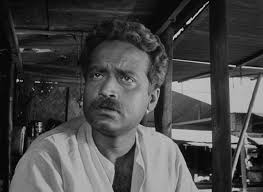
A still from Komal Gandhar
The second approach to read Komal Gandhar critically, as I mentioned earlier, is understanding Ritwik’s association with the, then undivided, Communist Party of India (CPI). Initially, the party leadership saw a potential cultural activist in him but soon his affair with the party ended in absolute dejection. While working in the cultural wing of the party, IPTA, Ghatak was asked by P.C. Joshi, the then general secretary of CPI, to undertake the task of writing a thesis concerning the party’s views on the cultural sphere. Thus, he wrote and submitted the thesis titled ‘On the Cultural Front’ to CPI in the 1950s. The thesis still remains an important documentation of the cultural scenario of the country, where Ghatak expressed his grave concern about the lack of communist influence in the production of art. He was anxious about the lack of enthusiasm party members showed towards culture and their simplistic views that somehow confused political activism with cultural activism. For culture, according to Ghatak, is “one of the remote superstructures of economics” and has the potential of “reshaping past heritages”, it needs a committed organization to bloom fully. Ghatak said “only by reshaping the past and carrying it to its logical conclusion, can culture come in the service of the working class.” He, in most of his films, attempted to reshape the past and Komal Gandhar is not an exception. Despite Ghatak’s broken ties with the party, his approach towards filmmaking remained dialectical. His shattered dreams and misery haunted him throughout his life.
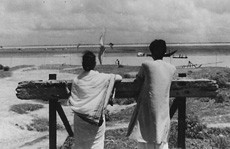
Bhrigu and Anasuya
In Komal Gandhar, it seems, perhaps he wanted to find his own earlier self in the two characters – Bhrigu and Anasuya. Bhrigu mostly reflects the material side of Ghatak, a committed, non-compromising, humane theatre activist, while Anasuya ideally becomes the spirit of Bangladesh for him. Ghatak was surprised to learn that the audience failed to accept Komal Gandhar. Hence, came an augury from him that, I believe, we have only partially realized yet: “I have a hunch that the film will come into its own maybe after twenty or twenty-five years. It deals with a problem that may not have become intense enough for the Bengalis as to endanger their very existence.”[7]
References:

Whether you are new or veteran, you are important. Please contribute with your articles on cinema, we are looking forward for an association. Send your writings to amitava@silhouette-magazine.com

 Landscape of Exile: Individual and Cultural Alienation in Ritwik Ghatak’s Films
 The Aesthetics of Fractured Dislocation in Ritwik Ghatak’s Cinema
 Riverine Stories: Titas and Ritwik Ghatak’s Cinematic Departure
 Reason Ramblings and Redemption
 Ritwik Ghatak: A Crusader Of The Rootless
 Satyajit, Ritwik – and the Renegade ‘Father’ Figure
Silhouette Magazine publishes articles, reviews, critiques and interviews and other cinema-related works, artworks, photographs and other publishable material contributed by writers and critics as a friendly gesture. The opinions shared by the writers and critics are their personal opinion and does not reflect the opinion of Silhouette Magazine. Images on Silhouette Magazine are posted for the sole purpose of academic interest and to illuminate the text. The images and screen shots are the copyright of their original owners. Silhouette Magazine strives to provide attribution wherever possible. Images used in the posts have been procured from the contributors themselves, public forums, social networking sites, publicity releases, YouTube, Pixabay and Creative Commons. Please inform us if any of the images used here are copyrighted, we will pull those images down.