Stay tuned to our new posts and updates! Click to join us on WhatsApp  & Telegram
  Channel
& Telegram  Channel & Telegram Channel




The film uses an unrequited romance, an attempted suicide, a rather tearful separation and suggestions of an eternity of waiting on behalf of the female ghost.
Produced in 1961, Tapan Sinha’s Kshudita Pashan veers considerably away from the openness of Rabindranath’s short story. The question that this paper seeks to explore is the rationale and ideology behind such a departure. Was it borne out of the context of a different requirement of cinema or was it a necessity for the ‘middle of the road’ cinema that Sinha was attempting to make?
The context of Kshudita Pashan is well documented. Speaking about the origins of the story, Tagore wrote in My Boyhood Days:
In Ahmedabad I floated amidst old history. The Shahibag was my elder brother’s allotted residence. During daytime he left for his work as a judge and those lonely enormous rooms haunted me. From the courtyard at front one could see the Sabarmati with knee deep water meandering in the sands. This courtyard with its pocket constructions of small water reservoirs whispered the secrets of the Begums’ luxury bath … History never bothered to peep into my city-bred self amidst the hustle-bustle of Calcutta life. Our perspectives were engrossed with the immediate present, In contrast, it was in Ahmedabad that for the first time I found history pulsating in its animated self. Its past days were like the hidden treasure concealed carefully undergroun . That was the first time my mind worked upon the story of The Hungry Stones.1
Rabindranath proceeded to add; “History was like a skeleton there … I dressed it up and in the museum of my mind … I created a whole image. The draft I created was a figment of my imagination”.2 In a letter to Hemantabala Devi Tagore clearly identified Khsudita Pashan as a “work of the purest imagination”.3
 For a majority of literary critics Kshudita Pashan remains a work that is clearly located within the aesthetics of the literature of the supenantural. For Narayan Gangopadhyay, Buddhadev Basu, Niharranjan Ray, this is a work that exemplifies the pleasures of the supranatural imagination within the structural form of the historical romance”.4 It is this interpretation that Sinha imports into this film. However the short story has a rich ironic context. The old collector, the protagonist of the tale, is introduced in a rather cheeky and ironic tone; “He held forth on every conceivable subject that you would think that the creator himself never moved a finger except on his advice”.(326) The phrases “we were real innocents … he held us spell bound … our awe of him increased with every word he uttered” (326) creates the image of gullible young men in the company of a rather conscious and crafty teller of tales. It is further extended in the portrayal of the author’s theosophist friend, who would in many ways reciprocate the reader within the text: “ My cousin who was a theosophist, was even convinced that he had some sort of supernatural power … He hung upon the lightest word from this unusual man with the rapt attention of a devotee”. (326)
 Rabindranath is here falling back upon a tradition of the hyperbolic teller of tales (the story is narrated in a railway waiting room). The responses of the author and the friend are rather different. The tax collector himself meets an Englishman and vanishes with a hullo leaving the context of the tale tantalizingly poised. When the collector is called away, he is about to launch into a second narrative of the Persian slave girl in that rose garden. The closure of the short story, especially the arrival of the Englishman and the immediate departure of the old collector, aligns him with the rational administration rather than any lingering supernaturalism. It is this trance from which the young narrator attempts to snap out: “The man took us for fools and had a good laugh at our expense. The story was all made up from the beginning to end”. (338) At this juncture he mentions that this comment later lost him the friendship of the theosophist cousin. There is a mirror of narratives poised on the brink of truth, illusion and fiction. A recent article even argues that the story, finely constructed, is the poet’s parody of the contemporary ghost story:
Was Khsudita Pashan a story that laid bare these narrative strategies ironically revealing the gullibility of the simple reader to a more discerning one? Was the text an effort in parody, consciously using the strategies of the short story only to undermine it?5
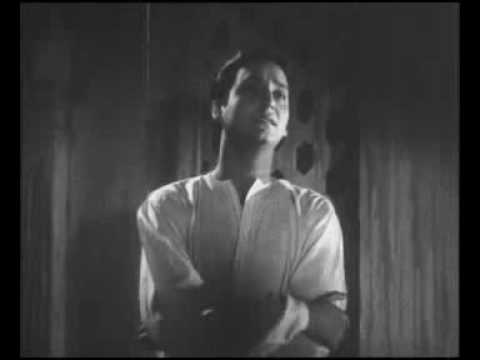
 Sinha’s 1965 film is a more straight forward adaptation of the main narrative while ignoring the self reflexivity of the story. Sinha borrows the theme of the strange fascination that the haunted house holds upon the protagonist (the mansion evocatively remains a background even through the window in his office). The untold tale of the Arab Girl stolen from the deserts of Arabia emerges in a flashback that develops into a romantic affair with the protagonist’s earlier incarnation as nobleman of the Shah. The film uses an unrequited romance, an attempted suicide, a rather tearful separation and suggestions of an eternity of waiting on behalf of the female ghost. What was at best the promise of a tale yet to be told, becomes the teleological goal of the cinematic narrative. As the narrative ends, a rather tearful Soumitra bids goodbye to the hungry stones, establishing both the supernatural and the romance credentials of the story. The question remains – having been faithful to the narrative in Kabuliwala, why did Sinha depart significantly from the suggestions of the story in Ksudita Pashan?
The clue probably lies in Sinha’s own response about the context of the films he decided to make. Samik Bandyopadyay uses the term ‘middle of the road’ cinema in an interview distinguishing Sinha’s differences with Ray and Ghatak and aligning him with mainstream Hollywood cinema:
In this environment of acute flux, we were drawn to the energies of an experimental cinema in Bengal … in this context we consciously or unconsciously rejected Tapan Sinha … the technical strength of Hollywood and the keen sense of storytelling attracted him. But he was conscious to take care that it suited the Bengali sensibility … he thus fell back upon a repertoire of established Bengali literature.6
Talking about his decision to experiment with Tagore’s narrative, Sinha confessed
Rabindranath was still unacceptable for filmmakers. A film based on his writings did not make money because he was only for intellectuals and not for the common man…It was a matter of transforming him from one medium to the other. 7
Two factors need to be underlined here – could Sinha have adequately managed to convey the self reflexivity and the ironical interface between the supernatural and the skeptical that the main narrative implied? Would questions about the encroachment of narrative rupture the cinematic script? In 1981, the film version of The French Lieutenant’s Woman was faced with a similar dilemma of accommodating the narrative encroachments. The director Karel Reisz and the script writer Harold Pinter chose to create a parallel narrative of an extramarital romance between the actors which would then underline an alternative to the romance between Sarah and Charles. It was only in this way that Pinter felt Fowles’s sustained comments on the narrative, the presence of the intrusive narrator and the possibility of multiple endings could be accommodated into the film. A similar problem would have arisen if Sinha had chosen to import the multiple responses to the story. An ironic perspective and a questioning of the credulity of the narrator could have been seen as a prohibitive feature for the form of the film, diluting the atmosphere and the sense of fear and emotional identification that Sinha was attempting to draw from the audience.
 A more urgent necessity was also Sinha’s insistence to make films that could at once please audiences aesthetically while performing well at the box-office. In drawing upon the incarnation of an earlier birth and a historical romance that drew upon the debauchery and cruelty of a Mughal ruler, Sinha was already falling back within the comfortable confines of popular expectations that were sure to appeal to the regular Bengali filmgoer. Therefore Sinha needed the relative simplicity and financial safety for creating a period piece embellished with the classical music of Ali Akbar Khan, without any encroachment of skeptical possibility. One notes that Sinha was keenly sensitive to the aptness of this particular story to the various opportunities of cinematic narrative. As Arun Kumar Roy points out: “The suitability of this text for a film also lies in its remarkable synesthetic quality – the story itself contains visual and auditory claims on the imagination”8. Sinha rearranges the narrative into a more linear plot while foregrounding the visual aspect of light and shade to create an ambience of fear and mystery within which all skepticism could dissolve into an aesthetic enjoyment of the supernatural. The technical innovations of the film need to be appreciated. The innovative set designs, the use of silence, the use of the mirror and the slow flying away of the hat, attempt a conjunction of the two temporal zones that the film inhabits. Sinha provides a visual treat in combining music, setting and location to convey and transform Kshudita Pashan into a tale of fascination and supernatural power. Arun Kumar Roy suggests:
The story teller did not intend this to be a merely supernatural tale. Tapan Sinha renders this into a tale of fear by manipulating light and shade. In the main narrative the collector is a more curious individual bordering between credulity and a strange fascination for the mansion.9
The making and the responses of the film also throws light upon the myriad expectations of the Bengali bhadralok at this point in history. Faced with the turbulence of the post-partition, did Sinha’s film offer a less complicated, bourgeoisie Rabindranath in whose narrative the audience could retire for an interval of two hours? Would the exotic locations and costumes, the music of an era that had passed by, create an illusion of a withdrawal of reality? Or was the theme of forced separation from one’s location, and the pain and trauma caused by it, a viable shelter for a Bengali audience struggling with the realities of partition? Would the mode of the romance have been an interlude from the urgent questions about contemporary existence?
Sinha’s Kshudita Pashan a ‘superhit’ film was thus a significant departure from Tagore’s text. The departure was conditioned by a different language of the cinema and the framework and context within which Sinha’s films were made. Sinha would have probably borrowed the words of Satyajit Roy to justify his departures from the narrative: “Well, I made this because I am an artist with my own feelings, I was using Tagore’s rendering of a story as a basis and this was my interpretation of it”.10
Notes
All textual quotations are from Tagore’s story translated by Amitav Ghosh. The story is titled “The Hunger of Stones”, and included in The Imaam and the Indian: Prose Pieces (Ravi Dayal and Permanent Black: Delhi, 2002), pp. 326-338.
1. Rabindranath Tagore, Chelebela in Rabindra Rachanabali, Vol.13 (Visva-Bharati: Kolkata,1967), p.735-36. Translations mine.
2. Ibid., p. 736.
3. Tagore, Chithipatra-9, 28 September, 1939 (Visva-Bharati: Kolkata,1964), p. 45.
4. For further details see Anuttam Bhattacharya, Rabindra Rachana Bidhan Vol. VI (Kolkata: Deep Prakashan, 2006), pp. 250-265.
5. Mausumi Sen (Bhattacharjee), Tagore’s The Hunger of Stones (Kshudhita Pashan): An Experiment in Parody? Muse India, Special Issue on Tagore, to be published in September, 2010. www.museindia.com.
6. “Prasanga Tapan Sinha: Shamik Bandyopadhyayer Sakshatkar”, Silhoutte VII (November, 2009).
7. Tapan Sinha, “Rabindranather Kahinivittik Chhobi”, in Paschimbanga, Rabindra Sankhya 39.10 (May, 2006): 15-22, p. 16.
8. Arun Kumar Roy, Rabindranath o Chalachitra (Kolkata: Chitralekha, 1986), p. 91.
9. Ibid., p. 91.
10. As quoted in Nilanjan Chattopadhyay, “Rabindrasahityer Chalachitrayan”, in Paschimbanga, Rabindra Sankhya 39.10 (May, 2006): 39-62, p. 45.

Whether you are new or veteran, you are important. Please contribute with your articles on cinema, we are looking forward for an association. Send your writings to amitava@silhouette-magazine.com

 The Impossibility of Love: Three Films of Tapan Sinha
 Tapan Sinha: The Humanist Filmmaker
 The Healing Touch: Doctors in Tapan Sinha’s Films
 Harmonium — A Symbol of Interconnected Lives
 The City, Crime and Middle Class Vulnerability in Tapan Sinha’s Films
 The Moulding of a Master: Bimal Roy and Tapan Sinha
Silhouette Magazine publishes articles, reviews, critiques and interviews and other cinema-related works, artworks, photographs and other publishable material contributed by writers and critics as a friendly gesture. The opinions shared by the writers and critics are their personal opinion and does not reflect the opinion of Silhouette Magazine. Images on Silhouette Magazine are posted for the sole purpose of academic interest and to illuminate the text. The images and screen shots are the copyright of their original owners. Silhouette Magazine strives to provide attribution wherever possible. Images used in the posts have been procured from the contributors themselves, public forums, social networking sites, publicity releases, YouTube, Pixabay and Creative Commons. Please inform us if any of the images used here are copyrighted, we will pull those images down.